The mobile chip business is under pressure, and Qualcomm is looking for its second growth curve.
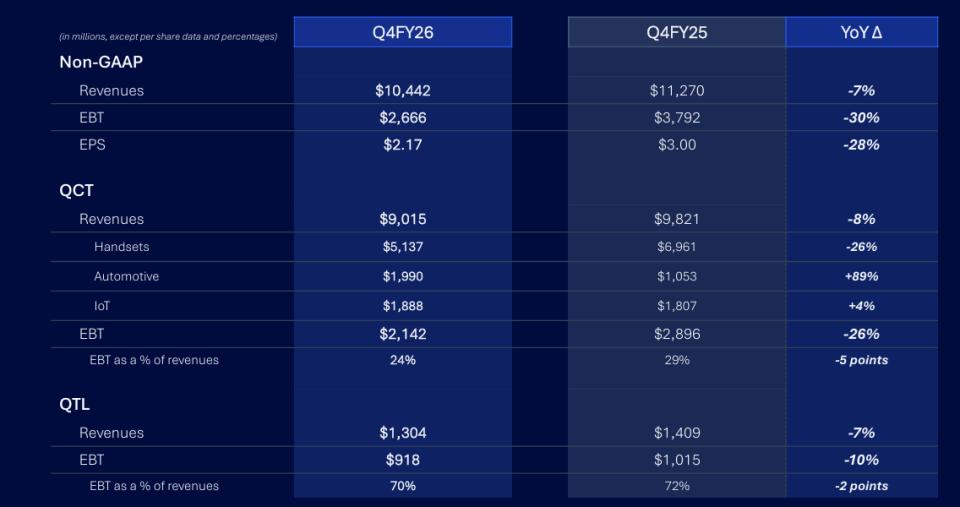
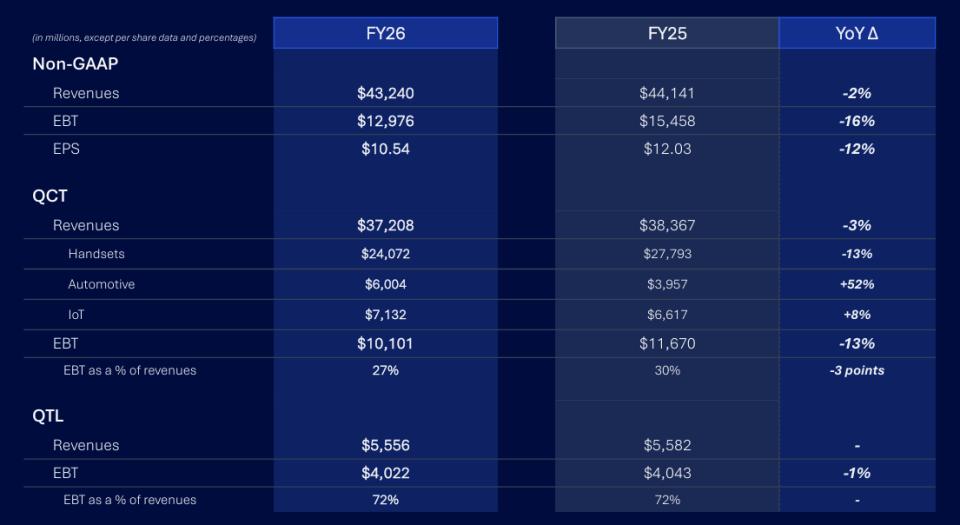
On November 4 local time in the United States, Qualcomm announced its financial results for the fourth quarter and full fiscal year of FY2026. Revenue in the fourth quarter reached 10.322 billion US dollars, down 8% year on year; Non-GAAP net profit was 2.332 billion US dollars, down 28% year on year, with adjusted earnings per share at 2.17 US dollars. Full-year revenue for FY2026 hit 43.120 billion US dollars, down 3% year on year, and Non-GAAP net profit was 11.311 billion US dollars, down 15% year on year.
The decline in the mobile phone chip business is particularly obvious. In the fourth quarter, Qualcomm's mobile phone chip revenue was 5.137 billion US dollars, down 26% year on year, and full-year revenue reached 24.072 billion US dollars, down 13% year on year. At the same time, the automotive business revenue in the fourth quarter reached 1.990 billion US dollars, up 89% year on year, hitting a new all-time high for a single quarter; the IoT business revenue was 1.888 billion US dollars, up 4% year on year.
Qualcomm is accelerating the exploration of growth space outside the mobile phone business. The company reaffirmed its target of 5 billion US dollars in data center revenue for FY2027, expecting that custom chip projects from two large cloud service providers will start contributing revenue from the first quarter of FY2027, and projecting that non-mobile business revenue will grow by more than 60% in FY2027.
However, the market still has doubts about this transformation. After the financial report was released, Qualcomm's stock price once fell by about 5% in after-hours trading. The rise in memory prices has prompted mobile phone manufacturers to adjust their procurement plans, and Apple's self-developed baseband chips are also squeezing Qualcomm's traditional market. Despite the rapid growth of the automotive business and the upcoming revenue recognition stage of data center orders, it remains to be verified whether the scale and profit margin of new businesses can fill the gap left by the mobile phone business.
01 Mobile Phone Business Under Pressure, Memory Price Hike Impacts the Industrial Chain
The rising memory price is changing the product planning and procurement rhythm of mobile phone manufacturers. As the proportion of memory cost in the total bill of materials of the whole device rises, mobile phone manufacturers are facing greater pricing pressure. Some manufacturers have begun to adjust their product portfolios, reduce high-cost configurations, and turn to chips of the previous generation or lower-cost solutions. Global mobile phone shipment volume and chip procurement demand are thus affected.
Cristiano Amon, CEO of Qualcomm, regards the memory price hike as an important factor for the contraction of the mobile phone market. Akash Palkhiwala, Chief Financial Officer, previously explained that some mobile phone manufacturers are adjusting chip selection in high-end products, or turning to use chips of the previous generation, which puts pressure on Qualcomm's product portfolio and QCT gross margin.
Regarding the Chinese market, the management believes that mobile phone chip revenue bottomed out in the third quarter of FY2026, but the recovery speed still needs to be observed. Palkhiwala said that previously Chinese mobile phone manufacturers purchased chips according to market demand while digesting channel inventory. As inventory gradually declines, procurement volume begins to reflect actual market demand more.
Qualcomm expects mobile phone chip revenue from Chinese OEM customers to achieve double-digit sequential growth in the fourth quarter. However, according to the overall mobile phone chip revenue disclosed by Qualcomm, the revenue in the fourth quarter was 5.137 billion US dollars, an increase of only about 1% compared with 5.086 billion US dollars in the third quarter.
Qualcomm is also raising prices to cope with rising supply chain costs. Palkhiwala said that the company is pushing forward price adjustments in multiple end markets with a double-digit range, but since contracts with some customers have not expired, price adjustments need to be implemented gradually with contract renewal and new product cycles. The company expects relevant measures to gradually improve QCT gross margin in the coming fiscal quarters.
Amon believes that Qualcomm's chip price hikes are mainly used to pass on wafer, manufacturing and other input costs, which are still limited compared with the increase in the cost of the whole device brought by rising memory prices. Therefore, the company has not seen fundamental changes in demand for high-end mobile phones for the time being.
The Apple-related business is also shrinking. Since Qualcomm's baseband chip share in the new generation iPhone is lower than the previously expected 20%, the company has previously warned that the decline in related revenue will accelerate. The management stated on the conference call that it expects Apple-related revenue to drop by about 50% sequentially from the fourth quarter to the first quarter of FY2027. The growth of Android business will partially offset the reduction of Apple business, but it is difficult to completely fill the gap in the short term.
Qualcomm still maintains a strong share in Samsung's high-end mobile phone market. Amon said that Snapdragon chips are currently installed in about 70% of Samsung's flagship models. The company also observes new opportunities brought by on-device AI agents, and Chinese mobile phone manufacturers are preparing to launch new on-device agents and task orchestration functions. Qualcomm believes this may provide new impetus for high-end mobile phone demand.
02 Automotive and Licensing Business Provide Support, AI Data Center Starts to Contribute Revenue
Against the backdrop of declining mobile phone business, the automotive and IoT businesses have become the highlights in Qualcomm's financial report.
In the fourth quarter, Qualcomm's automotive business revenue reached 1.990 billion US dollars, up 89% year on year; IoT business revenue was 1.888 billion US dollars, up 4% year on year. The total revenue of the two businesses reached 3.878 billion US dollars, up 36% year on year.
For the full FY2026, automotive business revenue was 6.004 billion US dollars, up 52% year on year; IoT business revenue was 7.132 billion US dollars, up 8% year on year.
The growth of automotive business comes from the increasing demand for in-vehicle computing platforms, digital cockpits and advanced driver assistance systems. Qualcomm disclosed in its financial report that the company has expanded cooperation with BMW, becoming the main computing chip supplier for its next-generation advanced driver assistance systems and digital cockpits, and the relevant cooperation covers multiple future vehicle model projects.
The IoT business is driven by demand for industrial network and robot products. The business revenue grew by 4% year on year in the fourth quarter and 8% for the full year. Qualcomm is expanding its business scope from consumer electronics to industrial edge computing, robotics and network equipment.
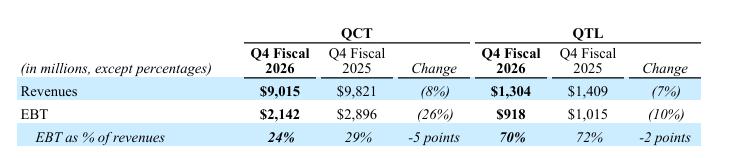
The performance of the licensing business QTL is relatively stable. QTL revenue in the fourth quarter was 1.304 billion US dollars, down 7% year on year; full-year revenue was 5.556 billion US dollars, basically flat with the previous fiscal year. The full-year pre-tax profit of QTL was 4.022 billion US dollars, with a pre-tax profit margin of 72%, which remains an important profit source for Qualcomm.
Qualcomm has recently renewed long-term patent licensing agreements with Apple, Huawei and Transsion. On the conference call, Palkhiwala said that the QTL business still operates under the existing licensing model. When the increase in device selling price is within the upper limit of patent royalty, it may bring certain revenue gain; after exceeding the relevant upper limit, the licensing revenue will no longer continue to increase.
Data center is Qualcomm's most important new growth direction in the next stage. The company is laying out custom chips, AI accelerators, high-bandwidth computing solutions and server-grade CPUs, and the products will be launched in phases.
Amon said that the custom chip projects reached by Qualcomm with two large global cloud service providers have started wafer production, and will begin to contribute revenue in the first quarter of FY2027. Palkhiwala confirmed that the company has received purchase orders for the two projects, and the revenue is expected to gradually increase starting from the December quarter, and then expand as the projects advance.
In addition to custom chips, Qualcomm is also developing the high-bandwidth computing product HBC. This solution integrates computing units with high-density memory to improve energy efficiency, memory utilization and total cost of ownership. The company has completed the tape-out of the first-generation HBC product, and expects to launch the first product in mid-2027.
The server CPU is planned to be launched in FY2028. Qualcomm hopes to use its low-power computing technology to further expand from custom chips to the data center CPU and AI accelerator market. Qualcomm said that it is negotiating long-term cooperation with many large data center enterprises, but has not disclosed more customer information.
Qualcomm reaffirmed its target of 5 billion US dollars in data center revenue for FY2027, and expects data center revenue to exceed 15 billion US dollars in FY2029. The combined revenue target of automotive and IoT businesses in FY2029 exceeds 24 billion US dollars, and the non-mobile business revenue target is raised to 40 billion US dollars, higher than the previously proposed 22 billion US dollars.
This growth plan still faces tests in terms of profit margin. Palkhiwala said in response to analysts' questions that the gross margin of Qualcomm's traditional business is usually between 48% and 50%, and it is expected to return to this range as price adjustments take effect gradually. However, the initial revenue of the data center mainly comes from custom chip projects, whose gross margin will be significantly lower than the company's existing business level, which may offset part of the gross margin improvement of the traditional business.
03 Transformation Accelerates in FY2027, But Mobile Phone Market Remains a Variable
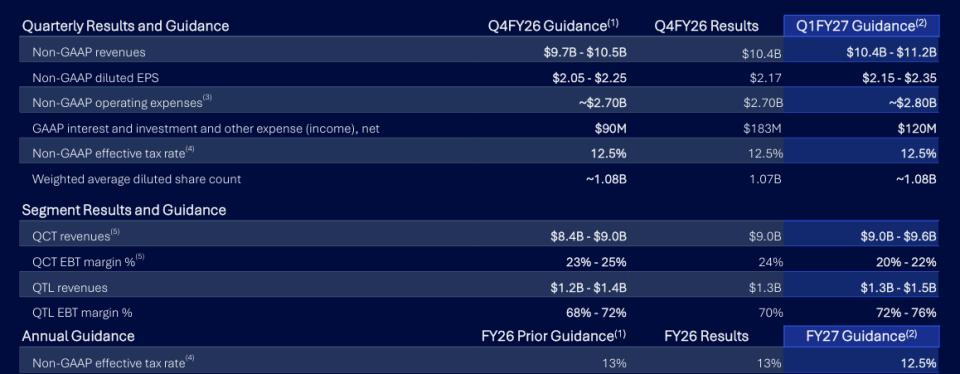
Qualcomm expects revenue in the first quarter of FY2027 to be between 10.4 billion and 11.2 billion US dollars, and Non-GAAP earnings per share to be between 2.15 and 2.35 US dollars. Among them, QCT revenue is expected to be between 9 billion and 9.6 billion US dollars, which already includes the data center business; QTL revenue is expected to be between 1.3 billion and 1.5 billion US dollars.
Qualcomm expects non-mobile business to grow by more than 60% in FY2027, and said this growth is expected to offset Apple-related product revenue in FY2026. Amon said that FY2027 will be an inflection point for Qualcomm's non-mobile business revenue growth.
However, the pressure on the mobile phone market has not disappeared. The management predicted on the conference call that the global mobile phone market size in 2027 may drop by double digits compared with 2026, and the impact will be mainly concentrated in the low-end market. Palkhiwala revealed that current QCT Android revenue is down about 20% year on year, impacting earnings per share by more than 1.50 US dollars. As the market environment stabilizes, this impact may gradually weaken.
Before the financial report was released, analysts' judgments on Qualcomm's mobile phone business had already diverged. Some institutions believe that the recovery of demand from Chinese mobile phone manufacturers, Samsung's high-end product portfolio and the growth of automotive business are expected to support the company's performance. Other analysts are worried about limited memory supply and weak mobile phone market, and believe that Qualcomm's expectations for the Android business in FY2027 still have uncertainties.
On the conference call, analysts also asked about the profitability of the data center business. The management admitted that the initial gross margin of custom chip projects is lower than Qualcomm's traditional business, but believes that as the product portfolio expands to AI accelerators, high-bandwidth computing and server CPUs, there is still room for improvement in business scale and profit structure. Qualcomm has not disclosed the specific identities of the two custom chip customers, nor has it given the revenue and profit margin breakdown of each project.
In terms of capital investment, Qualcomm's capital expenditure in FY2026 was about 2.494 billion US dollars, higher than 1.192 billion US dollars in the previous fiscal year; R&D expenses reached 10.207 billion US dollars, up about 13% year on year. Qualcomm's full-year operating cash flow was 11.145 billion US dollars, lower than 14.012 billion US dollars in the previous fiscal year. Qualcomm is also advancing the integration of Modular to supplement its software capabilities in data center and edge AI.
In terms of shareholder returns, Qualcomm returned 11.671 billion US dollars to shareholders through stock repurchases and cash dividends in FY2026, including 7.817 billion US dollars in stock repurchases and 3.854 billion US dollars in cash dividends.

Qualcomm's business transformation has entered the revenue realization stage. The custom chip projects of the two cloud service providers will start contributing revenue in the first quarter of FY2027, and the automotive business will also maintain rapid growth.
Nevertheless, mobile phone chips are still the largest single source of revenue for the company. Memory costs, end-user demand and the contraction of Apple-related business will still affect short-term performance. Whether the data center business can expand its scale as planned and when the low initial gross margin will improve will determine whether Qualcomm can maintain overall profitability during the downturn of the mobile phone market.
Special translator Jin Lu also contributed to this article
This article is from "Tencent Tech", written by Xiao Jing, edited by Xu Qingyang, published with authorization from 36Kr.