The AI-generated comic drama industry has no place for apprentices.
In the 2026 autumn recruitment season, AI manhua drama companies are still recruiting prompt specialists for AI character generation.
Senior college students come to apply for the job, and the job requirements are written very straightforward: proficient in using new tools, skilled in adjusting prompts and parameters, and capable of generating batch character illustrations.
The position being recruited is prompt specialist for AI character generation, not director or chief editor.
On the other side, four three-person teams at Chen Lili's company are operating simultaneously, producing 50 system-generated dramas plus one or two high-quality works per month;calculated on this basis, one three-person team needs to produce more than ten dramas per month, which already sounds like a very mature assembly line.
The smoother the assembly line runs, the fewer manpower it requires, yet positions on the recruitment pages are still listed. The phenomenon of companies recruiting staff and the phenomenon of companies having no extra manpower demand are taking place at the same time in the same industry.
This sounds rather awkward, but this is exactly the current market situation. To figure out exactly what kind of talents are in shortage, we need to break down the phrase "talent shortage" first.
There are two distinct pay levels in this industry now: one for new entrants, and the other for core talents who can take full charge of work, with a gap of dozens of times between the two.
……
Let's look at the lower end of the pay scale first.
On recruitment websites, the monthly salary for AI manhua drama trainees ranges from 1000 to 2000 yuan. Some positions do not even specify a base salary, and pay is calculated by the number of completed works, with no income once work is suspended.
A company in Guizhou once recruited 100 production staff at one go, with a probation base salary of 2130 yuan plus 20% commission, and applicants are required to submit a 60-second sample video during the interview.
Sixty seconds, the length of an opening title, applicants have to finish the work first before negotiating employment terms. This salary level in Guizhou is right at the local minimum wage standard, and what the company wants are people who can generate images, do editing, and deliver work in accordance with the workflow.
The requirements are also being lowered.
For positions such as storyboard artist and AI character generation prompt specialist, the experience requirement on most job postings is 1 to 3 years, and many others set the bar at less than 1 year. Companies do not expect to recruit many experienced hands, so naturally they are not willing to pay extra for relevant experience.
This sounds like an opportunity, but what they mean by "learning from scratch" refers to starting from learning how to use the software, not from learning how to evaluate film and television works.
You can learn to use the software in three days, but it takes years to learn how to evaluate works. Companies can pay for hands that can work, but cannot pay for discerning eyes.
Outside this lower end of the industry, there are rows of training institutions waiting to recruit students.
Their enrollment advertisements claim that students can get employed immediately after graduation, with an employment rate of over 90% and an average monthly salary of over 10,000 yuan. But the industry talks more about the other side of the story: many people cannot even produce a complete full episode after finishing the training.
There is a huge gap between the figures on the advertisements and the actual situation of the jobs. The figures are only used to attract students, and when it comes to the actual recruitment process, companies still care about whether you can deliver the work properly.
What is more interesting is that while training institutions claim that students can start working right after graduation, the job positions require employees to keep learning even after they are hired.
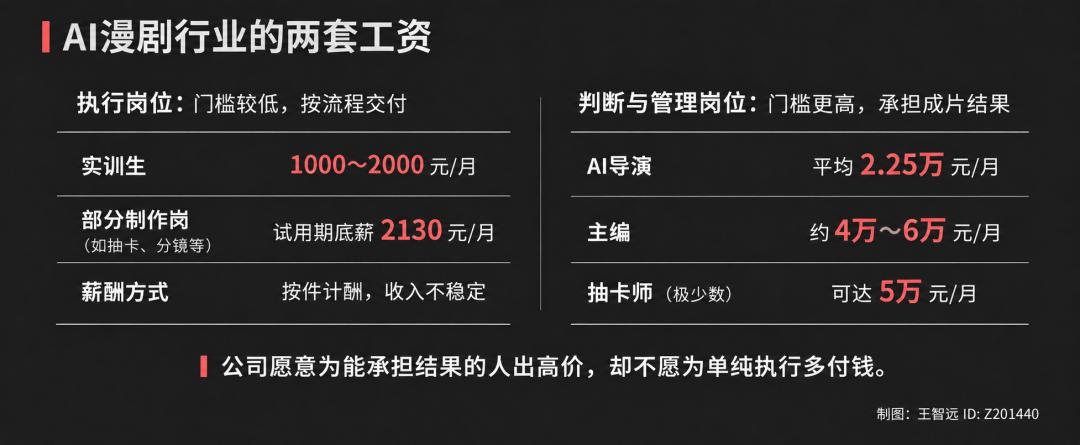
Moving up the career ladder, the pay system is completely different.
There are prompt specialists for AI character generation who earn 50,000 yuan a month, but their work content is almost the same as that of a director: they need to set the overall style, supervise storyboards, and judge which episode has the potential to become a hit before the drama is launched.
There are very few such talents. The average monthly salary of an AI director is 22,500 yuan, and that of a chief editor is around 40,000 to 60,000 yuan. The higher you go up the ladder, the fewer people there are, and the higher the pay is.
A monthly salary of 50,000 yuan is a very rare case. To get such a pay level, you cannot just rely on working for a few more years. Companies are willing to pay a high price for talents who can take full charge of the work, but are not willing to pay extra for people who only know how to generate images.
Where do these high-paid talents come from?
Most of the new directors recruited by Chen Lili's company have a background in traditional film and television, and they can get started right away because they know how to place the camera, how to cut a scene, where to pause, and which lines are redundant.
People who have led teams on film sets also know how many pages of script can be shot in one day, and which scene to prioritize when there are not enough machines. These skills cannot be taught by software;on the contrary, very few people can get promoted all the way from a prompt specialist for AI character generation to a core leadership position.
Talents transferred from other industries in the film and television field know how to evaluate works, while talents recruited directly from the market only know how to generate images.
Why are the former group more expensive? There are two main reasons:first, being able to organize and tune models is more valuable than being able to write prompts; second, the director position will never disappear, because someone has to take responsibility for bad results.
This statement is very easy to understand in the AI manhua drama industry.
The more models there are, the more people can generate images, but someone still has to make the final decision on how to shoot a drama, which images are usable, and which scenes should be deleted.
The longer the workflow is, the more people are needed to arrange tasks: which steps are assigned to machines, which steps are reserved for humans, and who will solve problems when something goes wrong. These skills cannot be learned from prompts, and are very difficult to practice just by generating more images.
Therefore, the phrase "talent shortage" refers to two completely different groups of people at the lower and upper ends of the industry.
The lower end needs cheap talents who can get started immediately and get paid by the number of completed works, while the upper end needs talents who can make decisions, arrange tasks, and take responsibility for the final results for the company.
......
Okay, we have finished talking about the two different pay levels. But where did the huge gap in between go? There are three facts behind it.
First, this career path used to be real and accessible.
In the traditional animation industry, a key art assistant needs 3 to 5 years of training, starting from tracing lines, gradually learning to draw key frames, and then getting to the point where they can set the overall tone of a scene.
They can only master skills like how to place the camera, how to set up lighting, and how many frames are enough for one scene through personal practice.
During these years, people learn while working: when they draw wrong, their seniors will point it out, and they can revise and redraw. In a team, a master usually takes two or three apprentices, and will review all the work submitted by apprentices. Any stroke that is not solid, or any structure that is distorted, will be pointed out on the spot.
What the master teaches is not only professional skills, but also how to evaluate film and television works.
There is a reason for this slow-paced training: for judgment capabilities, just listening to others' explanations is useless, you have to make mistakes yourself to remember the lessons. Make a mistake once, revise it once, and after three years of practice, you will develop the discerning eyes you need.
The sign of finishing apprenticeship is very practical: the master no longer reviews your work, and a shot you produce can directly enter the next process. Only at this point can you be considered capable of making independent decisions. The salary is not very high, but at least you have a stable position that exists this year and will still exist next year.
Second, in the AI manhua drama industry, this traditional career path has been dismantled.
A prompt specialist for AI character generation can start working after 3 days to 1 week of training. Now most of the image generation work can be done by models, and the remaining staff only need to select from the generated outputs. The storyboard team and the prompt specialist team are merged, and the traditional positions for beginners to practice their skills are gone.
What does a prompt specialist do in a day? Write prompts, wait for the model to generate images, select the images one by one, and revise after selection. The model can generate hundreds of images a day, and the staff has to go through all of them one by one.
Re-doing work is a very common thing. The director says this character's face is wrong, so you have to regenerate it from another angle; the platform says this segment is too slow-paced, so you have to cut 10 seconds and re-do the dubbing. After a whole day, you generate a lot of images, but very few of them are usable.
One prompt specialist, using the alias Xiao Lu, set a half-year deadline for himself: if he cannot get promoted to AI director within half a year, he will switch to another industry. He said he would never keep working as a prompt specialist, because this job has no future.
Even if you do this job for three years, your hands will be faster and faster, but your judgment ability will not necessarily improve. You spend all day staring at individual images, and rarely get the chance to think about the whole scene. Questions like why this scene is placed in the third episode, or whether deleting it will make the drama better, are never up to you to decide.
The longer you work, the more skilled you become, but the work you do is getting cheaper and cheaper.
In the past two years, platforms have been continuously lowering the unit price. The revenue per ten thousand views has dropped from 30 to 100 yuan in the second half of last year to 5 to 10 yuan this year. Companies also have to do cost accounting, so the work of training new staff which does not generate immediate revenue is the first to be cut.
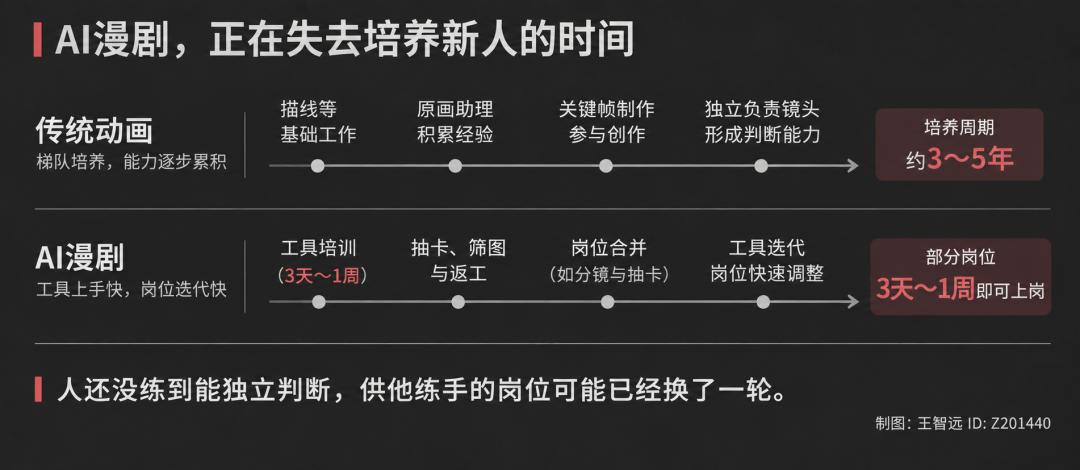
Third, the promotion path is still drawn on the recruitment advertisements.
Prompt specialist for AI character generation, full-process screenwriter and director, visual director, project creative lead, four positions in sequence, with salary ranging from 3000 yuan to 35000 yuan.
The advertisement describes a very complete promotion path, clearer than the promotion descriptions in many other industries. According to this description, you will have seniors to guide you, have enough work to practice, and you can get promoted after working for two years.
But the reality is not that smooth.
Xu Yueying used to be an executive director in the traditional film and television industry, and now she switched to work as a prompt specialist. A person who used to lead a whole team now has to re-learn how to generate AI images from scratch.
The path on the advertisement keeps going upward, but in reality many people are moving backward. What's more, the positions that offer a salary of 35,000 yuan on the market require talents who have led projects and can take full responsibility for the final finished drama. Just spending two years working as a prompt specialist cannot guarantee you can reach that level.
Putting these three facts together, the most piercing point is that before a person can accumulate enough experience to make independent decisions, the position that used to provide practice opportunities has already disappeared.
The position of prompt specialist for AI character generation has been replaced by image production specialists not long after it emerged. It takes 3 to 5 years to train a talent with independent judgment, but before the person is fully trained, the positions have already been completely replaced.
......
The positions have been replaced in a new round, and the staff are scattered as well. Where did they go? Some were laid off, some are still looking for new jobs. The talent turnover speed in this industry is indeed very fast.
I went through a lot of case files and found another thing worth mentioning:
When people lose their jobs, the final compensation they can get may differ by a huge margin depending on whether they have a formal labor contract or not.
A man named Zhou You in Hangzhou worked as an AI quality inspector at a technology company, not in the manhua drama industry. But the statement the court made in his case is very relevant to this industry.
The company asked him to take a pay cut, from 25,000 yuan to 15,000 yuan, cutting 10,000 yuan at once. When he refused, the company fired him.
He filed a lawsuit, and the court made it very clear that the company introducing AI to reduce costs does not count as a major change in objective circumstances, so the company cannot terminate the labor contract directly for this reason.
This regulation was originally reserved for situations such as company relocation or business sale. Replacing employees with cheaper tools does not fall into this category.
The final judgment awarded him more than 261,000 yuan in compensation.
Cutting salaries to save costs with AI is not a new thing at the moment. Whether you are willing to accept a pay cut sometimes becomes the dividing line between whether you can keep your job or not.
There is also a case in Tongzhou, Beijing, involving an actor who shoots short dramas.
They did not sign a written contract, and the pay of 3000 yuan for one drama was negotiated on WeChat, to be settled after filming. The company said he did not cooperate with the dubbing, so deducted one third of his pay. When he asked for the remaining money, the company refused to pay.
The court finally ruled that the company should pay him the remaining 1000 yuan of labor remuneration.The 1000 yuan is not because the court is stingy, he did not ask for much in the first place, the subject matter of this case is only that small.
The price negotiated on WeChat is legally recognized, but without a written contract, many things have to be proved through chat records. What was originally agreed, which party failed to fulfill the obligation, and how the responsibility should be divided, all have to be checked one by one in the chat history.
Many people doing this kind of work change teams several times a year, the team disbands after one drama is finished, and they look for new people for the next project.
These two cases are often compared on the Internet, people say 260,000 yuan vs 1000 yuan, the gap is too huge.
In fact, they cannot be compared like this. The first one has a formal labor contract, if the company wants to terminate the contract, it has to follow the rules of labor law, and if the reason is not valid, the company has to pay compensation. The second one is a labor service dispute, you can get back the agreed pay, but you cannot get extra compensation.
From a broader perspective, outsourcing has long been a normal state in the content industry. People sign service contracts instead of labor contracts, and companies buy work by project and settle payment after delivery.
For companies, this method is convenient and cost-saving. As long as there is no actual labor relationship between the two parties, companies do not need to undertake obligations such as social security payment and labor contract termination compensation as they do for formal employees.
Of course, in case of work-related injuries or other accidents, the specific responsibility still depends on the actual employment relationship, and companies cannot shift all responsibility to the outsourcing contractor.
After the new regulations came into effect in September, AI dramas with an investment of 800,0