5.3 billion tourist trips were recorded, yet 5A-level scenic spots are no longer able to reap substantial profits.
01
Recently, as the Q3 financial reports of the A-share cultural tourism sector are released one after another, a brutal industry inflection point has emerged.
Statistics from Travel Daily show that in the third quarter covering this year's summer vacation, among 17 listed companies of core scenic spots and performance operators, as many as 12 saw declines in both revenue and net profit attributable to shareholders.
If we take attributable net profit and non-recurring profit and loss deducted net profit as measurement standards, the number of tourism enterprises with declining profits has further risen to 14, accounting for more than 80% of the total.
Different from the downward trend of local cultural tourism groups behind 5A-level scenic spots, Chinese people's enthusiasm for traveling has not actually faded.
Data released by the Ministry of Culture and Tourism shows that in the first three quarters of 2026, the number of domestic resident trips reached 5.307 billion, maintaining a year-on-year growth of 6.2%. The total travel expenditure in the same period hit 4.95 trillion yuan, a slight year-on-year increase of 2.2%.
The huge increment of travel flow has obviously gone beyond the turnstiles of traditional paid scenic spots.
Take Huangshan Tourism, which owns top natural heritage, as an example. The number of tourists entering the mountain in the first three quarters still maintained a slight increase of 2.86%, but it dropped by 5.48% in the peak season of the third quarter.
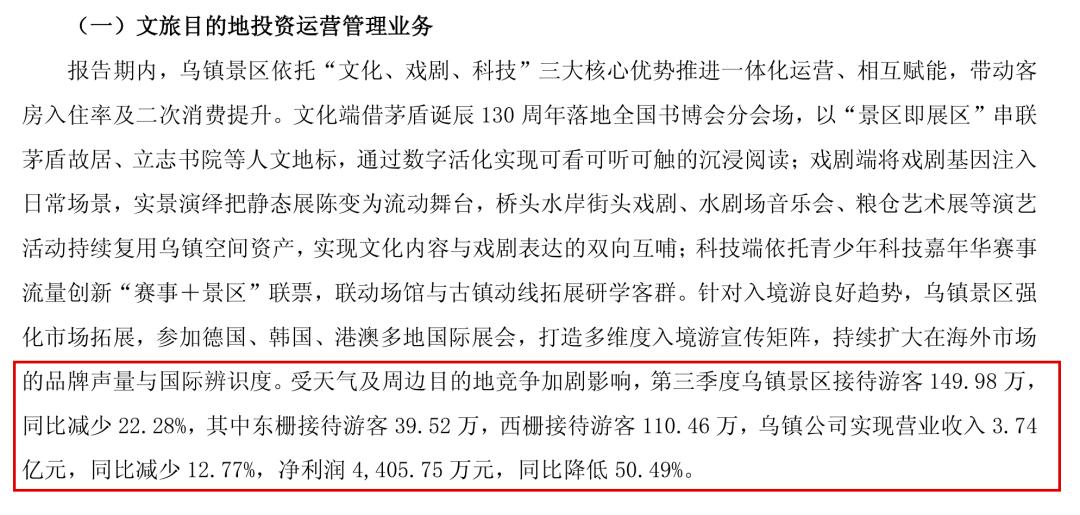
The loss of the benchmark of ancient town resorts is also very prominent. Wuzhen under CYTS received 22.28% fewer tourists in the third quarter, operating revenue shrank by 12.77% accordingly, and the net profit in a single quarter plummeted by 50.49%.
Although its peer Gubei Water Town barely drove a 6.15% growth in tourist volume in the third quarter, the revenue contributed by per tourist decreased by about 7.14%, resulting in a net loss of 51.7166 million yuan in the single quarter.
The tourism performance track, which was once regarded as a high-margin profit machine by the capital market, also suffered a fiasco in the peak season.
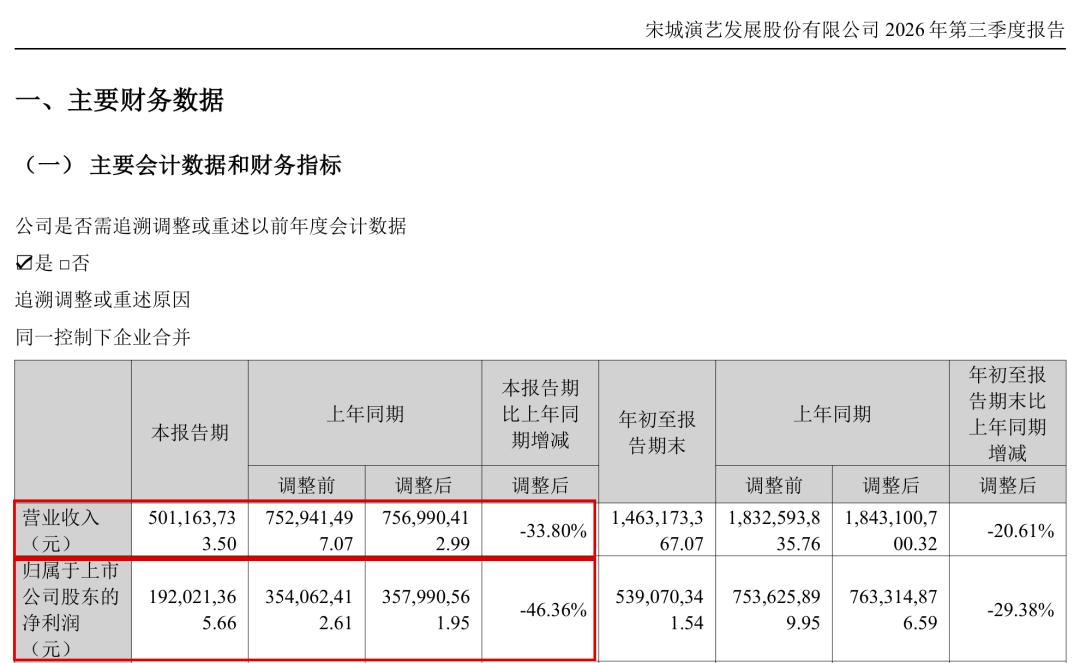
Songcheng Performance, the industry leader, saw its operating revenue drop by 33.80% in the third quarter, only recording 501 million yuan. Even though the company sharply cut sales expenses by 42.49% in the first three quarters to reduce costs, its attributable net profit in the third quarter still fell by 46.36%.
Traditional landscape and leisure resort scenic spots are facing even tighter financial pressure.
Guilin Tourism's operating revenue decreased by 21.38% in the third quarter, while the decline of its attributable net profit was as high as 67.94%, earning only 8.8996 million yuan in the single quarter.
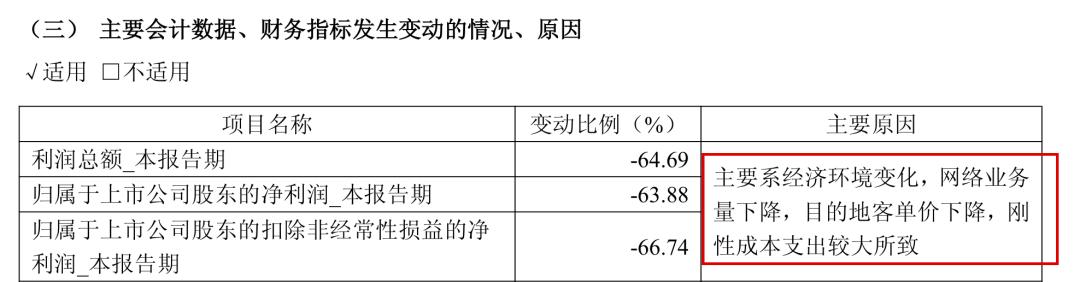
Tianmu Lake, a leading leisure operator in the Yangtze River Delta, saw its revenue drop by 23.70% in the third quarter, and its attributable net profit also plummeted by 63.88%. The single-quarter profits of Western Region Tourism and Emei Mountain A retreated by 30% and nearly 20% respectively.
A small number of enterprises that maintained positive revenue growth in the third quarter also fell into the quagmire of growing revenue without growing profits.
Sunriver Culture & Tourism's single-quarter revenue increased slightly by 3.33%, but dragged down by the shutdown of Danxia Mountain cableway for upgrading and increased expenses, its attributable net profit fell by 45.49% instead.
Even for enterprises such as Lijiang Co., Ltd. and Tibet Tourism that still maintained positive cumulative profit in the first nine months, when looking at the third quarter alone, their non-recurring profit and loss deducted net profit all turned to decline.
Including Shaanxi Tourism whose single-quarter net profit dropped by more than 40%, as well as Changbai Mountain and Sante Cableways whose revenue and net profit retreated simultaneously in the peak season, the growth fatigue of old 5A-level scenic spots is almost nowhere to hide.
When the golden summer vacation peak season turns into a collective tribulation, the oxygen that famous mountains and ancient towns rely on for survival seems to be drained.
02
The primary driving force that drains the oxygen of old scenic spots comes from the intergenerational shift of aesthetic preferences on the consumer side.
The core products sold by traditional 5A-level scenic spots in the past are essentially the static viewing right in the industrial era. Tourists spend a lot on tickets and physical strength to walk the established route, just to leave a standardized check-in photo in front of famous attractions, and the whole journey lacks real emotional interaction.
Today's young people and middle-class families have long been tired of acting as silent spectators in the crowd.
Kaifeng Wansui Mountain Wuxia City, which became a hit this summer, with a low threshold of 80 yuan for three days of unlimited visits, uses hundreds of high-density street interactive dramas throughout the day to pull tourists into the martial arts world setting.
Hengdian World Studios in Zhejiang also accurately grasped the public's desire to be part of the story, allowing urban white-collar workers to fully experience the feeling of being a protagonist through short drama shooting experience, triggering spontaneous online meme sharing and high-frequency repurchases on social media.

In contrast, traditional ancient towns and landscape scenic spots with outdated business formats are still relying on the sightseeing logic from decades ago.
When the monotonous antique commercial streets lose their scarcity, resort benchmarks such as Wuzhen and Gubei Water Town naturally cannot resist the diversion of homogeneous competition, and gradually lose the attractiveness that makes tourists make special trips.
Apart from aesthetic fatigue, the realistic consideration of the public tightening their wallets cannot be ignored either.
Converted according to the data of the first three quarters released by the Ministry of Culture and Tourism, the per capita travel expenditure of domestic residents decreased by about 3.77% year on year.
The macro account is projected into micro consumer behavior, which is manifested as the unprecedented restraint of the middle class and young groups on tourism premium, and careful budgeting has become the general background of travel this summer.
Over the years, the usual "three-piece set" strategy of old 5A-level scenic spots, which includes main gate tickets, environmental protection vehicles and cableways, often costs tourists hundreds of yuan of their budget.
Facing the high entry cost, more and more consumers vote with their feet, turning to free urban parks or high-cost-performance county-level destinations. Even when entering traditional scenic spots, they try to reduce secondary consumption such as catering and accommodation as much as possible.
Tianmu Lake admitted in its Q3 report that the decline in destination customer unit price and the shrinkage of online business volume had impacted its performance.
While the demand on the consumer side cools down, the heavy asset burden on the industrial side further amplifies the pain in financial statements.
Admittedly, some scenic spots encountered objective interference from force majeure this summer. Huangshan Tourism disclosed in its announcement that the number of days of heavy rainfall increased significantly between July and August, and the typhoon led to temporary park closure for 6 days, which objectively weakened the peak season reception capacity.
However, after excluding accidental factors such as weather and cableway renovation shutdown, the inherent reverse operating leverage of the heavy asset model is the real profit assassin.
The capital market once believed in the high gross profit myth of famous mountains, great rivers and mature performance projects for a long time, but underestimated the rigid costs in daily operation.
Neither the equipment depreciation of cross-mountain cableways, nor the huge manual operation and maintenance and theater amortization of ancient towns will automatically get a discount just because the number of peak season tourists drops by 20%.
When both peak season passenger flow and customer unit price touch the critical point, the non-reduced fixed expenses will turn into a fierce profit-eating machine, which also explains why the revenue of many listed tourism enterprises only decreased by 20% to 30% in the third quarter, but their attributable net profit generally collapsed by 40% to 60%.
The old scenic spots that are too big to turn around are paying a high price for their past path dependence.
03
The deeper crisis is that the business model of 5A-level scenic spots that charges tolls by enclosing land may have completely come to an end.
In the past 30 years, the development logic of old scenic spots highly relied on administrative barriers and resource monopoly. As long as they obtained the franchise right of a famous mountain or a group of ancient buildings, built walls and set up toll stations, they could lie down and enjoy the rolling cash flow brought by the demographic dividend.
In 2026, internet-famous cities with free tickets and affordable county destinations have already spread everywhere, and the exclusive premium of natural scenery has been rapidly diluted.
If local cultural tourism groups still use the past optimistic assumptions of full houses in peak season and cost recovery in three years when conducting feasibility studies for new projects, the scenic spots built with huge investment will most likely become non-performing assets that devour cash flow.
Some tourism enterprises that have already overdrawn their balance sheets have actually tasted the bitter fruits.
Although Zhangjiajie's attributable net profit in the first three quarters soared to 327 million yuan, after excluding the debt restructuring income of about 327 million yuan, its main business non-recurring profit and loss deducted net profit still lost 7.5842 million yuan.
Dalian Sunasia and Qujiang Cultural Tourism also rely on debt restructuring or more than 50 million yuan of receivables impairment reversal to decorate their books, while Yunnan Tourism, whose losses in the first three quarters expanded to 189 million yuan, further proves that relying solely on ticket revenue can no longer cover the historical old accounts from the heavy asset expansion in the early years.
Facing the failure of the ticket economy, many old scenic spots start to seek help blindly in a panic.
Seeing interactive performances become popular, landscape and ancient towns all over the country have spent a lot of money hiring good-looking actors to play ancient-style roles, or rigidly implanting national trend night tours and short video promotion.

Blindly following the trend without their own cultural genes often only evolves into another round of ineffective involution.
Actor interactions without the support of story core are difficult to convert into tourists' secondary consumption and repurchase barriers, but instead greatly increase the daily marketing and labor expenses.
When all ancient towns across the country are putting on identical romance dramas of talented scholars and beautiful ladies, the high operating cost will only add fuel to the fire of the already fragile profit statement.
It is worth mentioning that in this generally under-pressure Q3 report, a few players such as Three Gorges Tourism and Jiuhua Tourism still stand out relying on the endogenous growth of their main business.
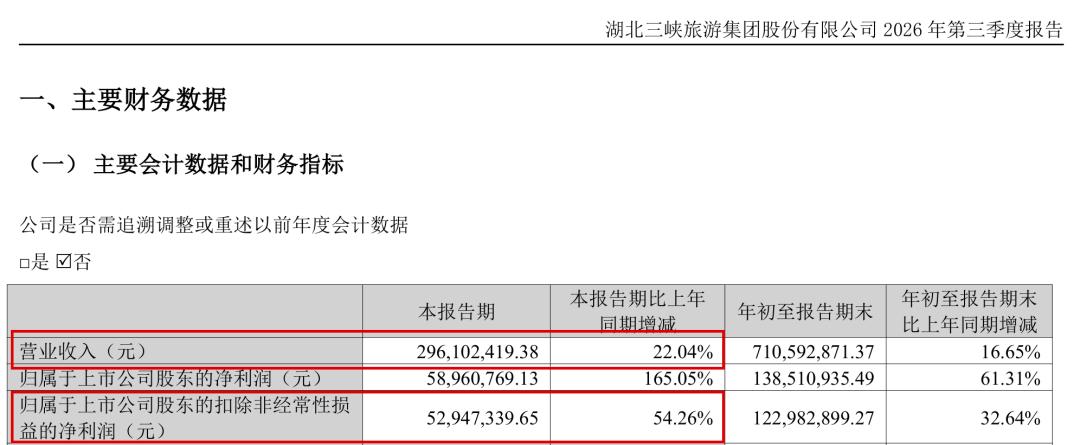
Three Gorges Tourism delivered a report card of 22.04% revenue growth and 54.26% surge in non-recurring profit and loss deducted net profit in the third quarter.
It is thought-provoking that the total number of sightseeing cruise receptions of this company in the first three quarters actually decreased by 2.67% year on year, breaking the industry myth that only a sharp surge in passenger flow can make money. The core driver supporting its profit jump comes from decisive product upgrading and the realization of pricing power.
The company launched high customer unit price inter-provincial resort cruises to attract overnight guests, and at the same time raised the external settlement price of its core product "Two Dams and One Gorge", achieving a qualitative change in profitability against the background of a slight drop in passenger flow.
The samples that break through against the trend provide a clear mirror for peers trapped in anxiety.
Rather than clumsily imitating internet-famous spots in unfamiliar tracks, old scenic spots should go back to their own resource endowments to deepen product depth, and convert passing visitors who just glance around into high-net-worth people who are willing to stay for in-depth experiences.
The second half of China's tourism industry no longer rewards the landscape landlords who build the highest walls and charge the most expensive tickets.
When the 5.3 billion-person travel wave continues to surge forward, old 5A-level scenic spots can only find their own audience again after tearing down their psychological walls, by forgetting their long-held gold-plated signboards.
This article is from the WeChat official account "Travel Daily", author: Theodore Xishao, published by 36Kr with authorization.