A top female computer science scholar from Princeton University has suddenly left Anthropic, and single-handedly made Claude Code a runaway hit.
The No. 2 figure of Claude Code has also left!
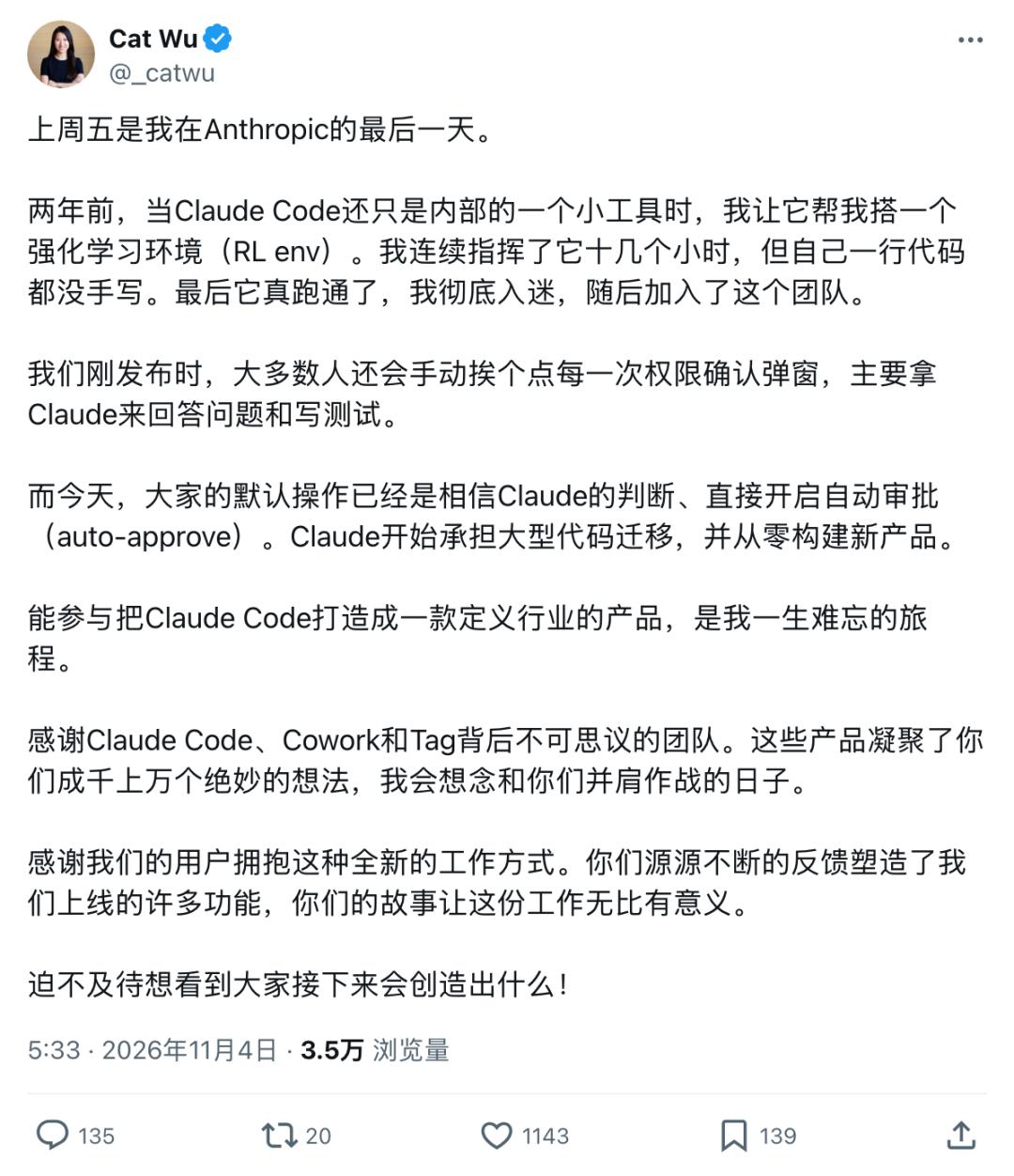
In the early morning of the 4th, Cat Wu (Catherine Wu), Head of Claude Code & Cowork Products and founding product manager, released a farewell letter, announcing that last Friday was her last day at Anthropic.
This is already the 4th core member to leave the Claude Code team in just 10 days.
Counting Thariq Shihipar, the CLI core who left on the same day 10 days ago, Anthony Morris, the lead developer of the desktop version, and engineering manager Sunil Shah, during the critical period around Anthropic's submission of its IPO prospectus, this founding team is going through a wave of intensive departures.
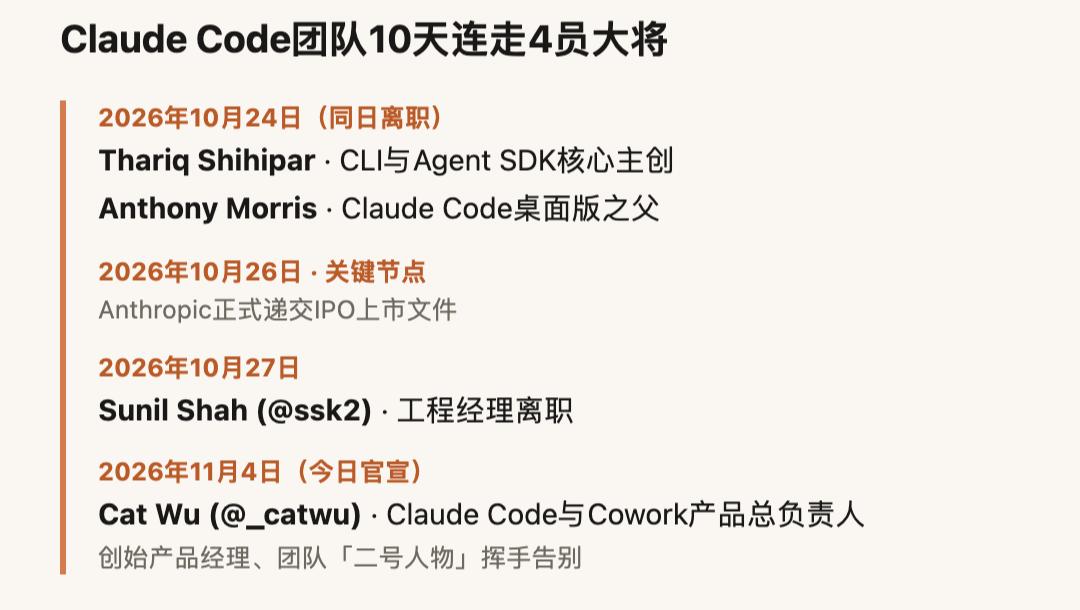
If Thariq is Claude Code's top external evangelist and Anthony is the one who moved it from the terminal to the desktop, then Cat Wu is the most core partner of founder Boris Cherny.
Silicon Valley media once referred to Boris and her as "Batman and Robin of Anthropic", where one wrote the initial prototype code and the other was responsible for the direction and implementation of the entire product.
In her farewell letter, she recalled the scene when she first came into contact with Claude Code two years ago.
From Princeton to the Venture Capital Circle, She Turned an Internal Small Tool Into a Multi-Billion-Dollar Product
Before joining Anthropic, Cat Wu worked as an intern on a Wall Street trading desk, a Silicon Valley engineer, and a venture capitalist for three years.
No matter which position she switched to, she could not stay idle and always wanted to build something by herself.
Writing Code Even as an Investor, Hand-Stitching Leather Bags at Home With a Small Knife
Cat Wu, full name Catherine Wu, graduated from the Department of Computer Science, Princeton University with a bachelor's degree in 2017. In her senior year, she and 6 friends developed Scratchwork, a collaborative whiteboard application that supports handwritten formulas and charts.
After graduation, she first interned at the JPMorgan Chase Equity Derivatives Trading Desk, then served as a product engineer at YouTube and early-stage Scale AI, and led the team at open-source data orchestration company Dagster to build Dagster Cloud, the core commercial product.
In October 2021, she joined well-known venture capital firm Index Ventures and worked as an investor for nearly three years.
Even when reviewing projects in the VC office, she never gave up the habit of writing code, and often wrote programs to crawl updates on X to find early-stage startups and see which open-source projects were gaining popularity.
Outside of work, she is also a person who enjoys making leather goods by herself.
During the pandemic, because she liked an Italian Il Bisonte leather bag given by a friend and was troubled by the small apartment that could not fit power tools, she simply bought a $40 beginner tool kit on Amazon and decided to hand-stitch leather bags at home.
To buy authentic Italian vegetable-tanned cowhide that will gradually turn dark brown after long-term use, she browsed all leather goods forums. At first, she mistakenly bought very hard American carving leather, and with an unstable small pocket knife, she spent a lot of effort but still could not cut through the thick cowhide.
After several setbacks, she finally got the hang of it, punched holes with a 3mm chisel hammer blow by blow, polished and sealed the edges with a wooden stick, and sewed a whole series of genuine leather bags by hand on the desk in her apartment.
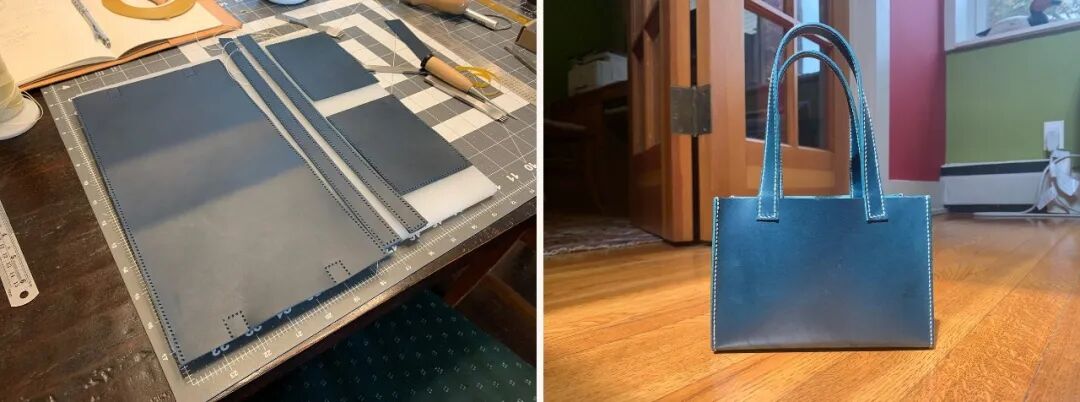
Cat Wu punching holes by hand with a chisel on her apartment desk (left) and the finished leather bags she sewed by hand (right)
After reviewing projects in venture capital for three years, she still felt that building products by herself was more interesting, so she decided to return to tech companies.
Not Writing a Single Line of Code for More Than Ten Hours, She Immediately Transferred to Join Claude Code
In August 2024, Cat Wu joined Anthropic, initially serving as a product manager in the research team, responsible for turning cutting-edge model capabilities into customer-facing products.
That autumn, the Claude Code built by Boris Cherny was just open for internal trial at the company, and the earliest demo posted on internal Slack even only received two emoji replies.
Cat first used it to write Streamlit applications to analyze user feedback, and then tried a bold move, letting Claude Code help her build a reinforcement learning environment (RL env) from scratch.
She recalled in the farewell letter that that time she let Claude run continuously for more than ten hours, did not write a single line of code by hand, and finally actually built the entire environment.
This experience completely shocked her, making her immediately decide to transfer to the newly established Claude Code team and become its founding product manager.
Jumped to Cursor With Boris, Only to Return Lightning-Fast After Just Two Weeks
As Claude Code became a hit in May 2025, she and Boris Cherny became the most sought-after partners in Silicon Valley, and even their top competitor could not sit still.
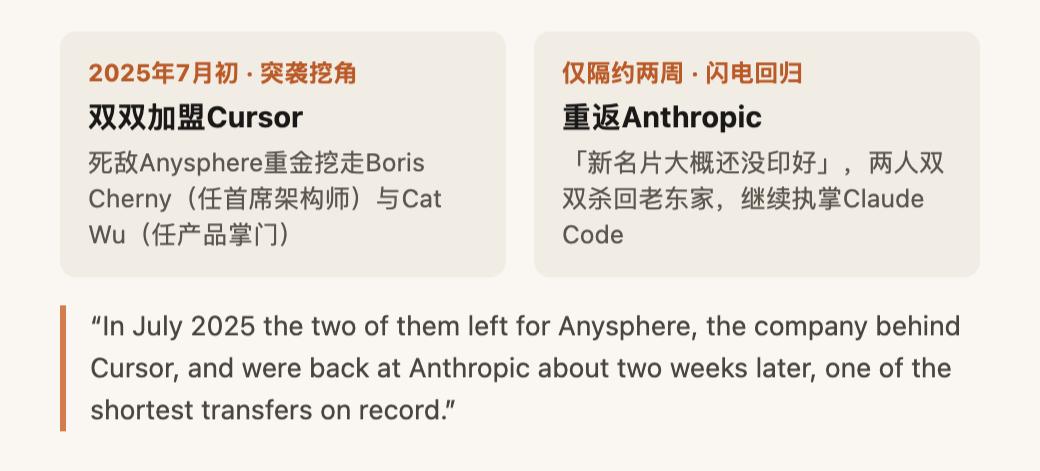
On July 1, 2025, Anysphere, the parent company of Cursor, made a surprise move to poach both Boris Cherny and Cat Wu, appointing them as Chief Architect & Head of Engineering and Head of Products respectively. As soon as the news came out, the entire Silicon Valley was in an uproar.
No one expected that things would soon take a big turn.
Only about two weeks later, before the business cards printed with their new titles were even ready, the two returned to Anthropic together, setting one of the shortest job-hopping records in the history of Silicon Valley's AI circle.
After returning, the two of them grew Claude Code all the way into a core business with an annualized revenue of billions of dollars.
When checking daily data, she also found that even colleagues from the legal, finance and operations teams inside the company were learning to use Claude Code in the terminal, and the proportion of non-technical users exceeded 20%.
She immediately realized that ordinary people who do not write code also need such tools, so she led the team to build Claude Cowork and Tag for general office workers.
No Long Documents, No Six-Month Plans: How She Led the Claude Code Team
A small team of dozens of people was able to launch the command line, IDE plugin, desktop, web version and Cowork at the same time in more than a year, which largely benefited from Cat Wu's unique way of leading the team.
In the article "Building Products Under Exponential AI Growth" published in March this year and multiple public speeches, she shared three daily work experiences of the team.

Cat Wu delivering a speech at the Code with Claude 2026 conference in San Francisco
No Daily Standup Reporting, the Desktop Version Was Built Through the "Afternoon Side Quest"
In traditional software companies, product managers usually have to talk to customers for several months and write long requirement documents before engineers can start writing code.
But in Cat's team, almost all product managers are full-time engineers by background, and the division of labor between product, design and engineering is very blurred.
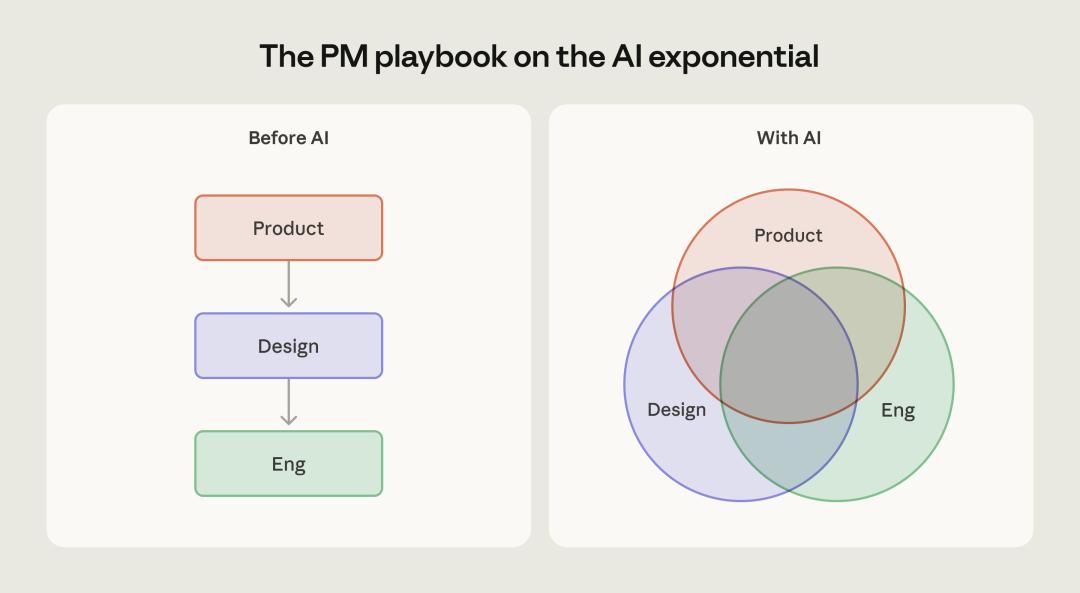
The role evolution drawn by Cat Wu: Product, Design and Engineering have changed from a one-way pipeline to deep integration
She revealed a team rule at the AI Engineer World's Fair this summer, "If we have an idea but can't convince any engineer to code it out, the product manager will write it themselves."
The team canceled traditional reporting standups, and instead spent half a day using Claude Code to directly build a runnable prototype for discussion.
She even wrote a set of testing tools for herself, letting Claude automatically open local applications and simulate real users clicking the interface to accept new features; when encountering errors, there is no need to ask others, just let Claude read the team's Slack chat history to see if any colleague has encountered the same problem before.
At the same time, she encouraged all staff to run "Side Quests" outside of the main line of work, and spend an afternoon freely trying new ideas.
The now widely popular Claude Code desktop version (the work of Anthony, who left 10 days ago, and his partner Alice), AskUserQuestion reverse query tool and Todo to-do list all came from these afternoon side quests.
The reason why the team emphasizes speed so much is that the underlying model capabilities are improving too fast.
One Test Question Witnessed a 41x Improvement, 20% of Prompts Were Deleted as Soon as the Model Was Upgraded
Starting from Sonnet 3.5 in October 2024, every time the team trains a new model internally, Cat will test the same question, letting Claude Code add a "Table Tool" to the open-source whiteboard tool Excalidraw.
The early models could not complete it every time; by Opus 4 in June 2025, it occasionally succeeded, and the team quickly recorded a video as a conference demo.
Less than a year later, Opus 4.6 is stable enough to be demonstrated live in front of thousands of developers.
Evaluation data from the third-party institution METR also confirmed this change.
When Claude Code was first established, the model could only complete a 21-minute software task for humans; 16 months later, Opus 4.6 can independently complete an engineering task that takes humans nearly 12 hours, and the task duration has increased by about 41 times.
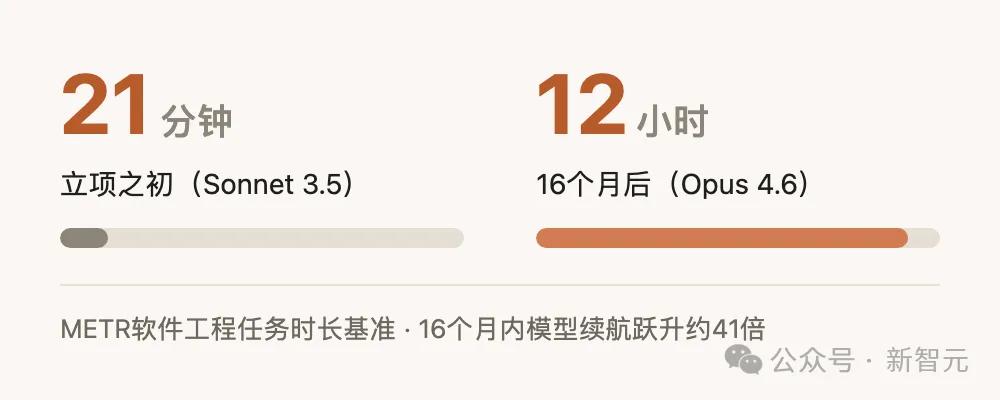
In her opinion, building AI products is like building a building on ground that is constantly rising, and any roadmap longer than six months will be invalidated by new models.
Therefore, she established a "three-month obsolescence principle": even if you know a feature will be eliminated by the new model in three months, as long as it can make the product easier to use today, launch it immediately.
Once the next-generation model comes with this capability, the team will simply delete the original patch code. When upgrading to Opus 4.6 alone, they deleted 20% of the system prompts to leave a cleaner context for the model.
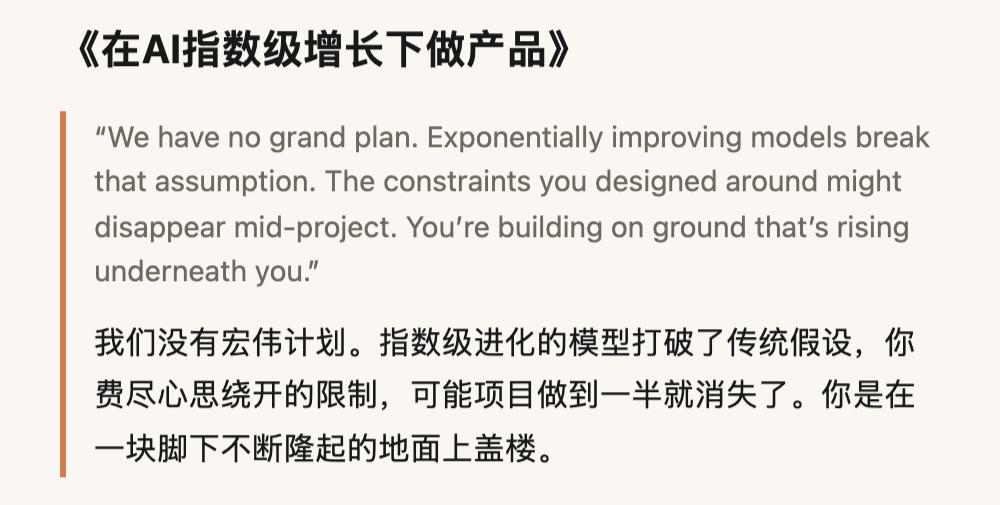
She never let the team copy the work of competitors, and said bluntly "If you always think about your competitors, your execution speed will always be two weeks to a month slower than your own limit."
Since they don't focus on competitors, the next step is entirely determined by the daily usage habits of real users.
Finding "99% of Popups Are Ignored", Making Video Calls With Complaining Users to Debug
In the early days, for safety reasons, Claude Code popped up a confirmation window for users every time it executed an operation, but Cat soon found a problem.
She observed that when users, out of habit, directly click "Agree" on 99% of popups without even looking at them, the permission popups lose their original security function, and truly dangerous operations are easily approved by mistake.
To this end, she and the team launched "Auto Mode", adding a lightweight security classification model at the bottom to automatically approve most conventional operations, and only remind users when there is real risk.
Today, enabling Auto-approve has become the default usage for most developers.
She also pays close attention to user complaints and feedback in daily work. When she found that developers always manually switch to the Chrome plugin to copy and paste for testing after writing web pages, she made the decision to connect the two sides and build the built-in Claude Code with Chrome.
Seeing some people in the community complain that Token consumption is too fast, she did not perfunctorily give official replies, but took the initiative to contact several users who posted the complaints to make video calls, and checked their local chat records together to find out where too many Tokens were consumed.
From a Perfectionist to Someone Who Learned to "Let Go"
Looking back on Cat Wu's two years at Anthropic, her own mentality has also undergone considerable changes.
When she hand-stitched leather bags in her apartment in the past, she was a perfectionist who repeatedly adjusted even the error of a few millimeters in the hole spacing, and was used to holding every detail in her own hands.
But at the end of that long article, she confessed that <