The sports market is witnessing extremely steep price cuts with discounts slashed to rock bottom.
Written by He Zhexin
Edited by Qiao Qian
Adjustments
In the second half of 2026, it is extremely hard to find a satisfactory financial report from sports brands.
For the first time, leading domestic sports brands collectively recorded negative retail revenue growth in the same quarter. Anta and FILA reported year-on-year declines in quarterly revenue for the first time since 2022. Li-Ning posted a low single-digit revenue drop, with e-commerce being the only growth driver. Xtep's core brand also saw a mid-single-digit decline. 361° was the only one among the four leading brands that recorded all-around growth, with its H1 revenue growth slowing to 8%.
Nike is still on a downward trajectory, reporting $11.2 billion in revenue in its latest quarter, down 5%, and its management expects full-year 2027 revenue to decline at a single-digit rate. Puma's decline narrowed to 6.3%, but it is still sliding.
Among the international brands that are still growing, adidas posted 7% revenue growth in Q3, which was mainly driven by apparel, while footwear revenue remained flat year on year. On Running recorded 21.6% growth in Q2 at constant currency, but its largest market the Americas only grew by 13%, missing expectations. HOKA's growth rate continued to slow to 6.8%, and its parent company lowered its full-year growth forecast to a single digit.
But the revenue figures themselves are not the focus. The real point is the signal behind them: the sports market seems to be going through a global promotion cycle.
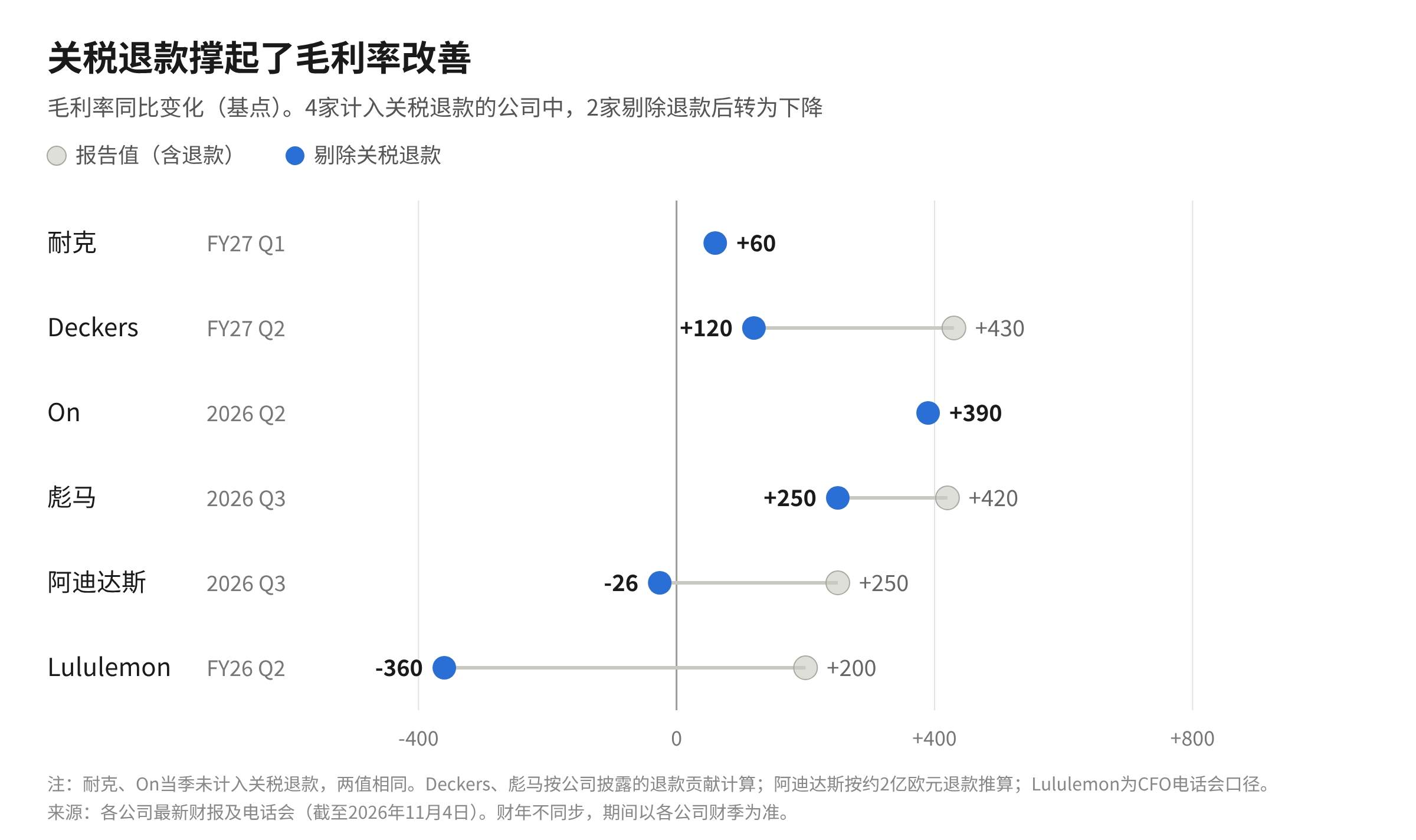
Illustration: 36Kr
Promotions and discounts in the North American and European markets are concentrated on classic models and lifestyle footwear. On the latest earnings call, Bjørn Gulden, CEO of adidas, noted that "the European and North American markets are saturated", which has impacted sales of lifestyle footwear. He mentioned that "some major product lines in the industry are being heavily discounted".
Dick's Sports attributes the root of promotions to the brands themselves. "Some brands are running heavy promotions on their own websites, which spills over to the whole market," said Ed Stack, CEO of the company. The implication is that leading brands took the lead in cutting prices, forcing distributors to follow suit.
Dick's Sports operates more than 850 stores across the United States, making it the largest full-category sports chain retailer. It mainly sells classic and lifestyle footwear, so it has been hit harder by discounts. Generally speaking, lifestyle footwear is priced lower, with higher frequency and larger magnitude of discounts, making it more vulnerable to fluctuations in the overall market environment.
Apart from casual categories, professional products have not escaped this storm either, but this seems to be a unique situation in the Chinese market.
Over the past two years, domestic brands have produced a large number of carbon-plate professional running shoes, leading to overcapacity and a price war in the market. E-commerce platforms make price comparison more direct and transparent, and the overall price level of professional running shoes has been significantly lowered. In the second half of the year, Nike's own channels and third-party distributors began to offer heavy discounts. The price level of professional running shoes continued to decline, squeezing the living space of domestic brands from both ends, which further deepened the discount intensity and inventory pressure indicators.
Data from Guosen Securities shows that at the end of Q3, the inventory-to-sales ratio of Anta's core brand across all channels stood at about 5 months, flat year on year; the offline discount for bulk products was about 29% off, flat year on year; the online discount was 52% off, 2 percentage points deeper than the same period last year. The all-channel inventory-to-sales ratio of FILA's bulk products remained below 6 months, improving by 0.3 months year on year; the offline discount was 28% off, 2 percentage points deeper year on year, and the online discount was close to 40% off, flat year on year.
According to CICC data, in Q3 2024, the retail discount of Xtep's core brand was about 25% off, with an inventory-to-sales ratio of about 4 months; Xtep's announcement shows that in Q3 2026, the retail discount was 30% to 25% off, and the inventory-to-sales ratio rose to 4.5 to 5 months. Over the two years, discounts have deepened slightly and inventory pressure has increased.
Responses from Various Players
According to industry conventions, new products of sports brands usually maintain their original price within 3 months after launch, and gradually enter the 20% off range after 3 months. But in the current discount environment, the discount start time of new products from all brands has been advanced to varying degrees, and the discount intensity is also higher.
According to media reports, in July, a new Nike sneaker priced at 649 yuan fell to about 50% off more than ten days after its release; a Nike running shoe launched in April and priced at 999 yuan was sold at 40% off on Topsports' online store in July. The background of the latter incident is that Nike announced that it would take back online distribution rights, and distributors needed to clear inventory before the end of the year.
The discount intensity of domestic brands is comparable to this. The difference is that under the impact of inventory-clearing discounts from international brands, even domestic brands cannot maintain the price of their professional flagship products: Xtep's 160X 8.0 PRO released in August can now be purchased at about 40% off in its official flagship store; Anta's latest top carbon-plate racing shoe C10 PRO 2 is already available at a 43% discount online.
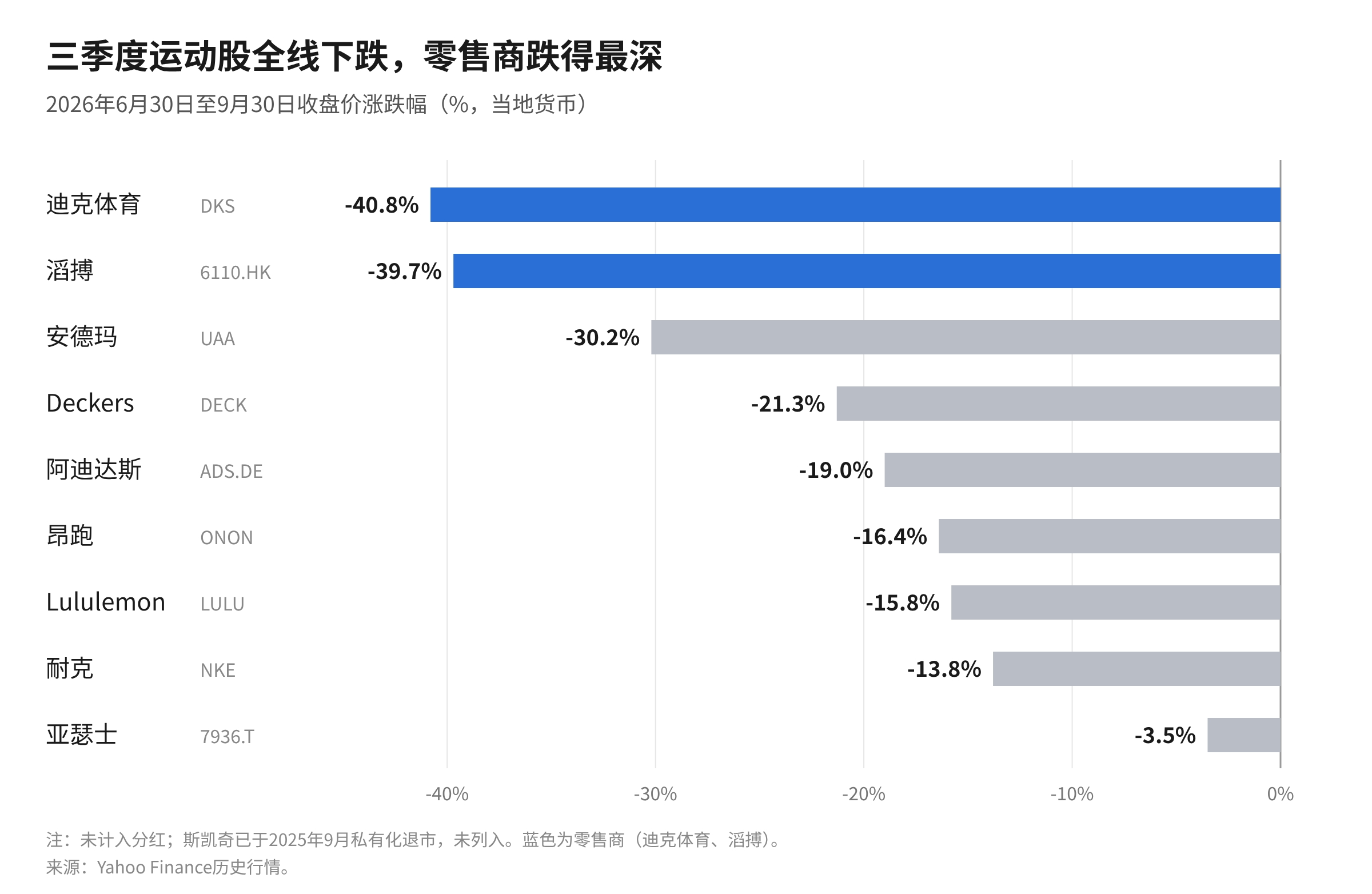
Illustration: 36Kr
For international brands that occupy most of the shelf space, reducing shipments is the fastest way to clean up the market, which can shorten the painful period.
Nike has gradually cut the supply of classic sneaker models such as Dunk, AJ1 and Air Force 1 since around 2023. The number of new Dunk colorways dropped from more than 150 in 2023 to dozens in 2025; in the latest quarter, Dunk's revenue was actively cut by nearly half. Even so, Dunks released many years ago can still be seen on the market. Nike's then CFO said in June that sell-through "remains difficult".
In the past year, adidas has shifted its focus to apparel. Gulden mentioned that Originals footwear is currently in negative growth, but its inventory is "much lower", and the pace of new product launches is also under control, because "there is no point in pushing new products into a discount environment".
After Samba, adidas did not rush to launch the next lifestyle sneaker. From last year's Superstar to this year's Stan Smith, adidas has been carefully testing the market response of casual fashion categories. In addition, it also needs to absorb the impact of Puma's "at all costs" inventory disposal, which makes Gulden not hold high expectations for improvement in the European market in the fourth quarter.
On Running also adopted the strategy of reducing shipments. The company had actively reduced its supply to North American wholesalers in the second quarter, leading to only 12.7% growth in the North American wholesale channel in the quarter, less than half of the growth rate in the same period last year. The management cannot give an answer on when the market will return to normal, but said that the terminal sell-through of North American wholesale in Q3 has rebounded significantly compared with Q2.
HOKA, whose growth rate has continued to slow down, is emphasizing its premium positioning and full-price sales on one hand, and has started to explore lower price ranges on the other. Next January, Fly Pace priced at $115 will be launched to attract new consumers; HOKA will also launch Cielo 70, a low-top sneaker inspired by 1970s running shoes, to expand its lifestyle category. CEO Stefano Caroti admitted that HOKA might lose share in the "more compact price range below $120".
When Will the Market Return to Normal
Regarding the cause of this round of promotions, a mainstream view holds that it is a supply problem rather than a demand problem.
A July report from Glossy cited industry insiders saying that a large part of today's North American promotion environment is because large brands have launched too many sneaker models in the past three years, which objectively led to supply exceeding demand in the market. Gulden and Nike CEO Elliott Hill also acknowledged the oversupply issue on different occasions: Gulden said that once supply is reduced, "you will see good numbers again"; Hill admitted that Nike "has been over-supplying classic retro models" for the Jordan brand.
As for when these sneaker models will be fully cleared, Arthur Hoeld, CEO of Puma who is fully focused on inventory clearance, said the company's inventory will return to normal before the end of the year; Gulden speculated that by the second half of 2027, "we will be in a different situation", but he also said "it may just be hope and speculation".
However, some analysts believe that the essence of the promotion environment is the lack of innovation in the entire sports market, and new products do not meet consumer demand. In this year's back-to-school season sneaker survey, Stifel analyst Peter McGoldrick summed up the overall theme as "lack of novelty", saying that the survey results show "lack of inspiration". On top of that, external factors such as inflation have led to a sluggish overall market.
Data from market research firm Circana shows that in Q3 this year, U.S. footwear sales were flat year on year, while sales volume posted a mid-single-digit decline. Beth Goldstein, industry consultant for footwear and accessories at Circana, said consumers will still pay for shoes that "can express their identity", as long as brands come up with products that "make people feel relevant".
Looking at China, national retail sales of clothing, footwear and headwear fell by 1.0% and 0.5% year on year in July and August respectively, and only turned positive in September, driven by the growth of e-commerce transactions, while offline channels remained weak.
After the apparel boom brought by the World Cup faded, adidas chose to make new efforts in the professional field. Next year, adidas will extend its running shoe category to Hyperboost and Supernova, targeting comfort and daily use scenarios respectively. Gulden told 36Kr that adidas already has "the best professional racing running shoes on the market", and the next task is to extend product advantages to a broader group of mass runners.
Nike has also taken a series of intensive actions. On October 13, it launched its first batch of "Local Origin Series" in China, including the NIKE Sportswear Morph Series and JORDAN Streetwear Rise Series, focusing on multi-scenario wearing and adaptability to different weather. Hill said this is the first series "made in China, for China", and it was deliberately launched exclusively in offline stores. Nike's China team is trying to shorten the cycle of products from concept to consumers to 120 days.
In the professional product line, Nike launched 4 running shoe innovations within two months, from the entry-level racing shoe Swooshfly for runners who finish a marathon in more than 4 hours, to the super running shoe with double-layer Air Zoom technology. At the New York Marathon on November 1, Swedish runner Andreas Almgren won the men's championship wearing the unreleased Apex.
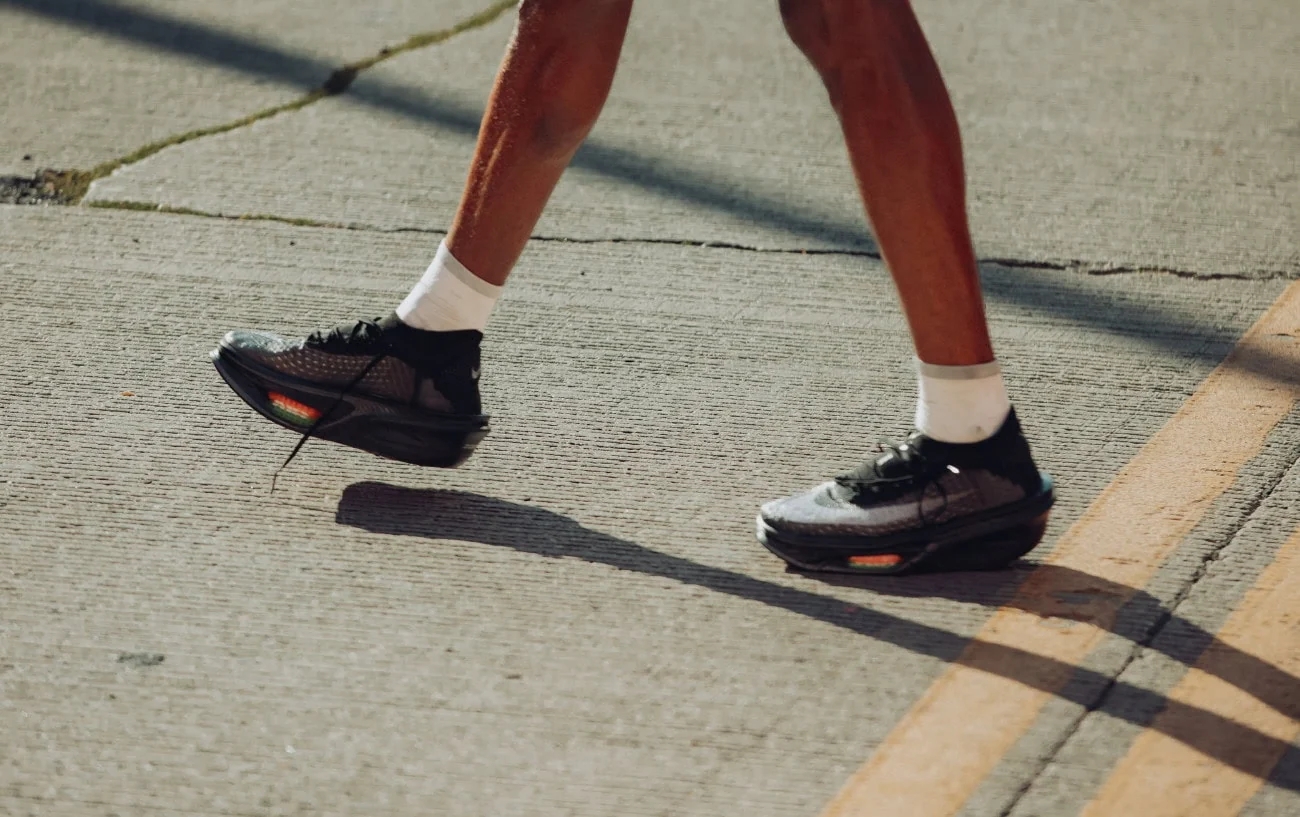
New York Marathon runner wearing NIKE Apex
Domestic sports brands continue to focus on the outdoor track, where there is new market space vacated after the reputational setback of Arc'teryx. Descente and KOLON SPORT under Anta Group recorded 25% to 30% retail revenue growth in Q3.
Anta is also using its sub-brands to capture this part of demand. "Anta Champion", which evolved from the Beijing Winter Olympics flagship store, is priced 30% to 50% higher than Anta's core brand, focusing on trail running, hiking and skiing, and has entered high-end shopping malls where Arc'teryx and Descente are located.
According to reports, by the middle of 2025, the store scale of Anta Champion has expanded 7 times, and there are more than 13 stores with annual single-store sales exceeding 10 million yuan. Kailas has developed its trail running shoe line FUGA into an independent brand: it entered Beijing Daxing International Airport in March this year, and opened its first European store in Chamonix, France in August. According to statistics from the Yuepao Data Research Institute, FUGA's wearing share in domestic trail running events is 34.8%, ranking first.
When the discount cycle comes, some companies are stopping losses, while others are waiting for opportunities. We cannot predict the market trend, just as a consumer investment industry insider said: "Because we are originally part of history."