AI Kidnaps the "Magnificent Seven" US Stocks

As of November 2, six of the "Magnificent Seven" US tech giants excluding NVIDIA have released their latest financial results. Their revenues have almost achieved overall growth, yet their stock price trends have gone in different directions.
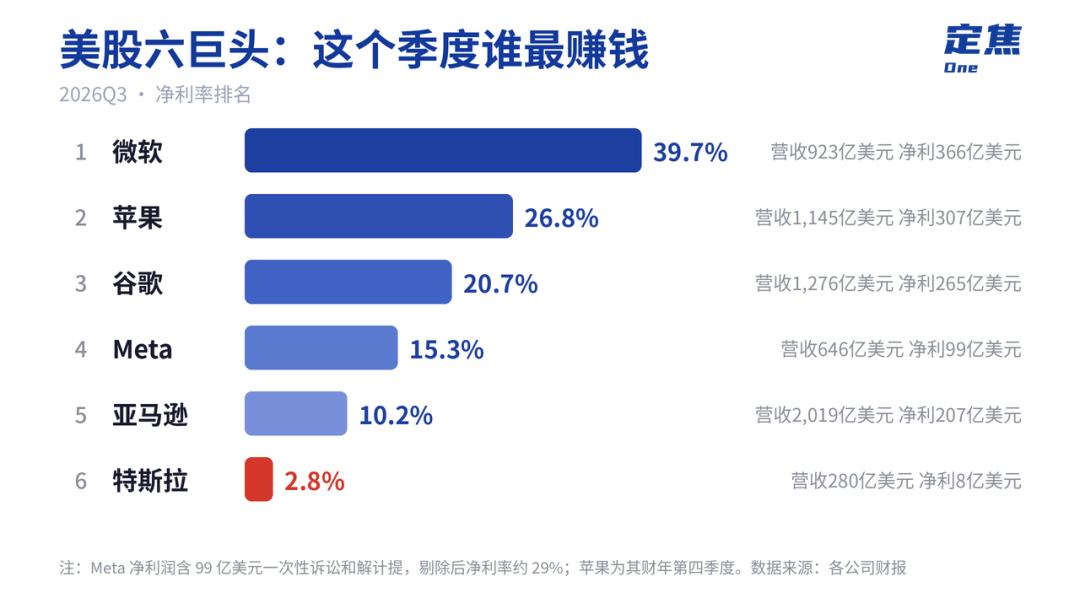
The one that fell the hardest is exactly the one with the fastest growth. On October 28 US Eastern Time, Alphabet, Google's parent company, released its Q3 financial report. Google Cloud posted a single-quarter revenue of 30.7 billion US dollars, up 103% year on year. However, the next day, its stock price plunged 12.64%, hitting the largest single-day drop in the company's history since its listing.
24 hours later, Amazon repeated the same scenario. AWS recorded a 39.3% growth rate, a new high in nearly five years, and its after-hours stock price dived by more than 7%. One week earlier, Meta's revenue rose 26%, while its stock price also fell by 7%.
The stock prices of the other three companies remained relatively stable. Microsoft Azure posted a 48% growth rate with solid performance, and its stock price edged down 0.2% the next day. Tesla's operating profit dropped by 56%, and its operating profit margin was only 2.6%. However, as it announced that it would cut the full-year capital expenditure from 25 billion US dollars to 20 billion US dollars, its stock price stabilized instead. Apple, which barely spent on AI infrastructure, saw its stock price rise by about 26.7% this year, making it the best performer among the "Magnificent Seven".
The "Magnificent Seven" refers to the seven US tech giants: Apple, Microsoft, NVIDIA, Amazon, Alphabet, Meta and Tesla. NVIDIA's fiscal quarter is not synchronized with the other six, and its Q3 financial report will not be released until November. Therefore, this article mainly analyzes the six companies that have disclosed their performance, and still discusses the seven companies when involving stock prices and industrial chains.
In the past few years, the stock price trends of the seven giants were roughly synchronized, but this pattern has completely changed this year. As of October 30, Apple's stock price rose 26.7% within the year, NVIDIA's rose 9.7%, while Alphabet and Tesla fell 10.5% and 11% respectively. The seven companies account for about one-third of the weight of the S&P 500, and their weighted gain within the year is only 6.2%, which failed to outperform the broader market. This is the first time that they have collectively fallen behind since the concept of the "Magnificent Seven" was put forward in 2023.
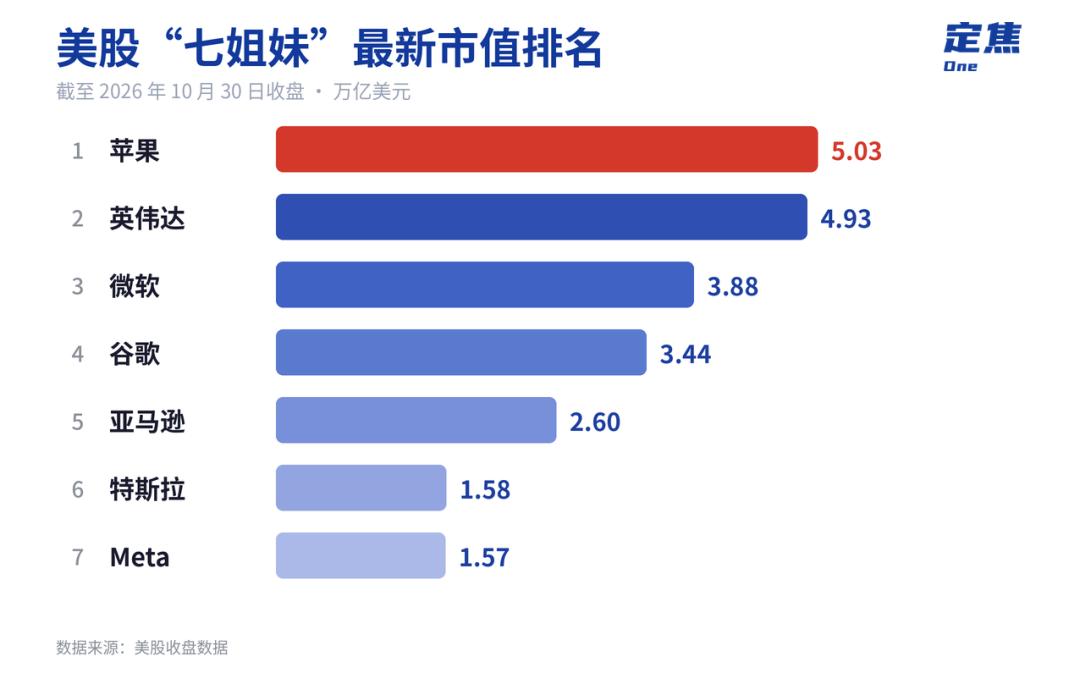
On the surface, the market is worried about the AI bubble, and whether huge investments can be recovered. Last quarter alone, the total capital expenditure of the six companies exceeded 200 billion US dollars, a large part of which eventually flowed to NVIDIA, while NVIDIA's own total capital expenditure in the last full fiscal year was only 6.1 billion US dollars. But if it was just fear of the bubble, why is Microsoft, which is also burning huge amounts of money, safe and sound, while Google, which has the fastest growth rate, has fallen the hardest?
To answer this question, we need to first break down the businesses of these giants and see clearly what each of them relies on to make money.
01. Who is earning "current money" and who is still betting on the "future"
All six companies are labeled as "AI concept" stocks, but four different logics are supporting their stock prices.
Microsoft and Amazon sell computing power, Meta sells advertisements, Apple sells hardware and services, and Tesla bets on autonomous driving. Google is special, covering both businesses: cloud and advertising. When the market starts to weigh the returns of AI with real money, the advantages and disadvantages of different models become obvious.
Selling computing power is the most stable business at the moment. As long as the entire industry is still scrambling for computing power, the revenue of the three cloud vendors Microsoft, Amazon and Google in the next two to three years is roughly guaranteed.
Microsoft Azure posted a single-quarter revenue of 33.17 billion US dollars, up 48%; AWS's revenue reached 46 billion US dollars, up 39.3% with an annualized rate of 184 billion US dollars, hitting the fastest growth in nearly five years; Google Cloud's revenue reached 30.7 billion US dollars, more than doubling directly.
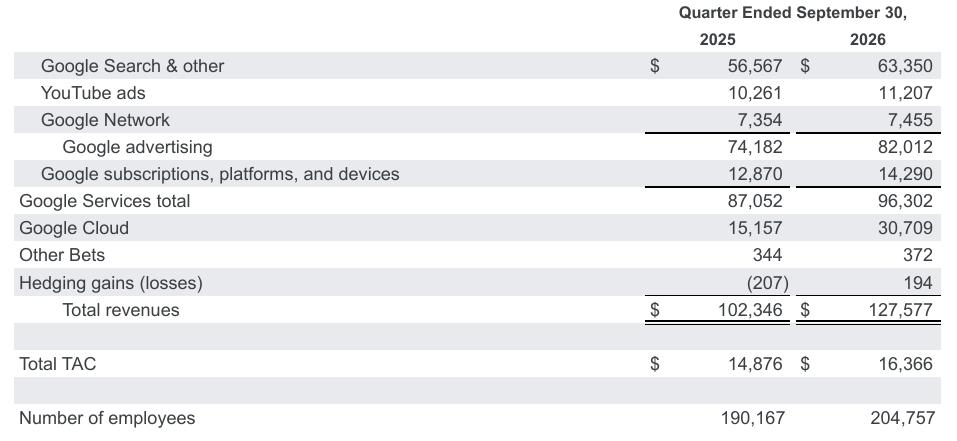
Google Cloud's revenue doubled to 30.7 billion US dollars
Source / Google financial report
Whether this growth rate can be sustained depends on the orders in hand. Microsoft's unfulfilled commercial contracts are as high as 677 billion US dollars, 73% more than the same period last year; Google Cloud also has 561 billion US dollars in backlogged orders, and the management said that more than half of them will be recognized as revenue within the next two years; Amazon's backlogged orders reach 578 billion US dollars, and CEO Jassy revealed on the conference call that OpenAI and Anthropic have each added hundreds of billions of dollars in long-term procurement contracts.
A large part of the revenue of cloud vendors in the next few years has already been booked. The current bottleneck lies in supply. Amazon now installs an AI chip in its data center every 14 seconds on average, and the production capacity is still insufficient.
Meta takes another path: using AI to sell advertisements at higher prices.
Its revenue this quarter was 64.6 billion US dollars, up 26%, the number of ad impressions increased by 10%, and the average unit price rose by 14%. The management attributed the growth to the improvement of the AI recommendation system on the conference call.
The problem is that the advertising business has an upper limit. The total budget of advertisers is a limited pool. The value of AI is nothing more than making advertisements more accurate and more expensive, or increasing the duration that users spend watching advertisements. The unit price has already risen by 14% this quarter, can it continue to rise? The daily active users of all its products exceed 3.6 billion, how much growth space is left? When the marginal benefit of AI investment begins to decline, can the growth rate of advertising always outpace the growth rate of expenses? These are all problems.
Apple barely participated in this round of arms race.
Its quarterly revenue hit a record of 114.5 billion US dollars, up 12%; its full-year revenue reached 478.8 billion US dollars, the best performance in the company's history. Its full-year capital expenditure was 9 billion US dollars, down 29% year on year. In the past two years, the market has always criticized Apple for falling behind in AI, while its peers are investing heavily, it seems to have taken no major actions. After this quarter, the trend has changed a little. When everyone is worrying about huge investment and increasingly tight cash flow, "not spending money" has instead become an advantage. In 2026, Apple leads the seven giants with a 27% increase.
Tesla represents the fourth scenario: its valuation is fully bet on the not-yet-materialized autonomous driving business.
Its quarterly revenue was 28 billion US dollars, flat with the previous year, but its operating profit fell by 56%. The profit of the car-selling business is shrinking, and the market is willing to give it a high valuation, betting on autonomous driving and robots. The number of paid FSD subscriptions reached 1.74 million, up 67%, and more than 75% of new cars delivered in North America are equipped with FSD; Robotaxi has also officially carried passengers in Austin, and the unsupervised mileage increased eightfold in one quarter.
But these are still far from making profits. The potential merger that Tesla and SpaceX are evaluating has also added a lot of variables to its capital allocation.
Google fell the hardest because its two businesses were questioned at the same time.
Search ad revenue grew by 12%, lower than market expectations (about 15%), and the monetization efficiency of AI search is still inferior to traditional search. The cloud business revenue doubled at the cost of 51.4 billion US dollars in single-quarter capital expenditure, and its free cash flow turned negative to 9.1 billion US dollars. Coupled with the drag of losses from equity investments such as SpaceX, its net profit fell by 24%. The financial report was comprehensively lower than expectations, and the market directly voted with its feet.
Roy, an investor focusing on US stocks, told "Dingjiao One" that it was unreasonable from the very beginning to treat all six companies as a single "AI concept" for speculation. When investing in AI, some can earn back the cost in the same year, while others have to wait for several years; some use customers' money to build infrastructure, while others use their own profits to bet on the future.
02. Negative free cash flow makes the market nervous
This quarter, the rise and fall of the six companies' stock prices correspond to the status of their free cash flow. The so-called free cash flow refers to the remaining part of the money the company earns after deducting the expenses of building factories, purchasing equipment and buying chips.
The three companies with negative free cash flow, namely Google, Meta and Amazon, all saw their stock prices fall in October. The other three companies with positive free cash flow, Microsoft, Tesla and Apple, all kept their stock prices stable.
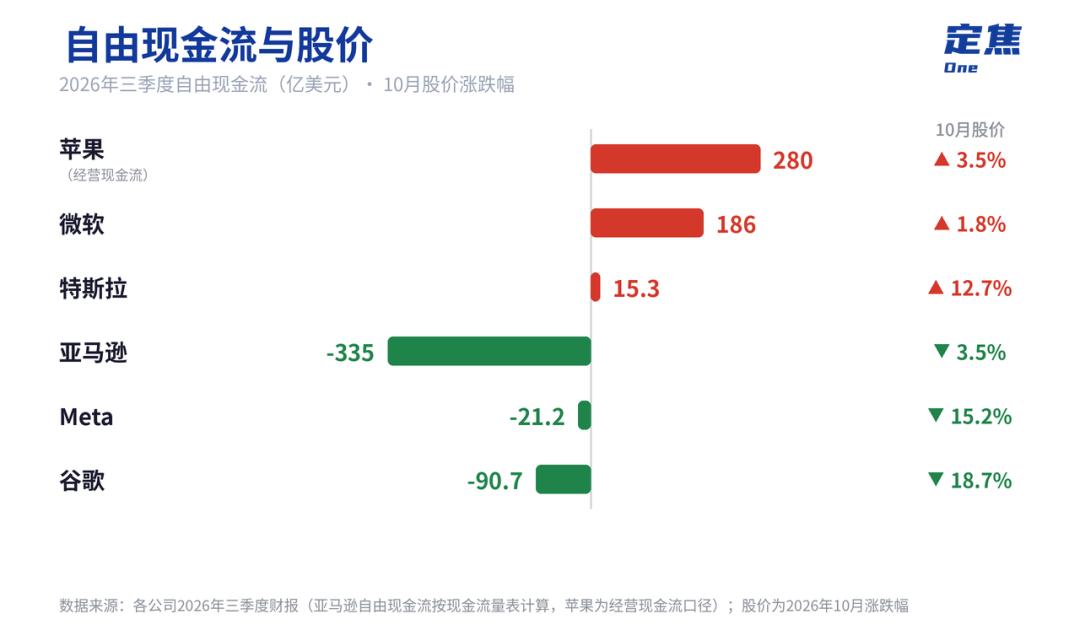
Roy said, In the past two years, the market was willing to bet on "companies that dare to spend money"; now, companies that spend a lot of money have to prove first that they can afford the cost.
Behind the change is the huge scale of this round of AI investment. The total capital expenditure of Microsoft, Amazon, Google and Meta in this quarter reached 202.9 billion US dollars, a new single-quarter record, and their total planned expenditure for the whole year exceeds 700 billion US dollars, 75% more than last year. The industry expects this scale to reach 1.3 trillion US dollars next year.
When the money is spent on such a large scale, the market will definitely pay attention: when will the money spent be recovered? Goldman Sachs summarized this shift in its industry review in the first quarter of this year: the focus on AI has shifted from "who invests the most" to "how far the invested money is from turning back into cash".
The three companies with "negative cash flow" are in different situations.
Google and Amazon spent all their money on data centers, chips and network equipment. The money spent will most likely be recovered, but it just takes time. Google's capital expenditure this quarter was 51.4 billion US dollars, more than doubling year on year. Its confidence comes from the 561 billion US dollars of backlogged orders in Google's hands, and the management said that more than half of them will be converted into revenue within two years. Amazon follows the same logic: AWS has 578 billion US dollars in backlogged orders, and OpenAI and Anthropic have each added hundreds of billions of dollars in long-term procurement.
It is worth mentioning that Microsoft's capital expenditure also doubled this quarter, reaching 39.4 billion US dollars. However, due to its high earnings, its operating cash flow was 58 billion US dollars, leaving 18.6 billion US dollars after deducting expenses.
Meta's situation is different. It also spends money on data centers, with a single-quarter capital expenditure of 34.9 billion US dollars, and plans to spend 1350 to 145 billion US dollars for the whole year, which is on the same order of magnitude as cloud vendors. The difference is that the data centers of cloud vendors are built for customers, and customers pay after they are completed; while Meta's data centers are built for its own use, and whether the investment can be recovered still depends on how much extra profit the advertising business can generate.
In 2022, Meta made a big bet on the metaverse, its stock price fell by 75% within a year, and it did not recover until it cut staff and reduced budgets. Although the advertising business is far more profitable than four years ago, the size of this bet is several times that of the previous one.
What is more noteworthy is that Meta is shifting from "funding the AI race with its own profits" to "raising funds from the capital market": its long-term debt rose from 58.7 billion US dollars to 80.9 billion US dollars within one year, and it also announced the plan to issue Class C shares with no voting rights. S&P recently downgraded Meta's rating outlook from "stable" to "negative", citing major uncertainties in capital expenditure and free operating cash flow.
As for the other two companies, Tesla took the initiative to shrink its expenditure, while Apple barely spent much.
Tesla has invested its main resources in Robotaxi and robots, but it has converged compared to its previous larger plans: the full-year capital expenditure is controlled from more than 25 billion US dollars to 20 billion US dollars, the free cash flow returns to positive 1.53 billion US dollars, and it still has a 30 billion US dollar credit line in reserve.
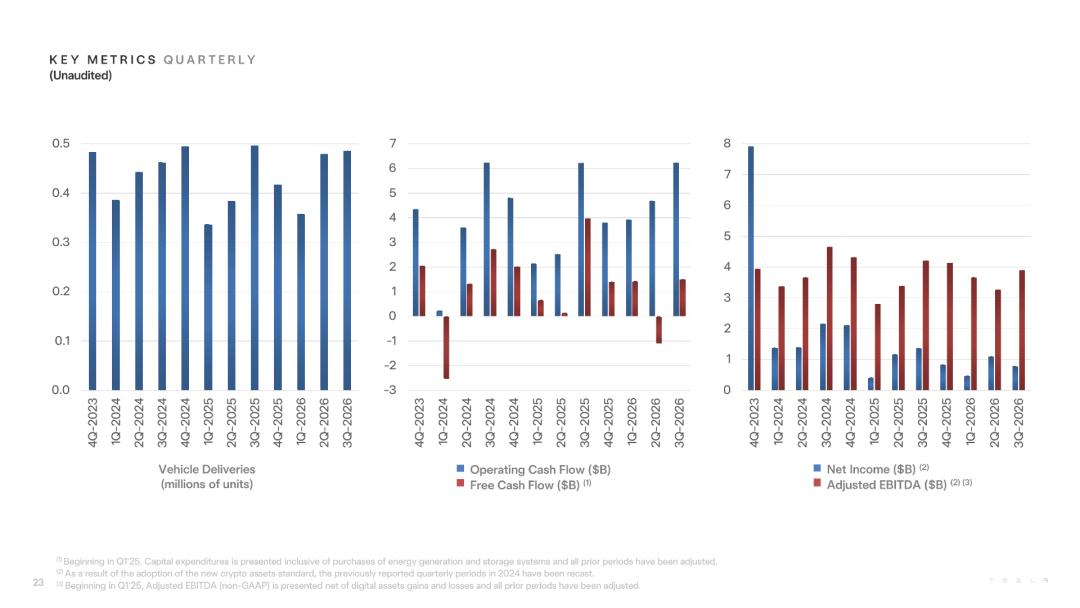
Tesla's quarterly operating cash flow and free cash flow
Apple barely participated in this round of investment. It does not build large-scale data centers, and its AI investment is concentrated on the gradual integration of existing products and services, rather than large-scale self-developed training clusters. Its full-year capital expenditure is 9 billion US dollars, down 29% year on year, and its single-quarter operating cash flow alone reached 28 billion US dollars.
But Apple also has a price to pay: its self-developed AI progress is not smooth, and in January this year, it announced that it would spend about 1 billion US dollars a year to buy Google's Gemini model to rebuild Siri; its