Luckin Coffee is keen on co-branding, and success or failure does not matter.
The scenario Luckin Coffee most longs to see: it does not need every co-branding campaign to be successful, it only needs to keep me forever curious about what the next cup will look like.
01 A Cup of Coffee and a Stranger's Face
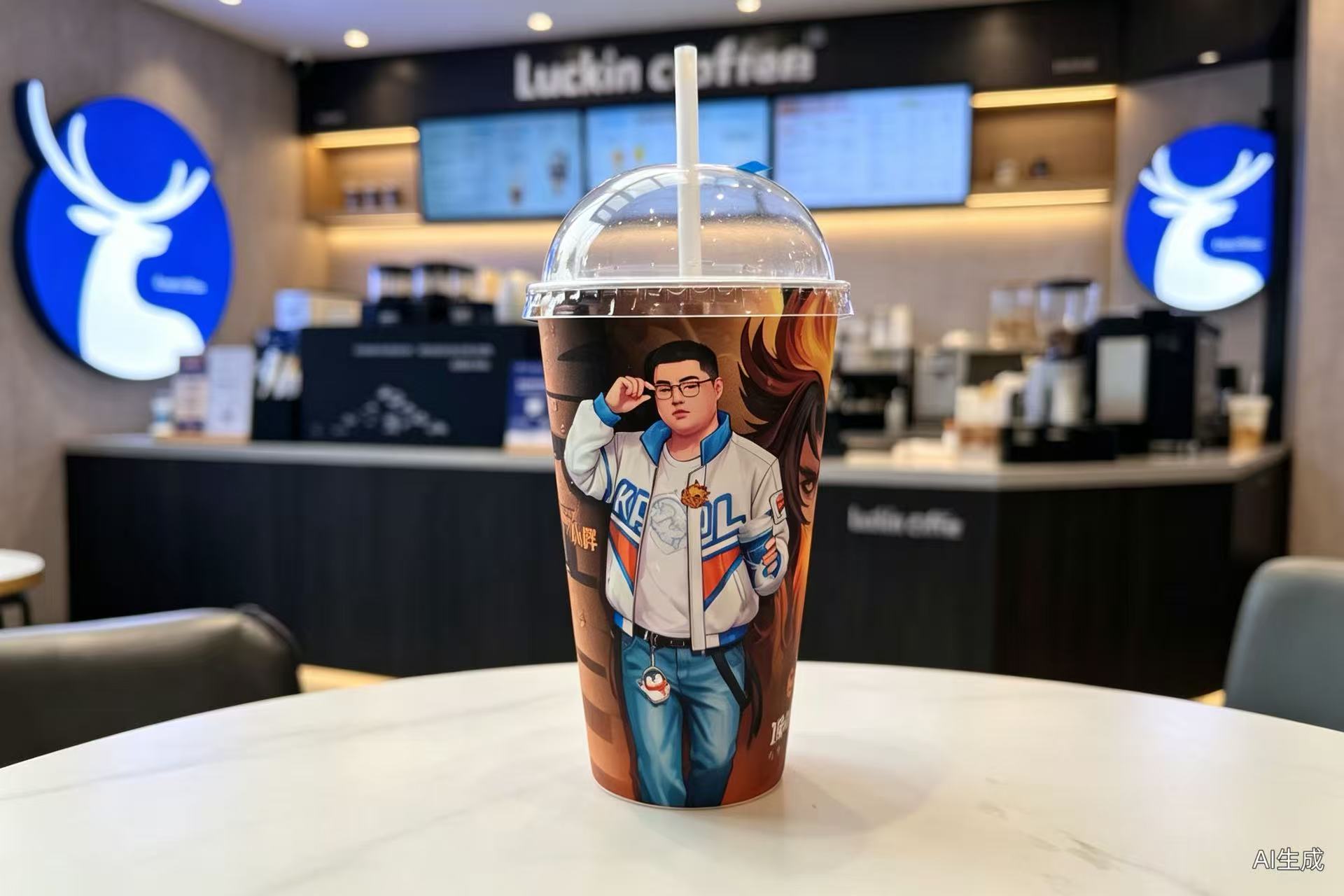
On the afternoon of November 2, I ordered an extra-large Americano at the Luckin Coffee store downstairs of my office. The moment the paper bag was handed to me, I froze for a second — a strange man's face was printed on the cup wall, wearing glasses and a team uniform, taking up almost the entire surface of the cup and staring right back at me through the wall.
I had no idea who he was. After asking the store staff, I learned that this was a limited-edition cup for Luckin Coffee's co-branding campaign with the 10th anniversary of Honor of Kings KPL, and the face printed on it belonged to the esports player "Xiaopang", the FMVP of this year's KPL Summer Tournament. For fans, this is a piece of their youth that they would set alarms to snap up; for me, it was an unanticipated face-to-face encounter.
The next day, the topic "Luckin Coffee's new co-branding campaign with real people printed on cups gets roasted" hit the trending search list. Netizens who do not play the game said they got "a big fright" and "lost all appetite" when opening the bag, joking that they "pulled a colleague's merchandise"; while players fought back by saying people who dislike the design can leave a note to ask for a regular cup when placing orders. To be fair, it is the consumers' right to complain about the ugly cup design, but venting their dissatisfaction on the player's appearance is targeting the wrong person — it is the brand that decides who to print, how to print, and who to distribute the products to.
Luckin Coffee did not respond. Its latest post on official social media was still a co-branding lucky draw, the customer service lines were busy, and no one answered the hotline. A more interesting detail is that when a reporter contacted the physical store, the staff casually said the current campaign will run for two weeks, and a new theme will be launched next Monday.
This sentence is almost the core point of this article — for Luckin Coffee, the success or failure of a single co-branding campaign really does not matter. Why? Let me break it down step by step.
02 From "Big Event" to "Disposable Daily Content"
Luckin Coffee was not so indifferent at the very beginning.
In April 2022, it launched the Coconut Cloud Latte in co-branding with Coconut Palm Coconut Juice. The extremely down-to-earth cup sleeve with black background and colorful characters, paired with the copywriting "Drink it since childhood all the way to the atmosphere", sold 660,000 cups on the first day, 4.95 million cups in the first week, with sales exceeding 81 million yuan. That was the first time Luckin Coffee tasted the sweetness of "packaging marketing" — at that time, it had just climbed out of the quagmire of financial fraud, and was in urgent need of public topics, so every campaign had to make a big splash.
On September 4, 2023, the Sauce-Flavored Latte was launched. The 19-yuan "Moutai" coffee after coupon discount sold 5.42 million cups on the first day, with sales exceeding 100 million yuan, setting a new single-product record for China's freshly made beverage industry. Luckin Coffee's stock price rose by 5% that day, and even Moutai's market value increased by about 20 billion yuan along with it.
After that came the familiar script we all know: JOJO, Tom and Jerry, Line Puppy, Black Myth: Wukong... In the summer of 2025, it even held a "century wedding" with the green owl of Duolingo, developing the whole story from official announcement of "falling in love" to the honeymoon "returning home to visit parents". The new co-branded product Green Sandy Latte sold 9 million cups in the first week.
By 2026, the style changed completely: in February, there were typos printed on the Line Puppy cup sleeves; in June, the Hello Kitty merchandise misprinted "HELLO" as "HEELO"; on Chinese Valentine's Day in August, the co-branding campaign with an IP of ordinary couples was roasted as "giving wedding money to strangers"; in November, the KPL real-person cups hit the trending search list for being "ugly". According to incomplete statistics, at least 5 co-branding campaigns triggered public controversy within the year.
But look at its operating rhythm: controversy is controversy, co-branding is co-branding, a new theme every two weeks, unshakable. Inside Luckin Coffee, co-branding has obviously evolved from a carefully planned "marketing campaign" to a content assembly line — cups are no longer just packaging, but billboards that get replaced every week.
03 The Recipe for Success is Surprisingly Consistent
Looking back at the truly viral cases in recent years, the recipe for success is almost exactly the same.
The essence of the Sauce-Flavored Latte is "price gap". What is Moutai? It is a luxury product that people only afford to open at wedding banquets, and a hard currency in the middle-aged social circle. Luckin Coffee turned it into a 19-yuan cup of coffee, which is equivalent to handing out a "class experience voucher" to every young person. My WeChat Moments was swiped by posts about it that week, no one discussed whether it tasted good or not — the public praise was actually quite polarized — everyone was just talking about "I got to drink it". It was a social ritual, not a daily drink, so the repurchase rate was low after the check-in trend faded, and it was naturally taken off the shelves eventually.
It is thought-provoking that in June 2026, Moutai publicly admitted at its shareholders' meeting that all cross-border co-branding campaigns including the Sauce-Flavored Latte were "strategic mistakes" and all related cooperation was fully stopped. For the same co-branding campaign, Luckin Coffee gained huge public attention and new customers, while Moutai concluded from its review that its brand tonality was diluted. Success or failure is a relative concept.
HEYTEA × FENDI followed the exact same formula for milk tea: in May 2023, the 19-yuan "FENDI Yellow for Joy" sold more than 1.5 million cups in three days, and netizens joked that "my first FENDI in life was given by HEYTEA". Duolingo's "wedding" campaign upgraded the formula: the product became a plot prop, buying a 9.9-yuan cup of coffee was equivalent to "giving wedding money", and the co-branding was no longer a one-off event but a serial drama that people could follow updates on.
To sum it up: IP momentum × price gap × social currency × zero cross-circle threshold. Missing any one of the four factors, the whole story will turn out completely different.
04 The Ways of Failure Vary From Case to Case
LELECHA failed because of its disrespect for culture. On World Book Day 2024, it launched the "Smoky Oolong" drink in cooperation with Yilin Press, making Lu Xun hold a milk tea in the promotional image, with the slogan "Old chain smoker, new youth". Lu Xun's eldest grandson Zhou Lingfei authorized a law firm to issue a lawyer's letter, and LELECHA removed the product from shelves and issued an apology. The incident did not end even this year — in March 2026, the court ruled that the co-branding also infringed the copyright of Lu Xun's portrait, LELECHA was ordered to pay 200,000 yuan in compensation and make another public apology. One single misstep left a lingering aftermath that dragged on for two full years.
Aunt Shanghai failed because of the out-of-control frontline organization. On December 14, 2022, the same day it officially announced its co-branding campaign with Tencent's game Light and Night Love, incidents broke out that store employees leaked unpublished materials in advance and insulted game players and characters. The game side announced the termination of cooperation on the very same day. The IP signed by the headquarters was ruined by a single inappropriate comment from a staff member of a random store — this is probably the deepest fear of all chain brands with tens of thousands of stores: no matter how good the creative idea is, if the last meter of the execution chain gets out of control, all previous efforts will be wasted.
HEYTEA's "Little White Gardenia" drink failed because it treated vulgar hints as humor, and it quietly changed the name to "Pure White Gardenia" after being widely mocked by the public. Luckin Coffee itself has also paid a lot of tuition fees: its second collaboration with Moutai, the "Sauce-Flavored Chocolate" product, got almost no public attention — the same IP, when used for the second time, is just rehashing old topics; this time the KPL real-person cup failed because "the circle-specific content was not translated for the general public". Posters can be enjoyed exclusively by people inside the circle, but cups cannot — cups go into offices, subways and meeting rooms along with the coffee. Cartoon patterns printed on cups are decorations, but a real person's face printed on a cup is a forced face-to-face encounter for people who do not know him. What is worse is the mechanism design: if you want a regular cup, you have to leave a note when placing your order — the brand passed the choice cost to the group of people who should never have taken that cost.
05 Why "Success or Failure Does Not Matter"
Putting all the success and failure samples together, Luckin Coffee's "lying flat" attitude becomes very easy to understand.
First, this is a simple arithmetic problem. By the middle of 2026, Luckin Coffee has more than 36,000 stores worldwide, with an average of 113 million monthly paying customers. For a brand of this scale, the cost of a single co-branding campaign is fixed — a sum of IP authorization fee plus a batch of packaging materials; while the benefit and loss are highly asymmetric: if it succeeds, it gains hundreds of millions of public attention and millions of new customers; if it fails, it is just a few days of complaints on trending search lists. If you draw cards enough times, you will always get a top-tier reward at the guaranteed minimum.
Second, the shelf life of public attention is even shorter than the lifespan of a cup. The rotation speed of a new theme every two weeks means before consumers' memory of the old theme settles, the next billboard has already been replaced.
Third, and the most fundamental reason: there is a ceiling for taste innovation, but there is no ceiling for content innovation. After the Coconut Latte, the whole beverage industry has never launched a second product that can match its huge success. But the content printed on cups can be updated infinitely. Co-branding is Luckin Coffee's method of turning "drinking coffee" into "following a seasonal anime series": you are not buying coffee, you are subscribing to a content channel that keeps updating forever. The essence of the subscription model is never that every issue is wonderful, but that there is always a next issue waiting for you.
But we have to make it clear — "Success or failure does not matter" is the privilege of industry giants, not a universal rule for the whole industry. LELECHA paid 200,000 yuan in compensation and kept apologizing for two years for one single misstep; Aunt Shanghai did not even get a chance to correct its mistake. For small and medium-sized brands, co-branding is still a life-or-death gamble. Even giants have red lines that they cannot touch: they can play dead and ignore public complaints for aesthetic missteps, but cultural missteps and legal missteps will still cause them huge losses. Luckin Coffee dared not to respond to this incident, precisely because it calculated that this misstep falls into the category of "unimportant".
06 Final Notes
I ended up finishing the cup of coffee printed with Xiaopang's face. It tasted exactly the same as the cup I drank last week.
I do not know the stranger on the cup, and next week it will be replaced by another stranger I do not know. But I know I will still buy it — not for the cup, but for "seeing what it will be this time". This is probably the exact scenario Luckin Coffee most longs to see: it does not need every co-branding campaign to be successful, it only needs to keep me forever curious about what the next cup will look like.
Success or failure does not matter. Being present in the public vision is what matters.
This article is from the WeChat official account "Zinc Consumer Research Center", written by Kai Kai, published with authorization from 36Kr.