Attention Inflation: Major Corporations Are Getting Busier Yet Less Profitable
In 2026, there are no new users in China's internet industry, only the continuous redistribution of user time. Who has captured user time and converted it into revenue is the same core variable in the financial books of major internet giants this year.
QuestMobile 2026 Fall Report shows that the monthly active users of China's mobile internet reached 1.281 billion in September, with a year-on-year growth of 0.9%, and the average monthly usage duration per capita hit 189.8 hours, up 6.5% year on year. In August, this figure stood at 200.1 hours, crossing the 200-hour threshold for the first time. The total user base barely grows anymore, yet the time each person spends on mobile phones keeps rising.
After the only remaining increment becomes user time alone, a series of seemingly unrelated events including Douyin catching up with Tencent, the number of AI users doubling while their usage duration stays flat, mobile phone shipments hitting a 14-year low and Apple taking the top spot, are in fact different facets of this "time war".
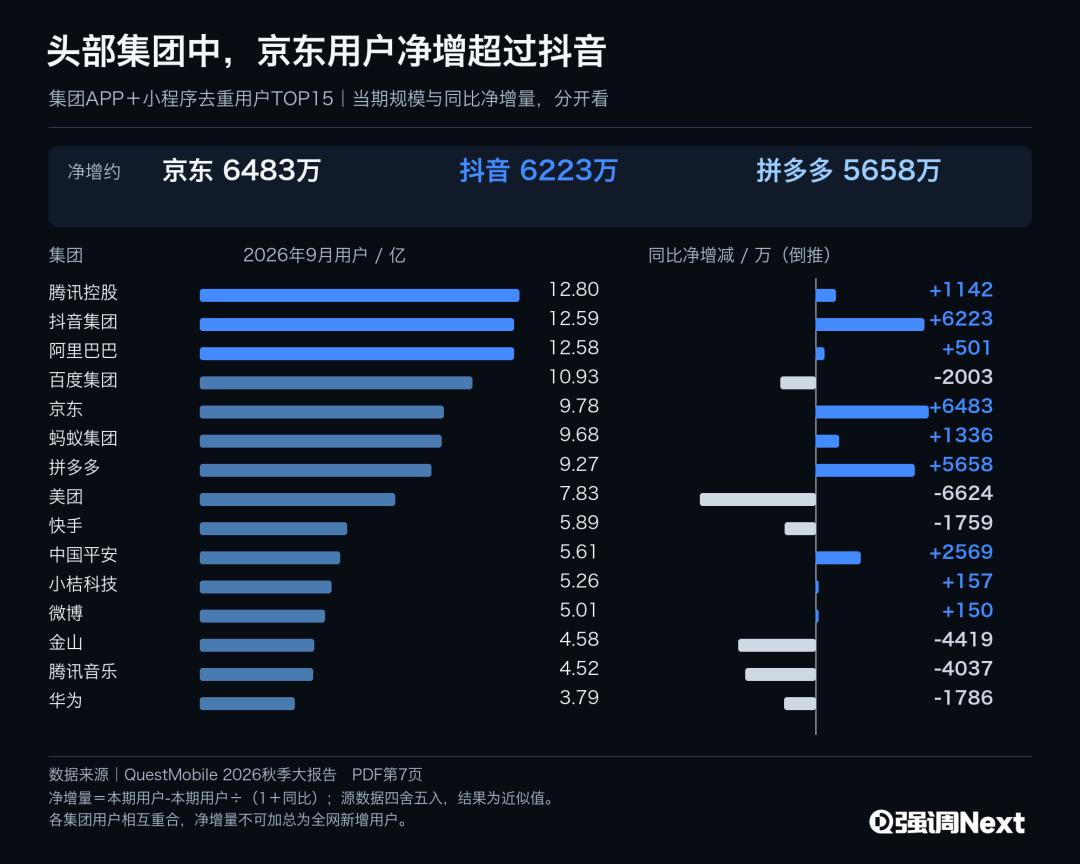
Newly increased user time mostly flows to short dramas and short videos
Calculated back based on the net increase in industry duration disclosed in the report, the total internet usage duration in September was about 17.1 billion hours more than that of the same period last year, of which short dramas accounted for 13.329 billion hours and short videos 5.717 billion hours. The sum of the two exceeds the total net increase, and the sum of all other tracks is negative. The tracks that lost the most usage time are online video (1.38 billion hours less), general information platforms (1.307 billion hours less) and search engines (984 million hours less). Short dramas alone account for about 78% of the newly added user time.
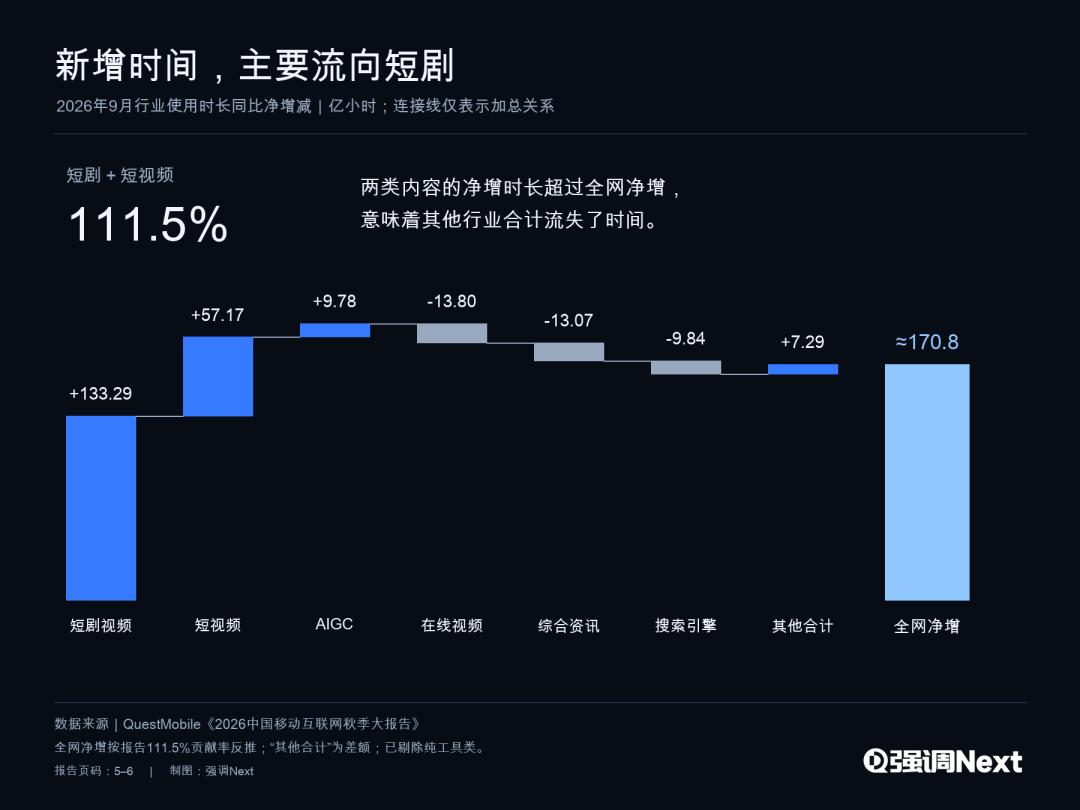
To see who is supplying this usage time, checking the application ranking of ByteDance gives a clearer picture.
Last September, its top three applications were Douyin (936 million monthly active users), Toutiao (389 million) and Douyin Speed Version (305 million). This September, the ranking changed to Douyin (1.029 billion), Hongguo Free Short Drama (430 million) and Doubao (419 million). The two positions previously occupied by information platforms and subsidy-driven duration growth have been taken over by short dramas and AI. Nearly 90% of Hongguo's users (88.5%) use Douyin at the same time, the two applications are competing for the time of the same group of users, while the usage duration of online video decreased by 13.8 billion hours in the same period.
In September, the total de-duplicated users of ByteDance reached 1.259 billion, up 5.2% year on year; Tencent Holdings reached 1.28 billion, up 0.9% year on year, with a gap of 21 million. Calculated backwards based on their respective growth rates, the gap a year ago was about 70 million. Tencent itself disclosed that the combined monthly active users of WeChat and WeChat outside Chinese mainland reached 1.439 billion, including overseas users, with a different statistical caliber. No matter which standard is used, the two companies have covered more than 98% of all internet users under QuestMobile's statistical caliber. After catching up, the number of users no longer distinguishes the two companies, and what differentiates them is what they can sell in the same minute.
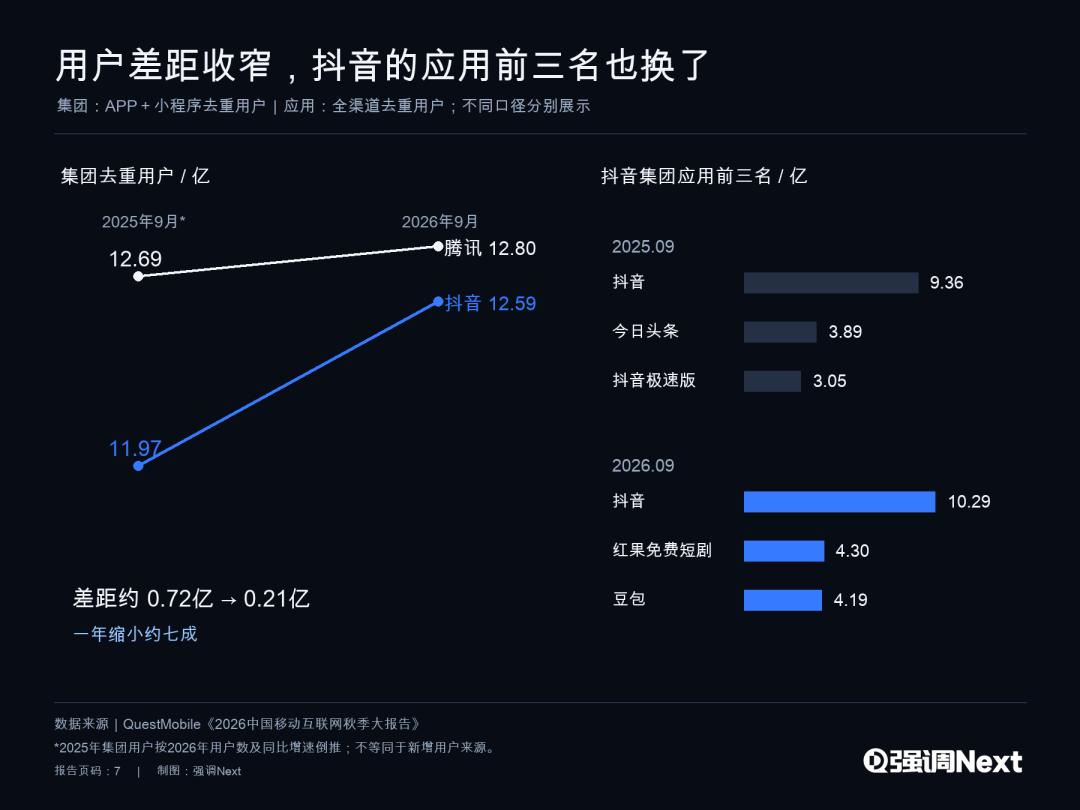
There is currently only one deduction clue for who the new incremental time comes from.
The report shows that the proportion of users aged 46 and above has exceeded 40%, up 2.6 percentage points year on year, while the proportion of users aged 25 to 45 has dropped to 39%, and the positions of the two groups have reversed. Data from CNNIC shows that the internet penetration rate across China reached 80.1% in December 2025, and the usage rate of internet users aged 60 and above was 53.7%, 26.4 percentage points lower, which is the largest remaining untapped gap.
The report does not give the age structure of short drama users. The phenomenon that "middle-aged and elderly users are supporting the short drama industry" is only two phenomena that appear at the same time, and user portraits of platforms like Hongguo are still needed to confirm this conclusion.
User time has shifted, revenue only recognizes transaction conversion
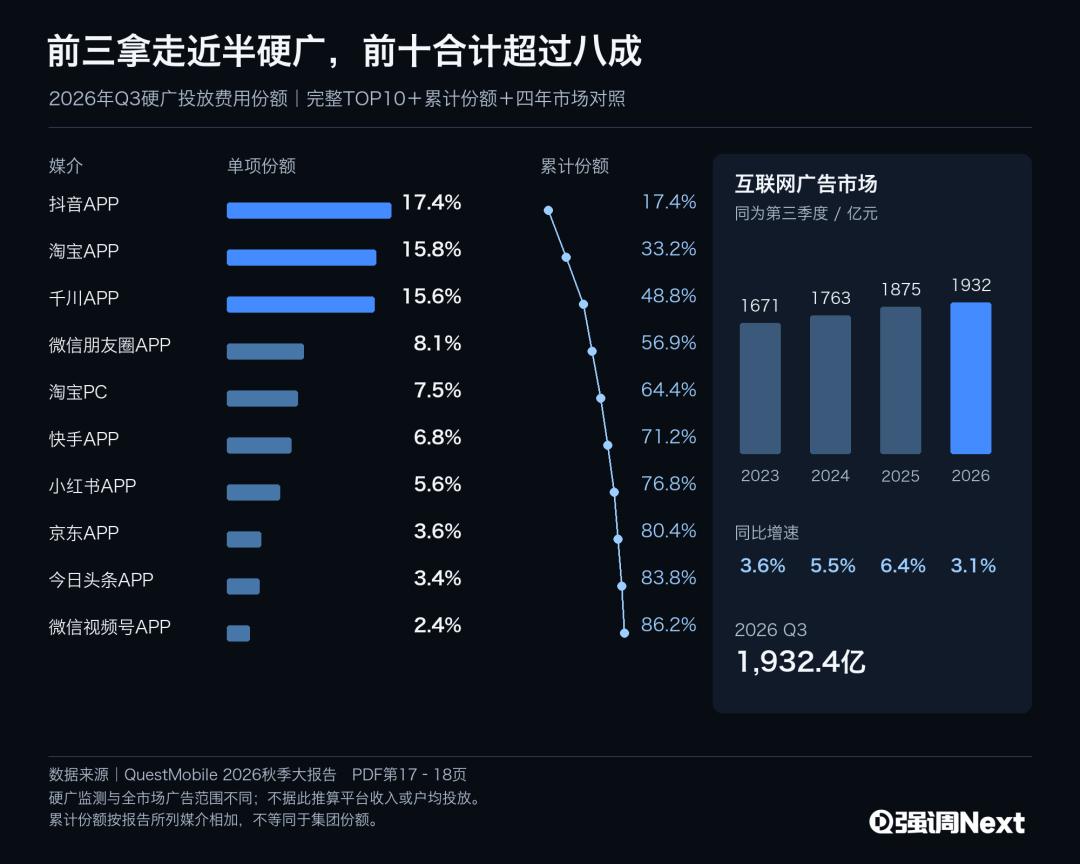
User time can no longer be directly "converted into money". The size of the internet advertising market in the third quarter reached 193.24 billion yuan, with a year-on-year growth of 3.1%, less than half of the duration growth rate, while the growth rate in the second quarter was 8.1%. The number of advertisers increased from 7,594 to 8,356, up 10%, and the average investment per advertiser decreased by about 6% after rough calculation.
Revenue has neither increased synchronously with user time, nor been distributed evenly. The top three media in terms of hard advertising investment are Douyin (17.4%), Taobao (15.8%) and Qianchuan (15.6%), accounting for 48.8% in total, all of which are scenarios where advertisers can directly see transaction results.
The two financial reports of Q2 can better illustrate this point.
Tencent's marketing service revenue in the second quarter reached 43.6 billion yuan, up 22% year on year, and its proportion in total revenue rose from 19% to 21%, while the growth rate of the whole market in the same period was 8.1% (QuestMobile). The management attributed this result to AI recommendation models and AIM+ advertising placement products, as well as more services within WeChat such as WeChat Mini Shops and mini-games being placed through Tencent's advertising platform. On this chain, seeing advertisements, placing orders, making repurchases and placing advertisements again all happen in the same place. The user time is only one step away from transaction conversion, so the price advertisers are willing to pay is higher. Tencent's user base is about to be caught up by Douyin, but this does not prevent its advertising revenue growth rate from being nearly three times that of the overall market.
In the same period, Baidu's online marketing revenue was 13.1 billion yuan, down 19% year on year. Search used to be the most expensive section before transaction conversion, where users come with clear demands, and advertisers bid for these demands by click. At the performance meeting, Luo Rong, President of the Mobile Ecosystem Group, gave two reasons: the intensified competition for user time and attention, and Baidu's active restraint on the commercialization of AI search, and he predicted that the advertising business will still face pressure in the second half of the year. However, the overall market grew by 8.1% in the same period, which also shows that Baidu's decline is not only related to the weak market.
The lost user time in the search track corresponds to the advertising positions with the clearest user intent and the highest bidding price, while the newly added time in the short drama track corresponds to the free model that recovers content costs through advertising. The price of one minute on both sides is not the same.
Paid membership and user scale also show the same trend. The number of paid value-added service subscribers of Tencent in the second quarter reached 259 million, down 2% year on year and 3% month on month. In terms of user scale, according to QuestMobile data, the de-duplicated users of Tencent Music reached 452 million, down 8.2% year on year, while the monthly active users of Qishui Music reached 172 million, up 43% year on year.
AI has not grabbed enough attention yet, but it has changed the profit model first
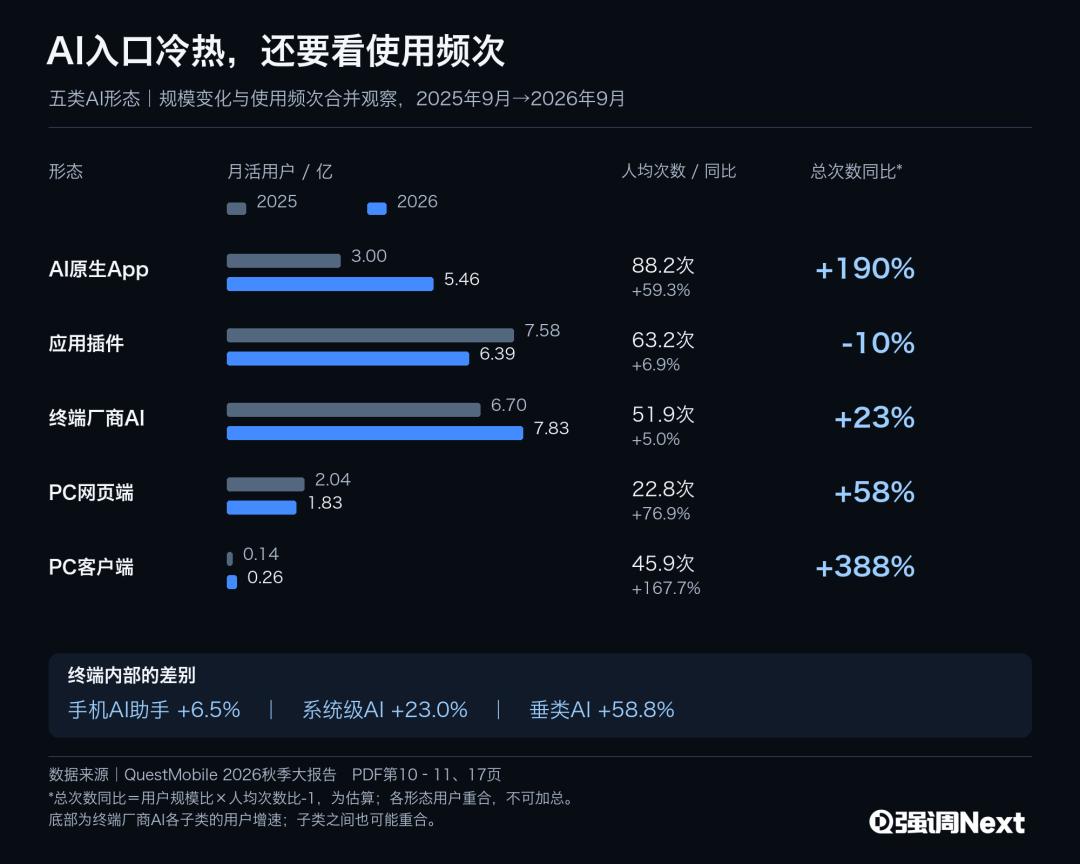
AI is the smallest part in this time account. In September, the monthly active users of AI-native apps reached 546 million, up 82.1% year on year, but the net increase in duration of the AIGC industry was only 978 million hours, accounting for about 5.7% of the total new internet time, less than one tenth of that of short dramas, and only enough to make up 43% of the lost time of search and information platforms.
The reason lies in the usage pattern. The average monthly usage of Doubao is 72.0 times per capita, 132.5 minutes in total, about 1.8 minutes each time; Qwen is 17.8 times, 22.7 minutes in total, about 1.3 minutes each time; DeepSeek is about 2.1 minutes each time.
The report released by CNNIC on September 29 shows that 76% of users mainly use generative AI to answer questions, and question-and-answer interaction is the most common usage. Even if calculated approximately based on the average monthly internet usage duration of 189.8 hours (about 11,400 minutes) per capita across the network, the average time Doubao users spend on it only accounts for about 1.2% (the total online duration of Doubao users themselves is not disclosed). Short usage time does not mean unimportance. The faster users use this kind of product, the higher its value. The past revenue model of the internet is attached to user time, while AI compresses time.
The differentiation within the AI industry is also accelerating, and the scale and depth of usage have been decoupled.
The monthly active users of Qwen are 158.17 million, which is 38% of that of Doubao, and the average monthly duration per capita is only 17% of that of Doubao, with the monthly active users decreasing by 5.4% quarter on quarter. The monthly active users of Yuanbao decreased by 25.1% month on month, while the average usage times and duration per capita increased by 32.6% and 34.1% respectively; the monthly active users of DeepSeek decreased by 15.2% year on year, while the average usage times and duration per capita increased by 5.8% and 9.5% month on month.
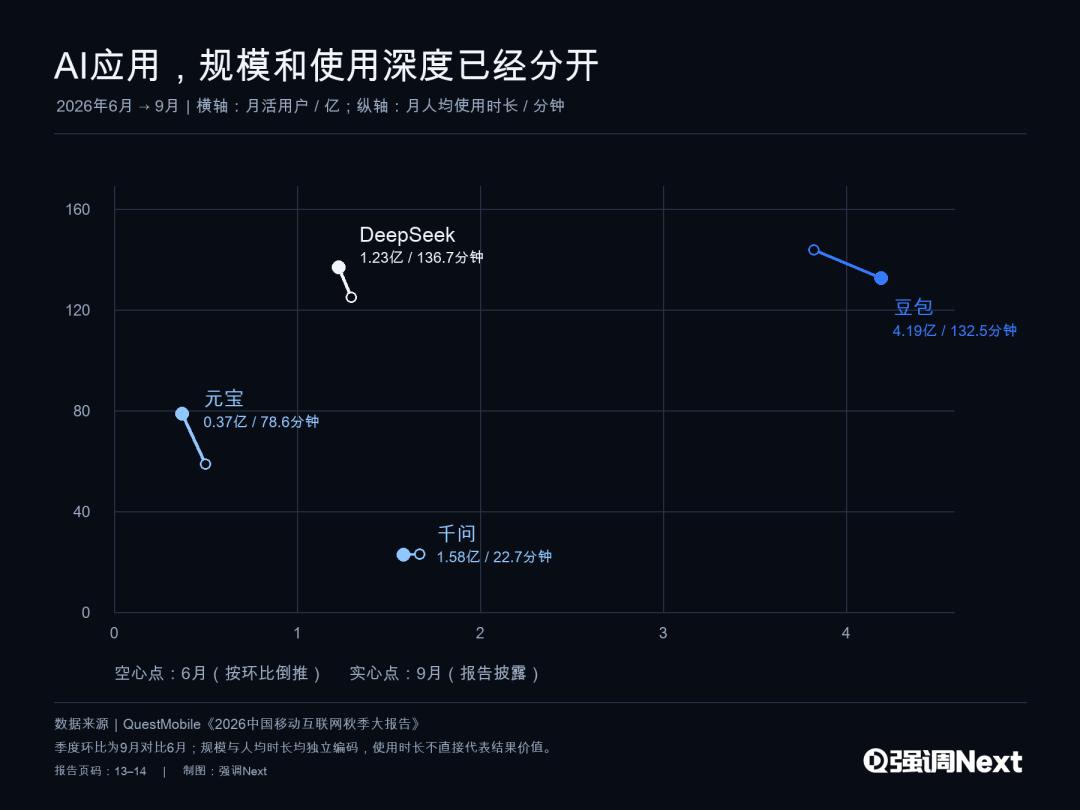
The number of users is decreasing, and the remaining users are using the product more frequently, the shallow users brought in during the user acquisition stage are exiting. Doubao is in a different situation, its monthly active users increased by 9.6% month on month, while the average usage times and duration per capita decreased by 6.1% and 7.8%, the expanding user scale is diluting the usage depth of users.
The entry points are also concentrating at two ends. The monthly active users of independent AI-native apps increased by 246 million in one year. System-level AI (built into the operating system, no need to download) increased by 111 million, reaching 592 million, up 23.0%.
The number of AI plugins embedded in third-party apps in the middle decreased by 119 million, and the number of AI users on PC web pages decreased by 21 million. The monthly active users of mobile phone manufacturers' AI assistants reached 616 million, with an annual growth of only 6.5%. Assistants that require users to actively call have not won, while direct independent apps and system capabilities that do not need to be called have won.
After user time is compressed, AI can only charge in a different way, and currently the only clear revenue stream is the computing power selling side. Baidu's second-quarter financial report discloses that among the 12.5 billion yuan of AI business revenue, AI cloud infrastructure accounts for 7.3 billion yuan, up 50% year on year, of which GPU cloud revenue increased by 283%. AI application revenue was 2.5 billion yuan, with a year-on-year growth of only 3%. AI-native marketing services revenue was 2.6 billion yuan, basically flat.
Tencent's financial report states that WorkBuddy users have strong willingness to pay for tokens through subscription and top-up. No public information shows that Doubao or Qwen have disclosed the number of paying users and renewal rate. This is the biggest gap at present: if the payment rate cannot rise, the result brought by AI will be that the advertising revenue of the search track is compressed, and there is no equivalent new revenue to make up for it.
Stock competition in the mobile phone market, manufacturers begin to allocate new demand entry points
Data from Counterpoint shows that in the third quarter of 2026, China's smartphone shipments decreased by 10% year on year, the lowest level in the same period since 2012. IDC's figure is about 57.9 million units, down 15.4% year on year, and the decline in the first half of the year was about 4%. The main reason is that the price increase of storage chips has pushed up the price of the whole device. IDC predicts that there will be no improvement in the fourth quarter, and the decline will continue for most of 2027.
However, market share is concentrating on high-end products. According to Counterpoint's statistics, Huawei ranks first with a share of 21.3%, with shipments up 19% year on year, and Apple ranks second with 19.5%, the two together account for about 40% of the market. The sales volume of the iPhone 18 Pro series in the first three weeks after its launch is 23.5% higher than that of the iPhone 17 Pro series, which is boosted by the