Is this year's Double 11 a case where AI is responsible for both its success and its failure?
The 18-year-old Double 11 still carries old lingering problems.
There are no countdown timers, no scrolling big screens refreshing transaction data, no roaring shouts of "the lowest price across the entire network". If you only browse your Moments feed, you can barely feel that this year's Double 11 campaign has already passed its halfway point.
Data from Baidu Index shows that the search popularity of "Double 11" has dropped by more than 70% in the past five years.
However, calmness does not equal bleakness. The latest phased statistical data released by Syntun Data shows that as of October 31, the cumulative total sales of comprehensive e-commerce platforms have reached 1.0263 trillion yuan, with Tmall, JD, and Douyin ranking top three respectively, and home appliances becoming the largest category with a 15.7% market share.
Compared with previous years, the biggest variable this year is AI. From Tmall, JD to Douyin and Xiaohongshu, AI is becoming the infrastructure for e-commerce operation and user shopping.
Rules have also been simplified: cross-store full reduction and complicated order combination have been replaced by official direct discounts, in-stock immediate price cuts, and direct discounts for single items, as platforms are trying to reduce consumers' decision-making costs.
But simplification does not mean there are no "traps". Old problems including reverse price hikes, big data-enabled price discrimination against existing customers, and cases where deposit plus final payment is more expensive than direct single purchase still exist. China Consumers Association and other related organizations have also released consumption reminders to warn consumers against merchant tricks. In addition, AI-generated images and AI-powered celebrity live-stream selling have also brought the risk of mismatched products and descriptions.
01
Double 11 no longer tests users on math problems
This year's Double 11, Kuaishou was the first to kick off the event, announcing the launch of pre-sales on October 7, and the in-stock sales period started on October 14, with the whole event lasting 40 days until November 15.
Xiaohongshu followed closely, announcing that it would officially start the campaign on October 10, which lasts for about a full month with no pre-sales session, focusing on direct in-stock sales.
JD and Suning both chose to launch their Double 11 events at 8 p.m. on October 12, also cutting off the pre-sales session, starting direct in-stock sales directly, focusing on eliminating unnecessary waiting for users.
Three days later on October 15, Tmall and Douyin respectively announced the launch of their Double 11 events on the same day. The former set up a pre-sales session, after users pay the deposit, full in-stock sales will start at 8 p.m. on October 20; the latter adopted the in-stock sales mode with no pre-sales session set.
After that, as platforms including Pinduoduo, Vipshop and DeWu launched their Double 11 campaigns one after another, all mainstream domestic e-commerce platforms have kicked off their Double 11-related activities.
Looking at the preferential policies launched by major e-commerce platforms including Tmall, JD and Douyin during this year's Double 11, they abandoned the previously complicated gameplay, focusing on simplicity and clarity.
Tmall canceled the cross-store full reduction that had been used for many years, replacing it with official direct discounts, so consumers no longer need to add an extra pair of socks to their order to meet the threshold of 50-yuan-off for every 300-yuan spent; JD adopted the method of in-stock immediate price cut to make discounts visible to consumers; Douyin continued the gameplay of "direct discount for single item, immediate reduction discount"; Xiaohongshu also focused on official direct reduction and official immediate price cut, allowing users to enjoy discounts even when buying only one item.
Although major platforms take different paths, they point to the same goal, that is, to reduce consumers' decision-making costs, and put "shopping with peace of mind" and "shopping for real benefits" back at the core of Double 11 consumption.
However, it is worth noting that although major platforms have simplified their preferential policies, there are still no lack of "traps" in actual shopping.
Investigations by media outlets found that as Double 11 approaches, the promotional prices of many products are even higher than their usual prices, and "reverse price hike" has triggered many complaints. In addition, old problems including big data-enabled price discrimination against existing customers, network lag, and cases where deposit plus final payment is more expensive than direct single purchase still exist this year.
「TMT Planet」 searched with the keyword "Double 11 price hike" on social platforms and found that many users complained that the products they bought during Double 11 were more expensive than usual, "the price was still 160 yuan in the morning, and it rose to 170 yuan in the afternoon".
Some consumers found that the product price dropped by 400 yuan after payment, and they could not get the price difference refund, so "they had to return the order and repurchase it".
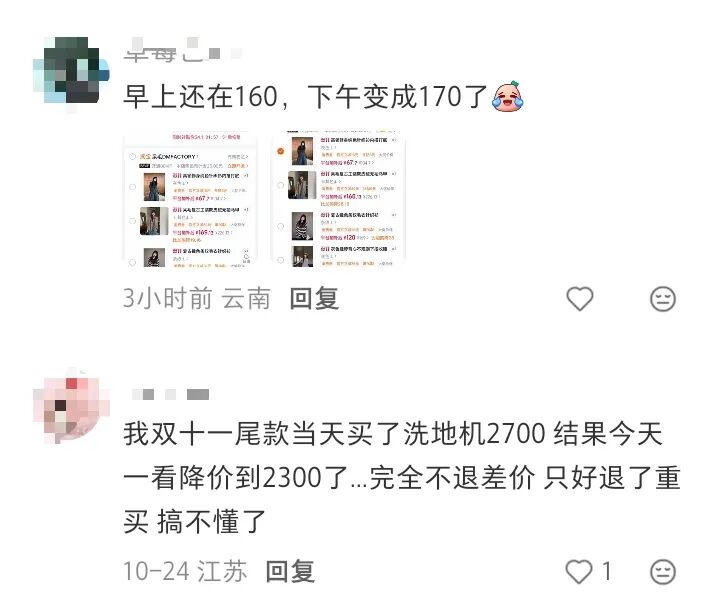
Figure / Xiaohongshu
After the Double 11 campaign kicked off, China Consumers Association released a Double 11 consumption reminder on October 26, reminding consumers to put "check carefully" before "snatch quickly" when participating in promotional activities, and put "practical to use" before "looks cheap".
Prior to that, Guangxi Consumers Association, together with Qinghai, Inner Mongolia and many other provinces (autonomous regions and municipalities directly under the Central Government) jointly released the Double 11 online shopping consumption reminder, once again reminding consumers to identify promotional tricks and be alert to various consumption traps.
02
AI can select products and compare prices, but cannot give the optimal solution across the entire network
In previous Double 11 campaigns, AI was more of an optional auxiliary plug-in. During this year's Double 11, AI has become an indispensable tool for Double 11 shopping, running through the full link of the big promotion and bringing a brand new experience to consumers.
On the consumer side, Taobao launched the Qianwen shopping Agent "Qianwen Go!", which connects to a product library of billions of levels. Users can put forward their demands in natural language, and the system will automatically filter products, compare prices, stack coupons, and follow up on price protection after-sales services.
JD pushed the shopping intelligent agent "Dongdong" based on the JoyAI large model to the front stage, connecting the full process of product selection, price comparison, order combination and after-sales.
Douyin's Doubao "Help You Select" is connected to the mall and live streaming rooms, so users can complete the order directly in the conversation.
On the merchant side, the role of AI is more practical, helping merchants improve operational efficiency while further facilitating purchases.
For example, Douyin announced that the Feige intelligent customer service is free for a limited time during the big promotion, and the Compass AI Data Query allows small and medium merchants to query business indicators through conversations;
Kuaishou splits AI into on-demand business tools;
The AI operation intelligent agents of Taobao and Douyin start to optimize product detail pages and size labels in reverse, making precise targeting for the 40% return rate of the apparel category.
Even so, the real experience of consumers on social platforms is far more complicated than what platforms promote.
Some media pointed out in reports that many AI large models can only read price information of associated platforms, and cannot truly compare prices across platforms; the motivation for platforms to develop AI is to keep transactions on their own ecosystem, while what consumers want is the optimal solution across the entire network, and there is a structural mismatch between the two.
「TMT Planet」 tested multiple built-in AI shopping assistants on e-commerce platforms and found that the logic for most AI shopping assistants to recommend products usually comes from consumers' past consumption and browsing records. If you want to accurately find a specific product you want, you need multiple interactions, but the final result given may not be what you want or suitable for you.
And by inputting demands into mainstream AI large models on the market such as Qianwen, Doubao and Yuanbao, and selecting the products you want to buy from the given results, the whole process takes no less time than searching in the e-commerce APP by yourself.
「TMT Planet」 input the same demand into different AI large models. From the results, Qianwen parsed the demand, gave the key points that need attention when buying a floor washer, recommended related products according to these key points, further asked about the user's specific needs to push more accurate products, and attached purchase links.
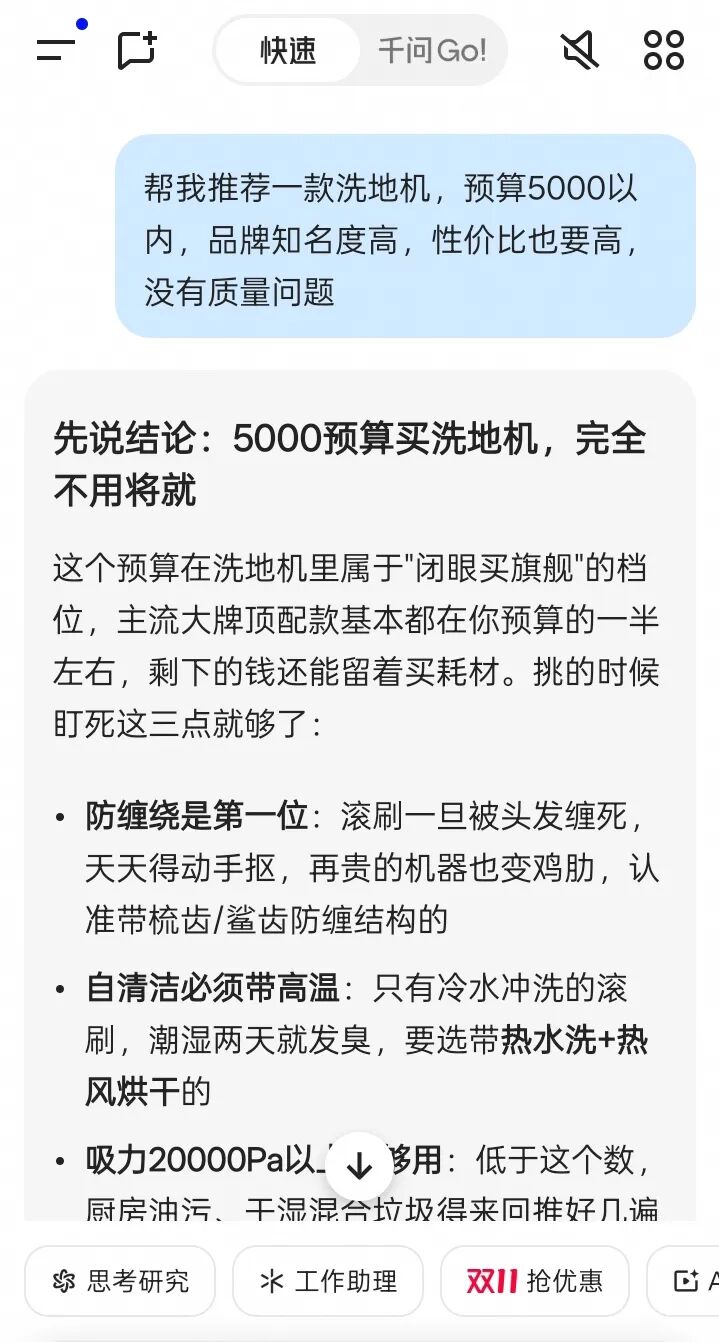
Figure / Qianwen
After the same demand was fed to Doubao, it gave three floor washer products with different focuses, analyzed and compared the highlights of each product, and provided purchase links. In addition, Doubao also recommended live streaming links of relevant merchants on Douyin, which users can click to jump directly to make purchases.
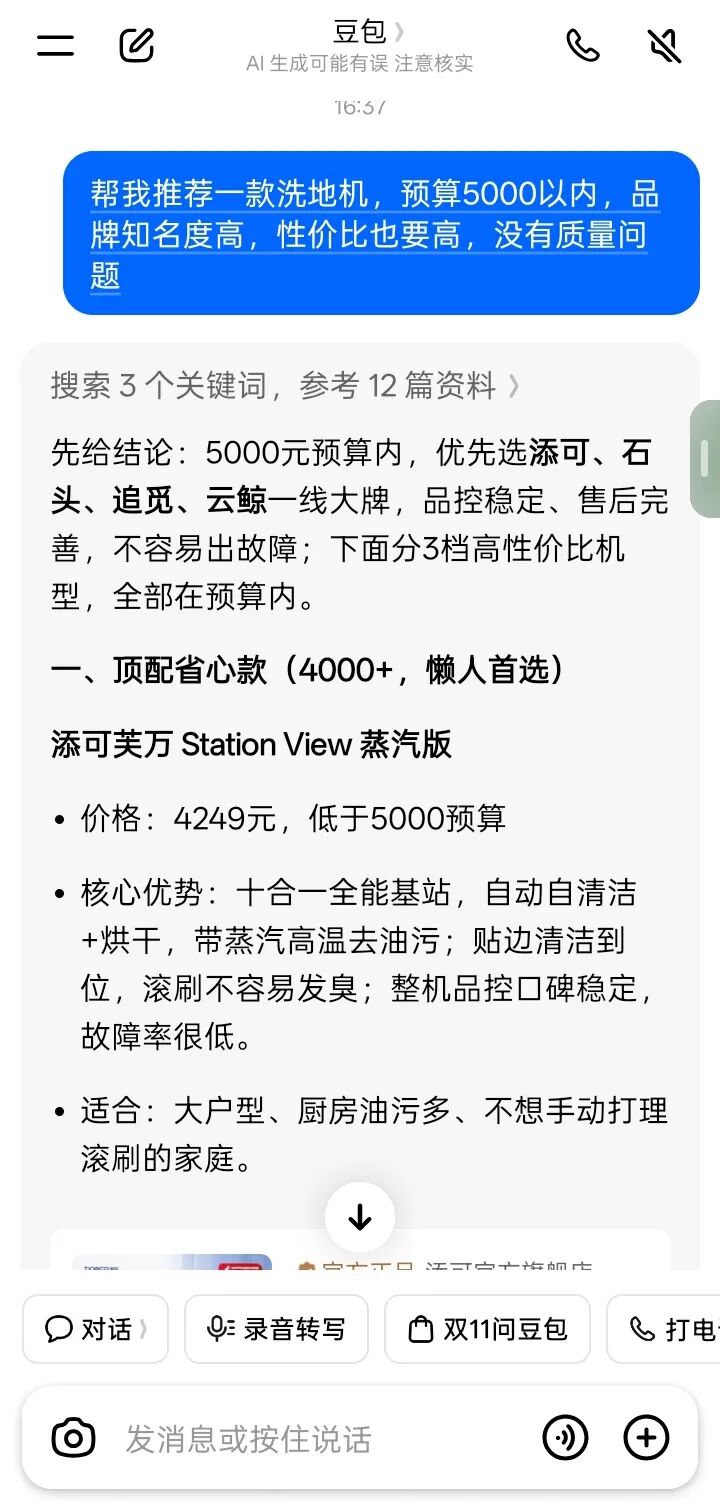
Figure / Doubao
Yuanbao recommended 3 floor washer products, inferred the user's usage preference to give a detailed introduction, and explained how to select suitable products according to the user's own needs. In addition, at the end of the recommended products, Yuanbao also reminded users of some matters needing attention during use.
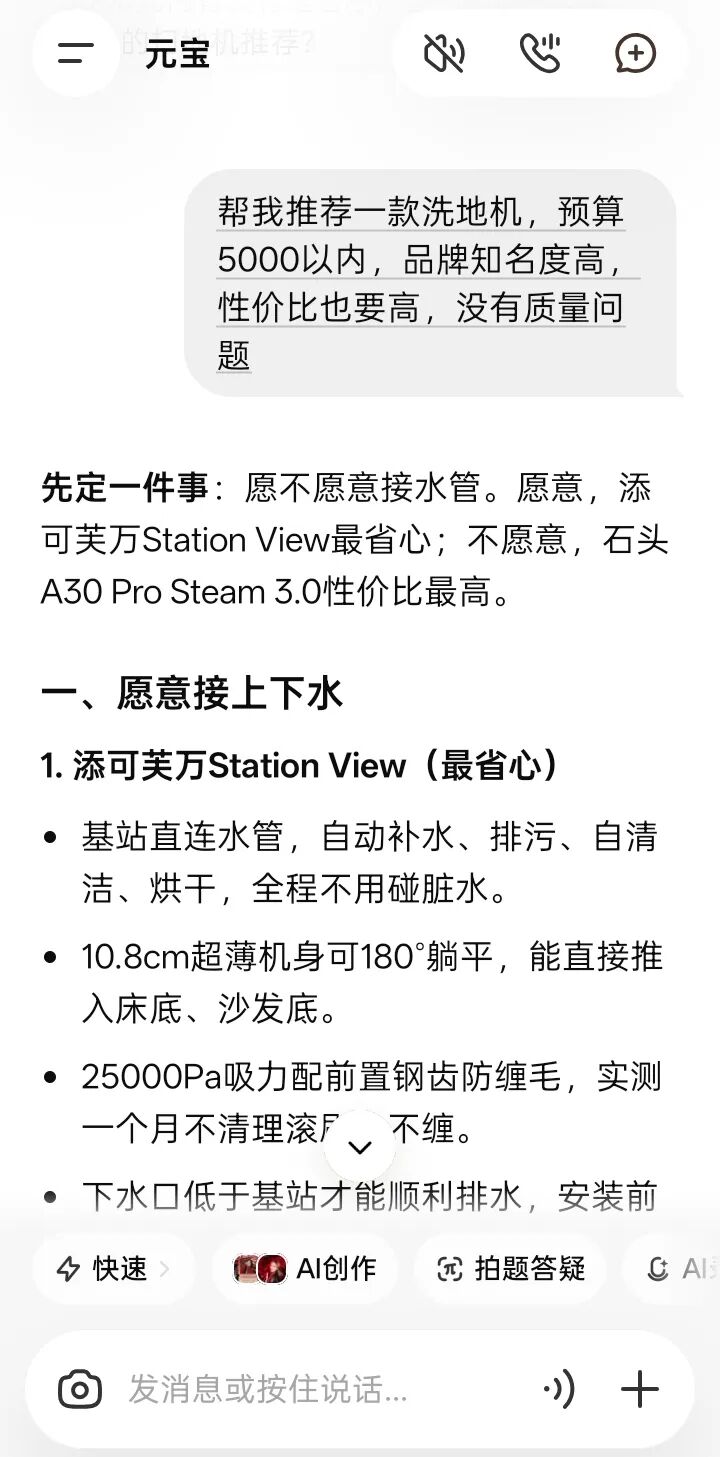
Figure / Yuanbao
From the results, the answers given by the above three AI large models can be used as references when purchasing products, but users still need to compare them and make choices according to their own demands.
In addition, the priority of different AI large models to recommend products is very obvious: they all preferentially display the price information of associated e-commerce platforms, and cannot compare prices across the entire network.
For example, Qianwen recommends products from Tmall, Doubao provides links from Douyin, and Yuanbao gives purchase links from JD, which means that if users want to compare prices across all platforms, they still need to do it manually.
It is worth noting that as merchants become proficient in using AI technology to reduce costs and increase efficiency, a new problem has also emerged.
NetEase E-Commerce Research Institute published an article pointing out that many of the "exquisite real shot photos and real person model videos" displayed by merchants are mostly AI-generated. When consumers receive the products and compare them with the pictures from merchants, serious mismatch between products and descriptions appears. At this time, AI has become a sharp tool to deceive consumers, and shopping has become a "blind box opening" game.
Not only that, some illegal merchants use AI deep synthesis technology to replicate celebrities' faces and voices, mass produce live streaming selling videos with "celebrity recommendation" and "celebrity endorsement" for cycle live streaming. Consumers place orders because of the credibility of celebrities, but receive inferior products that have nothing to do with the promotion. This situation not only damages consumers' shopping experience, but also may touch the legal red line.
03
For the 18th Double 11, traffic entrances have shifted
From the first session in 2009 to the present, the Double 11 Shopping Festival has gone through 18 years, and the path for consumers to make purchases has also undergone visible changes.
In the past, the process was "have demand, search for keywords, browse lists, compare prices, place orders". Now the more common process is "scroll through content, get attracted, click into the product card, place the order conveniently", or even "have no intention to buy at all, but place the order after watching".
This path is short, fast, and with high emotional intensity. It does not belong to shelf e-commerce, but belongs to content e-commerce, with Douyin and Kuaishou as representatives.
According to estimates from iResearch, the market size of China's short video e-commerce (the core transaction form of content e-commerce) has exceeded 1.2 trillion yuan in 2025, and the total transaction size in 2026 is expected to exceed 1.8 trillion yuan, with the annual compound growth rate remaining at 24.3%, significantly higher than the overall growth rate of the online retail sector in the same period.
For e-commerce platforms including Taobao Tmall, JD and Pinduoduo, the impact brought by content e-commerce is real. Douyin and Kuaishou have become important players in the e-commerce track relying on their content advantages.
However, although players including Douyin and Kuaishou are growing rapidly in scale, they are currently facing the challenges of peaking traffic and declining GMV growth rate.
Taking Douyin as an example, public data shows that Douyin e-commerce's GMV was about 4.3 trillion yuan in 2025, but its year-on-year growth rate has dropped all the way from about 220% in 2022 to about 30% in 2025, and fell to around 20% in the first half of this year.
At the same time, merchants are also starting to calculate carefully whether the investment is worth it.
According to relevant media reports, when the commission of top influencers rises from 40% to 60%, superimposed with traffic investment and a return rate of about 35%, merchants are almost losing money just to make a show. By comparison, the return rate of brand self-live streaming is only about 8%.
As a result, "acquiring new users via Douyin, precipitating profits via shelf e-commerce" has become a survival strategy for many brands, and some cosmetics brands have raised the proportion of self-live streaming to nearly 70%.
The counterattack of traditional platforms is to turn big promotions into "certain business".
Tmall locks in brands and high-value users with new product launches and 88VIP, and then integrates instant retail, which effectively drives the increase of product sales. According to reports from media including Global Network, as of October 25, the transaction volume of Tmall's flash sale of alcohol products increased by 265% year on year, and 1145 alcohol brands exceeded their full-day sales of last year within one hour after the launch.
JD turns services into commodities. According to its first-week Double 11 performance report, as of October 19, the order volume of service categories including housekeeping, moving, and home appliance cleaning increased by more than 130% year on year, securing its position in the home appliance and 3C sectors with the advantages of "fast delivery, proper installation, and reliable maintenance".
According to the statistical data from Syntun, as of October 31, the total sales of comprehensive e-commerce during Double 11 reached 1.0263 trillion yuan, among which Tmall ranks first, JD ranks second, and Douyin ranks third.
From this perspective, with the peaking of content dividends and the efforts of traditional platforms, it is not easy for content e-commerce platforms to continuously surpass the industry "predecessors" in the short term.