The price of automotive chips has risen for three consecutive times, automakers are once again choked by the supply chain, and the industry profit margin has dropped to 1.4%
Automakers are about to face another headache! The chip giant has raised prices again.
CheDongXi News on November 3: According to multiple sources in the industry, NXP, the world's leading semiconductor manufacturer, has sent a letter to distributors, planning to adjust prices for some distribution and direct supply product lines, with the new regulation taking effect on January 1, 2027.
It is worth noting that this is the third round of price adjustment notices issued by NXP in 2026.
Previously, NXP sent letters in March 2026 and May 2026 respectively, notifying customers of two rounds of price hikes, both attributed to sustained inflationary cost pressures, including rising raw material, energy, labor, logistics and supplier input costs.
Public information shows that NXP is a leading enterprise in the global automotive chip sector, currently focusing on deploying products related to software-defined vehicles. Its core products include the S32 series automotive processors, S32N5 central computing platform chips, in-vehicle network communication chips, radar chips, etc.
Against the backdrop of continuous price adjustments by component suppliers, news of raw material shortages for vehicle models of automakers such as Li Auto and Geely has spread, directly affecting the delivery rhythm.
Under the double impact of rising upstream raw material prices and component supply cuts, domestic automakers are facing a severe supply chain test.
01.
Less than 5,000 yuan profit per car on average?
Industry profit drops to the lowest level in nearly 4 years
Changes in the supply and price of automotive chips are often passed down along the industrial chain. UBS estimates that the price hike of storage chips alone may increase the cost of high-level intelligent driving vehicles by thousands to tens of thousands of yuan per unit.
The rise in raw material prices has brought huge cost pressure to complete vehicle enterprises. According to data from the China Passenger Car Association, the operating revenue of the automotive industry in the first three quarters of this year reached 8.04 trillion yuan, a year-on-year increase of 2.6%; operating costs reached 7.16 trillion yuan, up 3.8% year on year; total cumulative profit was 267.5 billion yuan, down 23% year on year sharply; the cumulative sales profit margin was 3.3%, continuing the trend of declining profitability in recent years.
Especially in September this year, the industry's profitability pressure was more prominent. In that month, 3.06 million vehicles were produced, with revenue of 1.04 trillion yuan, a slight year-on-year increase of only 0.6%, operating costs rose 2.5% year on year, the total monthly profit was only 14.2 billion yuan, a sharp drop of 68% year on year, and the monthly sales profit margin was as low as 1.4%, hitting the lowest monthly profitability level in nearly 4 years.
According to a rough conversion of the industry's total profit and output, the average profit of producing one vehicle in September was only about 4,640 yuan. The cost growth rate significantly outpaces the revenue growth rate, and the industry's contradiction of "increasing revenue without increasing profit" continues to intensify.
02.
From headlights, batteries to screens,
Automaker deliveries are "choked" by the supply chain
On the one hand, rising raw material prices continue to squeeze profits, on the other hand, supply cuts of key components disrupt the delivery rhythm, putting automakers under huge pressure.
A few days ago, "Old Tango", head of the product line of Li Auto, posted an article apologizing for the screen supply shortage of the new generation MEGA.
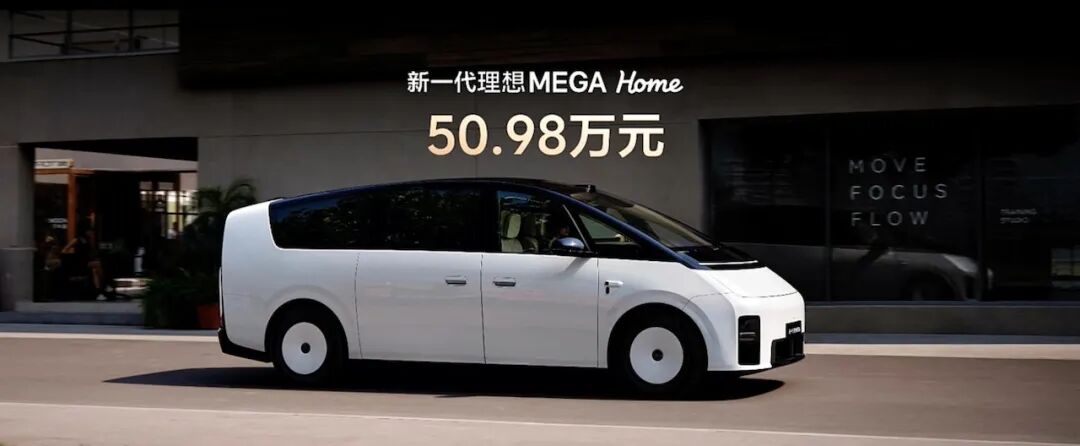
▲New generation Li Auto MEGA
It is reported that the 29-inch 6K panoramic screen installed in the front cabin of the new generation MEGA is an automotive-grade OLED screen exclusively customized by Samsung for MEGA. At present, there is a shortage of this screen, and the delivery of vehicles locked for orders from 17:06 on September 11 to 9:52 on October 26 and scheduled to be off the assembly line from November 10 to December 17 will be affected.
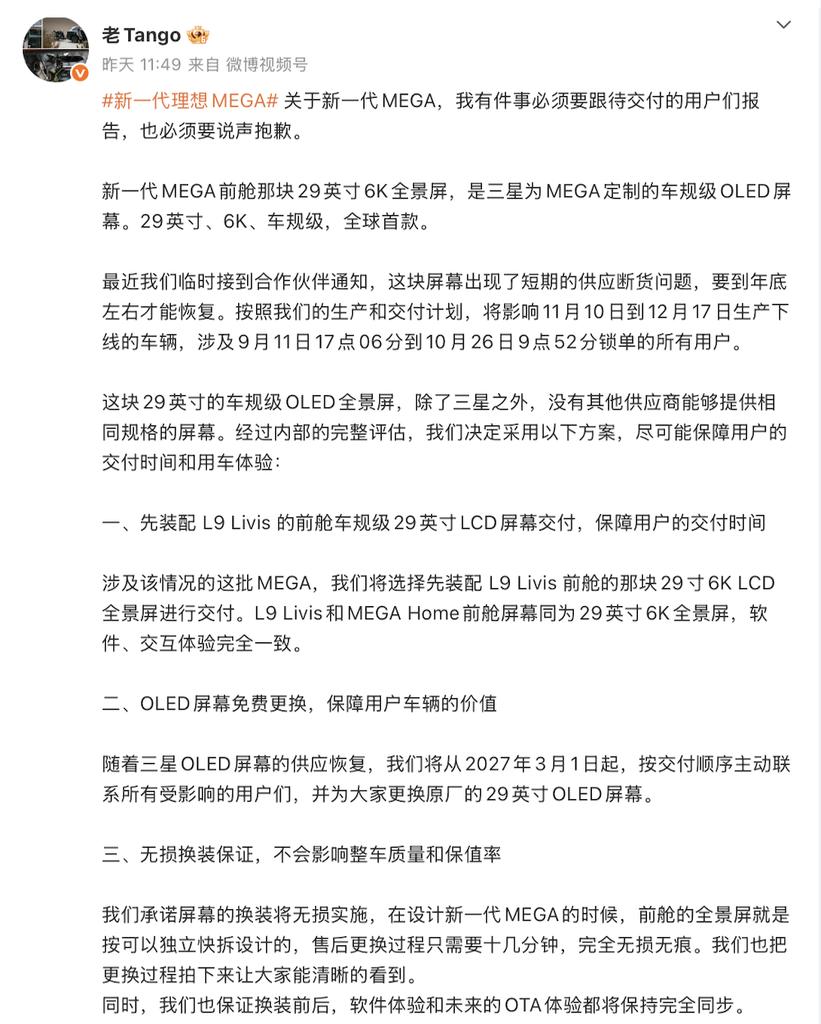
▲Li Auto's official post on the shortage of the front cabin panoramic screen of the new generation MEGA
The solution given by Li Auto is to first install the 29-inch 6K LCD screen of L9 Livis to ensure delivery. For the Samsung OLED screen, the batch screen replacement service is expected to start on March 1, 2027, and users will be compensated with a 3-year service package.
It is worth noting that this is not the first time the MEGA has encountered a core component supply shortage this year.
At the end of October this year, multiple domestic media reported that many prospective owners of the new generation Li Auto MEGA received a notice from Li Auto that orders locked before 15:00 on September 7, which were originally scheduled to be equipped with CATL 5C ternary lithium batteries, cannot be delivered as agreed, and will be replaced with Li Auto's self-developed "Lianshan" batteries, due to "the shortage of CATL batteries".
To this end, Li Auto proposed two solutions for prospective car owners: first, continue to pick up the car and replace it with the self-developed battery, and get a benefit package worth 3,500 yuan as a gift; second, return the car, get a full refund of the 5,000 yuan deposit and an additional 5,000 yuan compensation. Li Auto also said that the company has been striving for more battery quotas, but there is still a gap.
In addition to the Li Auto MEGA, the Li Auto i6 has also faced a similar situation. In the middle and late July this year, Li Xinyang, head of the product line of Li Auto, revealed that the supply of the front headlights of the Li Auto i6 had a "short-term fluctuation", and the output of that month was about 4,000 units less than the original plan; at the beginning of this year, the i6 also experienced delivery delays due to the battery production capacity ramp-up failing to meet expectations.
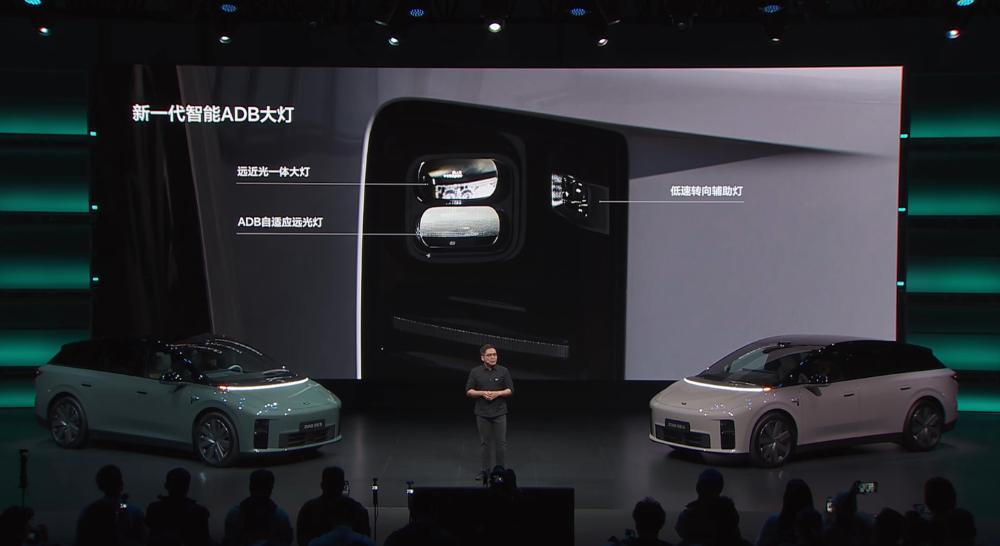
▲2026 Li Auto i6
03.
Conclusion: Automakers are facing a more rigorous major test from the supply chain
The automotive industrial chain is under the double squeeze of "price hikes" and "supply shortages" at the same time.
On the cost side, the rise in costs of raw materials, energy, logistics, etc. is transmitted to complete vehicle enterprises along the supply chain; on the delivery side, the shortage of a single headlight, a single screen or a single battery is enough to make the already running production line brake suddenly.
More severely, the industry's profitability is still declining, which means that automakers are not only facing a short-term rise in procurement costs, but also a comprehensive test of their capabilities in supply chain security, delivery performance and product rhythm management after the profit margin is compressed.
The pressure on automakers is becoming more and more obvious. In the short term, replacement plans and compensation measures may be used to stabilize deliveries. In the long run, some automakers have enhanced their risk resistance capabilities through diversified supply chains, independent controllability of key chips and components, and refined cost management.
This article is from the WeChat Official Account "CheDongXi", author: Er Yan, editor: Zhi Hao, published with authorization from 36Kr.