Why did the 100-billion-yuan acquisition with a 23.9% premium send the optical module sector tumbling?
The competition in AI data centers is pushing chip giants into the optical communications industry.
On November 2, U.S. semiconductor design company Marvell and leading optical communications device manufacturer Lumentum officially announced that they have reached a definitive acquisition agreement.
Marvell will acquire Lumentum through an all-stock transaction, implying an enterprise value of approximately USD 115 billion, equivalent to about USD 1132 per share of Lumentum, representing a premium of approximately 23.9% compared to the closing prices of the two companies on October 28, 2026, before news of the potential transaction broke.
However, the market did not respond positively.
As soon as the news came out, Marvell's closing price plummeted by 12.72%, while Lumentum tumbled even more sharply by 18.59%.
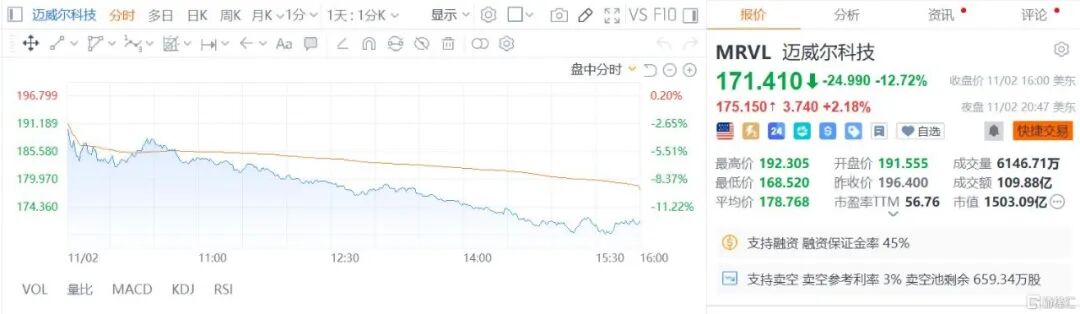
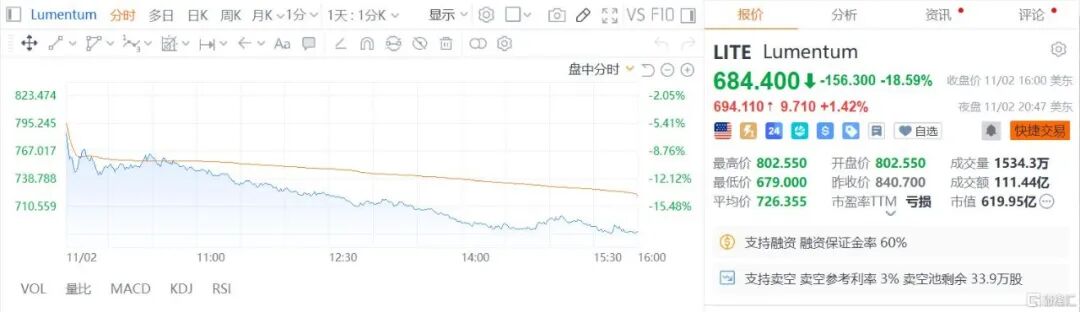
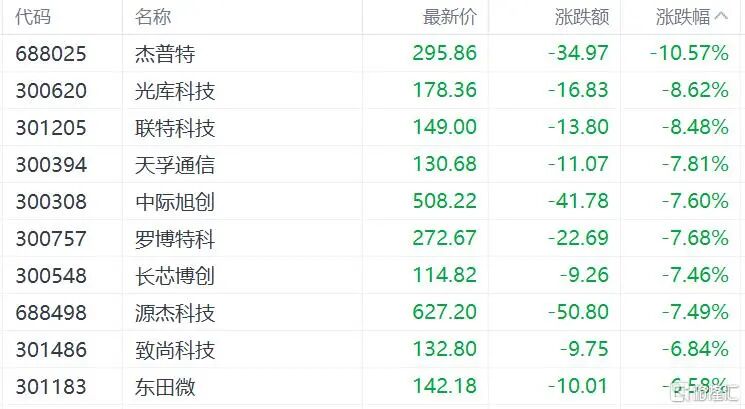
At the same time, the optical communications concept stocks in both Hong Kong and A-share markets plunged. In the A-share market, JPT Opto-electronics fell by more than 10%, Guangku Technology and Liantec Technology dropped by over 8%, while TFC, Innolight and Source Photonics declined by more than 7%.
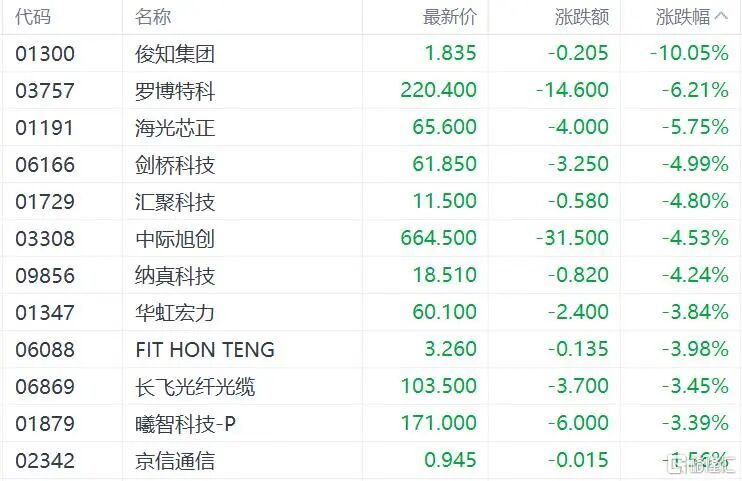
In the Hong Kong stock market, Junzhi Group fell by more than 10%, Hygon Core Semiconductor dropped by over 5%, and Cambridge Technology, Huiju Technology and Innolight declined by more than 4%.
It is worth noting that if the acquisition is finally completed, two types of critical upstream components in the global optical module market will be concentrated in the same enterprise. For Chinese optical module manufacturers, this means that new changes may arise in procurement, bargaining and supply chain management, which may also prompt more enterprises to accelerate the search for alternative suppliers.
A $100 Billion High-Stakes Wager of "Exchanging Equity for Optical Assets"
From the terms, this is a typical large-scale vertical merger that uses high-valuation equity as currency.
On a fully diluted basis after closing, existing Marvell shareholders will hold approximately 67% of the combined company, and Lumentum shareholders will hold approximately 33%; Matt Murphy, Chairman and CEO of Marvell, will continue to lead the combined entity, while three directors including Michael Hurlston, CEO of Lumentum, will join the Marvell board of directors.
Financially, the combined company is expected to achieve an annualized revenue of USD 17.7 billion (USD 12.6 billion from Marvell and USD 5.1 billion from Lumentum), with the addressable market size expanding to USD 550 billion, annualized cost synergies exceeding USD 1 billion, and the transaction will be accretive to Marvell's non-GAAP earnings per share in the first year after closing.
It is worth mentioning that the AI infrastructure industry is at a turning point.
The rapid growth in bandwidth demand and the physical limitations of copper-based interconnections are accelerating the transition to optical technologies.
As AI infrastructure expands to increasingly complex architectures, especially Scale-up and Scale-in (in-package scaling), the industry is shifting from discrete modular components to highly integrated optical solutions.
Such solutions require tighter co-design of electrical and optical technologies to deliver higher bandwidth, performance and energy efficiency.
Matt Murphy, Chairman and Chief Executive Officer of Marvell, said that AI infrastructure is undergoing a fundamental architectural shift to optical interconnection, creating a once-in-a-generation opportunity.
"Companies that move first and help define this transformation will set the standards for decades to come. By bringing together two leading enterprises with highly complementary technologies, talent and specialized manufacturing capabilities, we aim to help shape the new era of AI interconnection and deliver exceptional shareholder value."
Michael Hurlston, President and Chief Executive Officer of Lumentum, also said that joining Marvell will create a uniquely positioned company that can capture the USD 550 billion market opportunity and generate significant and sustainable shareholder value.
The explosive growth of AI data traffic requires rapid hardware innovation, and this merger enhances the ability to deliver next-generation solutions at scale.
Working with Marvell will meet customers' full range of interconnection needs — from Scale-across and Scale-out, to tomorrow's Scale-up and Scale-in.
Extreme co-design centered on customers' stringent requirements will help them achieve faster time-to-market, accelerated innovation cycles, and category-defining performance.
Impacts on the Domestic Industrial Chain
Marvell's acquisition of Lumentum brings short-term valuation and sentiment shocks to China's optical module industry, while in the medium and long term, it poses dual challenges of compressed upstream bargaining power and a forced opening of the domestic substitution window.
The most direct impact comes from the "double backstab" of the supply chain.
After the merger, Marvell will control two core devices: high-speed DSP and EML/CW lasers, while Lumentum's Cloud Light is itself an optical module manufacturer.
For leading Chinese optical module manufacturers, this means that upstream supply bottlenecks and a new strong downstream competitor will emerge at the same time: on the one hand, their bargaining power for DSP and laser procurement will be weakened, and on the other hand, they will face head-on competition from peers that have chip synergy advantages at North American cloud vendor clients.
Coupled with the reality that Lumentum's production capacity has been scheduled until 2029 and its 200G EML market share exceeds 50%, the market is worried that the new entity will prioritize securing its own solutions when production capacity is tight.
The sharp drop of the sector today is a concentrated pricing of such concerns.
However, from a longer-term perspective, this transaction is not necessarily a bad thing, and may even become an accelerator for domestic substitution.
On the one hand, the anti-monopoly review itself serves as a buffer.
Marvell generates about 36% of its revenue from China, and both companies far exceed the threshold for concentration of undertakings declaration in China, so the transaction must be approved by the State Administration for Market Regulation.
Referring to NVIDIA's acquisition of Mellanox in 2020, which took 13 months for review and came with conditions such as "continuing to supply Chinese customers without discrimination and not forcing bundled sales", this transaction will most likely also be attached with fair supply terms. In other words, the "supply cut-off" that the market fears the most is precisely the clause that is most likely to be included in the additional conditions.
On the other hand, customers' self-protection will actively create opportunities for the introduction of second suppliers.
NVIDIA previously invested USD 2 billion in Lumentum to lock in light sources. Now that its core supplier has become an asset under its competitor, it will inevitably force NVIDIA to accelerate the cultivation of second and third suppliers; overseas cloud vendors, out of supply chain risk control considerations, will not allow a single supplier to grow too dominant.
This has opened a verification window for domestic optical chips: substantial breakthroughs have been made in domestic 200G EML:
Solais, a subsidiary of Dongshan Precision, is the only domestic manufacturer that has achieved large-scale mass production, with a yield rate of 85%-90%; Changguang Huaxin's 100G EML yield exceeds 92%, and 200G mass production is planned for the fourth quarter; Source Photonics' 200G EML has entered customer verification, and high-power CW light sources for CPO are being advanced simultaneously.
However, what really needs to be watched out for is that the certification cycle from sample delivery to large-scale overseas procurement still takes one to two years, and production line construction takes 18-24 months, so full-chain domestic substitution will not be realized until around 2028.
This article is from the WeChat Official Account "Gelonghui Finance Hotspot" (ID: glh_finance), written by Outsider, published with authorization from 36Kr.