Anthropic is still frantically grabbing computing power: with a commitment of 895.4 billion US dollars, it does not even spare old coal-fired power plants.
AI companies are evolving into large-scale infrastructure buyers.
Anthropic's expansion path has extended from training models and competing for enterprise clients to building data centers, procuring chips and coordinating power resources. To secure sufficient computing power, the company has begun to directly engage in work that was previously mainly undertaken by cloud service providers and infrastructure operators.
On local time November 2 in the United States, Anthropic submitted an updated prospectus to the U.S. Securities and Exchange Commission. The document supplements relevant financial data for the third quarter of 2026 and discloses long-term procurement and lease arrangements.
Documents show that computing power has become the most critical cost item in Anthropic's expansion process. To meet the needs of Claude model training and enterprise client calls, the company has not only signed long-term agreements with cloud service providers such as Amazon, Google and Microsoft, but also started to directly procure chips, participate in data center construction, and seek power and computer room resources from former cryptocurrency mining enterprises and new-type cloud service providers.
01
Revenue surged 12 times, operating losses re-emerged
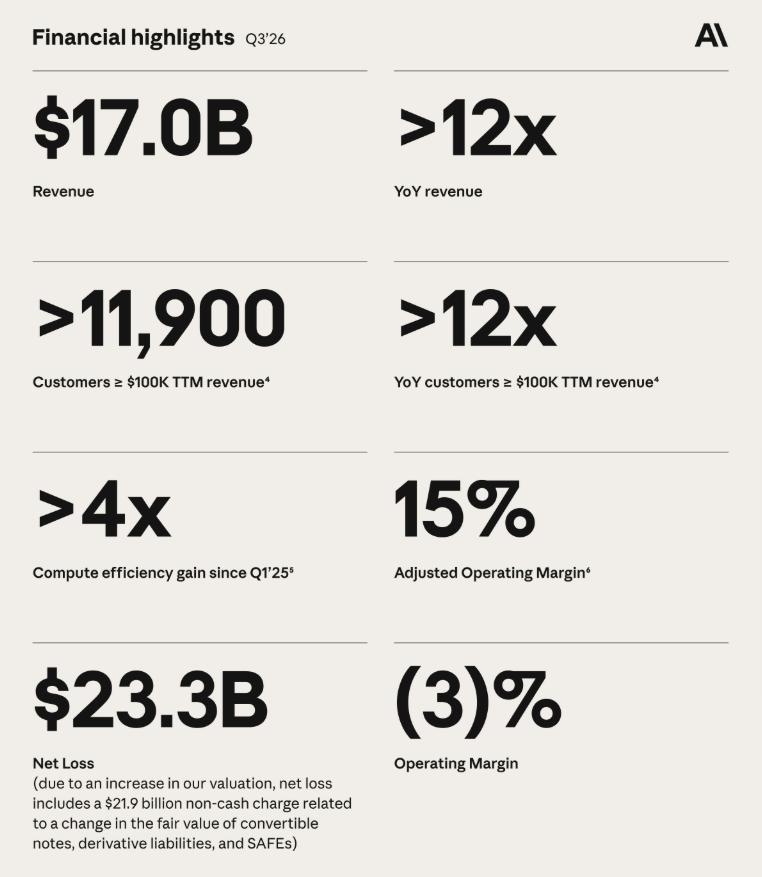
The updated prospectus shows that Anthropic's revenue in the third quarter was 169.6 billion U.S. dollars, higher than 115.6 billion U.S. dollars in the second quarter and far higher than about 13.8 billion U.S. dollars in the same period of 2025.
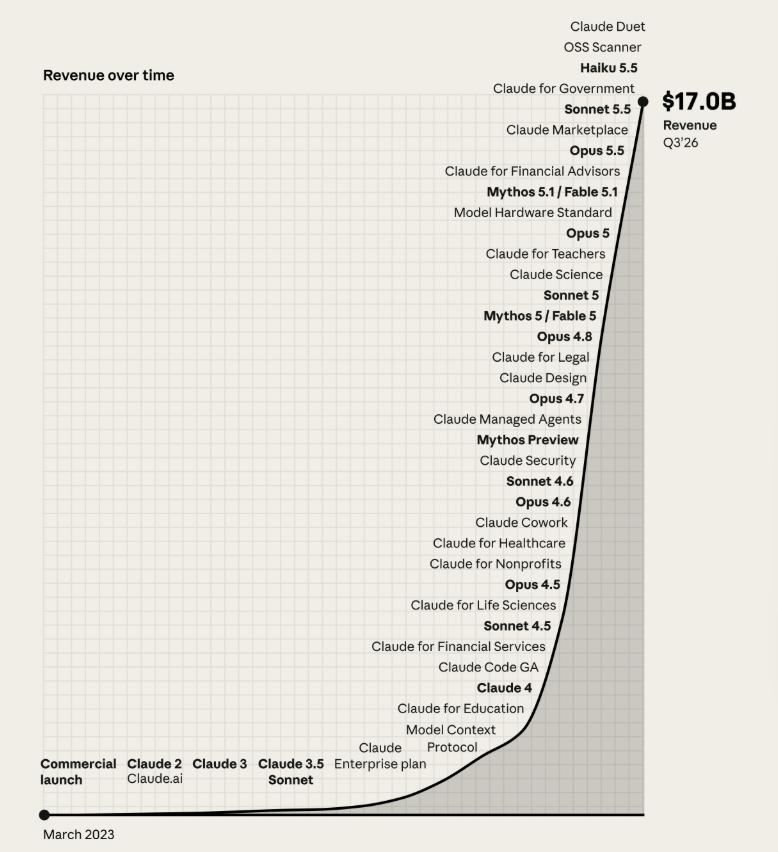
In the first three quarters of this year, Anthropic's cumulative revenue reached 332.42 billion U.S. dollars, compared with 25.45 billion U.S. dollars in the same period last year, representing a year-on-year increase of about 12 times.
However, the growth of revenue has not brought synchronous improvement in operating profit.
In the third quarter, Anthropic's operating expenses rose to 175 billion U.S. dollars, compared with 106 billion U.S. dollars in the second quarter. The company recorded an operating loss of 567 million U.S. dollars in the quarter, while it achieved an operating profit of 974 million U.S. dollars in the second quarter. Computing and infrastructure expenses reached about 99 billion U.S. dollars, nearly doubling from about 56 billion U.S. dollars in the second quarter.
Anthropic attributes the turn to negative operating profit mainly to short-term computing power procurement. As customer demand growth outpaces the previously locked-in computing power supply, Anthropic has had to purchase additional computing resources on the market on a temporary basis, and the price of short-term procurement is significantly higher than that of multi-year agreements.
In the third quarter, Anthropic's short-term computing power procurement amounted to about 50 billion U.S. dollars. In addition, a non-cash expense of about 20 billion U.S. dollars related to the employee donation matching program also affected the operating results of the quarter.
Excluding equity compensation and the aforementioned donation matching expenses, Anthropic's adjusted operating margin in the third quarter was about 15%, lower than 19% in the second quarter. The decline in adjusted profit margin reflects that computing power procurement and other operating costs are still eroding profit margins during the revenue expansion process.
Changes have also taken place on the price side. Anthropic disclosed that from the second quarter to the third quarter, the revenue increase brought by the growth in customer usage was partially offset by price cuts for new model versions and contract discounts, with an impact amount of about 6 billion U.S. dollars.
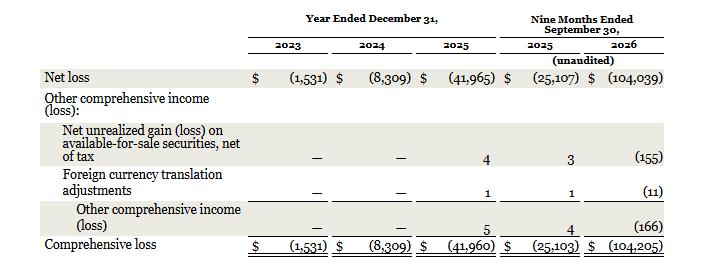
Anthropic's net loss in the third quarter was 232.9 billion U.S. dollars, lower than 663 billion U.S. dollars in the second quarter. The cumulative net loss in the first three quarters reached 1.04039 trillion U.S. dollars, but about 943 billion U.S. dollars of this was related to changes in the fair value of financial instruments such as convertible notes and derivative liabilities, mainly affected by the rise in the company's valuation.
02
$8.954 Trillion in Commitments, Nearly Half to Be Fulfilled by 2030
The prospectus discloses that by the end of September, Anthropic's cumulative expenditure commitments formed through procurement commitments and lease agreements have reached 8.954 trillion U.S. dollars, the vast majority of which are related to computing resources and infrastructure.
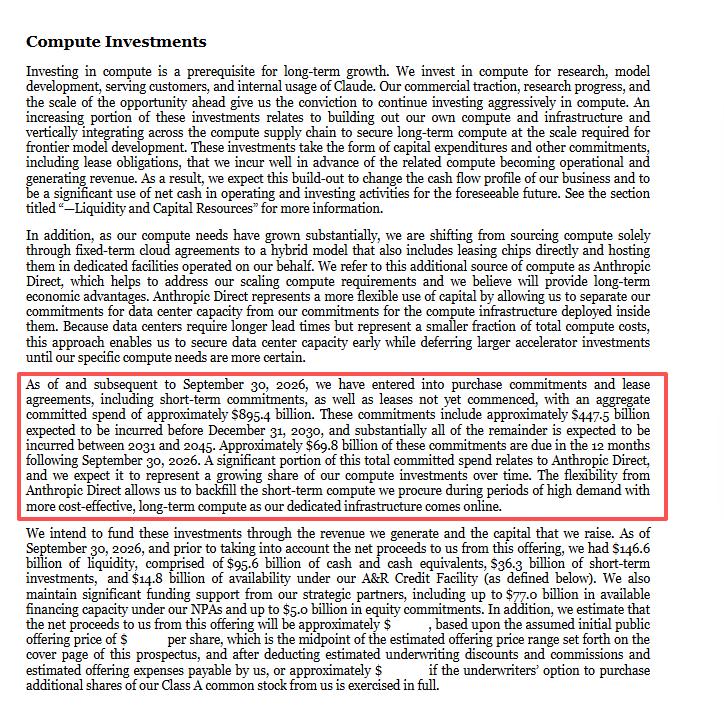
Of this amount, about 4.475 trillion U.S. dollars is expected to be fulfilled by December 31, 2030, and the rest will extend from 2031 to 2045. Commitments due within the next 12 months amount to about 698 billion U.S. dollars.
This amount does not equal the existing interest-bearing debt, nor does it mean that Anthropic needs to pay the full amount immediately. It includes different types of procurement contracts, equipment leases and data center related agreements, with payment times distributed over many years in the future. However, some contracts are highly binding, and the company may still be required to assume corresponding payment obligations even if the actual usage is lower than expected.
In terms of contract composition, unstarted lease commitments amount to about 3.214 trillion U.S. dollars, and fixed minimum procurement commitments amount to about 2.656 trillion U.S. dollars. These long-term arrangements lock in future computing power procurement and infrastructure usage costs in advance, and also expose the company to payment responsibilities for a long period of time.
By the end of September, Anthropic held a total of 1.31845 trillion U.S. dollars in cash, cash equivalents and short-term investments. If available credit lines are included, the company's total liquidity is about 1.466 trillion U.S. dollars.
Compared with the funds on the books, the scale of long-term commitments is significantly larger. 8.954 trillion U.S. dollars is about 6.8 times Anthropic's cash and short-term investments; the maturing commitments of about 698 billion U.S. dollars in the next 12 months are equivalent to about 53% of the existing cash and short-term investments.
The prospectus also clearly points out the operating risks involved. Anthropic's revenue mainly comes from consumption-based businesses billed on a usage basis, most of which are not guaranteed by long-term contracts, while computing power and infrastructure expenditures usually need to be locked in many years in advance. The company may sign long-term agreements based on expected revenue, but the actual revenue in the future may not meet expectations.
If the growth in customer revenue cannot cover the relevant payments, or the company cannot continue to raise financing on acceptable terms, Anthropic may not be able to fulfill some of the contracts. Default on certain commercial agreements may also trigger cross-default clauses in credit agreements and convertible notes, leading to early maturity of debts, and even prompting suppliers to terminate cooperation.
The cost growth has already been reflected in the financial data. In the first three quarters, Anthropic's computing and infrastructure expenses increased by 329% year-on-year, an increase of about 144 billion U.S. dollars. The relevant expenses in the third quarter were about 99 billion U.S. dollars, accounting for about 58% of the quarter's revenue.

03
From Cloud Service Providers to Mining Enterprises, Anthropic Searches for Computing Power Globally
According to foreign media reports, at the end of last year, Anthropic's management had realized that there was great uncertainty in the forecast of computing power demand, and then signed dozens of computing power and infrastructure agreements intensively, with cooperation partners extending from large technology companies to data center start-ups, chip manufacturers, and enterprises that were once engaged in cryptocurrency mining.
This round of procurement is no longer limited to purchasing cloud services. Anthropic has begun to recruit data center construction and supply chain experts, directly purchase server equipment and cooling systems, and help partners accelerate computer room construction. It has also contacted data center developers in multiple states to study grid access, project permits, and the possibility of transforming old coal-fired power plants and industrial facilities into data centers.
New-type cloud service providers and former cryptocurrency mining enterprises have thus entered Anthropic's supply system. According to public information integrated by foreign media, companies such as Fluidstack and Lambda provide computing power resources, while enterprises such as TeraWulf and Hut 8 participate in data center construction.
These partners hold land, power access resources or ready-made data center facilities. For Anthropic, using existing sites and power resources can reduce the time required to build large parks from scratch. For some former mining enterprises, shifting to AI data centers also provides new business growth space.
However, ready-made sites do not mean that computing power can be delivered immediately. Power supply, equipment installation and construction personnel may all slow down the project progress.
The initial data center projects Anthropic looked for were at least about 200MW in scale, and later it began to accept projects of about 50MW, and then supplemented power supply through methods such as battery energy storage and natural gas power generation. The company also considered combining multiple small projects to gradually increase computing power capacity.
Anthropic has also begun to directly participate in the design and procurement of infrastructure projects. The company purchases equipment such as chips and cooling systems, and then hands them over to cooperative operators for installation, so as to shorten the time from project construction to computing power launch.
This model expands the range of resources Anthropic can access, but also increases the complexity of project management. The construction cycle, equipment specifications, power conditions and delivery time of different data centers are not consistent. Even if the contract has been signed, the actual computing power can only be put into use after construction, equipment installation, grid connection and commissioning.
John Tough, Managing Partner of energy investment institution Energize Capital, believes that Anthropic does not have a complete computing power supply pipeline, and can only search for power and infrastructure resources one by one around the world, and then splice together projects of different scales.
Anthropic refers to this part of dedicated infrastructure as Anthropic Direct in its prospectus. The company hopes to reduce its dependence on more expensive short-term computing power procurement by locking in dedicated capacity for the long term.
Citing people familiar with the matter, foreign media revealed that Anthropic expects to have a computing power capacity of more than 3.5GW in 2026, and plans to double the scale in 2027.
Anthropic's long-term computing power contracts are concentrated in a small number of large technology companies and infrastructure suppliers.
According to the prospectus and relevant disclosures, Anthropic's contract amount with Google is about 1.213 trillion U.S. dollars, with Amazon about 1.1 trillion U.S. dollars, and with Microsoft about 449 billion U.S. dollars; the relevant agreement amount with SpaceX is up to 1.205 trillion U.S. dollars, with the term extending to 2036. In addition, the company has signed relevant agreements with Fluidstack and Lambda.
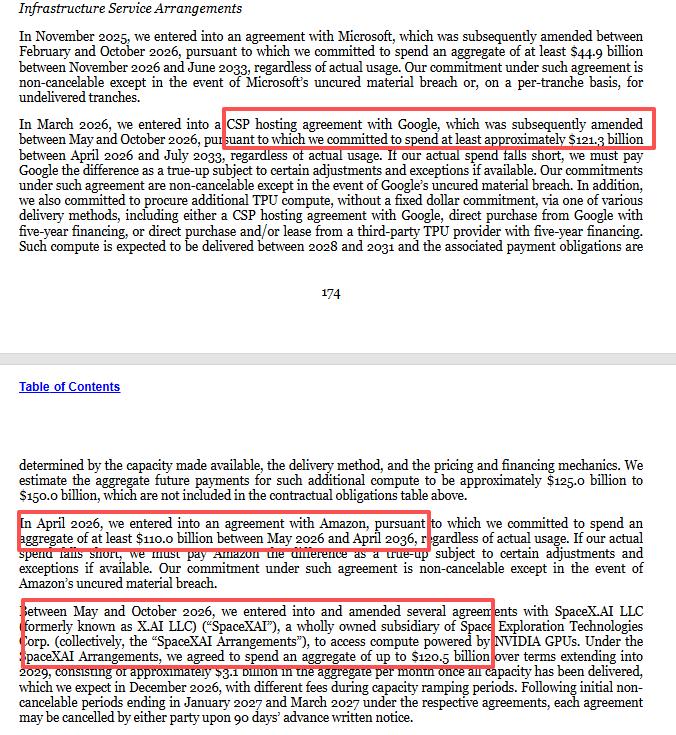
Broadcom's relevant equipment lease commitments amount to about 1.612 trillion U.S. dollars, which is also an unignorable part of this computing power expenditure structure.
In addition, Anthropic plans to additionally procure about 125 billion to 150 billion U.S. dollars worth of Google chips, and expects to spend more than 20 billion U.S. dollars on AMD chips. These arrangements do not have a fixed contract amount, so they are not included in the aforementioned total commitment of 8.954 trillion U.S. dollars.
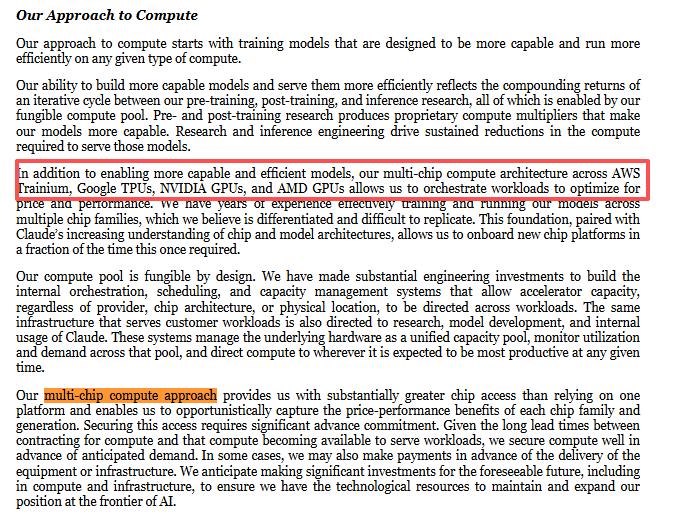
Multi-chip architecture is another arrangement for Anthropic to reduce supply risks. The company stated in its prospectus that its computing power resources come from AWS Trainium, Google TPU, NVIDIA GPU and AMD GPU, and it uniformly schedules computing power from different sources to allocate resources according to the price and performance requirements of different tasks. This helps reduce dependence on a single chip supplier, but also makes the relationship between Anthropic and its supply chain partners more complex.
Amazon and Google are not only important investors of Anthropic, but also suppliers of cloud services and chip resources. Microsoft also provides cloud infrastructure. Broadcom participates in the supply of chips and equipment. Anthropic pays computing power fees to these enterprises, and at the same time obtains investment or financing support from some of them.
Evercore ISI analyst Mark Mahaney previously pointed out that the relationship between Anthropic and large cloud service providers has multiple attributes: they are both customers, competitors, sales channels and investment targets.
This article is from the WeChat official account "Tencent Tech", author: Su Yang, editor: Xu Qingyang, published with authorization from 36Kr.