Is Anthropic really worth 1.5 trillion US dollars?
On October 26, 2026, Anthropic, the developer of Claude, publicly filed its US IPO (Initial Public Offering) registration documents. The IPO process of Anthropic has made the $1.5 trillion valuation the focus of the market. The company's financial statements are also notable: revenue is growing rapidly, huge net book losses coexist with positive operating cash flow; the amount of fixed asset purchases seems small, but R&D and long-term computing power investment are extremely staggering, and external capital continues to flow in.
Following the value investment framework used in the previous two columns, Zhang Feida, Associate Professor of Accounting at China Europe International Business School, intends to discuss in this article: How much of the productivity created by Anthropic can be continuously converted into shareholder returns? How much of the future has the $1.5 trillion price pre-empted?
In the two articles about SpaceX and Unitree Robotics, I introduced the Ohlson residual income model. In short: Equity value equals the book value of shareholders' equity plus the present value of future residual income; residual income is the balance of net profit after deducting the return that the capital invested by shareholders deserves.
Before analyzing with the four-dimensional framework, we can see what Anthropic has already proven and what capital has bet on through a set of figures?
First look at the revenue Anthropic has achieved. Its full-year revenue in 2025 was 45.85 billion US dollars, and it reached 162.86 billion US dollars in the first half of 2026.
Then look at how much it has paid for growth. In the first half of 2026, its R&D expenses reached 97.41 billion US dollars, compared with 18.50 billion US dollars in the same period of 2025 and 63.38 billion US dollars for the full year of 2025; the computing power and infrastructure expenses classified by the nature of expenses were 89.45 billion US dollars, and personnel expenses were 31.52 billion US dollars.
R&D is classified by purpose, while computing power and personnel are classified by nature. There is overlap between the two groups of expenses, which cannot be added together. These figures better illustrate the capital intensity of cutting-edge model competition than the phrase "huge R&D investment".
In addition, from the three types of cash flow, we can see another picture of Anthropic's capital expenditure in the first half of 2026.
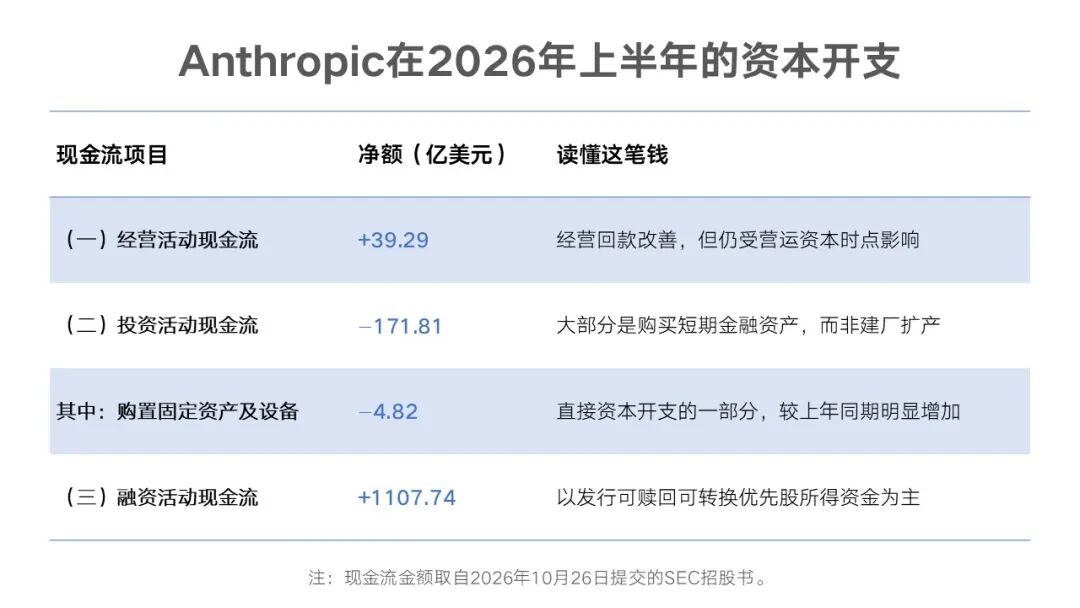
Putting these figures together, the company presents two simultaneous facts: on the one hand, operating cash flow has turned positive, the financing scale has risen sharply, and external investors are willing to continuously provide funds; on the other hand, the real R&D and computing power investment is mainly not in the line of fixed asset purchases.
Anthropic is an AI company that is relatively asset-light on the statement but has heavy capital demand in the economy. The willingness to invest and financing capacity can confirm its growth expectations, but cannot replace the test of return on new capital.
Next, we will analyze Anthropic's future value from four dimensions: how high the ROE (Return on Equity) is, how long the excess return can last, how large valuable growth can be, and how much risk these returns face.
01
Four-dimensional Framework to Look at Anthropic
I. ROE: After Revenue Growth, Can Capital Returns Be Established?
ROE = Net Profit Margin × Asset Turnover × Equity Multiplier
Anthropic's current capital structure and accounting treatment make it difficult for traditional ROE to directly reflect the real return on capital. Following the idea of DuPont analysis, we need to focus on three issues more: whether high gross margin can be converted into net profit, whether the asset-light model can improve real capital efficiency, and whether large-scale financing can create excess returns.
Profitability (Product Strength): How Much Can High Gross Margin Retain?
According to the functional classification in the notes to the prospectus, the cost of revenue in the first half of 2026 was 23.80 billion US dollars, corresponding to a gross margin of about 85.4%. However, R&D expenses reached 97.41 billion US dollars in the same period, and sales and marketing expenses were 38.08 billion US dollars, the latter of which also includes channel partner costs.
Therefore, the high gross margin of 85.4% cannot directly represent the final high profitability.
Profit from a single call does not guarantee that the whole company has sufficient profits. Cutting-edge models require continuous training and R&D, part of which is to develop new capabilities, and the other part may only be to maintain competitive positions. If more R&D has to be invested every year to retain revenue, this part of the expenditure cannot be regarded as a cost that will naturally disappear in the future.
The accounting treatment of R&D expenses also affects the interpretation of profits: Anthropic's model development costs are usually expensed when incurred, which will reduce the current accounting profit. However, R&D may not only form technological accumulation with multi-year value, but also include continuous costs necessary to maintain the competitiveness of the model. We cannot simply regard all R&D expenses as one-time investments that can be added back. To judge normalized profits, we should not only see what R&D has formed, but also how much we still need to invest every year in the future.
Operational Capability: Light Assets on Statements Do Not Equal Light Capital Demand
Cloud computing enables Anthropic to mainly use external infrastructure instead of including all GPUs and data centers in its own fixed assets. Part of the infrastructure investment is undertaken by suppliers, and Anthropic pays its economic costs through cloud computing power fees, prepayments and long-term procurement arrangements.
Few fixed assets do not mean that the invested capital required to serve customers is small; mechanically dividing revenue by total assets on the statement may also overestimate the real asset turnover efficiency.
Long-term procurement and lease arrangements are not all recognized debts, and should not be mechanically added with other computing power announcements. However, locking in resources means that if future demand is lower than expected, part of the expenditure may become a fixed burden that is difficult to adjust; conversely, if charging tasks grow rapidly, pre-guaranteed production capacity may also form cost and delivery advantages.
Moreover, this model is not static. Anthropic clearly stated in its prospectus that it expects to build more self-owned or leased infrastructure in the future, and capital expenditure and advance payments will increase significantly.
In the future, it may gradually shift from mainly "buying computing power" to partially "building computing power"; the unit cost may decrease, but the risks of fixed assets, depreciation, idleness and chip iteration will also rise accordingly.
Capital Operation Capability: After Successful Financing, Can the Money Be Used Effectively?
Amazon is not only an investor of Anthropic, but also a computing power supplier and distribution channel. The cooperation announced by the two parties in April 2026 puts new investments and AWS procurement commitments of more than 1000 billion US dollars over the next ten years in the same arrangement. This can help the company expand, but it also requires investors to distinguish between financing inflows, computing power procurement and end-customer revenue.
From the perspective of financing cash flow, external capital has indeed cast a strong vote of confidence. The net inflow of financing activities in the first half of 2026 was 1107.74 billion US dollars, of which the net income from the issuance of redeemable convertible preferred shares was 1104.32 billion US dollars; the Series H financing of 650 billion US dollars announced in May corresponds to a post-investment valuation of 9650 billion US dollars, and investors include many large institutions. Compared with the net financing inflow of 199.60 billion US dollars for the whole year of 2025, the scale of capital support has increased significantly.
However, large financing volume does not mean that external institutions unanimously agree that the stock is cheap: financing may serve market seizing, strategic binding and preferred stock terms, and does not guarantee that continuous financing can be carried out at the same valuation in the future.
Whether the management can invest funds in truly productive computing power, products and customer relationships, and retain a reasonable share of equity for original shareholders, ultimately depends on the return on new capital, not the scale of financing itself.
Therefore, in addition to the traditional DuPont analysis, I prefer to add an "adjusted return on invested capital (ROIC)" as an auxiliary judgment: it not only considers the equipment purchased by the enterprise itself, but also takes into account the recognized right-of-use lease assets, operating prepayments, and technological accumulation formed by R&D that may have multi-year value; and conducts separate cash payment scenario analysis for future minimum procurement commitments.
Financial Conclusion
The key to measuring Anthropic's return on capital is not the low capital expenditure on the statement and the apparent asset turnover; but whether all economic inputs such as R&D, leased computing power, self-built infrastructure and long-term commitments can continuously create returns exceeding the cost of capital①.

II. Sustainability: How Long Can the Model Leadership Be Maintained?
The Ohlson framework is concerned about how long excess returns can last, that is, how deep the moat is. For Anthropic, leading a certain generation of models is an advantage, but whether it can maintain customer relationships and profit margins across multiple rounds of technological iterations determines the thickness of its valuation.
There are at least two layers of barriers here: the first layer is model capability, reliability and usage cost; the second layer is the replacement cost formed after the model enters the customer's code base, permission system, business process and compliance requirements. The deeper the latter layer, the more likely customers are to pay for continuous services, but the adoption of multi-models by customers and easier replacement of underlying interfaces may also weaken this stickiness.
The benefits of cost reduction also need to be distributed between the company and customers. When Anthropic released Opus 5.5 in September, it reduced the unit price of input and output by 20% compared with the previous generation, and said that the customer cost of typical tasks can be reduced by about 40%. This shows that technological progress can expand demand and will also be passed on to customers through price reduction. How much profit the company retains depends on the relationship between the decline in internal unit cost, the decline in selling price and the growth of calls.
Financial Conclusion
A sustainable moat must withstand the test of model replacement and price decline, and finally be reflected in customer retention and return on capital. The financial value of technological advantage depends on how long it can last.

III. Growth: From Assisting Work to Completing Tasks
Products such as Claude Code expand the growth space from chat to actual work. If AI moves from giving a piece of advice to further completing a development, analysis or operation task, the amount customers are willing to pay will have the opportunity to be linked to the value created by the task, rather than only depending on the price of a software seat.
This also changes the way growth is tested. But the growth of call volume does not necessarily equal the growth of value. More calls may also come from longer reasoning processes or repeated attempts. What really needs to be observed is the total cost and willingness to pay of customers to complete a task, as well as the incremental return of Anthropic after deducting computing power and continuous R&D investment.
If efficiency improvement reduces customer costs, brings more tasks, and at the same time makes revenue grow faster than the investment required to maintain competition, there is room for residual income to expand.
Conversely, if new revenue requires a proportional increase in computing power, R&D and delivery support, the return on capital may not necessarily improve; whether growth creates value still depends on whether the return on new investment can exceed the cost of capital.
The management's advance locking of resources indicates strong expectations for future task demand; the willingness of external institutions to provide large amounts of funds shows that the capital market and strategic partners support this expectation. But both are expectations, not returns: only when new paid tasks, computing power utilization, unit economics and operating cash recovery continue to keep up, can it show that growth investment is being converted into sustainable value.
Financial Conclusion
Whether growth creates value depends on whether all productive inputs, including expensed R&D, leased computing power and self-built infrastructure, can bring repeatable revenue and incremental returns higher than the cost of capital.

IV. Risk Assessment: How Do Management, Governance and ESG Affect Valuation?
Management Quality: Dario Amodei, Can Strategic Ambition and Investment Discipline Be Balanced?
Dario served as Vice President of Research at OpenAI, founded Anthropic in 2021, and integrated safety and reliability into the company's mission. The company has written part of the mission requirements into the system through responsible expansion policies and long-term interest trusts; in 2026, Anthropic had a legal dispute with the US defense department because it opposed the use of models for large-scale domestic surveillance and fully autonomous weapons. These choices show that the management is willing to bear real costs for some principles, but the policy effect and subsequent implementation still need to be observed.
Dario's risk preference is more worthy of analysis combined with real money. He admitted in the same interview that rapid technological progress does not mean that revenue will be realized synchronously: if you buy trillions of dollars of computing power every year in 2027 in advance according to the most optimistic scenario, as long as the demand is realized one year later, the company may go bankrupt.
Therefore, he would rather bear the opportunity cost of insufficient supply for part of the demand than control the survival risk of over-betting. This