Apple: The storage backlash has finally arrived, is the "safe haven" facing AI about to spring a leak?
Apple (AAPL.O) released its fiscal 2026 Q4 earnings report (covering the period ending September 2026) after US market hours on the morning of November 3, 2026 Beijing Time, key highlights are as follows:
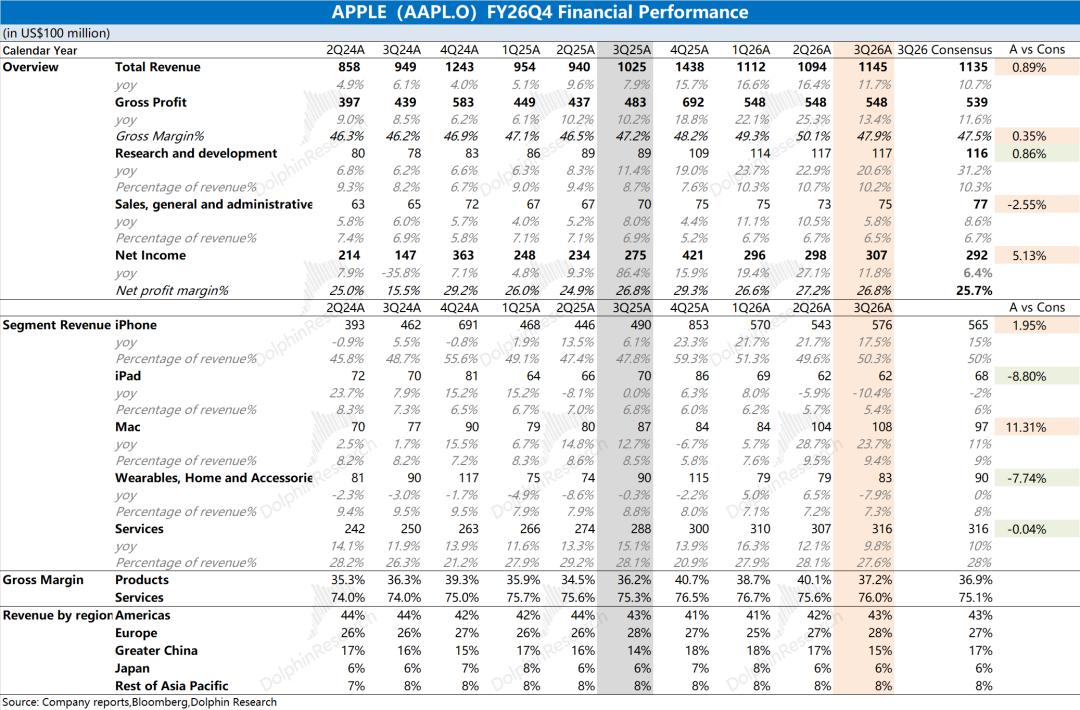
1. Overall Performance: In this quarter, Apple posted revenue of 114.48 billion US dollars, up 11.7% year on year, which exceeded market consensus (113.5 billion US dollars) and also surpassed the upper end of the company's previous guidance (9-11% year-on-year growth).
The revenue growth in this quarter was mainly driven by the iPhone and Mac businesses. Among them, the iPhone 18 Pro series hit the market at the end of the quarter and began to contribute revenue from mid-September; software services grew 9.8% year on year, which was basically in line with market expectations.
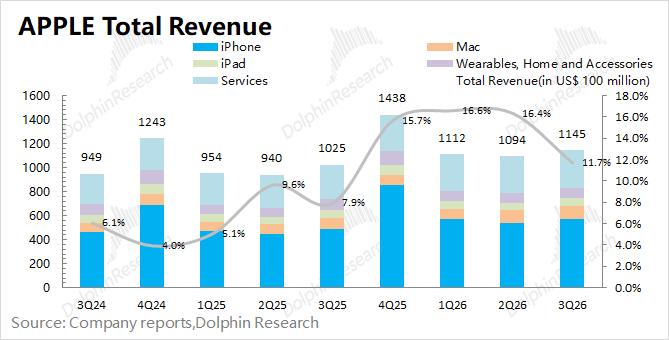
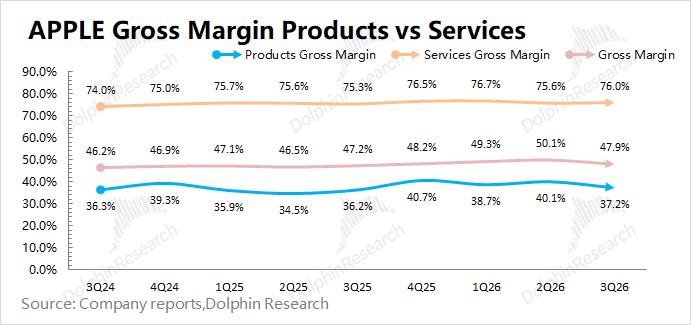
Apple's gross margin stood at 47.9%, down 2.2 percentage points quarter on quarter, slightly better than market expectations (47.6%). This figure still includes the impact of tariff refunds of about 1 percentage point, and the gross margin after excluding this factor is about 46.9%.
The gross margin of the software services business was 76.0%, up 0.4pct quarter on quarter; the gross margin of the hardware side was 37.2%, about 36% after excluding tariff refunds, down about 1pct quarter on quarter, which was mainly affected by the price hike of storage components.
According to the management's breakdown, after excluding the tariff refunds in the June and September quarters, the overall gross margin and hardware gross margin both fell by about 1 percentage point quarter on quarter, and almost all of the decline came from storage: The actual impact of rising storage costs is even larger, which was only partially offset by the consumption of low-cost inventory, cost reduction of non-storage components and product price hikes. By the end of this quarter, the company has recovered most of the refunds of paid tariffs, and there will be no such positive contribution in subsequent quarters.
2. iPhone: In this quarter, the company's iPhone business recorded revenue of 57.58 billion US dollars, up 17.5% year on year, higher than market expectations (56.5 billion US dollars). Under supply constraints and exchange rate headwinds, the growth of the mobile phone business this quarter mainly came from the increase in average selling price (ASP) after the price hike of the iPhone 18 Pro series, as well as the continued demand for the iPhone 17 series; both the US and Greater China regions achieved strong double-digit growth.
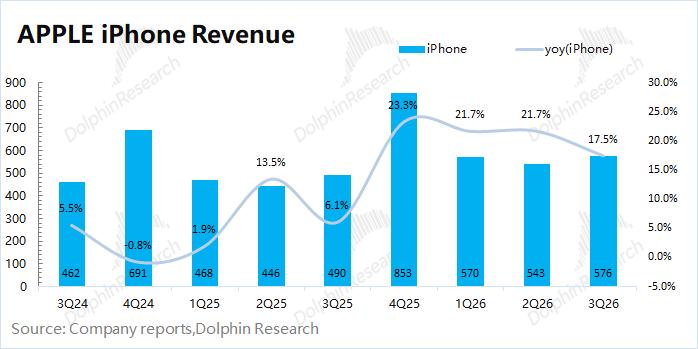
From the perspective of volume-price relationship, Haitun Research found that the growth of iPhone business this quarter mainly came from the increase in average selling price:
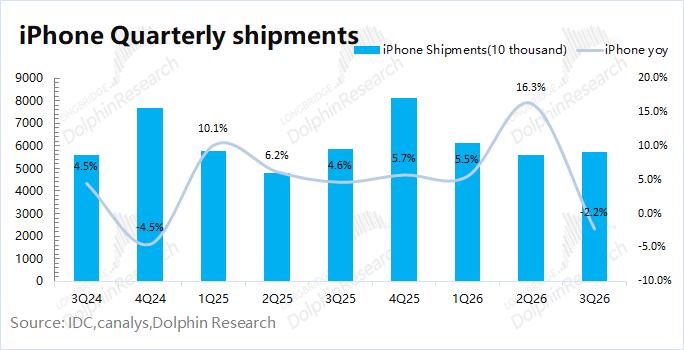
1) iPhone Shipment Volume: According to IDC data, global smartphone shipments in Q3 2026 were about 255 million units, down 21% year on year. Apple's global shipments this quarter were about 57.3 million units, down 2% year on year, and its market share rose from 18.2% in the same period last year to 22.4%, meaning Apple's shipment performance was significantly better than the overall market.
The storage price hike has prompted Android brands to raise prices one after another, and Apple also chose to raise the price of the Pro series by 100 US dollars this time. Judging from the delivery cycle, the demand after the price hike remains robust, and the delivery cycle of iPhone 18 Pro/Pro Max was the same as that of the same period last year by late October.
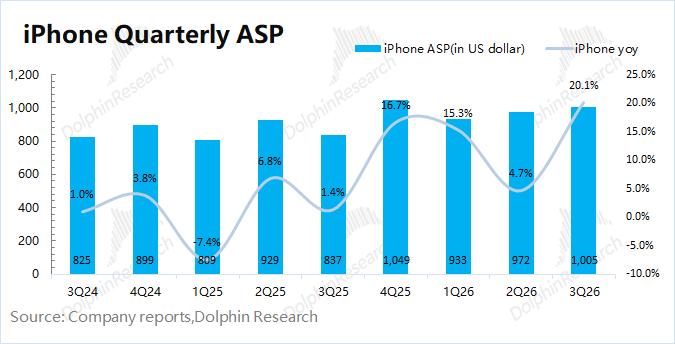
2) iPhone Average Selling Price: Calculated by combining iPhone business revenue and shipment volume, the ASP of iPhone shipments this quarter is about 1005 US dollars, up about 20% year on year (about 837 US dollars in the same period last year).
This round of price adjustment by Apple mainly raised the starting price of 18 Pro/Pro Max by 100 US dollars respectively, and the old model iPhone 17 also increased by 100 US dollars simultaneously, and no base model was released this autumn, making the product structure skewed towards the Pro line.
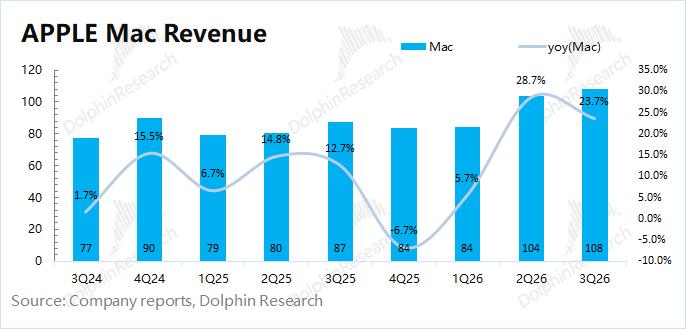
3. Other hardware products outside iPhone: The company's Mac business revenue reached 10.79 billion US dollars this quarter, up 23.7% year on year, far exceeding market expectations (9.7 billion US dollars). Mac continued to benefit from the hot sales of MacBook Neo and MacBook Pro, achieving more than 20% growth even under supply constraints (with shipment volume down 13% year on year and ASP up 42% year on year).
iPad revenue was 6.23 billion US dollars, down 10.4% year on year; other hardware such as wearables recorded revenue of 8.3 billion US dollars, down 7.9% year on year, both of which were below market expectations (6.8 billion and 9 billion US dollars respectively).
iPad was dragged down by supply constraints and the high base in the same period last year; the wearables business faced a high base from the release of Watch SE3 and AirPods Pro 3 in the same period last year, and the new Watch S12/Ultra 4 and AirPods 5 were only launched in mid-September, making limited contribution to this quarter.
4. Software Services: The company's software services revenue reached 31.57 billion US dollars this quarter, in line with market expectations (31.6 billion US dollars), up 9.8% year on year. With a high gross margin of 76.0%, the software business, accounting for 27.6% of total revenue, generated 43.7% of the company's total gross profit.
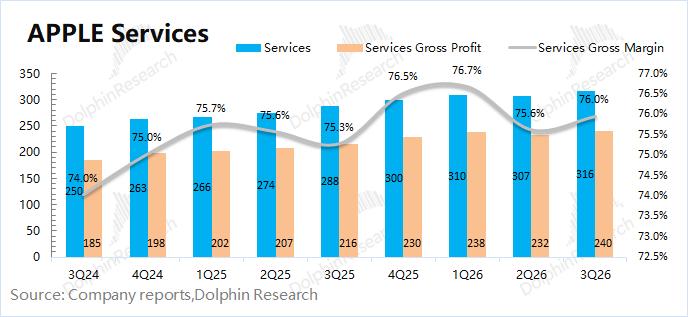
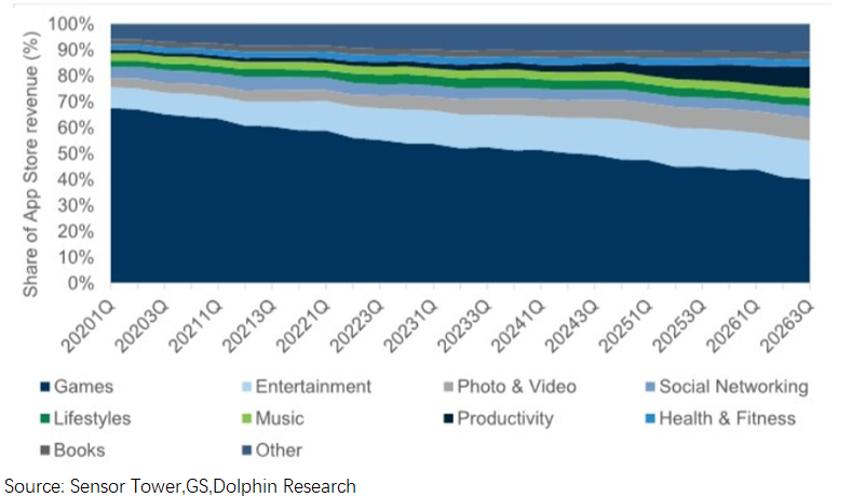
By segment, video, cloud services, payments and advertising all hit all-time highs, while music set a September quarter record; the performance of App Store was similar to that of the same period last year, and mobile games remained a drag. Exchange rate was the main reason for the slowdown in service growth: from the March quarter to the September quarter, about 4 percentage points of the decline in year-on-year service growth came from exchange rate. The App Store fee reduction in the EU (from 30% to 26%) took effect on October 1, and the impact will mainly appear in the next quarter.
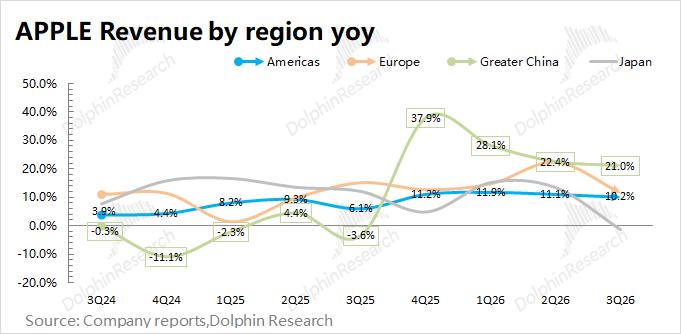
5. Revenue by Region: The Americas region remained the company's core market, with revenue of 48.68 billion US dollars, accounting for 42.5% of total revenue, up 10.2% year on year; Europe region recorded revenue of 32.01 billion US dollars, up 11.5% year on year; Greater China region posted revenue of 17.54 billion US dollars, up 21.0% year on year, still the fastest growing region; Japan's revenue fell 1.4% year on year, and other Asia-Pacific regions grew 15.0% year on year.
iPhone shipments in China market this quarter were about 10.33 million units, down 4% year on year, while the overall smartphone market in China fell 15% year on year, the storage price hike suppressed low-end Android products, and iPhone's market share rose by 2 percentage points year on year.
Haitun Research's Overall View: Revenue "passed steadily", but profits were eaten up by rising storage costs
Apple delivered a solid performance this quarter, with revenue exceeding the highest guidance the company previously provided. However, the gross margin still includes tariff refunds, after excluding this factor, the pressure from rising storage costs has begun to emerge.
The revenue growth was almost entirely driven by higher average selling prices of iPhone and Mac, rather than higher shipment volumes, and sales volume actually recorded a slight decline. The Pro series directly raised prices this year, and no base model was launched in autumn, so the sold products were naturally dominated by higher-priced models.
The profit side was not that easy. Storage prices surged wildly, and the extra cost of the new Pro Max was almost all spent on storage, the management itself said the price increase was "unprecedented". This quarter, the company withstood the pressure with cheap old inventory and price hikes, but the inventory is being consumed less and less, while the procurement price is still rising. Fortunately, Apple has long targeted the mid-to-high end market and has already raised prices, making it more resilient than its competitors.
Beyond this quarter's data, the management also provided guidance for the next quarter: the company expects revenue in the December quarter to grow 7-10% year on year, corresponding to about 153.8-158.1 billion US dollars, slightly higher than market expectations (152.6 billion US dollars); among them, software services will grow 8-9% year on year (about 32.4-32.7 billion US dollars), lower than market expectations (12% year on year), which is mainly dragged down by the sequential weakening of third-party licensing revenue (mainly the default search engine fee paid by Google to Apple) and exchange rate headwinds.
The growth of service revenue has entered a high single-digit range. The third-party licensing revenue mainly comes from the "rental fee" paid by Google and other companies for Apple's default search position. It cannot be ruled out that the slowdown of Google's traditional search revenue will also affect the share paid to Apple.
The company expects the gross margin in the next quarter to be 45-46%, lower than market expectations (46.7%), the midpoint is about 1.4 percentage points lower than the 46.9% after excluding tariff refunds in this quarter, which mainly comes from rising storage costs and Siri AI-related cloud costs.
Calculated based on the guidance, Haitun Research estimates that the operating profit in the December quarter will be about 50 billion US dollars, which may even be lower than that of the same period last year (50.9 billion US dollars). That is to say, "revenue recorded high single-digit growth, but profits declined", and the extra revenue was almost eaten up by storage costs.
The management said that the supply-side constraints in the September quarter mainly came from advanced manufacturing processes, which are easing as more products shift to the 2nm node; the main constraint in the December quarter will shift to storage.
In order to improve supply, the company's manufacturing procurement commitments increased by 33 billion US dollars from the June quarter to the September quarter, and the ending inventory also increased from 11.1 billion US dollars at the end of the previous quarter to 14.5 billion US dollars (5.7 billion US dollars in the same period last year), the intention to lock in materials in advance is quite obvious.
Beyond Apple's current earnings report, the market also pays attention to the following aspects:
a) China Market: Market share maintained, total market volume declined
Greater China's revenue grew 21% year on year this quarter, mainly driven by iPhone and Mac. In terms of shipment volume, China's mobile phone market was significantly impacted by rising storage prices: China's smartphone shipments in Q3 2026 were about 58.06 million units, down 15% year on year; iPhone shipments were about 10.33 million