After the democratization of intelligent driving, why can't the cockpit computing power achieve the same democratization?
In early 2025, BYD's "God's Eye" launched the equal access to intelligent driving, bringing high-level intelligent driving features rapidly to vehicles priced at 100,000 RMB level or even lower, officially kicking off the era of universal intelligent driving.
However, the equal access to intelligent cockpit functions has fallen into a new dilemma. First, the equal access to "basic availability" of intelligent cockpits has long been completed. Data from Gasgoo Automotive Research Institute shows that the penetration rate of intelligent cockpits in domestic passenger vehicles reached 87.5% in August 2026, approaching full popularization. The configuration rate of intelligent cockpits for models priced below 100,000 RMB has increased from 52% to 70%. Large screens, voice control and vehicle internet are no longer exclusive to high-end vehicles, and the price of basic cockpit hardware has already dropped significantly.
But widespread hardware popularization does not mean equalized user experience. Currently, high-level chips such as Qualcomm Snapdragon 8295 are mostly installed on models priced above 200,000 RMB, while mainstream models priced at 100,000 to 200,000 RMB or below still mainly adopt Qualcomm Snapdragon 8155.
Not long ago, the intelligent driving track put forward a new solution direction. Momenta proposed the concept of "large model defines chip", realizing joint definition and synchronous iteration of algorithm models and chip architectures. This also confirms that how to make computing power keep up with model iteration has become the core proposition that intelligent vehicles must answer.
Meanwhile, the competition of cockpit intelligence is also shifting from "whether it can be used" to "whether it is user-friendly and can support long-term iteration". More cutting-edge cockpit AI capabilities and continuously updated active intelligent experiences are still bound to the price tiers along with chip configurations.
More critically, it is difficult for cockpits to replicate the equal access path of intelligent driving. The functional boundary of intelligent driving has been converged, and computing power demand can be measured in advance, while the capabilities of large cockpit models are still expanding at a high speed, with new application scenarios launched every quarter, making it difficult to predict future computing power consumption in the vehicle development stage.
Against this background, simply relying on pre-buried higher computing power at the time of delivery is no longer a stable solution. What the industry really needs to build is a computing power upgrading system driven by intelligent upgrades. The main competitive line of intelligent cockpits has thus shifted from the competition of fixed computing power to the game of evolvable computing power.
01.
More capabilities are shifting to the end side
The pre-buried practice fails at the cockpit end
End-cloud collaboration has long become a consensus in the industry. The cloud end undertakes complex reasoning and cross-platform ecosystem calls, while the end side is responsible for full-time perception, millisecond-level response, and processes interactions in weak network and no-network scenarios at the same time, keeping sensitive data such as voice and occupant status in local closed-loop operation to meet privacy protection and data compliance requirements.
The intelligence of vehicle cockpits has already drawn an upward curve: from the early 1.0 era of initial intelligence that relied on fixed commands and one-question-one-answer mode, to today's 4.0 era of active service intelligence based on memory and decision-making. Every section of this curve can only be established when the end-side model actually runs on the vehicle.
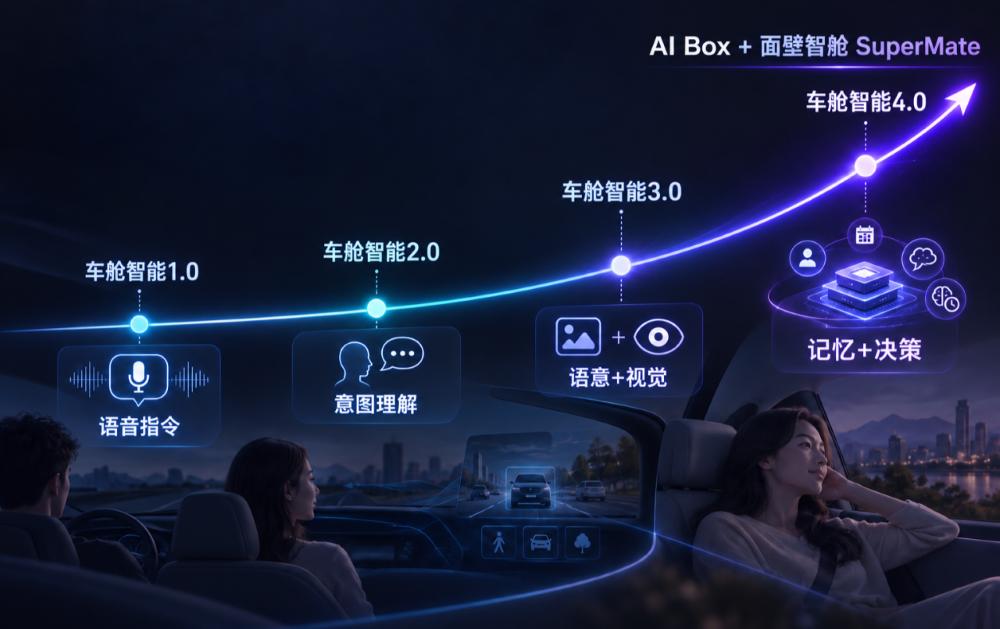
▲ Schematic diagram of the evolution of intelligent cockpit from 1.0 to 4.0
End-side computing power has become the core foundation of high-quality intelligent cockpit experience, and the high-frequency, close-fitting interaction experience in the cockpit must be rooted in the local end-side computing power. If the iteration of end-side computing power cannot keep up with the update rhythm of models, it will eventually fail in real vehicle usage scenarios.
When more and more high-frequency interactions and cockpit control tasks are transferred to the local side, the inherent limitations of end-side hardware become unavoidable problems.
Different from cloud computing power, vehicle-grade cockpit chips are strictly restricted by power consumption, heat dissipation, hardware cost and vehicle power supply conditions. The upper limit of chip computing power is fixed, and available memory resources are limited, so it is impossible to load larger-scale models without restriction. At the same time, high-load reasoning will bring pressure on power consumption and heat generation, affecting the stability of the cockpit system.
In addition, for end-side intelligence, there is also a contradictory point in the intelligent cockpit industry: the iteration cycle of large models is 3-4 months, while it takes at least half a year to one year for vehicle cockpit SoC from selection to mass production and launch.
Cockpit models evolve rapidly, but once the vehicle infotainment hardware is finalized, the computing power will basically be locked. Subsequent software OTA can hardly break through the hardware boundary, forming a mismatch dilemma that "computing power supply cannot keep up with model evolution".
In the intelligent driving track, the boundaries of scenarios such as driving, parking and active safety are becoming clearer, and automakers can configure hardware as needed and reserve appropriate computing power margin.
But large cockpit models follow a completely different logic: the capability boundary of models continues to expand every quarter. When making vehicle model plans this year, it is difficult to predict how much computing power the interactions and Agents in the cockpit will need two years later.
Such problems turn the pre-buried computing power process of manufacturers into a "gamble" on the future. If the reserved computing power is too small, the new vehicle will face the problem of backward capabilities once delivered, but if too much computing power is reserved, the cost of the whole vehicle will rise for no reason.
This contradiction will be further amplified by the vehicle model price positioning. High-end models generally have sufficient profit margins to pre-bury more surplus computing power, while affordable models are limited by cost, with no extra profit margin to pay for uncertain future computing power demands.
The same technical problem eventually evolves into market differentiation, and the continuously iterated intelligent cockpit experience mostly appears in the high-end price range.
02.
Computing power becomes a pluggable and upgradable independent module
Solve the mismatch problem between computing power and models
For the required question of "how to make computing power keep up with model iteration", an open route solution has emerged in the industry, that is, no longer binding a single fixed chip, and making computing power into a pluggable and independently upgradable independent module.
The AI Box jointly developed by Facewall Intelligence, partners including Wutong Technology and Intel is exactly the mass production sample of the open route.
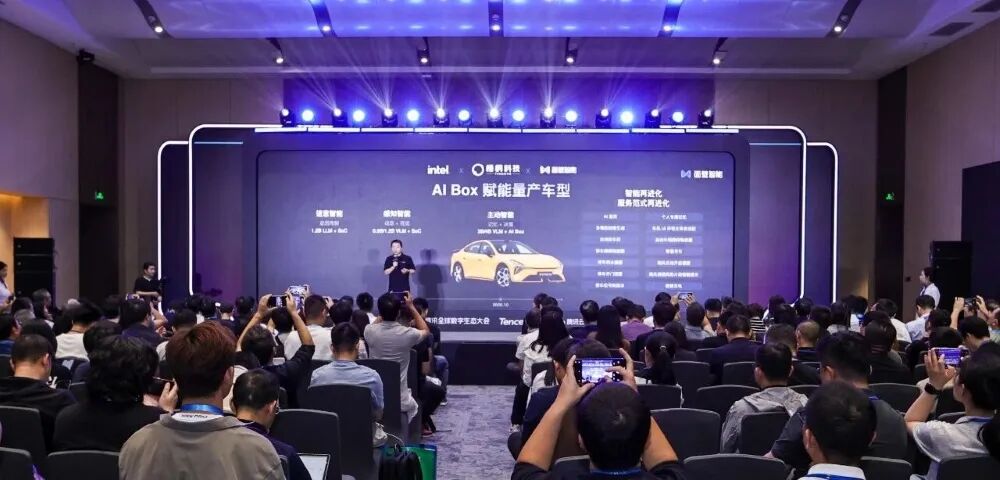
▲ AI Box end-side intelligent cockpit solution
As a low-intrusion, configurable modular computing power node, while providing users with more powerful end-side intelligence, it provides an independent, pluggable computing power and intelligent solution for the vehicle infotainment computing platform, offering a mass-producible solution for the mismatch problem between computing power and models.
In addition, it also supports OTA upgrades, allowing automakers to continuously provide users with intelligent applications and services based on cutting-edge end-side large models, extending the intelligent life cycle of vehicles.
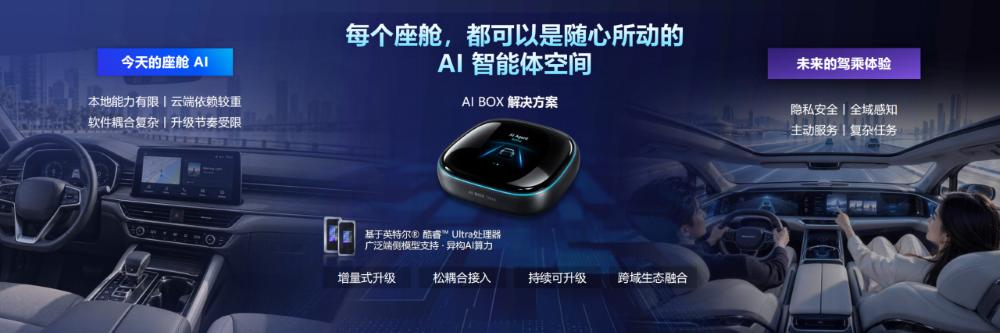
▲ The continuous upgradable capability brought by AI Box
At present, AI Box is officially delivered as an optional feature equipped on Changan Deepal L06, carrying a 4B VLM model plus multiple end-side models. From its debut in July to the realization of pre-installed mass production in October, the whole project cycle is only three months.
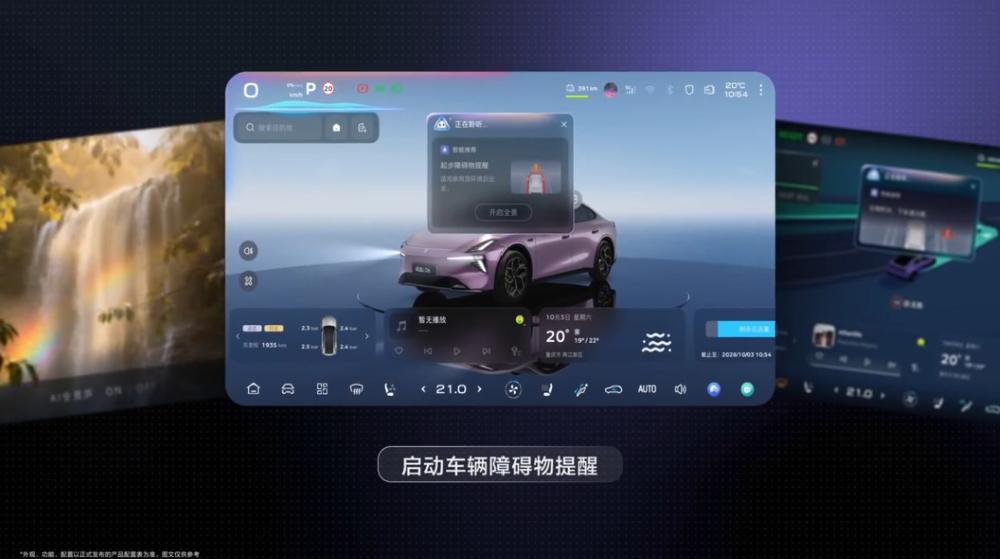
▲ Changan Deepal L06 equipped with AI Box
The open route is more suitable for automakers that do not have self-developed chip capabilities but want to maintain their competitiveness in cockpit intelligence, as well as for export vehicle models. The strict data compliance requirements overseas further amplify the value of local end-side computing.
And the open route bets that in the cycle of rapid model iteration, flexibility is more "valuable" than certainty.
The open route of modular computing power upgrade has ushered in its first mass production sample, but to evolve from a single case to a general paradigm for the whole industry, it still needs to face three industry variables.
In the automotive market, there is uncertainty in the intelligent feature optional mode. Whether consumers are willing to pay extra for subsequent intelligent upgrades still requires long-term market verification.
At the same time, third-party external computing power modules need to cross the vehicle-grade reliability threshold and clarify fault responsibility definition, which also brings the problem of whether automakers are willing to open cockpit hardware resources.
Whether to hand over incremental computing power to external modular solutions tests the open mindset of automakers.
03.
The digital arms race of model parameters cools down
Shifting to the competition of "intelligence density"
The dilemma brought by solidified computing power is not a unique problem in the automotive industry. Robots, smartphones and IoT devices are all facing the same bottleneck.
However, the parameter competition that simply compares TOPS computing power has reached a bottleneck under the constraints of intelligent cockpit conditions. Major manufacturers often release large models with dozens of B parameters at press conferences, but the actual scale of cockpit models that have achieved pre-installed mass production on vehicles is far smaller than the released caliber. Most end-side models actually running on vehicle infotainment systems are concentrated in the 0.9B-3B range, and the paper parameters are difficult to be implemented on real vehicles.
The density law proposed by researchers from Tsinghua University and Facewall Intelligence gives a new competition ruler: the capability density of large models roughly doubles every 3.5 months, and the computing power required for the same level of intelligence continues to decrease.
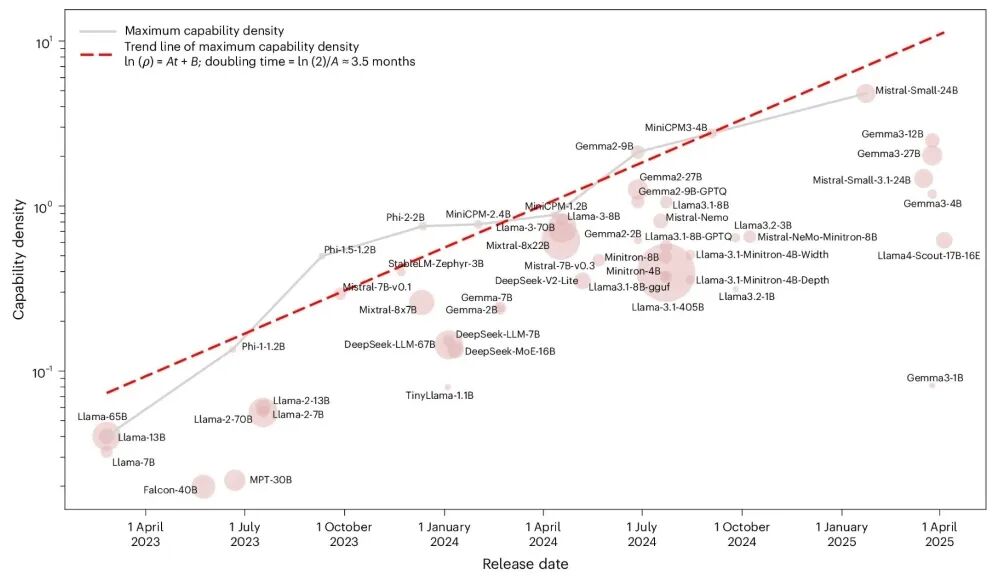
▲ The density law proposed by researchers from Tsinghua University and Facewall Intelligence
Once the modular upgrade mechanism breaks the solidified shackles of hardware computing power, the focus of industry competition will naturally shift from simply comparing the scale of paper computing power to the contest of computing power utilization efficiency. Parameter competition only stays on the paper of press conferences, while model density is the core that determines the gap of mass production experience.
The density competition does not need to trust anyone's slogans. The ranking lists and mass-produced vehicles will vote for this path.
04.
Conclusion: End-side intelligence makes vehicles intelligent partners
In the field of intelligent cockpits, the equal access of "basic availability" has been basically completed, but the AI cockpit experience and continuous evolution capabilities are still locked in price stratification by chip grades and pre-buried computing power. What intelligent cockpit intelligence needs is not larger pre-buried computing power, but a set of "computing power upgrade mechanism".
The equal access to intelligent driving solves the problem of "basic availability", while the upgradable computing power mechanism aims to bring "continuously evolving cockpit intelligence" to more vehicle models — making computing power keep up with intelligence, and not only limited to high-end vehicles. This is the next ticket to cockpit equal access.
Meanwhile, automotive intelligence is evolving in two main lines in two directions: for the vehicle end, it will further integrate in depth, become the cockpit AI computing power hub, and promote the transformation of the vehicle electronic and electrical architecture. For users, it will become a cross-device personal intelligent carrier, supporting plug-and-play and cross-vehicle memory migration in the future, connecting multiple terminals including vehicles, PCs, mobile phones and home appliances.
When intelligence occurs at the end side closest to people, vehicles will no longer be just travel hardware, but form a personalized intelligent system with perception and memory capabilities, and implementing privacy protection.
This article is from WeChat official account "CheDongXi", author: R, editor: Zhihao, published with authorization from 36Kr.