Klook has called off its IPO, is the destination experience business still a good business?
01
On October 16, 2026, Klook, the largest in-destination activities platform in the Asia-Pacific region, withdrew its listing application from the U.S. Securities and Exchange Commission.
The company attributed the move to market volatility, arguing that the timing was not appropriate for a public listing at that moment.
Roughly one year prior, Klook was still actively preparing for its IPO, with an original plan to raise approximately USD 300 million to 500 million.
In November 2025, Klook submitted its prospectus, attempting to present a growth story focused on independent travel, travel experience consumption and digitalized supply chains to the capital market.
According to data disclosed in public documents, the overall market size of in-destination activities that Klook operates in has further expanded in recent years.
From 2022 to 2024, in just three years, Klook's GTV (Gross Transaction Value) surged from USD 660 million all the way to USD 2.507 billion, and its revenue also increased sharply from USD 129 million in 2022 to USD 417 million in 2024.
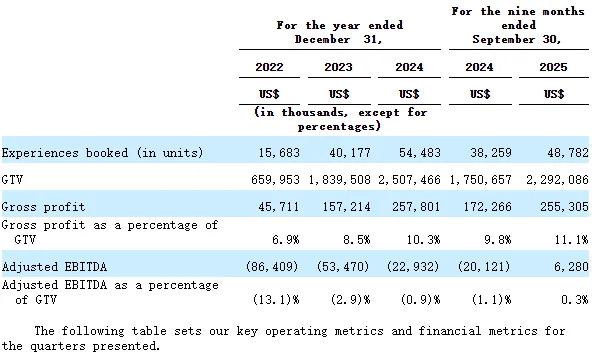
As of the end of September 2025, Klook's GTV reached USD 2.292 billion, up 30.9% year on year, with revenue of approximately USD 407 million, representing a 43.5% year-on-year growth. Its gross profit in the same period hit USD 255 million, equivalent to 11.1% of GTV.
The company also projected that the number of experience product bookings in 2026 would exceed 80 million.
However, on the other side of this growth, Klook's profitability is still under pressure.
In 2024 and the first three quarters of 2025, Klook recorded losses of USD 99.274 million and USD 141 million respectively.
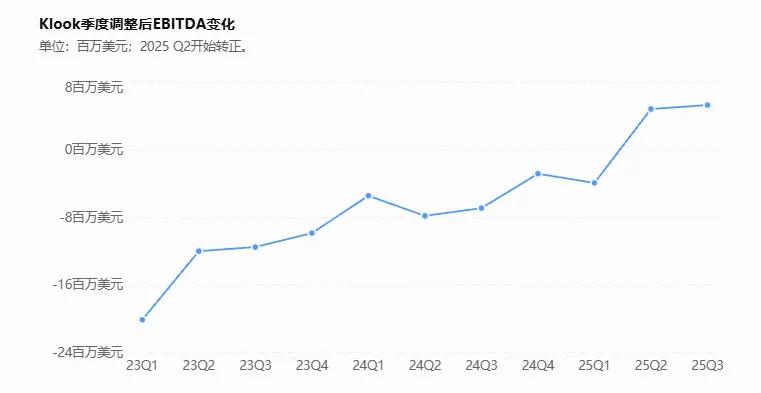
It is worth noting that in the first nine months of 2025, Klook's adjusted EBITDA turned profitable at about USD 6.28 million, but the loss related to convertible preferred shares amounted to approximately USD 126 million, which had a significant impact on the final net profit.
In fact, since 2023, Klook's gross margin has shown an improving trend. Starting from the second quarter of 2025, the adjusted EBITDA for a single quarter has already turned positive.
However, the book losses caused by convertible preferred shares in recent years have made Klook's capital structure an unavoidable topic when observing this company.
In the annex to the company's articles of association submitted to the SEC in 2025, Klook disclosed the redemption arrangements for some of its preferred shares.
In accordance with relevant terms, some preferred share investors may request redemption under specified conditions starting from January 1, 2027, with the redemption price including the principal and annual compound interest of 8% to 15%.

Meanwhile, the shareholder agreement also mentions that the company shall make its best efforts to promote the IPO or facilitate a sale transaction, and the overall sale price shall reach a valuation of at least USD 3.4 billion.

However, judging from the valuation the capital market currently gives to similar businesses, the secondary market may hardly offer the quotation that Klook's investors expect.
Among the existing listed companies, the comparable peer of Klook is Viator, the experiences platform under Tripadvisor.
Klook's GTV in the first nine months of 2025 was about USD 2.292 billion; while the GBV (Gross Booking Value) of comparable Tripadvisor Experiences (dominated by Viator) in the same period was about USD 3.7 billion.
As of October 16, 2026, Tripadvisor's market value was approximately USD 1.09 billion. Previously, the company had reached an agreement with American Express to sell its restaurant booking business TheFork for USD 700 million in cash.
Subtracting the two, there is only about USD 390 million left, which can be regarded as the reference value of Viator. Of course, this calculation is not rigorous and cannot be directly taken as the real valuation of Viator.
But as a reference, it still shows that the capital market does not give a high valuation to experiences platforms.
Luo Haizi, founder of Haize Capital, analyzed and pointed out: "Viator, Klook's main comparable company, has a larger transaction scale, but the rough residual equity value of Tripadvisor after deducting the sale consideration of TheFork is only about USD 400 million, which has a huge gap with the USD 3.4 billion overall sale threshold stated in Klook's shareholder agreement, highlighting its valuation challenges for U.S. listing."
"What is more noteworthy is that the redemption right of some of Klook's preferred shares will be exercisable from 2027. If the public market continues to be unable to support the expected valuation, how to establish a non-listing Plan B through private financing, strategic investment, equity transfer or renegotiation of exit terms in the next one to two years may become an important capital issue for Klook."
02
If what the capital market cares about is whether Klook can present a sufficiently appealing growth narrative, what suppliers care more about is how much business the platform can actually bring to them.
Mr. S, the head of a local ground operator in Australia and New Zealand, used to be Klook's supplier in the New Zealand market. He recalled that before the pandemic, Klook mainly purchased tickets through local agents, and later recruited local BD staff to shift to direct signing with scenic spots and API system integration.
For the platform, direct procurement can reduce intermediate links, lower procurement costs, and also grasp inventory more directly.
But in-destination activities are not a business that can maintain sustainable competitive advantage simply by moving products online.
Mr. S observed that with the intensification of competition in destinations, leading domestic OTAs have also strengthened direct procurement and supplier connections in Australia and New Zealand in recent years. Coupled with the impact of self-media platforms such as Xiaohongshu, WeChat Channels and Douyin, Klook's original traffic advantage has been diluted.
In his view, Klook is more positioned on standardized in-destination activity products. What platforms need to compete for is not only scenic spot resources, but also the fulfillment and local service capabilities behind these resources.
Compared with air tickets and hotels, in-destination activities have inherent complexity. What consumers buy on the platform may only be a scenic spot ticket, an airport transfer or an island hopping tour, but the actual consumption process takes place overseas locally.
Flight delays, driver lateness, temporary closure of scenic spots, changes of meeting points, and even temporary itinerary adjustments by tourists may turn an apparently standardized order into a complex problem that requires manual intervention.
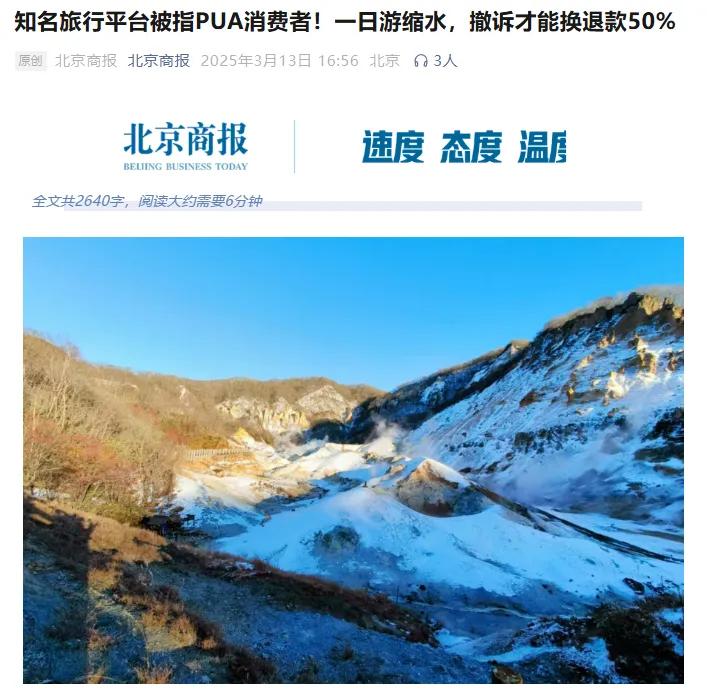
For example, in March 2025, Beijing Business Today reported a consumption dispute over a one-day tour in Hokkaido: consumers purchased a "one-day tour" product through Klook, but the actual trip turned into a "half-day tour" due to unclear product information labeling.
After multiple rounds of communication, the platform agreed to issue a refund, but the whole process from applying for a refund to resolving the dispute lasted for nearly two months.
A senior tourism industry practitioner Mr. A also had a similar experience.
He said that during his trip in Southeast Asia, he saw many discussions about Klook's after-sales service in independent travel communities, such as late airport pick-up, local suppliers failing to pick up people on time, and low processing efficiency of the platform when problems occurred with on-site orders.
"Many after-sales issues need to be communicated via email, which is low in efficiency. Unlike domestic OTA platforms, which have dedicated customer service staff that can handle issues quickly with just a phone call."
In Mr. A's view, the biggest difference between in-destination activity products and traditional shelf e-commerce is that the delivery and fulfillment of activity products can hardly be completely solved by standardized API interfaces and automated systems.
What the platform promises is a one-stop booking experience, but behind it, what really determines service quality is often the suppliers, local ground operators, drivers and scenic spots outside the platform.
For activity platforms, the shelf model can quickly expand SKUs and cover more destinations, but the accompanying delivery and fulfillment pressure will also increase synchronously with the number of SKUs and order scale.
In the report of Beijing Business Today, Klook once responded: the relevant person in charge said that the tourism industry has a long delivery chain, and in some cases, Klook needs to wait for approval from suppliers. Currently Klook is also making every effort to improve the overall process.
03
In the view of Xiao Yuanshan, a senior tourism industry observer, public opinions about Klook's fulfillment and after-sales issues cannot be simply attributed to the platform's lack of attention to service. Behind it lies the differences in business philosophy and management methods.
In his words, online activity platforms like Klook that focus on standardized products have strong internet genes from the very beginning of their rise, and are inherently better at solving problems through technology and processes. In addition, the founding team comes from Hong Kong, so their management style also carries the characteristics of overseas service providers.
Xiao Yuanshan has been engaged in overseas activity products for more than ten years, and has cooperated with Klook for five or six years, working both as a supplier and a distributor.
He talked about his experience dealing with overseas suppliers: "Many suppliers in Europe and the United States will reply to your email after a very long time when they receive a complaint, and there is no use getting anxious. Unlike in China, where you can clarify the whole matter in a few WeChat messages."
This business style of overseas suppliers will naturally bring different experience to consumers who are accustomed to the rapid response mechanism of domestic OTAs.
"For example, if you book a one-day tour product overseas and cannot contact the driver or the driver does not come to pick you up as agreed, tourists have to contact the supplier to solve the problem by themselves. Unlike in China, where you call the after-sales hotline and the platform will help you solve it. Domestic tourists are accustomed to the latter, so the experience gap with Klook arises."
However, in the settlement link that suppliers value most, Klook left a good impression on Xiao Yuanshan. "When it's time for settlement, not a single cent will be delayed, not a single day will be delayed."
He recalled that when he cooperated with Klook as a distributor, the platform once gave merchants a certain credit line according to the cooperation situation, "I remember it was about 20,000 yuan. Within the range of 20,000 RMB, I didn't need to pay in advance, and I just settled my bill every month."
In Xiao Yuanshan's view, the supply chain of in-destination activity products is very fragmented. The platform not only needs to purchase from different suppliers, but also supply to different distribution channels. There are many links with transparent prices, and standardized tickets and airport transfer products are very easy to be price-compared, making it difficult to obtain high gross margins.
"If a company operates with the goal of IPO, there are only two possibilities: one is to achieve a sufficiently high gross margin and build a sufficiently large competitive barrier; the other is to expand its volume to a large enough scale and use scale as its competitive barrier. Obviously, Klook belongs to the second category."
This also means that Klook needs to continuously expand its product SKUs, destination coverage and order scale, and dilute technology, traffic and operation costs through scale effect.
However, the larger the scale, the more suppliers and fulfillment scenarios the platform needs to manage. If the service system is not improved synchronously, the operational pressure brought by the scale will break out concentratedly, which is also an unavoidable issue for activity platforms at home and abroad.
Although Klook suspended its IPO some time ago, it does not mean that the in-destination activity business has come to an end.
According to the data from the report "The Outlook for Travel Experiences 2019-2029" jointly released by Arival and Phocuswright, the global travel experience market reached a scale of about USD 271 billion in 2025, and is expected to reach USD 342 billion by 2029.
What is more noteworthy is that the online booking share of global in-destination experience products in 2025 is only about 33%, while the online booking share of the entire tourism market is about 64%.
This means that there is still much room for growth in the online booking of in-destination activities.
In addition, another study by Arival and Phocuswright also points out that more than 70% of in-destination experience operators around the world are micro and small enterprises.
Due to the highly fragmented supply and obvious local characteristics, there are considerable difficulties in bringing these suppliers into the online distribution system in practice. In particular, some small enterprises do not have a strong willingness to expand their business scale or develop distribution channels.
This means that to complete digital integration, the platform still needs a large amount of local BD work, supplier training, system docking and fulfillment management, which are exactly the areas that activity platforms need to continuously invest in.
From this perspective, the real opportunity for activity platforms is not just to move offline tickets online, but that the one who can integrate the supply chain at lower cost while taking into account consumer services will have the opportunity to build long-term barriers.
Klook's suspension of IPO this time reflects that relying solely on market scale growth and order expansion is no longer enough to meet all the expectations of the capital market for activity platforms.
Whether the GMV on the books can be turned into a stable, replicable and profitable business is the question that in-destination activity platforms need to seriously consider at the moment.
This article is from the WeChat Official Account "TravelDaily", author: Hu Biao, published by 36Kr with authorization.