AI-generated manhua dramas' global expansion is not about purchasing users.
When AI manhua dramas go global, there is a very easy-to-misunderstand point. You are looking at the global download volume, but what you really need to earn is the local currency from each individual market.
The domestic AI manhua drama track is getting increasingly crowded, so many practitioners are turning their sights to overseas markets. The overseas market is huge, traffic is cheap in some regions, and AI has pushed production costs down. No matter how you calculate it, it seems worth a try to expand overseas.
But after reviewing several overseas short drama reports, I found that the accounting is far less straightforward than it seems.
......
In the first quarter of 2026, the number of downloads of overseas short drama apps reached 850 million, a year-on-year increase of 140%; in the same period, in-app purchase revenue was about 750 million US dollars, with a growth rate of only 20%.
The data comes from Sensor Tower. The statistics here cover the entire overseas short drama app market, including live-action short dramas; in-app purchase revenue does not include advertising, and cannot directly represent the operating performance of AI manhua dramas.
However, downloads have more than doubled, why has in-app purchase revenue only increased by 20%?
Looking further at the regional distribution, the picture becomes very telling.
Southeast Asia accounts for 32% of downloads, Latin America 23%, and India 22%, adding up to 77%. The United States only accounts for about 3% of downloads, but contributes about 37% of global in-app purchase revenue. Calculated in another way, the in-app purchase revenue generated by one download in the United States is more than ten times the global average.
Short Drama Study Room and Amazon Web Services jointly released a "2026 White Paper on Short Drama Global Expansion" in late October, using the same calculation method and counting the data of the first half of the year.
Indonesia and India together contribute 41.76% of downloads, while the United States contributes 36.24% of in-app purchase revenue, amounting to about 378 million US dollars.
The figures for the first half of the year are even more extreme: total downloads reached 1.667 billion, up 25.34% from the previous six-month period; while in-app purchase revenue was 1.043 billion US dollars, a year-on-year decrease of 0.86%.
The two reports cover different time periods and use different statistical calibers, but one conclusion aligns: regions with high download volume are not necessarily regions with high in-app purchase revenue.
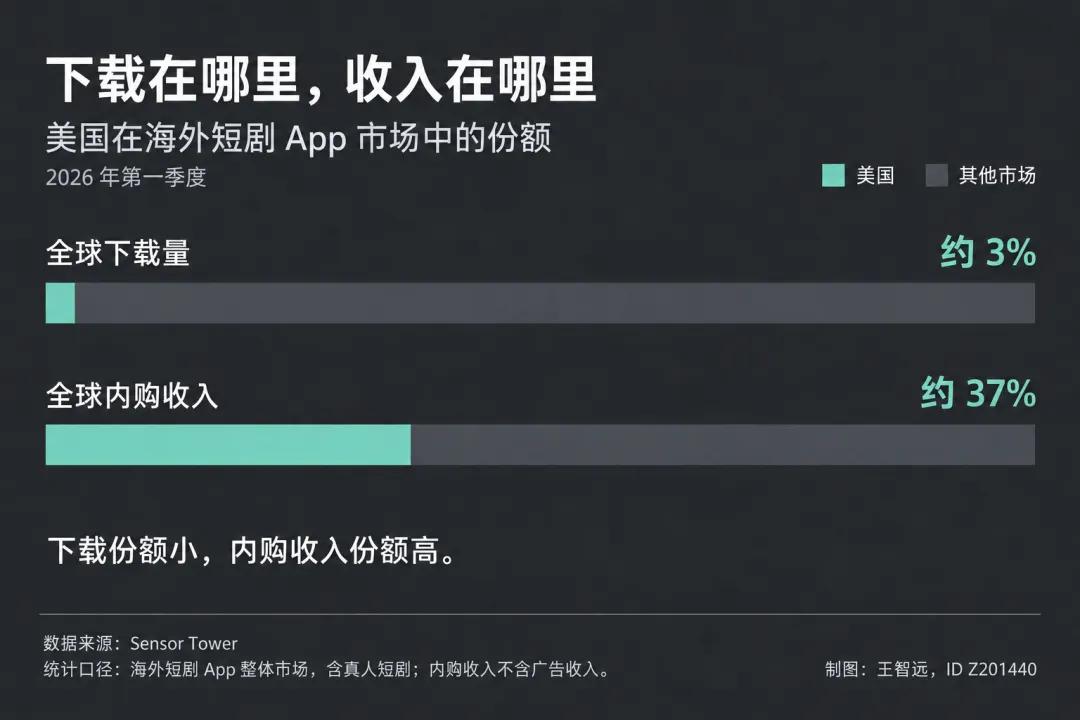
Why is this happening? Part of the reason lies in the user acquisition cost per new user.
According to statistics from Diandian Data, the average cost per installation in North America is 5.28 US dollars, while it is only 0.34 US dollars in Latin America, a 15.5-fold gap.
With the same 528 US dollars, you can only buy about 100 installations in North America at this average price, but you can get more than 1500 installations in Latin America. Practitioners in charge of growth can hardly resist the temptation of such a huge price gap.
But after the download volume goes up, the revenue side is no longer such a simple calculation.
The amount of payment and advertising revenue that Latin American users can generate depends on the local consumption power and advertising market maturity.
For the same drama, no one in Jakarta may be willing to pay 30 cents for the next episode, while some users in Texas are willing to subscribe on a monthly basis.
Downloads can be added up globally, but revenue has to be calculated by individual market, which leads to a very easily overlooked problem.
The same 1 million downloads, generated in the United States versus generated in Latin America, may come with completely different user acquisition costs, payment willingness, and advertising revenue; but once you put them on the global download ranking list, they are all presented as the exact same number.
Therefore, some platforms choose to spread their downloads across many countries, while others simply focus on operating in one single market.
For example:
TrueShort, a US-based short drama platform, launched in April 2025, focuses on acquiring users and monetizing for US audiences. Six months after launch, its annualized recurring revenue (ARR) reached 2.4 million US dollars.
Note that this is annualized recurring revenue, which does not mean that the platform actually earned 2.4 million US dollars in six months, let alone profit.
The scale of TrueShort cannot be compared with leading platforms. 2.4 million US dollars is roughly equivalent to 17 million RMB, while ReelShort generated 1.57 billion RMB in revenue in just one quarter, a gap of more than 90 times.
However, it provides a different sample: going global does not necessarily require spreading traffic volume across all regions. Creating content, acquiring users and generating revenue around a single market is also a viable approach. This path can work, but it cannot support very large scale.
You can tell how hot a market is just by looking at the download ranking list, but the download list tells you nothing about whether a market is worth investing in.
……
You can roughly know in advance where to buy an installation and how much it will cost. But after you acquire that user, how much is this user actually worth?
There are three sets of accounts to calculate here. The first one: how long will the user stay on the platform.
Data from Adjust shows that the 30-day retention rate of overseas short drama apps is about 2%, and around 3% in North America.
What does this mean? Suppose 100 people download your app today, by the 30th day, only 2 or 3 of them may still be using it.
The 98 users who churned earlier did not spend zero money at all: they may have watched ads and unlocked several episodes, but just did not stay long-term.
Some users leave after watching two episodes, some binge for a whole week, and others are willing to renew their subscriptions. At the moment of download, you have no idea which type of user they will turn out to be.
In addition, the short drama business has a unique feature: users may come to the platform just for one specific drama.
After they finish watching that drama, they may not be interested in watching the next one; the platform has to continuously roll out new content to have a chance to keep them engaged. Otherwise, the users you paid to acquire today will have to be re-acquired again tomorrow.
Even among the 2 or 3 users who stayed, not all of them have spent money. Retention and payment are two separate things: you have to retain the user first to get a chance to monetize them, but among the retained users, only a small portion are willing to pay.
The second set of accounts: how much revenue can this user generate.
According to existing statistics, the monthly revenue per monthly active user in Latin America is about 0.68 US dollars, and about 1.29 US dollars in North America, nearly twice as much.
Interestingly, North American users contribute higher average revenue, but the user acquisition cost there is also much higher.
These two figures cannot be used to calculate the payback period, as they use different statistical calibers and cannot show how much the same group of users will spend in subsequent periods. To judge whether the investment is cost-effective, you have to calculate the total revenue generated by a user from the day of download to the day of churn.
Moreover, the monetization model of overseas short dramas is also changing now.
Relevant statistics show that nearly 80% of new applications adopt the free model. The proportion of apps that mainly monetize through advertising has risen from 53.6% to 62.8%. Breaking down the structure: 57.6% use a hybrid monetization model, 39.9% rely purely on advertising, and only 2.5% use a pure paid model.
This means that if a user does not pay, it does not mean the platform cannot make money from them.
This user may never buy a membership for any episode, but binge on more than a dozen episodes every day. For the platform, this user still has value.
But advertising monetization also has its own set of calculations.
How many episodes a user watches, how many ads can be displayed in each episode, whether advertisers are willing to place bids, and how much each ad impression is worth, all affect the final revenue. If you can insert one ad between every two episodes, watching ten episodes means ten ad impressions. The total advertising value of the user is the product of the number of impressions multiplied by the unit price per impression.
According to estimates from MPA, for every 1 US dollar of advertising revenue, the final profit retained is 65 to 70 cents.
The same user who leaves after watching the first episode and the user who binges ten episodes can generate vastly different amounts of advertising revenue. Even if neither of them has paid, you cannot simply say that they are of equal value.
What's more, the free model is just a different way of collecting revenue, and the user acquisition cost you spent earlier does not disappear because of this.
Therefore, both in-app purchase revenue and advertising revenue have to be counted in. This accounting is not settled at the moment of user acquisition, but is settled gradually over the user's lifecycle.
The third set of accounts: whether the content can keep users watching continuously.
When you operate this business overseas, there are even more variables. For example, in North America, downloads of sweet romance CEO-themed dramas once dropped by 37%, while the number of werewolf-themed works rose from 6 in April to 19 in May.
This does not mean that werewolf dramas are more profitable, it only means that popular themes are changing.
You may bring a hit drama that has been proven successful in China overseas, but it may not even retain users after the first episode. If you change the story and adjust the character relationships, the performance may be completely different. Moreover, user preferences change very quickly: the users attracted by werewolf-themed dramas will leave once the werewolf trend fades out.
An ad delivery adjustment made by DramaWave in September this year is also very thought-provoking.
It cut its delivery scale by nearly half, the number of downloads dropped by more than 40% that month, but revenue only decreased by 6.56%.
You cannot judge whether it is profitable or not by looking at the data of just one month, as the revenue may come from users accumulated in previous periods. But it is very clear that there is no direct correspondence between the number of new downloads you get today and the amount of revenue you receive today.
For operators, this set of accounts has two columns: one column records the money you spend today, and the other records the revenue you get back later. The trouble is that you never know in advance when the second column will be fully filled. Just looking at the CPI and the download ranking list, you really cannot find the answer.
……
Okay, here comes the question: even though you know that user acquisition does not necessarily pay back, why do you still keep buying traffic?
Because for short drama platforms that rely on paid user acquisition, buying traffic is not only a way to get users, but also the cost to verify whether your content can be sold. If you don't buy traffic, you don't even get the chance to verify.
Think about it, after you finish producing an AI manhua drama, what should you do next?
You can't just leave it in the app and wait for users to come. Users don't even know who you are, no matter how good your drama is, you have to get it in front of people first.
Xiaguang Think Tank has a set of very striking data. According to its statistics, among Chinese short dramas going global, AI short dramas account for about 95% of the total production, but their total view count only accounts for about 4%.
This is only the sample covered by that report, and cannot be regarded as the proportion of the entire market. However, the fact that a large number of dramas have been produced but the audience size has not kept up is a real contrast.
Now look at the overseas ad delivery landscape.
From January to February 2026, the number of ad creatives for overseas short dramas reached 5.18 million groups, a year-on-year increase of 260%, while the in-app purchase revenue in the same period only increased by about 5%.
The number of creatives is not equal to the total ad cost, and in-app purchase revenue does not include advertising revenue, so these two figures cannot be directly used to calculate return on investment. But it is clear that there are more and more creatives competing for users, while in-app purchase revenue has not grown accordingly.
Suppose you have produced an AI manhua drama and plan to test it in the US market.
First you cut several creatives, invest a certain amount of budget, see if people click on them and can be directed to your app. If the performance is not good, you revise the creatives and launch them again. If the performance is good, you increase the budget.
AI has greatly accelerated the creative revision process. In the past, you had to wait half a day for one version, now you can generate several versions in a very short time. But creatives can be generated in batches, while ad inventory cannot, so the actual cost you have to spend has not been reduced at all.
The problem arises when you scale up the campaign. A small budget that runs well does not mean that it will still perform well when you increase the budget tenfold. The group of users who are easily attracted by your creatives may have already been almost fully tapped, and to get more new users, you have to target audiences who are far less receptive.
Testing can help platforms avoid detours, but it cannot guarantee that the next dollar you spend will definitely generate returns.
You have to start all over again when you enter a new country. The creatives and unit prices you figured out in the US may not work in Indonesia. Content can be distributed across borders, but operational experience cannot be directly copied.
Now look at where most of this ad budget is spent.
According to current industry statistics, in the overseas short drama ad delivery landscape, Meta accounts for about 65%, Google accounts for 20%, and TikTok accounts for 10%.
For short drama apps that rely on paid traffic acquisition, if you want to promote your dramas to overseas users, you usually cannot bypass these channels.
Industry estimates show that for this type of business model, traffic acquisition costs account for about 50% of total expenditure, and content production accounts for about 20%. This is not the unified cost structure for all teams expanding overseas, but it shows that for platforms that build their own apps, user acquisition is a very heavy expense.
And what the ad platforms sell you is not the same thing as what you actually want to buy at all.
You pay for impressions, clicks and installations, all three of which the platform can deliver as agreed and count clearly. What you want is for this user to stay and be willing to pay, two outcomes that the platform does not and cannot guarantee, as it has no control over them.
The two parties are not measuring the same thing. One side considers the task completed once the delivery is done, while the other side's work only starts after the delivery is finished.
Therefore, no one is cheating in this transaction. The platform has delivered everything it promised, but you may still suffer losses.
Whether you stop the ad campaign or switch to a new drama, the money you have spent already cannot be recovered. If you want to verify new content or enter a new market, you have to allocate new budget again.
This transaction is interesting in this way: if you want to know whether a drama can sell well, you have to spend money to get it in front of users; but spending money only buys you one chance to verify.
Teams that do content revenue sharing, for example on TikTok, may not need to buy traffic on their own. The discussion here refers to platforms that rely on self-built apps and paid ad delivery to acquire users.
Therefore, the hardest part to calculate for AI manhua dramas going