Anthropic returned to operating loss in the third quarter
Revenues are still surging, but bills are growing even faster. The latest prospectus submitted by Anthropic on Monday local time shows that this star AI enterprise has returned to losses after only one quarter of operating profitability; meanwhile, its nearly $900 billion computing power commitment has become the most thorny test on its way to IPO.
On November 2 local time, Anthropic submitted a revised prospectus to the U.S. Securities and Exchange Commission (SEC), supplementing the missing financial data for the third fiscal quarter of fiscal 2026 (ended September 30) in the first version of the prospectus.
Data shows that the company's revenue in the third quarter was about $17 billion, up about 47% from $11.6 billion in the second quarter, and more than 10 times higher than $1.4 billion in the same period last year. Compared with the 144% quarter-on-quarter growth rate in the second quarter, this growth rate has slowed down significantly.
The prospectus also notes that 5% to 7% of the revenue in the first nine months of this year came from customers who violated its usage policies or commercial terms. The company has stepped up efforts to rectify unauthorized usage since August, and future revenue growth may face further pressure as a result.
Was the operating profit just a flash in the pan?
In the third quarter, Anthropic recorded an operating loss of $567 million, while in the previous quarter, it achieved operating profit for the first time, amounting to $974 million.
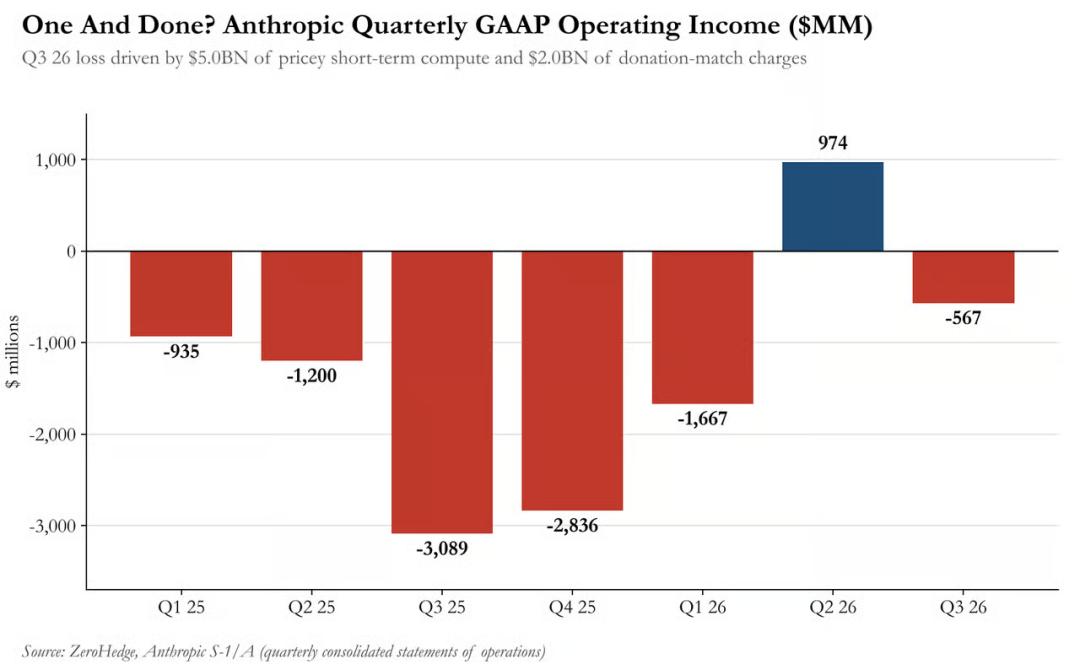
Note: Anthropic's quarterly operating profit, it only achieved profitability in the second quarter of 2026 among the seven quarters
A major reason for the shift from profit to loss is the sharp surge in computing power costs. Anthropic usually signs long-term contracts 12 to 18 months in advance to reserve computing power, but user demand growth in the third quarter exceeded expectations, and the originally reserved computing power was insufficient. The company had to temporarily purchase an additional $50 billion worth of short-term computing power at a price significantly higher than that of long-term contracts.
Affected by this, computing power and infrastructure expenditures in the third quarter jumped 77% quarter-on-quarter to $99 billion, every $1 invested in computing power and infrastructure only brings $1.72 in revenue, lower than the $2.08 in the second quarter, marking the first decline of this indicator.
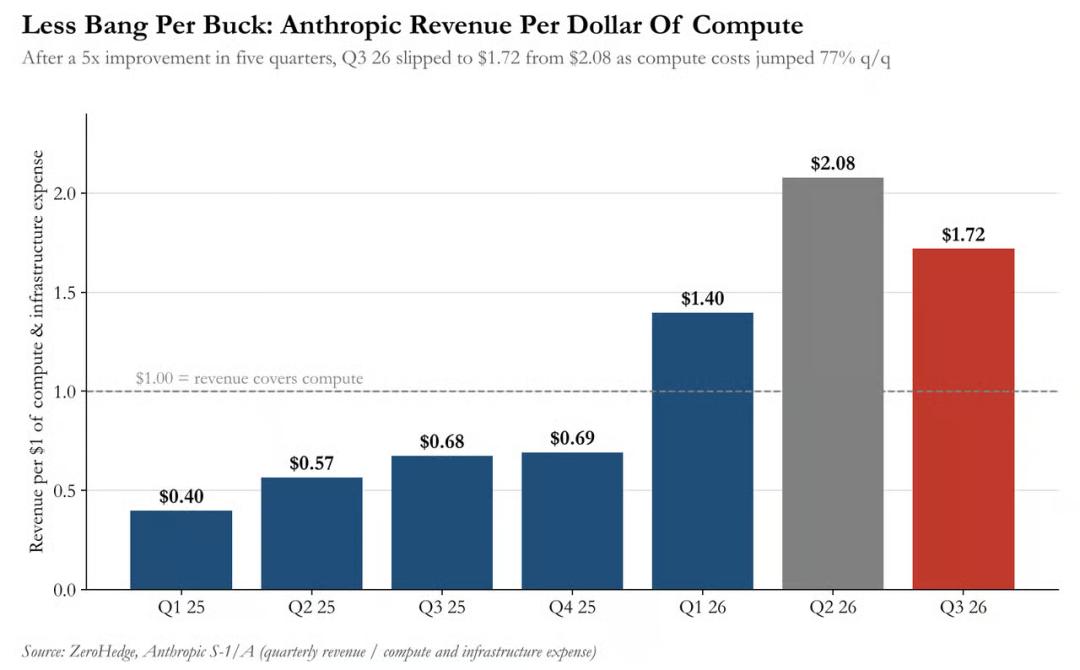
Note: Revenue generated per $1 of computing power and infrastructure expenditure
At the same time, price cuts for new models and contract discounts reduced revenue by about $6 billion in the third quarter. The combination of rising costs and falling prices has squeezed profit margins from both ends.
In addition, a $2 billion non-cash expense related to the employee donation matching program was also recorded in the quarter. After excluding such items and equity incentives, Anthropic still had an adjusted operating profit of about $2.5 billion, but the profit margin had dropped from 19% to 15%.
According to reports, to get rid of the expensive short-term computing power, Anthropic is advancing the "Anthropic Direct" initiative. "Anthropic Direct" is an exclusive computing power infrastructure built by Anthropic for itself, aiming to replace short-term computing power with lower-cost long-term capacity.
As early as three days before the release of the revised draft, Jay Goldberg, an analyst at U.S. investment research firm Seaport Research Partners, warned that Anthropic's profitability is unsustainable, and it will return to losses in the future, and bluntly stated that the situation its IPO faces is quite challenging.
The sky-high computing power bill
This revised draft also disclosed the total amount of committed expenditures for the first time, while the first version of the prospectus only listed the amounts of major contracts item by item, leaving the total sum blank.
Including newly signed contracts after September 30, Anthropic's total procurement and lease commitments are approximately $895.4 billion, almost all of which are used to purchase computing power and lease data centers, with the payment period extending all the way to 2045.
According to reports, the most urgent part is about $69.8 billion due within the next 12 months. This figure has exceeded Anthropic's annualized revenue based on third-quarter operating results, and is equivalent to more than half of its approximately $131.8 billion in cash and short-term investments as of the end of September.
The prospectus shows that the $895.4 billion is not the full amount. Anthropic also plans to purchase $125 billion to $150 billion worth of chips from Google, and spend more than $20 billion on chip giant AMD. These two contracts are not yet included because no fixed amount has been agreed. The company estimates that such contracts will require payments of approximately $150 billion to $175 billion in the future, and the total computing power bill will exceed $1 trillion after inclusion.
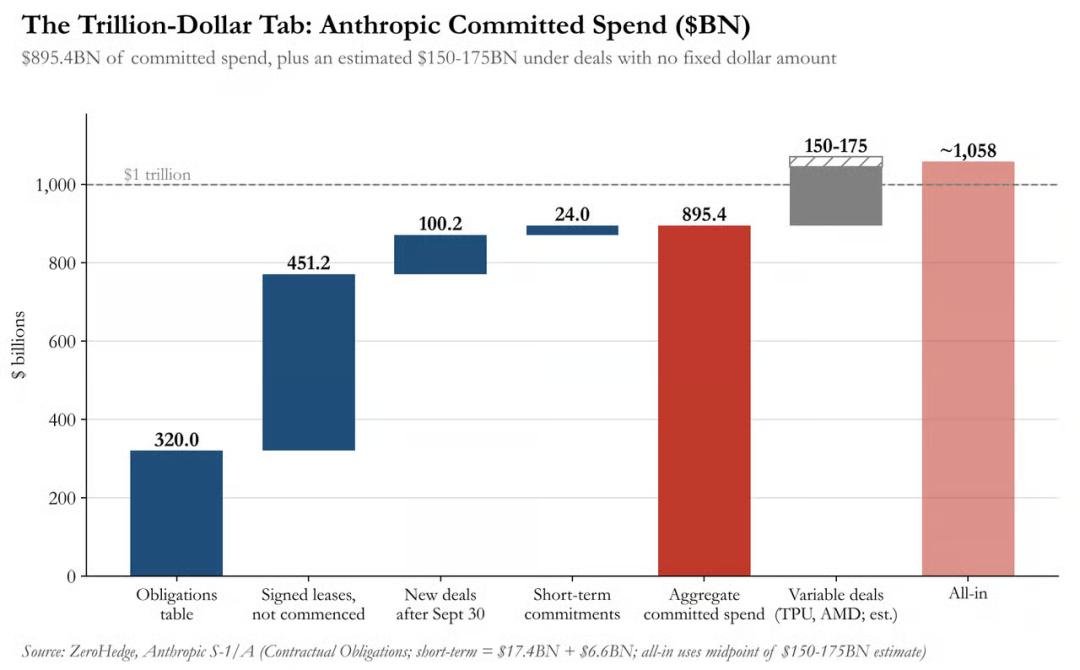
Note: Composition of Anthropic's computing power bill (in $100 million): contractual obligations $320 billion, signed but not yet commenced leases $451.2 billion, new contracts signed after September 30 $100.2 billion, short-term commitments $24 billion, totaling about $895.4 billion; there are also estimated $150 billion to $175 billion for non-fixed amount contracts, with a total of about $1.06 trillion
Who gets the money?
From the perspective of division of labor in the AI industry chain, chip designers provide computing power chips, cloud vendors and data center operators install chips in computer rooms for external lease, and model companies like Anthropic lease computing power to train and run models, then sell services to enterprise and individual users.
Anthropic's bills are paid to all links in this chain. Media reports point out that Broadcom ranks first with a TPU equipment lease of about $161.2 billion, while Google under Alphabet has no less than $121.3 billion, which is higher than the $114.5 billion in the first version of the prospectus.
Following closely is the AI division of Elon Musk's SpaceX, with a maximum contract amount of $120.5 billion; Amazon's contract amount is no less than $110 billion; and Microsoft's is $44.9 billion.
British AI cloud service provider Nscale and American GPU cloud service provider Lambda have also won contracts with upper limits of $44.6 billion and about $41.3 billion respectively, and the performance of some of these contracts depends on whether the counterparty can obtain financing or data center sites.
Such a cooperative relationship is quite complicated. After Anthropic publicly submitted the first version of the prospectus on October 26, Mark Mahaney, an analyst at U.S. investment banking research institution Evercore ISI, pointed out that for cloud computing giants, Anthropic is simultaneously a customer, a competitor, a sales channel, and an investment target.
This article is from the WeChat Official Account "Sci-Tech Innovation Board Daily", written by Li Ying, authorized for release by 36Kr.