Superintelligence Is Yet to Come, But the Super Bill Has Arrived First? Debt Landmines Deal a Heavy Blow to the AI Bubble
01
The Devastating Crash Moment
Have you noticed any changes recently?
Fewer people are discussing the South Korean stock market, not because its frequent sharp surges and slumps have made investors numb to the volatility.
Instead, the whole global market is in a state of nonstop plunging recently, from US stocks, South Korean stocks to A-shares, none of them are spared......

A perfectly fitting Halloween costume
In the last week of October, the market value of the Nasdaq 100 evaporated by approximately 2 trillion US dollars, which is equivalent to the GDP of several countries vanishing in just one week.
Especially on last week's "Black Friday", the three major US stock indices closed sharply lower collectively, with the tech stock and semiconductor sectors leading the decline.
They could even be described as the absolute main targets of market sell-offs.

In this round of plunge, Google's parent company Alphabet plummeted 12.64%, with its market value evaporating by about 500 billion US dollars in a single day.
Intel fared even worse, closing down 28.58% on the day, with 150 billion US dollars of market value wiped out, marking its second largest single-day drop since the company went public.
China's A-share semiconductor sector has also experienced drastic adjustments recently, with consecutive sharp declines on October 29 and 30.
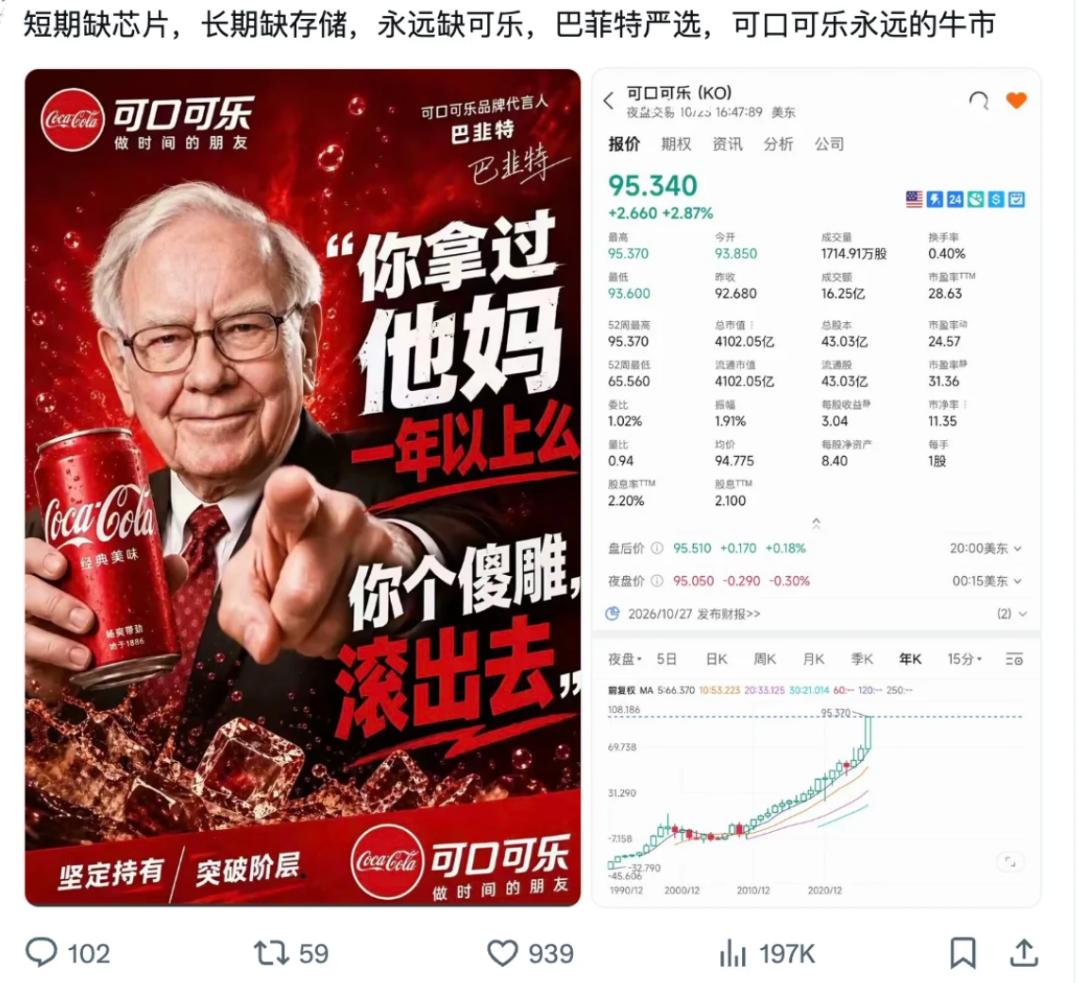
Warren Buffett and his Coca-Cola still hold strong
For stock investors, although the broader market is not as volatile as the South Korean stock market's previous roller-coaster performance, this rapid plunge concentrated in highly popular sectors and leading companies is as stinging as a needle prick or an awl stab, and the downward pressure now feels like a mountain pressing down on everyone.
So it's not that people don't care about the stock markets of other countries, it's that everyone is in the same miserable situation now, with no time to pay attention to others, as their own investment accounts are already in a precarious state.

But even Buffett didn't escape this round of losses
Wait a minute, that doesn't make sense?
Since the whole industry rushed into the AI era at full speed, weren't all companies supposed to see booming performance with fanfare?
Including this time around, why is it that the better the performance, the sharper the decline?
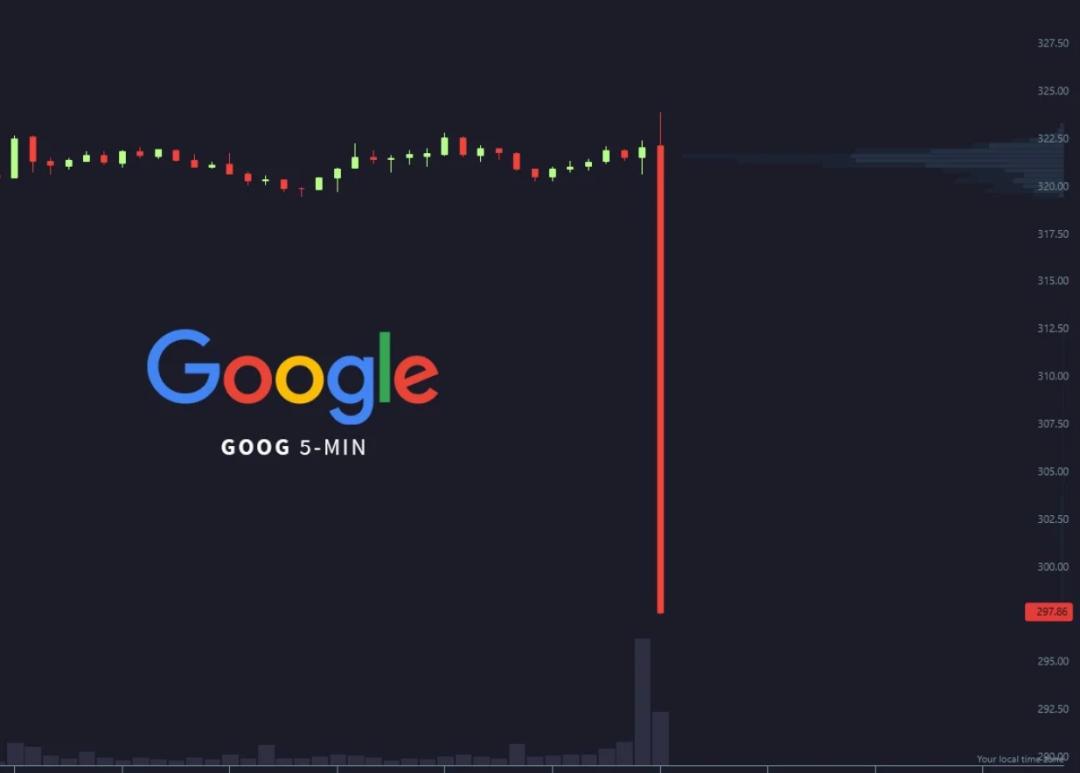
Taking Google and Intel, which suffered the biggest drops this time, as examples, their performance in this quarter actually looks quite good on paper, but the market just refuses to buy in.
First for Google, its third fiscal quarter revenue hit 127.6 billion US dollars, up 25% year on year, and Google Cloud's revenue doubled. However, the company's free cash flow unexpectedly turned negative this quarter: it earned so much money but still couldn't cover the huge gap from its aggressive bet on AI infrastructure.
Intel is in a similar situation: its third quarter revenue reached 16.513 billion US dollars, up 21% year on year, and its data center and AI business grew 78% year on year, marking its strongest growth in 15 years. However, the CFO warned that the company still cannot achieve positive free cash flow by 2027, not to mention that future capital investment will continue to increase.
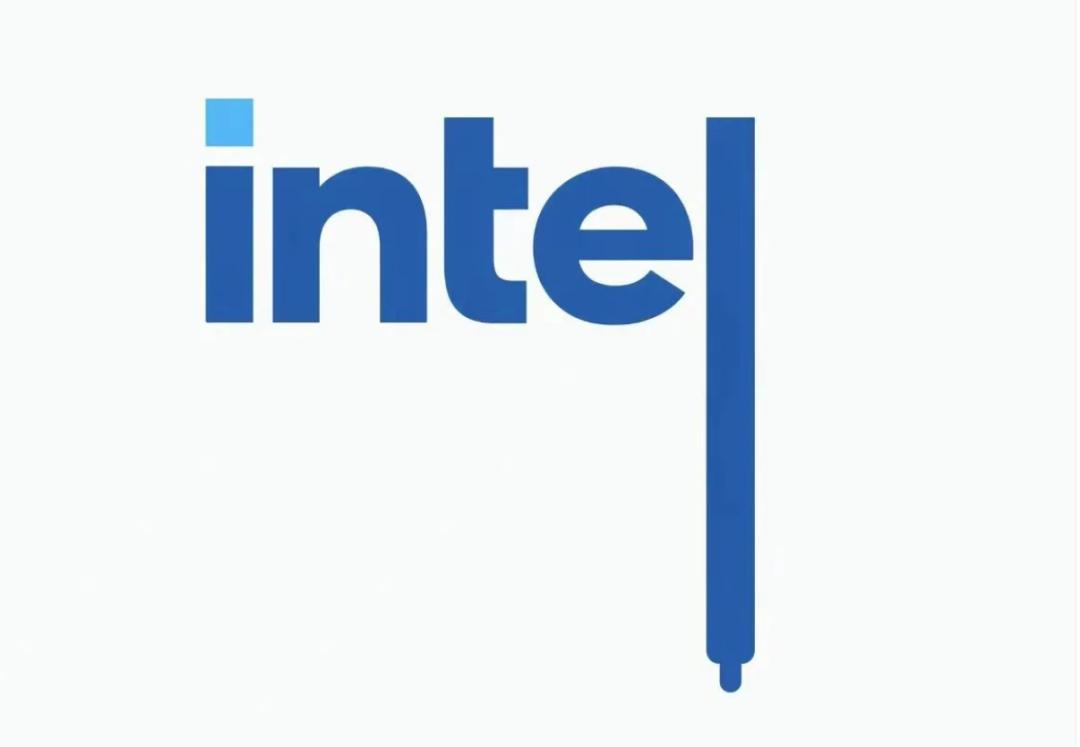
Two fellow sufferers hit hard by the slump
No wonder the market won't buy in: even with explosive performance growth, it still can't keep up with the money-burning speed of these companies in the AI competition arena.
Behind this stark contrast between extreme highs and lows, Silicon Valley has entered the era of great suppression after the massive money-spending spree!
After fully stepping into the AI era, Silicon Valley has completely turned money burning into a tangible, concrete reality.

How to describe it? Even if you literally burned all this money with fire, it would definitely take far longer to burn it all than the current crazy spending pace.
Because right now, tens of billions of dollars is just the entry ticket, hundreds of billions is the normal spending level, and trillions is the ultimate goal for the long term.
The total capital expenditure of Alphabet, Microsoft, Amazon, Meta and Oracle in 2026 is expected to reach 769.2 billion US dollars, which is almost twice the figure in 2025, and may hit 1 trillion US dollars in 2027. If we count SpaceX as well, according to S&P's estimates, these leading companies will spend more than 7 trillion US dollars on AI projects such as data centers from 2025 to 2030, which is truly an astronomical figure.
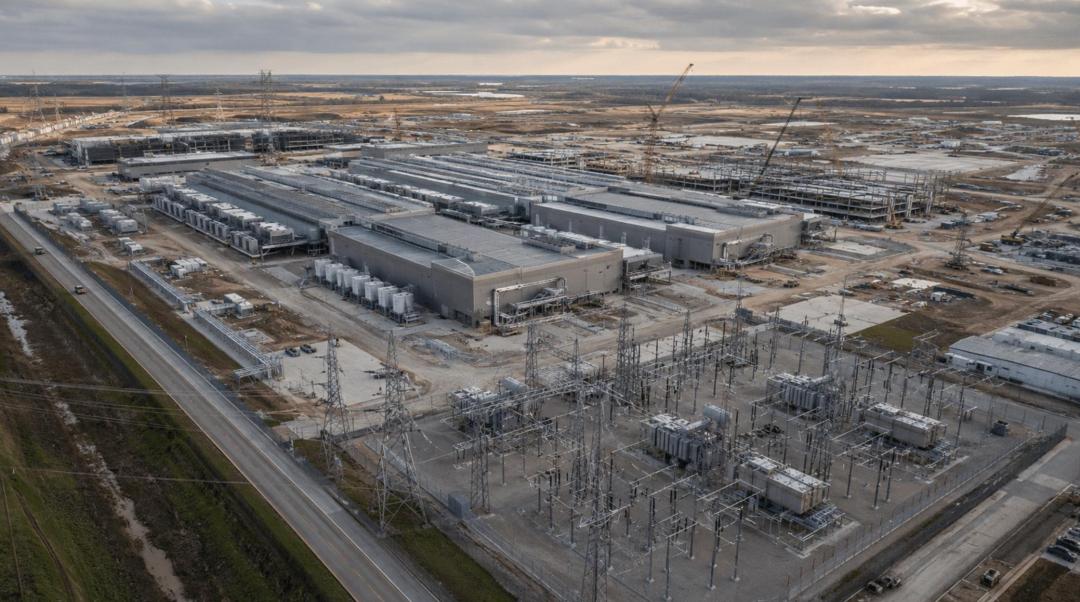
The multi-hundred-billion-dollar "Stargate" data center project gets built right away, and hundreds of billions of dollars worth of computing power units get purchased without hesitation. Everyone knows the Silicon Valley elites are extremely wealthy, but no matter how deep their pockets are, they can't keep spending at this pace, and eventually even the richest households will run out of spare cash......
Take Amazon for example: although it generated 42.4 billion US dollars in operating cash flow in the latest quarter, it spent 77.3 billion US dollars on land purchases, chip acquisitions and data center construction, resulting in a negative free cash flow of 33.5 billion US dollars, which is 4 times worse than the analysts' expected negative 7.7 billion US dollars!
How to fill the gap? Borrow! The company added 48.1 billion US dollars in long-term debt this quarter, and its total long-term debt has skyrocketed from 65.6 billion US dollars at the start of the year to 173.1 billion US dollars.
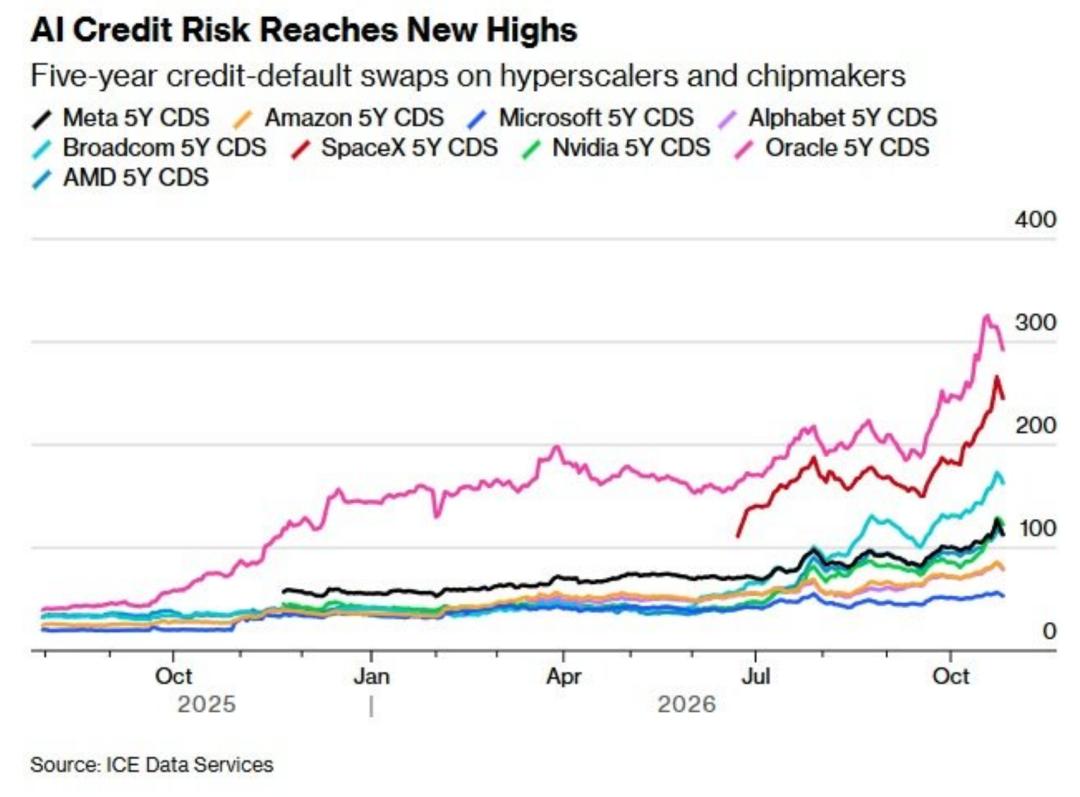
AI credit risk is rising sharply
Alphabet is also in negative free cash flow territory: it raised 12.4 billion US dollars by selling stocks in the same quarter, and borrowed another 29 billion US dollars.
Meta is even more extreme: it earned 32.8 billion US dollars in a single quarter, but dared to spend 34.9 billion US dollars, directly driving its free cash flow to negative 2.1 billion US dollars, the first time since the company went public.
If we combine the "Big Five" of Microsoft, Alphabet, Amazon, Meta and Oracle, their total operating cash flow in the first three quarters reached 5.429 trillion US dollars, up 29% year on year and hitting an all-time record. But their capital expenditure doubled to 5.569 trillion US dollars.
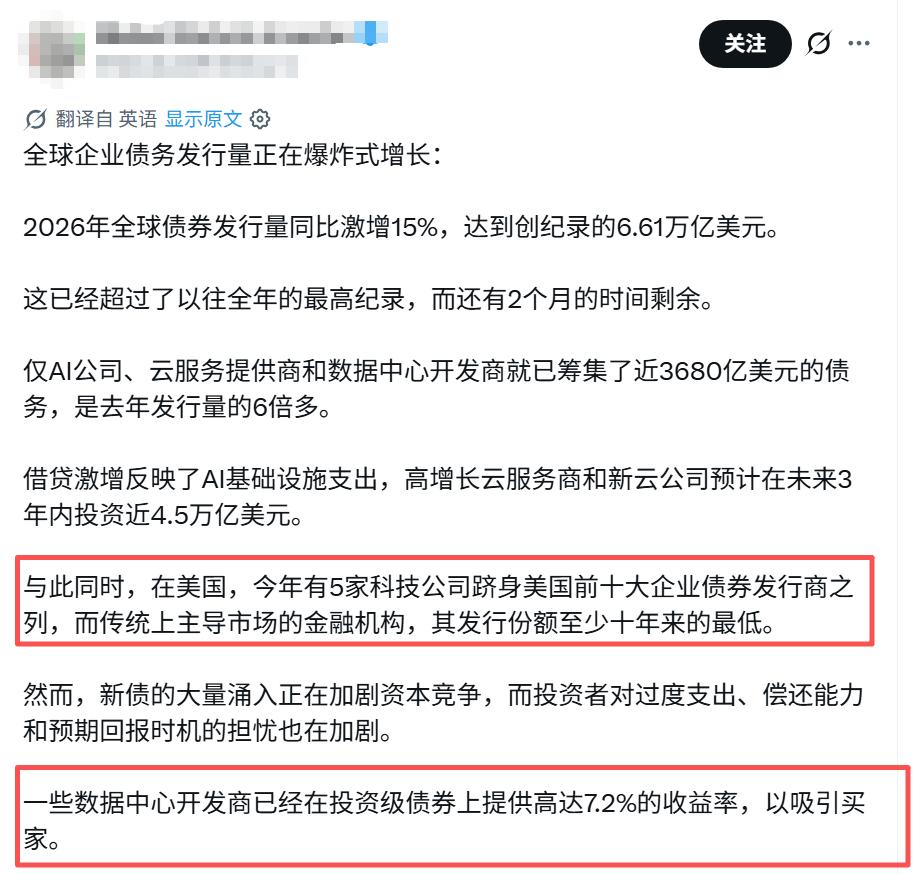
Massive bond issuance spree
Obviously, they are spending more than they earn, which is the first time since records began in 2011.
This means that the Big Five's free cash flow has shifted from a surplus of 143.5 billion US dollars in the same period last year to a deficit of 14 billion US dollars.
Very often, the money they earn hasn't even arrived in their accounts before it's already spent in advance, which can be described as the "cash cows" collectively suffering from "milk-production anemia".
When money runs short, the first stakeholders to be sacrificed are naturally the shareholders.

The share buybacks of the five companies have been cut by 83%, dropping from 81.8 billion US dollars to 13.6 billion US dollars. Companies like Alphabet and Meta haven't bought back a single share this year, while the two companies bought a combined 66.5 billion US dollars of shares in the same period last year. Now the money used to reward shareholders only accounts for 9.3% of the cash they earned, compared to 27.4% last year, not counting all the money they spent currently.
In the past, tech giants could fund their investments with the money they earned on their own, but now even after using shareholders' money, it's still not enough, and the next step is to raise money by issuing bonds on a large scale.
Up to this year, leading companies in the AI sector have issued about 244 billion US dollars of bonds, compared with only 108 billion US dollars for the whole of last year. JPMorgan Chase predicts that the total bond issuance of the tech industry will reach 540 billion US dollars this year, hitting a new all-time high.
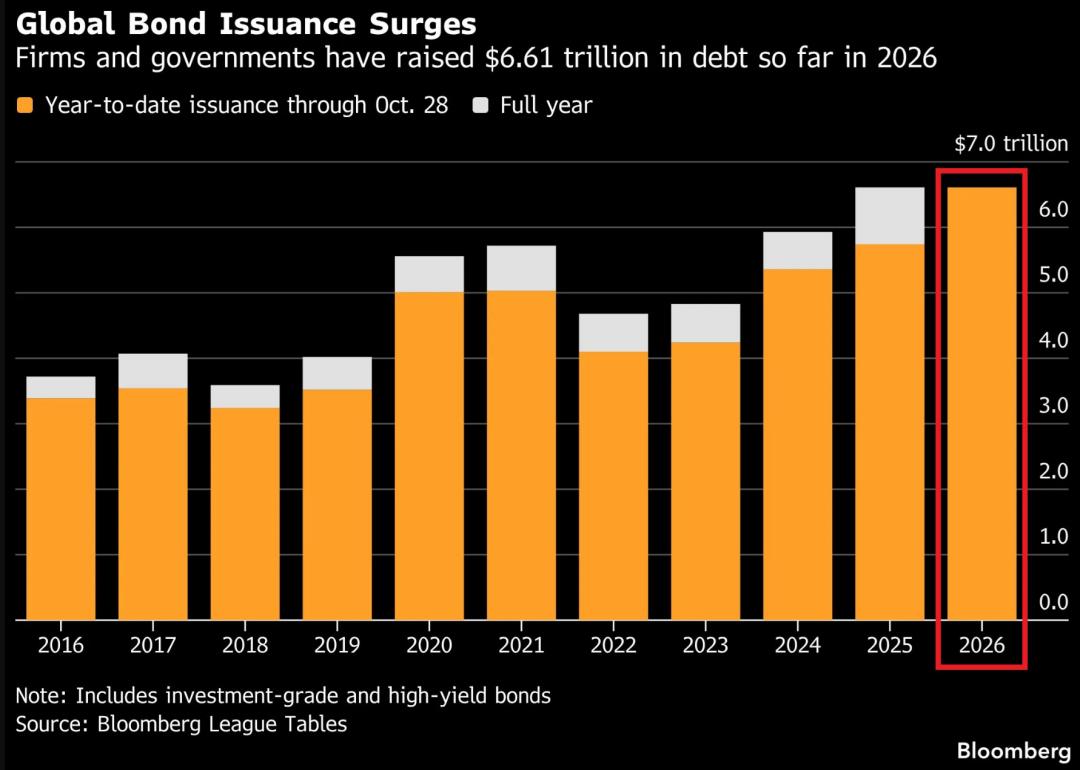
It has driven up the global bond issuance volume
The market sentiment is also changing: previously, spending money was seen as "confidence in development", but now it is regarded as the behavior of a "reckless spendthrift who lets down everyone".
Therefore, good performance and vigorous construction efforts can no longer reassure investors for now.
This distrust even extends to the star large language model companies.
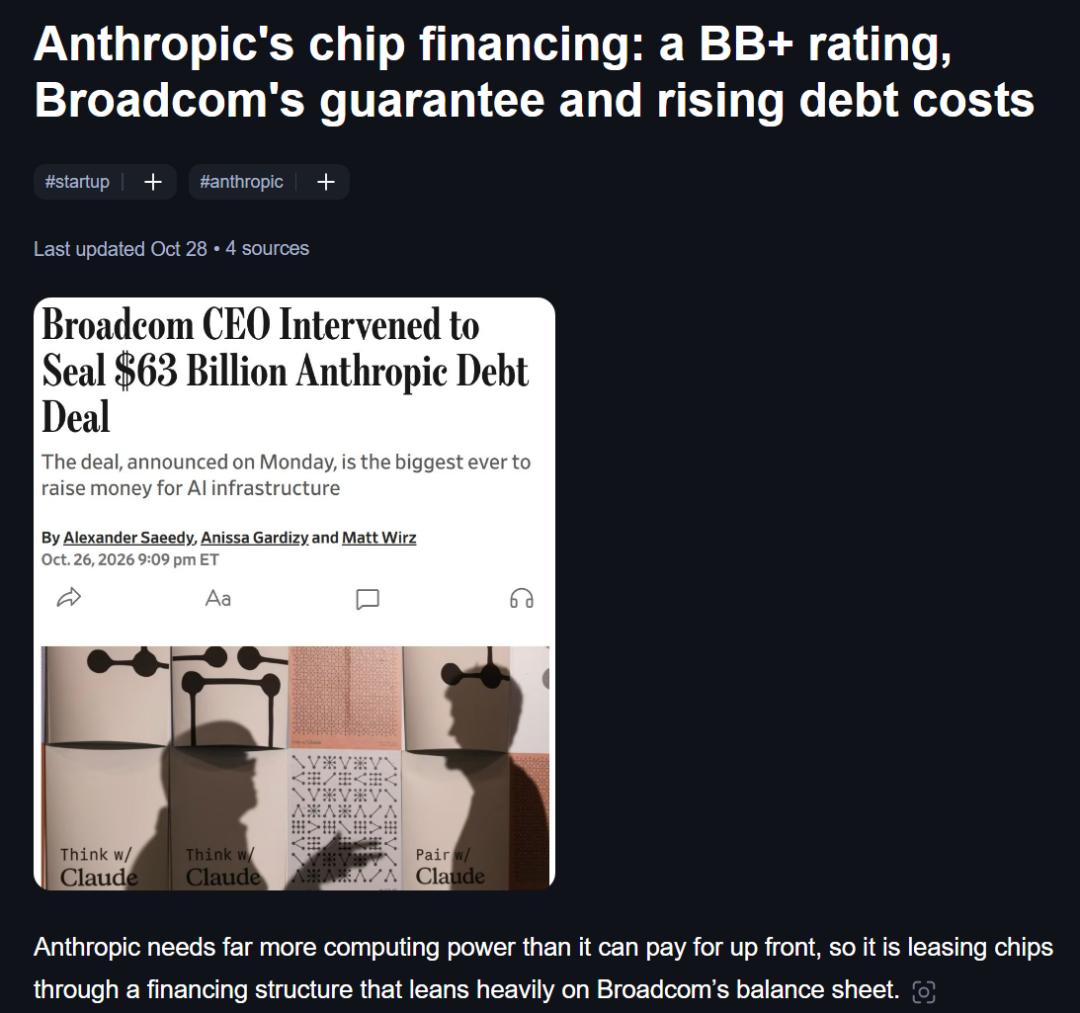
Raise funds, raise funds, and keep raising funds!
Anthropic, which is preparing for an IPO, has had its credit rating revealed for the first time, and it is only BB+, the highest tier in the speculative grade, one level below the investment grade.
It is safe to say that in the bond market, this rating is basically considered "junk bond" in the eyes of many people.
This means that the capital market still has obvious doubts about Anthropic's long-term solvency, cash flow stability and the sustainability of its business model.
02
The Hidden Giant Shadow
What is more terrifying than discovering a bunch of bubbles is that even more bubbles are hidden in the shadows.
When they are exposed to the light, the bubbles in the sun will not be colorful, they will only burst in a brutal, chain reaction, leaving nothing behind.
Last year, media outlets went through the notes to the financial reports of the five Silicon Valley giants and found a counterintuitive fact: their debts not listed on the balance sheet have risen to about 1.65 trillion