The Great Bull-Bear Debate Over the AI Bubble: Root Causes and Lessons of This Round of Plunge
On October 28, Alphabet (parent company of Google) released its Q3 financial report. Its revenue increased by 25% year-on-year, cloud business revenue doubled, and operating profit rose by 30%. Judging only from these sets of figures, this is an exceptionally strong report card.
However, at the close of trading that day, its stock price plunged by 12% overnight.
The same company and the same set of figures have triggered huge divergences in the market: some focus on the 103% growth rate of the cloud business, while others fixate on the negative free cash flow of 9.07 billion US dollars; some calculate total revenue, while others deduce debt levels; bears claim that "the bubble is starting to burst", while bulls argue that "the market is making a huge mistake".
Virtually no AI participant denies that AI is reshaping the way software, advertising, industry and organizational production operate. Yet divergences have abruptly emerged at the current moment: can the capital invested in this round of construction eventually be earned back from the new revenue created by AI? Before the answer comes out, who is qualified to keep spending shareholders' money?
This question may seem to belong to Wall Street, but it actually concerns every city in China that is building intelligent computing centers, every factory that is preparing to connect large language models to production lines, and every ordinary investor who is still asking "can I invest in AI now".
01
Why does one single financial report get interpreted as two completely different worlds?
The most confusing part of Alphabet's financial report is that it contains four sets of contradictory facts at the same time.
First, the growth is real.
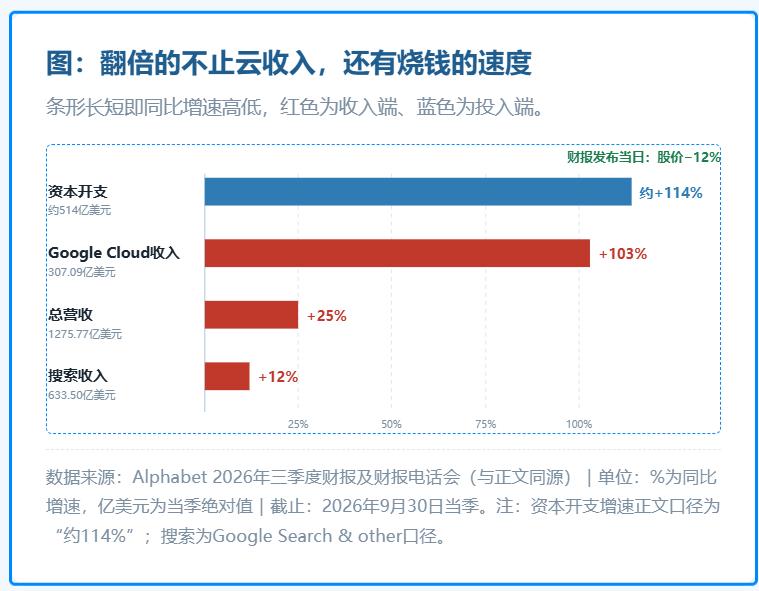
Quarterly revenue reached 127.577 billion US dollars, up 25% year-on-year; Google Cloud's revenue hit 30.709 billion US dollars, up 103% year-on-year, and the cloud business' operating profit reached 11.1 billion US dollars, more than triple the figure in the same period of the previous year, with the profit margin rising to 36.2%. The number of Gemini application users has reached 1 billion, and the first-party model API processes nearly 32 billion Tokens per minute, more than four times the figure a year ago. AI is no longer a story confined to presentations, it is already driving real usage volume.
Second, the pressure on the traditional cash cow is also real.
Google Search & other generated revenue of 63.350 billion US dollars, up 12% year-on-year. The management acknowledged on the earnings call that queries in AI modes are growing rapidly, but the monetization level is still relatively low. The growth rate of search queries has hit a five-year high, while monetization lags behind.
Third, the pressure on cash flow remains real.
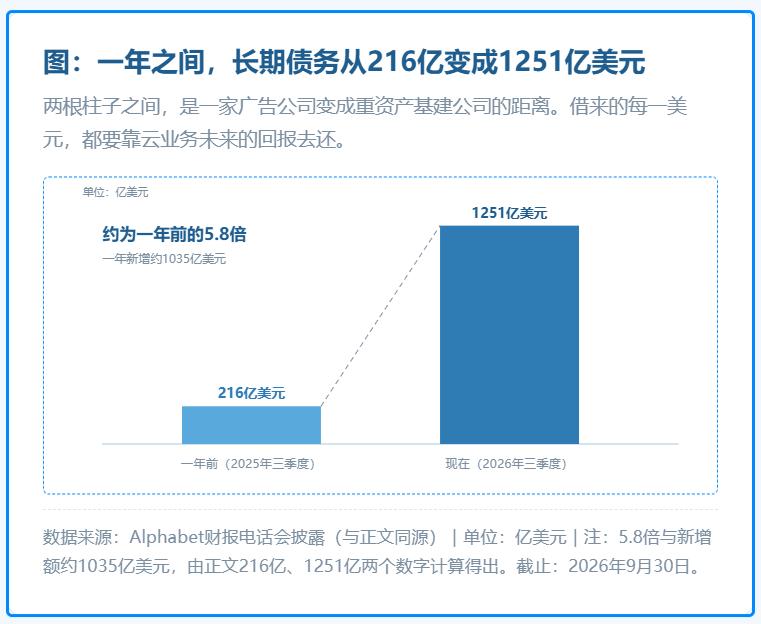
Operating cash flow for the quarter was about 42.3 billion US dollars, capital expenditure was about 51.4 billion US dollars, free cash flow was negative 9.07 billion US dollars, and capital expenditure increased by about 114% year-on-year. The earnings call disclosed that the company's long-term debt has risen from 21.6 billion US dollars a year ago to 125.1 billion US dollars. The cash cow is still generating revenue, but the bill for building the pasture has for the first time grown large enough to change the fundamental state of the enterprise.
Fourth, the profit decline cannot be entirely blamed on AI.
Net profit for the quarter was 26.170 billion US dollars, lower than the same period of the previous year; other income turned from positive to negative, and the equity investment portfolio recorded a loss of about 8.66 billion US dollars. The earnings per share fell short of expectations, which is not entirely caused by "computing power investment dragging down profits", and investment gains and losses account for a large proportion. Therefore, it is not rigorous to directly equate the $2.12 per share figure with "the failure of the AI business model".
Bears sum up this set of figures as: negative free cash flow, halted share repurchases, reliance on financing, and the risk that RPO (Remaining Performance Obligation) may not be fulfilled.
Bulls seize on another point: cloud revenue has doubled, profits have tripled, and negative cash flow is only an accounting time difference where investment precedes returns. Some bulls even estimate that the return on newly invested capital is about 20%, significantly higher than the cost of capital.
Neither side has fabricated facts. They just chose different sections of the same river.
In fact, free cash flow is the most easily misused indicator. Its accounting relationship is very simple: Free Cash Flow ≈ Operating Cash Flow - Capital Expenditure. Operating cash flow shows how much money the existing business can collect today, while capital expenditure shows how much money the company invests for the future. A negative result after subtraction may mean that expenditure exceeds income, or it may mean that the company is using today's strong profits to build larger production capacity for tomorrow. Judging only by whether the figure is positive or negative proves nothing.
What really needs to be explored are two other questions: what assets are formed after this sum of money is invested, and how many cents can be earned back every year in the future for every one yuan invested? This is exactly the relationship between return on capital and cost of capital.
If the annual after-tax operating profit brought by new data centers, chips and networks, divided by the total invested capital, can stay higher than the financing cost in the long run, today's negative free cash flow is the prelude to value creation; otherwise, it will turn a good business into a bad balance sheet.
There is another easily overlooked statistical caliber here: ROIC (Return on Invested Capital) should refer to the return on new investments, not the average profit margin of old businesses. The high returns Alphabet earned from search advertising in the past do not prove that today's new AI capital expenditure naturally has the same level of return. When an advertising company transforms into a heavy-asset infrastructure company, its valuation can no longer only be measured by the price-to-earnings ratio, but also by how much sustainable cash each additional unit of new capital can eventually precipitate.
Bulls have sufficient confidence here: the operating profit of the cloud business is rising rapidly, and the cloud backlog of orders disclosed on the earnings call is about 561 billion US dollars, with slightly more than 55% of the revenue expected to be recognized in the next 24 months.
The bears' reasons are also valid: backlog orders are contracts, not cash already in hand. Especially in the AI industry, suppliers, investors and customers sometimes belong to the same small circle. The larger the contract amount, the more we need to ask where the money ultimately flows from.
This leads to circular financing, the real watershed in the debate over the AI bubble.
The concept of circular financing can be explained clearly with one example: a chip company invests in an AI lab, the lab uses the money to purchase computing power from a cloud vendor, and the cloud vendor then buys GPUs from the chip company. All three parties can announce cooperation, with revenue, orders and valuations growing together, but it becomes hard to identify how much real money external customers have actually paid.
This scene has been repeated in history long ago.
A hundred years ago, in the 1920s, US electric utility companies relied on a pyramid structure of multi-layer holding to hold each other's shares and guarantee each other, putting the same sum of capital into different company statements repeatedly. The utility empire built by Samuel Insull once magnified the cash flow of one power grid into the valuations of dozens of holding companies. After the crash in 1929, the Public Utility Holding Company Act of 1935 was specifically legislated to dismantle this structure.
Previously, the Bank for International Settlements warned of risks in its 2026 Annual Economic Report that the opacity of financing in the AI industry has aggravated financial fragility, and circular financing is particularly worthy of vigilance; several types of arrangements that have been publicly discussed in the market, such as NVIDIA investing in OpenAI and discussing providing guarantees for its data center leasing, Google providing support for data centers related to Anthropic, and AMD matching chip deployment agreements with warrants, etc., are essentially the same ancient impulse as the utility holding pyramid: using structures to cash in the future in advance.
However, it must be pointed out that the scale, constraint conditions and implementation status of these transactions are not completely the same, and it is inappropriate to generalize that "all are false revenue". Circular financing itself is not a sin. In the history of railway, telecommunications, aviation and energy construction, it is not uncommon for suppliers to help customers with financing: when external demand is real, it can accelerate the formation of infrastructure; if demand mainly relies on continuous blood transfusion from financiers, it will postpone the demand test.
Therefore, to judge whether the AI boom is healthy, the most important question is not "whether there are circular transactions", but: after stripping off the three layers of investment, guarantee and procurement, how much fees are terminal enterprises willing to pay independently.
The market fluctuates between panic and buying back, essentially arguing over this point: it is not only revaluing infrastructure companies, but also rearranging "who will finally get the AI value": who can survive the peak of capital expenditure, who can convert usage volume into sustainable charges, and who will be replaced by large language models.
The market sometimes worries that CapEx is too large, and sometimes worries that AI development is not fast enough, which is not contradictory. It is pricing both "over-investment" and "being replaced" at the same time. The real danger is using only one single answer to explain all companies.
02
Technology can win, but valuation can still lose
When talking about the AI bubble, the most frequently cited case is the Nasdaq in 2000: the index plunged by about 78% from its high point, and countless .com companies disappeared. But comparing only the index decline can hardly lead to any useful conclusions. Today's large technology companies have profits, users and global cash flow, which are completely different entities from the companies back then that only had traffic but no revenue.
A more reasonable reference is the infrastructure bubble. And before the telecom bubble, there was an older sample: railways.
In the 19th century, the United States spent far more capital on railway construction than people can imagine today. By 2000, the annual capital expenditure on telecom equipment in the US was about 120 billion US dollars, and the construction relied heavily on debt, with the total industry debt reaching about 1 trillion US dollars by 2002. All of this was previewed by railways 150 years ago at an even greater cost: duplicate construction, competing to lay tracks, land speculation, multiple waves of bankruptcies, until the Panic of 1893, when J.P. Morgan stepped in for restructuring. Railways eventually reshaped the United States, but most early investors did not live to see the harvest day.
The telecom bubble just repeated this script. Demand did not arrive at the expected speed, WorldCom and Global Crossing collapsed one after another, and only a small proportion of the optical fibers laid during the boom period were actually lit up. Cisco's story is particularly striking: In March 2000, its stock price was 80.06 US dollars, with a market value of about 500 billion US dollars; by October 2002, its stock price was about 8.60 US dollars, with a decline of about 88%. During the same period, the company's revenue did not collapse proportionally, and later the Internet changed the world as expected.
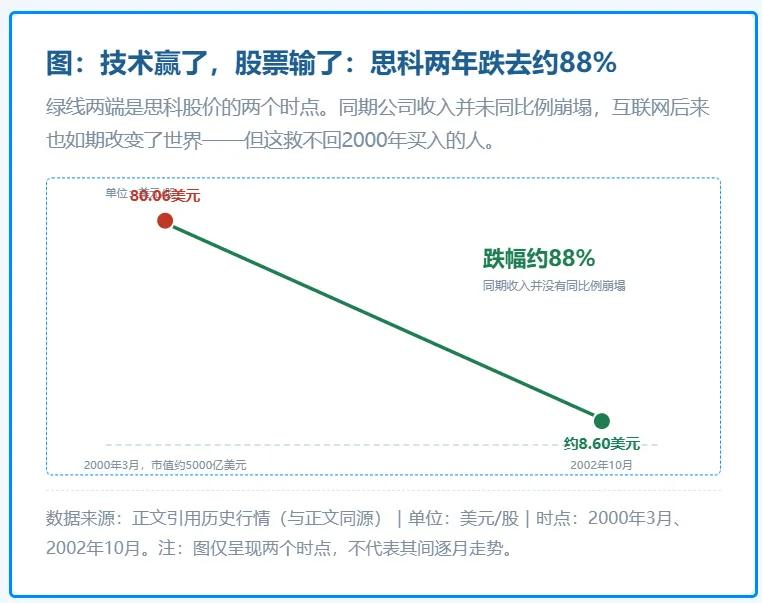
A correct technical judgment and heavy stock losses can happen at the same time completely.
This period of history gives three inspirations for today:
The first point, the return of infrastructure depends not only on whether the technology is useful, but also on the time difference between the construction pace and the arrival of demand. If production capacity arrives first while customers are still on the way, financing costs will trigger risks.
The second point, who the profits belong to. Early telecom builders were not necessarily the final winners of the Internet. Equipment vendors could be repriced due to customer debt problems, while later platform companies took more value. The same is true for AI: the simultaneous growth of chip factories, cloud vendors, model companies and application companies does not mean that they will share the final profits in the same proportion.
The third point is asset specificity. Once optical fibers are laid, it is difficult to repurpose them; general-purpose computing power, dedicated chips and power facilities in data centers have the same attribute. The faster chips iterate, the more likely depreciation will become an invisible examiner of profits. AI assets with high book profit margins today, if they lag behind in efficiency and their prices drop in three to five years, may have an actual economic life shorter than their accounting depreciation period.
In other words, history has never given the answer that "the AI bubble will definitely burst". Instead, it provides a more sophisticated testing method: whether demand can arrive on time, whether returns can outperform depreciation, and whether builders can survive to the harvest period.
From an economic perspective, this is a typical marginal return proposition. The huge future market of AI does not mean that all investments made today will generate returns. Total demand is one thing, while the marginal return of building a new data center, producing a new chip or launching a new industry-specific large model is another. The capital cycle is most likely to get out of control under the consensus that "the market is huge", because every company believes that if it does not invest, it will lose the next round of competition.
The result is a prisoner's dilemma: if competitors expand capacity but I do not, I may lose market share; if everyone expands capacity, the industry may face excess production capacity. The rationality of a single company adds up to over-investment in the whole industry.
To solve this problem, we need to put three indicators into the same pool and keep observing them:
Incremental Return on Invested Capital (the operating profit of new input divided by new invested capital, not the historical profit margin of the whole company);
Price and utilization rate (if revenue growth comes from price increases, it must be followed by higher utilization rate and lower costs. An intelligent computing center with high idle rate is just expensive fixed assets no matter how large its scale is);
Cash payback period (long-term contracts can ease uncertainty, but cannot eliminate it. The longer the payback period is, the more important customer credit, technology substitution and financing costs become).
That is exactly why bulls emphasize cloud business profits and vertical integration, while bears emphasize terminal demand and financing structure. The two views can be partially true at the same time: self-built computing power of leading companies may have reasonable returns, while highly leveraged marginal projects may not. The bubble does not have to occur across the whole industry on average. It often bursts first in the most vulnerable projects and the most optimistic valuations.
Putting financial reports, transaction structures and historical facts together, we do not agree with two extreme views: "AI is just a scam" cannot explain why Google Cloud's revenue has doubled and model call volume has increased several times, nor can it explain that AI has already entered advertising, office and industrial processes; "As long as AI is useful, all investments are reasonable" avoids the issues of capital cost, depreciation and payback period.
A more accurate perspective may be: which revenue comes from repeated payments by external customers, and which revenue mainly comes from mutual confirmation of capital and contracts. The more the former type there is, the more the construction can survive the cycle; the higher the proportion of the latter type, the more we need to guard against chain reactions caused by changes in financing conditions.