313.8 billion yuan, the three major state-owned oil giants in China hit all-time highs in their third-quarter financial reports, geopolitical conflicts have further intensified profit differentiation, and PetroChina has become the biggest winner.
The profits of China's three major oil companies diverge in their Q3 reports, and their profit paths will further differentiate after oil prices shift direction.
Energy Insight learned that from October 28 to 30, the Q3 financial reports of the three major oil companies were released one after another.
China National Petroleum Corporation posted 155.773 billion yuan, China National Offshore Oil Corporation 119.118 billion yuan, and China Petrochemical Corporation 38.988 billion yuan, totaling 313.879 billion yuan, with a daily profit of over 1.16 billion yuan. All three have delivered figures that satisfy their shareholders, but the underlying factors behind these figures are far from identical.
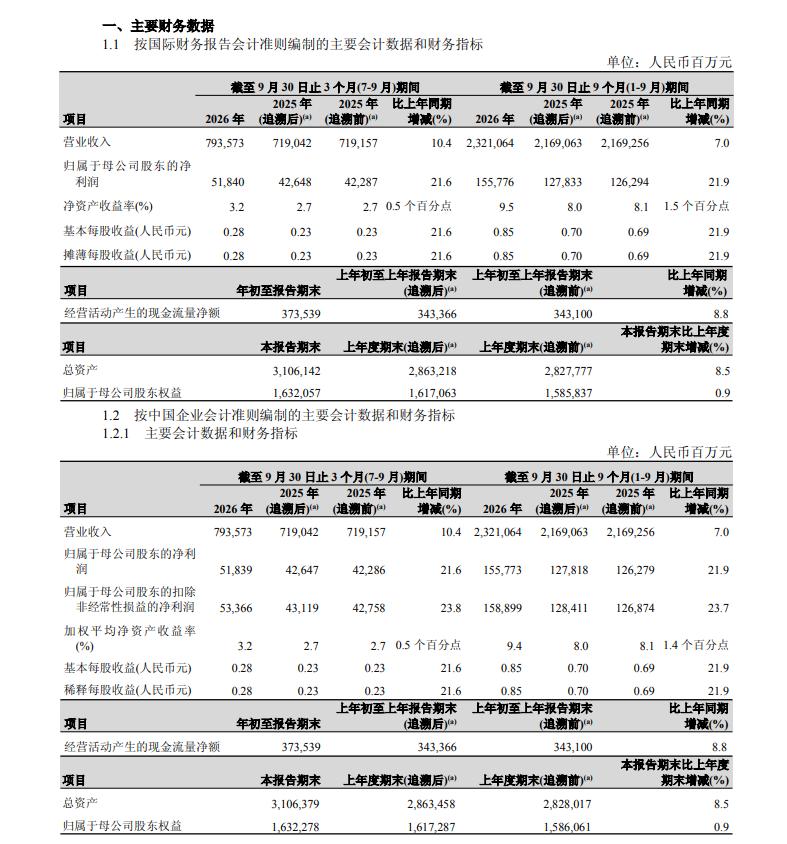
Excerpt from CNPC's 2026 Q3 Financial Report
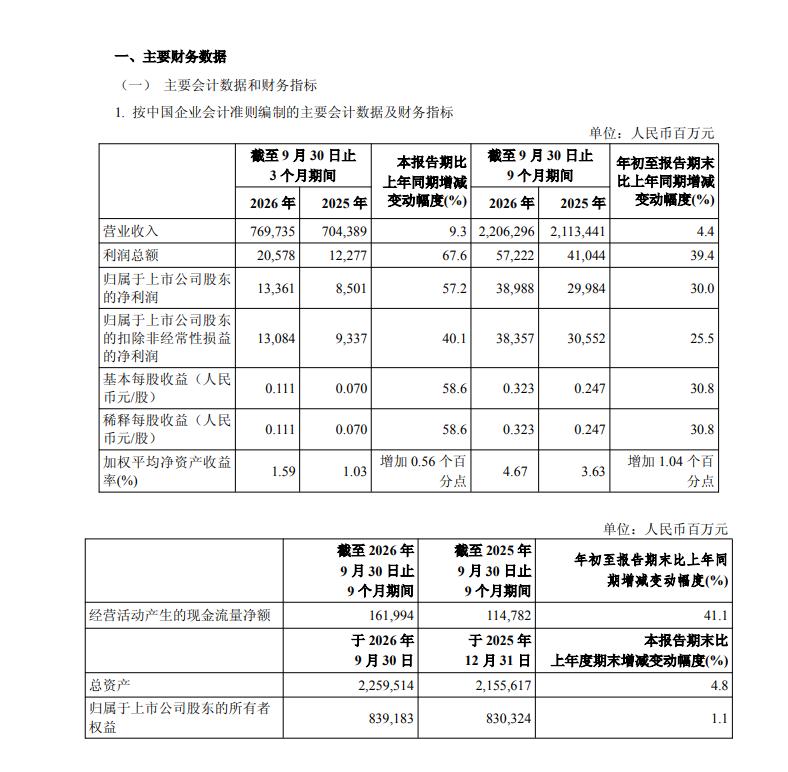
Excerpt from Sinopec's 2026 Q3 Financial Report
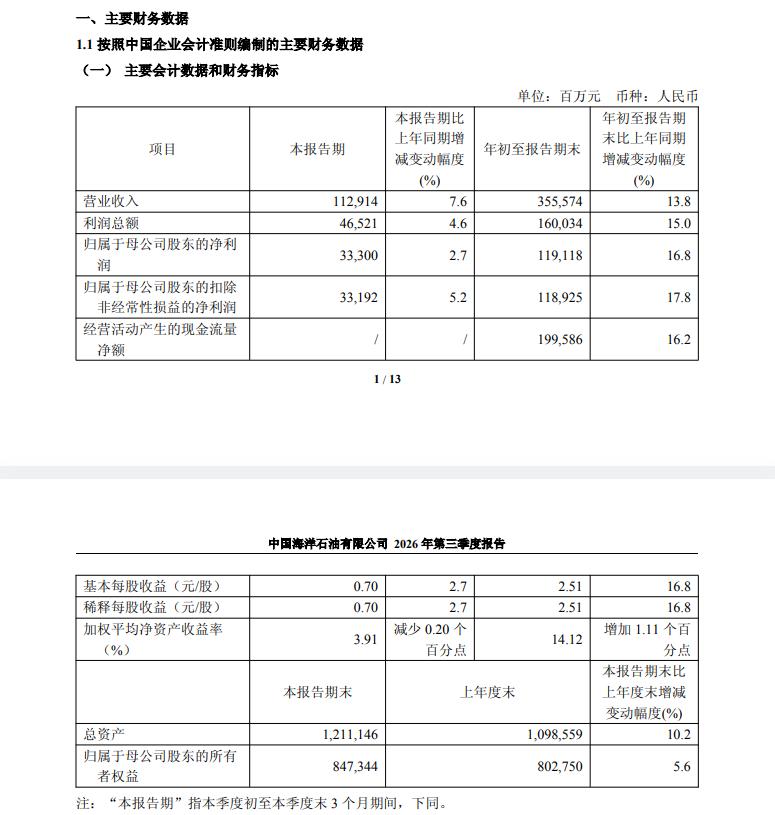
Excerpt from CNOOC's 2026 Q3 Financial Report
Oil prices driven up by the same geopolitical conflict have taken three completely different transformation paths across the three profit statements. One benefits from business structure, one benefits from asset purity, and one benefits from an accounting entry that may reverse and erode earnings at any time.
The pricing model of this game is shifting from "premium generated by conflicts" to "discount generated by negotiations".
01
Elasticity of Pure Upstream Business
Sharpest, and Most Transparent
CNOOC is the easiest one to understand among the three, as it focuses purely on upstream business. Its realized oil price reached 86.32 USD per barrel, up 26.4% year on year, and the oil price almost flows into its income statement without any friction.
The 33.5% attributable net profit margin in the first three quarters is at an absolute leading level across the entire A-share market; its ROE stands at 14.12%, higher than CNPC's 9.4% and Sinopec's 4.67%, and the sum of the latter two is only equal to its figure. This quarterly report serves as the standard answer to demonstrate how competitive low-cost upstream assets can be in a high oil price cycle.
But the other side of the answer is hidden in the single Q3 performance.
The cumulative growth rate in the first three quarters was 16.8%, while the year-on-year growth rate of single Q3 dropped to only 2.7%. This is not caused by production decline, as its net oil and gas production of 593.7 million barrels still hit a new all-time high for the same period; nor is it caused by cost out of control, as the main cost per barrel of oil is 30.57 USD, which still ranks in the first echelon globally.
The real reason is that the profit elasticity of pure upstream business is bidirectional. When oil prices rise, it performs the most sharply, as every 1 USD increase directly falls into net profit; when oil prices loosen from 88 USD to 85 USD, its profit correction amplitude will also be the steepest among the three companies.
Q3 also recorded an asset impairment of 7.243 billion yuan, which dragged the growth rate down to single digits. Rather than a problem in operation, this result shows that the business structure of this sector leaves no buffer layer. Purity brings elasticity, but purity also means no fallback.
02
CNPC's Profit Does Not Come From A Single Well
30% of Sinopec's Profit Includes A Temporary Item That Will Disappear
The 155.7 billion yuan profit of CNPC is the "least pure" among the three, and this very impureness is exactly its most valuable advantage at the cycle inflection point.
The operating profit from oil, gas and new energy business reached 152 billion yuan, natural gas sales contributed 33.293 billion yuan, and refining & new materials contributed 23.132 billion yuan, forming a three-pillar stable business structure.
Its natural gas sales volume reached 231.3 billion cubic meters, with a growth rate of only 3.0%, but it provides rigid demand that cannot be penetrated by falling oil prices — scenarios including residential cooking, industrial boilers and urban heating are not affected by crude oil market fluctuations. The upstream business benefits from price increases, the natural gas business benefits from stable demand, and the refining business benefits from price spreads. Only when all three variables decline simultaneously can the income statement be broken through, and historically the probability of all three collapsing at the same time is far lower than the probability of oil prices reversing alone.
For Sinopec, the EBIT of its refining segment reached 30.099 billion yuan, surging 330% year on year, which sounds very impressive; but the company itself stated in the quarterly report: The improvement of refining product price spread, increased production of high value-added products, and "inventory profit brought by rising crude oil prices".
The improvement of price spread is a real improvement at the industrial level, while inventory profit is a time difference at the accounting level — from crude oil entering the factory to finished oil products leaving the warehouse, there is a transportation and processing cycle. When oil prices rise, this time difference turns into book profit; when oil prices stop rising and start to fall, the same time difference will reverse and erode earnings.
The 38.988 billion yuan profit is based on a realized oil price of 81.92 USD per barrel, and its sensitivity to oil price direction is no lower than that of CNOOC, except that the transmission path is changed from "selling price" to "inventory gain and loss".
The chemical segment still posted an EBIT loss of 1.69 billion yuan, with a net profit margin of less than 2%, and its safety cushion is too thin to withstand a single reversal of inventory accounting. Its 30% growth rate ranks first, but this first place is pushed up by inventory accounting on an extremely low base.
03
The 18-Year High Valuation Is Backed By Profits
But The Profit Base Is Being Repriced
On October 26, CNPC's A-share price hit 13.41 yuan in intraday trading, the highest point since May 2008, with a dividend yield of 5.19% and a PB ratio of 1.47. Capital withdrew from the technology sector and poured into the three major oil companies. The superficial narrative is "high dividend for risk aversion", but at a deeper level, the market is repricing profits supported by geopolitical premium.
But the physical foundation of the geopolitical premium is loosening. In October, EIA sharply raised its 2026 average Brent price forecast from 91 USD to 96 USD, on the grounds that the traffic volume of the Strait of Hormuz has decreased by 23% to 30% compared with the pre-conflict level, and the risk premium per single vessel exceeds 1 million USD per day.
This premium is "generated by conflicts" — missiles, drones, boarding inspections, forced course changes, every barrel of crude oil passing through the Persian Gulf is paying for the freedom of passage.
The problem is that Saudi Arabia is transporting oil to the Red Sea via east-west pipelines crossing the desert, and shipping companies are choosing to detour around the Cape of Good Hope instead of sailing directly through the strait.
According to Kepler's statistics, in the week ending October 18, oil exporting countries in the Gulf (excluding Iran) shipped 24.6 million barrels per day on average, higher than the pre-conflict average of 23.3 million barrels per day. However, CLSA also reminds that the daily average level from October to date is still lower than the pre-conflict level, and the weekly data fluctuates greatly; the traffic volume via the Strait of Hormuz is still more than one third lower than the pre-conflict level.
Alternative routes do not eliminate bottlenecks, they only shift the bottleneck from the strait to pipelines and detour costs. Pipelines have already proven to be vulnerable to attacks — in September 2026, Saudi Arabia's east-west pipeline was temporarily shut down due to a drone attack, and resumed operation within five to six days. Its current flow is about 5.8 million barrels per day, with a nominal upper limit of about 7 million barrels per day; the number of ships detouring around the Cape of Good Hope has surged 112% year on year, the voyage has increased by 3500 to 4000 nautical miles, the basic freight rate has risen by 15%-20%, and the war risk premium for a single voyage of a very large crude carrier passing through the Strait of Hormuz can reach up to 14 million USD. All these costs will also be repriced along with shipping supply and demand.
The core of the divergence does not lie in the present, but in next year.
JPMorgan Chase has given a baseline scenario: in 2027, global peace is restored and the passage of the Strait of Hormuz is substantially resumed, the average Brent price will be about 63 USD per barrel. The mechanism is not an instant evaporation of geopolitical premium, but the suppression of high oil prices on demand superimposed on continuous production increase in non-Middle East producing regions; under the scenario of prolonged conflict, the average price in 2027 will be about 87 USD per barrel, still significantly lower than the current level.
Its July report also mentioned that more than 60 million barrels of oil have actually been frozen in the Persian Gulf since February, and millions of barrels of oil will re-enter the market after the Strait of Hormuz reopens.
On the other hand, EIA and some institutions have also upwardly revised their 2027 forecasts under the assumption of prolonged conflict. The 2026 profit statements of the three major oil companies are benefiting from the dividend of a geopolitical conflict, and the pricing model of this conflict is shifting from "premium on the battlefield" to "discount at the negotiation table".
CNPC's 18-year high valuation is backed by the buffer provided by its natural gas and integrated business structure, which still holds when the premium evaporates; CNOOC's record high production is backed by the realization capacity of its low-cost curve under high oil prices, but the 2.7% growth rate in Q3 has already sent a warning signal; Sinopec's 30% growth rate is backed by low base, inventory accounting and just-starting recovery of price spread, two of the three factors will disappear as oil prices reverse direction.
When oil prices stay at 88 USD, all cracks can be covered by growth rates. Once oil prices fall below 85 USD, which income statement will change first has actually been written in the Q3 reports.
This article is from the WeChat Official Account "Energy Insight", written by ZHAO Jianan, authorized for release by 36Kr.