Ocean Engine cancels rebates: all advertising agencies will be service providers in the future
On October 30, a "task notice" popped up in the backstage of Ocean Engine: Starting from January 1, 2027, the rebate policy for agent partners will be canceled, which will be replaced by lowering the list price and optimizing framework discounts to directly transfer benefits to customers; the incentives for agents will be fully adjusted to the "combination of assessment system and ranking system".
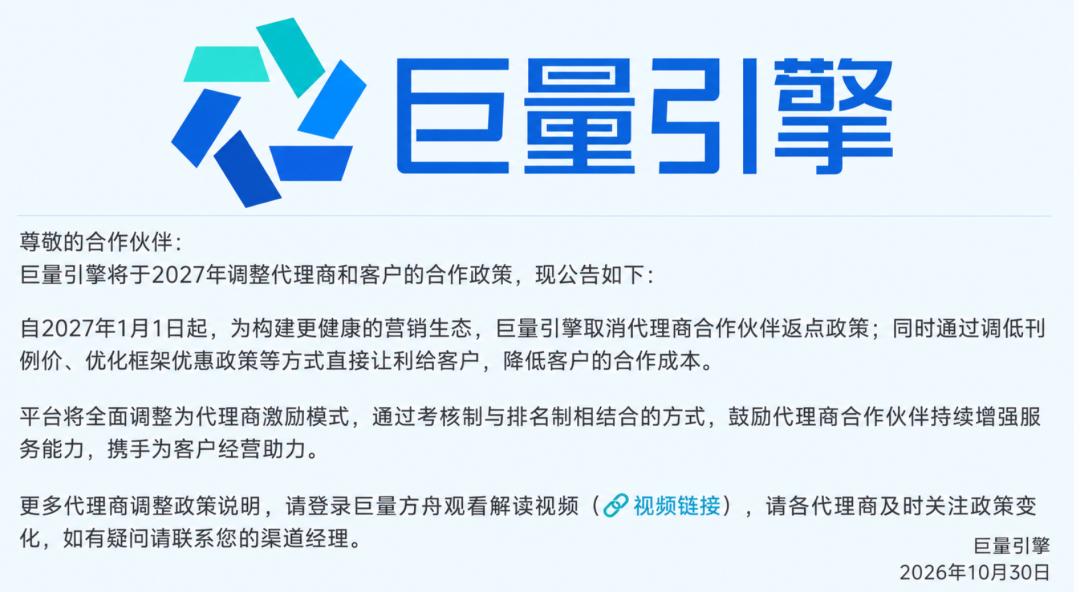
For thousands of agents who make a living from Douyin's transaction volume, this is no different from dropping a timed nuclear bomb, which also marks the end of an era.
1. Replacing Rebates with Incentives
One key change of this new channel policy from Ocean Engine is replacing rebates with incentives.
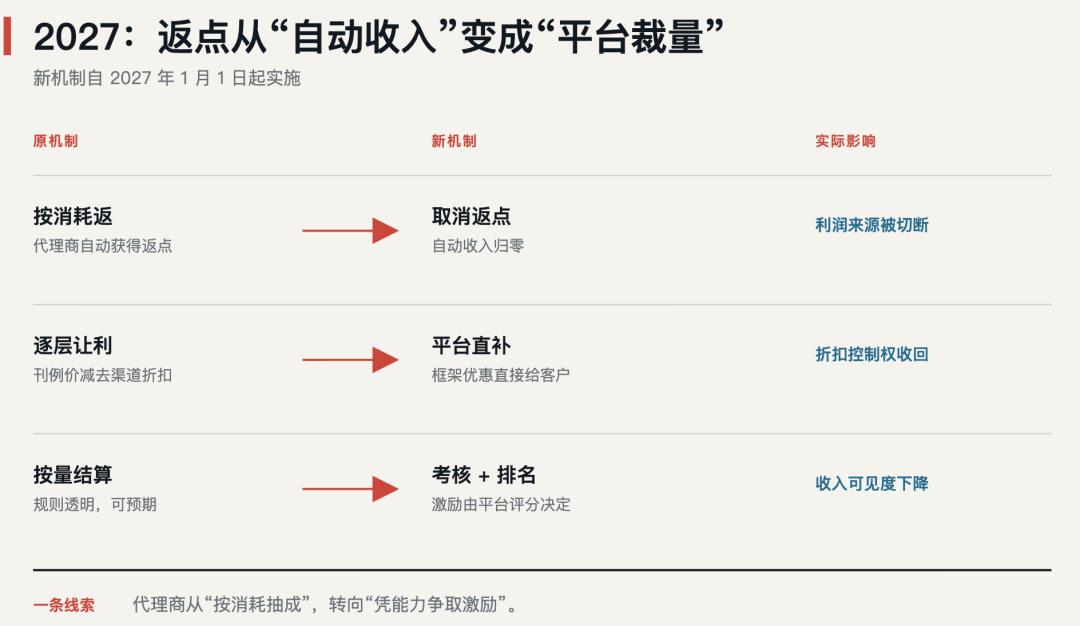
There are significant differences between rebates and incentives.
In fact, it is just like joining a new company: the rebate is the year-end bonus written in the contract. The amount of consumption and the corresponding rebate are clearly stated in the annual policy with high certainty, so agents can calculate accounts, raise funds and quote prices for customers based on it.
Incentives are different, which are performance bonuses. The specific amount depends on the Party A's year-end performance. It is highly flexible: the assessment dimensions, ranking rules and bonus amounts are all set by the platform, and can be adjusted every year.
Further, rebates serve three functions: sales commission, credit interest and pricing tool.
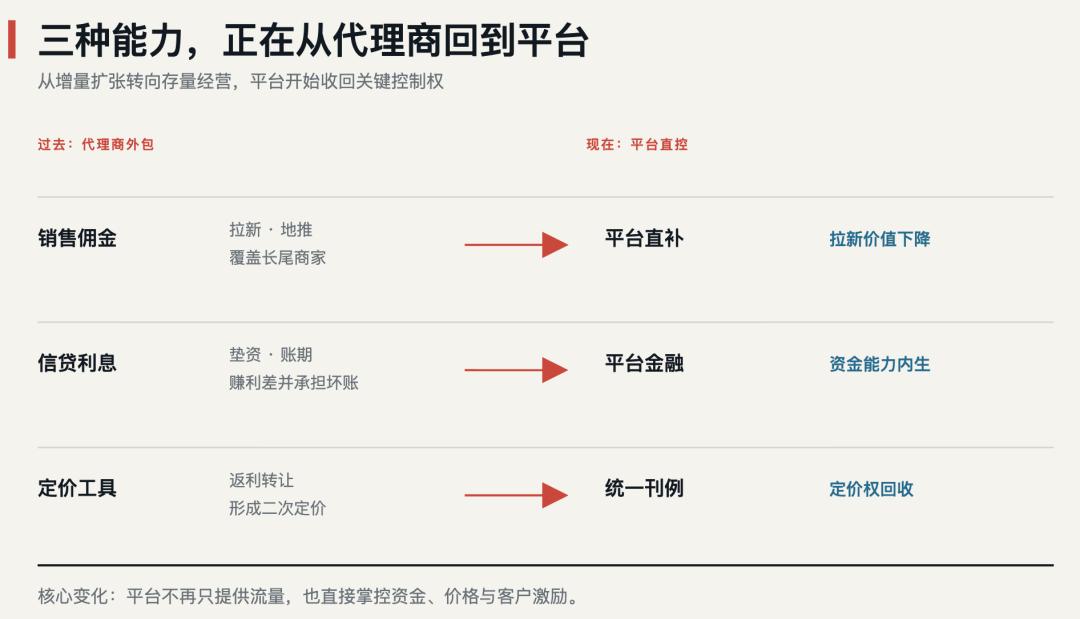
The so-called financial function is the point that most agents complain about and mock themselves with.
Some practitioners told *Doc Dao Ke* that part of the rebates for agents of a large domestic manufacturer comes from the credit period provided by the official. That is to say, some agents are essentially "advertising credit companies": the platform gives them a credit period, they advance funds for advertisers, and the rebate is the spread of this business.
In 2023, when replying to the annual report inquiry from the Shenzhen Stock Exchange, Blue Focus also publicly admitted that in order to reduce the financing cost of advance payment, the company negotiated with cooperative media to increase the credit limit of accounts payable and extend the payment cycle, at the cost of sacrificing part of the rebates.
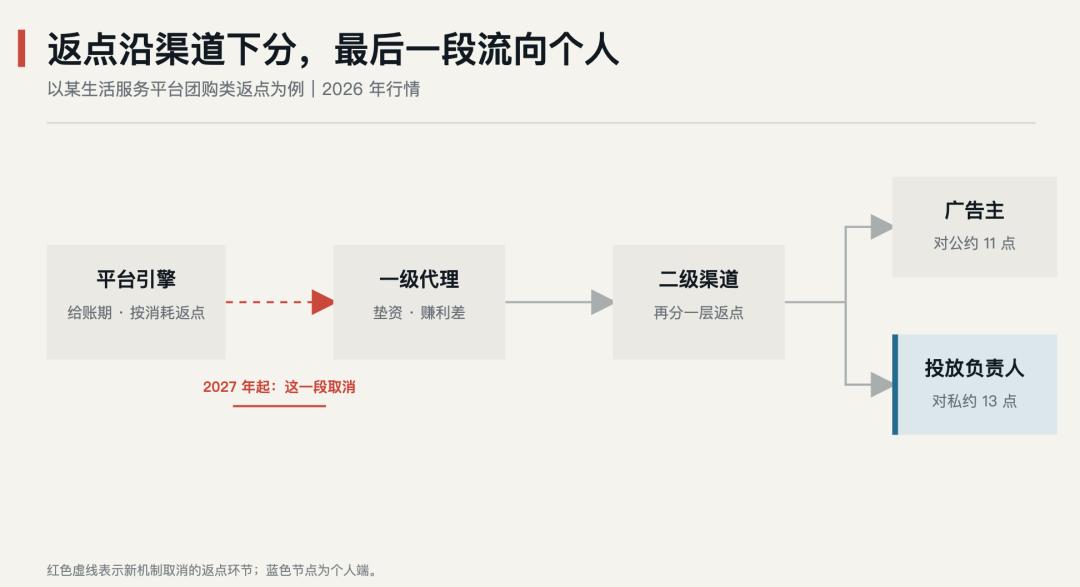
In the figure above, the red dotted line is the link cut off by this new policy: the rebate from the platform to the first-tier agents. The spread of each layer in the downstream all comes from this link.
After getting the rebate, agents often pass part of it to large customers to grab orders and renew contracts. The platform is well aware of this, but is willing to acquiesce, because it can implement different pricing policies for different customers without publicly reducing prices.
For example, for the same 10 million yuan of advertising investment, the platform gives the agent a 15% rebate, the agent can return 10% to large customers and keep 5% for itself. For small and medium customers with weak bargaining power, the rebate may only be 3%, leaving 12% for the agent. The platform maintains a unified list price, but the actual transaction price varies with the customer's scale and bargaining power. Thus, agents become the intermediate layer for the platform to implement differentiated pricing.
An agent provided a document to Doc Dao Ke, showing that in 2026, the rebate for group-buying merchants on a certain platform is generally 11 percentage points for public accounts and 13 percentage points for private accounts; for the first-tier industries of lead generation type, the rebate is 9 percentage points for public accounts and 11 percentage points for private accounts.
A large part of the two percentage points more for "private accounts" than for "public accounts" flows to the individuals in charge of advertising investment within the advertisers. At this point, the rebate is close to commercial kickback, which is improper.
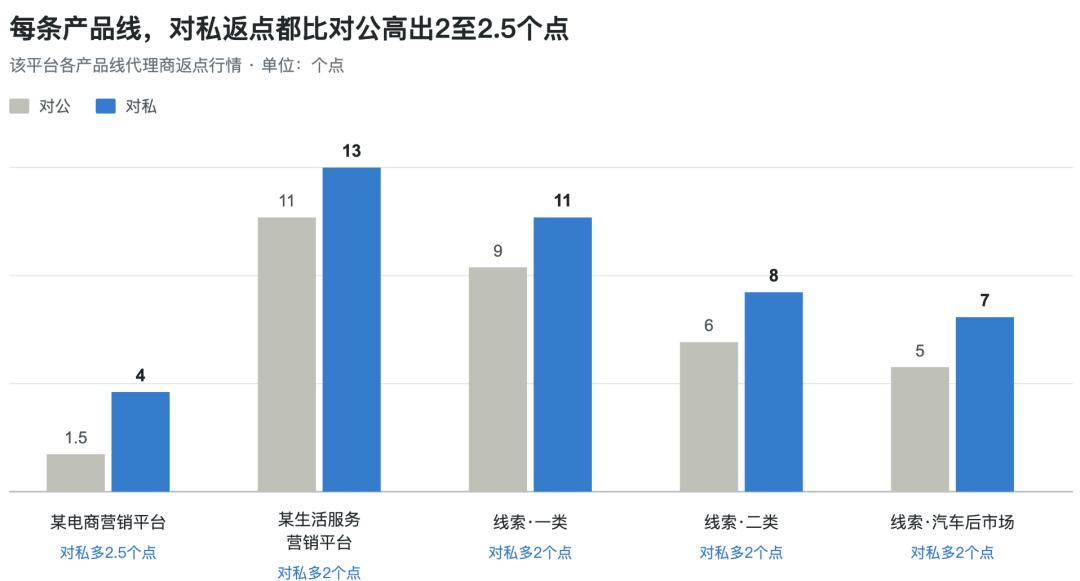
No matter how high or low the rebate is, there is always a stable price difference between private accounts and public accounts.
The same is true in the US market.
In 2016, the Association of National Advertisers (ANA) commissioned the research firm K2 Intelligence to produce a media transparency report, which found that cash rebates issued based on investment amount are common in US media procurement, while the surveyed advertisers said they did not receive rebates, and even did not know the existence of rebates.
The evidence cited in the report shows that the rebate ratio ranges from about 1.67% to about 20%.
The three platforms have different paces but the same direction. Google took three years to clear the rebates step by step, Meta moved from halving rebates to linking rebates with assessment, while Ocean Engine directly canceled rebates after one year of assessment preparation.
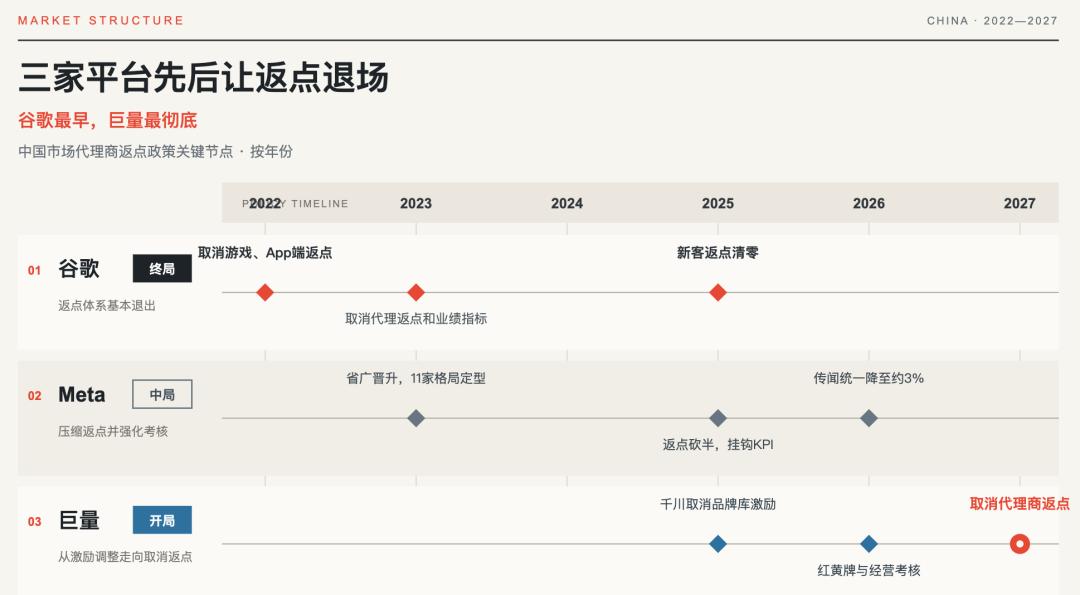
Final Stage: Google Has Completed the Whole Process First
Google's channel policy tightening is carried out in stages.
According to publicly available data: in 2022, Google first canceled advertising rebates for the gaming industry and the App side; since 2023, the industry has widely spread that Google canceled agent rebates and no longer set annual or quarterly performance indicators for agents; on January 1, 2025, industry forums reported that rebates for new customers were officially canceled.
According to the prospectus documents submitted by an advertising agency to the U.S. SEC, until 2024, Google still signed formal agency agreements with some agents in the Chinese market, paying commissions based on qualified advertising consumption, with historical commission ratios ranging from 3% to 12%; the cooperation corresponding to this agreement was terminated in January 2025.
This company once provided Google advertising agency services for Chinese cross-border merchants. The Google advertising commission obtained by its Hong Kong subsidiary HQT Network was USD 1.53 million in FY2023, dropped to USD 310,000 in FY2024, and only USD 80,000 in FY2025; in April 2025, the company closed the relevant business. Its revenue comes from the commission paid by Google based on consumption.
Why did Google do this? There are two interpretations in the industry.
One starts from channel efficiency. Most of the rebates that agents get from Google are returned to large customers to maintain cooperation, and the platform turns a blind eye to this; many agents have weak service capabilities and cannot earn service fees, they can only earn rebates by passing the transaction volume through their accounts, which are essentially trading companies. Google has passed the development period, and began to tilt to the direct customer model, focusing on big brands, while small and medium customers are still handed over to agents.
The other starts from sales outsourcing. More than 100 agents and thousands of sales personnel form a nationwide offline network, which saves Google the cost of building its own sales team. The rebate is essentially the commission for Google's outsourced sales. After the market enters the stock stage, the role of agents in expanding new customers becomes smaller, and the proposition Google faces in China has changed from "creating customers" to "retaining customers".
After the policy was implemented, there are roughly four reactions from agents.
The first type is charging channel access fees. After the rebate is gone, agents change to charge a certain proportion of channel fees for all advertising transaction volume. Advertisers can not only get no rebates, but also have to pay extra fees.
The second type is selling services and tools, transforming to agency operation, SaaS or CRM, replacing rebates with service fees.
The third type is exiting directly. According to industry reports, at least half of Google's agents in China survive on rebates, and many people change careers or close down after the policy is implemented.
The fourth type: regulatory arbitrage. Some advertisers turn to the so-called "overseas accounts", opening accounts through agents in Argentina, Nigeria and other regions, where more favorable rebates are still retained. The rebate for mainstream Nigerian accounts is more than 20%, and that for Argentine accounts is more than 16%. For a time, it was popular in the cross-border circle to call themselves "spiritual Argentines". But this window was soon tightened by Google.
After the dust settles, the market stabilizes again.
Google distinguishes channel authorization, commercial incentives and partner certification.
Google has established a global partner evaluation system for advertising agencies.
The highest-level Premier Partner is selected from the top 3% of participating enterprises in the country or region every year. The selection indicators cover new customer growth, old customer retention, advertising consumption, product diversification and so on.
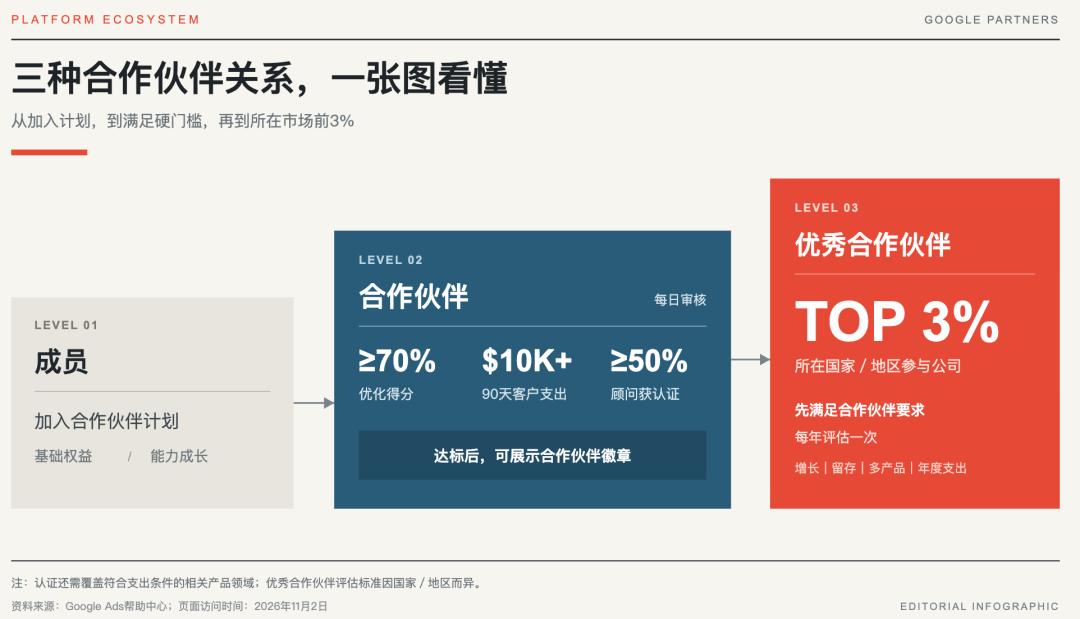
This mechanism of Google has a similar business logic to Ocean Engine's proposed "combination of assessment system and ranking system": the platform still needs agents, but prefers to pay for the incremental value brought by agents.
Mid Stage: Meta's Halving and Linkage
If Google adopts a one-size-fits-all approach, Meta takes another path: first cut the rebate range, then link rebates with assessment.
The first feature of Meta's China agency system is the scarcity of licenses. In 2014, Cheetah Mobile became the first official top-tier agent, and then the list was gradually expanded, forming a pattern of 11 agents around 2021.
After Guangdong Advertising Co., Ltd. was promoted in July 2023, the list did not change until the middle of 2026: Feishu Yitu, GatherOne, Guangdong Advertising Co., Ltd., Blue Focus Media, Wezon, HuntMobi, Cheetah Mobile, Panda New Media, Hugo Cross-border, YinoLink, TTD Media.
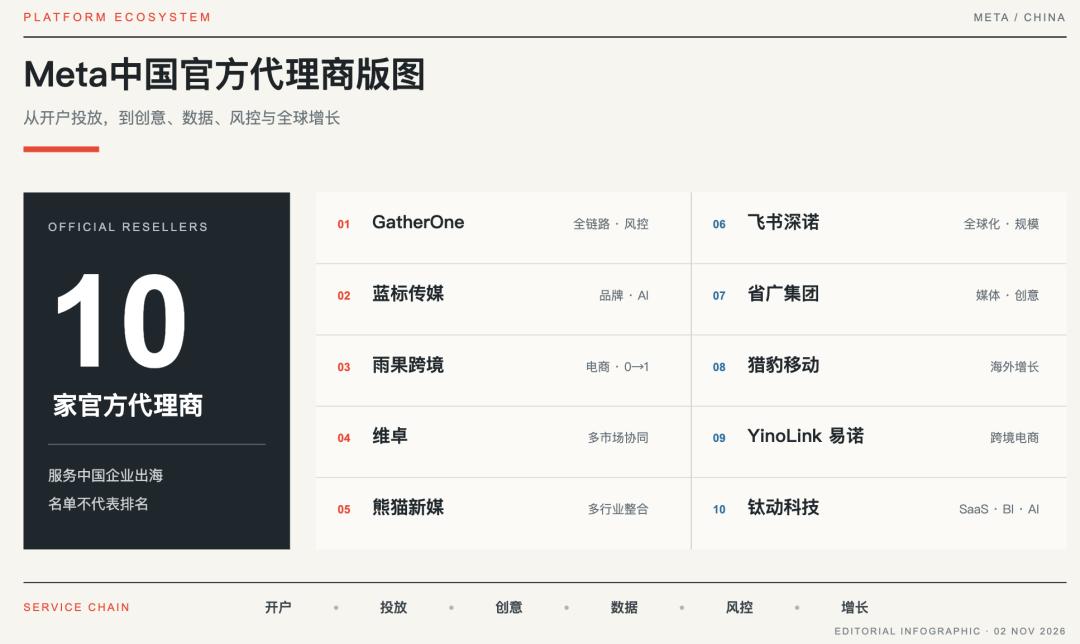
The second feature is deep moat. According to Meta's policy, Chinese mainland enterprises cannot submit account opening applications to Meta by themselves, and must go through official first-tier agents. This is in sharp contrast to Google, which allows Chinese enterprises to open accounts for free by themselves. Holding the account opening channel is the biggest chip of Meta's agents, and it is also the reason why the exit of rebates for Meta's agents is slower than that of Google's agents.
But slow does not mean no exit.
In early 2025, Meta made an unprecedented adjustment to the rebate policy that had been used for more than ten years: the rebate for non-direct customer accounts was cut by about half, and the rebate for direct customers was reduced by about 70%. How much rebate an agent can get began to depend on the KPI completion rate and account ban rate. Some sellers revealed that the monthly rebate dropped from USD 50,000 to USD 20,000.
By the end of 2025, there have been rumors in the market that Meta will follow Google to gradually cancel rebates.
According to insiders, Meta may no longer distinguish between direct customers and non-direct customers in 2026, the rebate will be uniformly reduced to about 3%, and KPI assessment will be introduced, and agents that meet the standards can get an extra 0.5 percentage point. This plan has not been officially confirmed yet.
Why does Meta tighten the policy?
On the one hand, the company plans to invest more than USD 100 billion in capital expenditure for AI in 2026, and every cost is being carefully calculated;
On the other hand, large customers at SKA and KA levels have long been locked by Meta's direct customer team, leaving agents mainly small and medium customers, and the increment of pure new customers is getting rarer.
At the same time, Meta's requirements for new agents have also changed. New agents need to have unique customer pools and new customer development capabilities, AI and self-developed technologies, brand full-case capabilities, and mature compliance risk control.
In other words: Meta is recruiting service providers, not agents.
Ocean Engine's Actions Have Been Paved in Advance
Some agents told *Doc Dao Ke* that the voice of Ocean Engine canceling rebates has long existed. As early as at the channel agency conference in 2019, Ocean Engine mentioned the cancellation of rebates at the internal private sharing meeting with customers.
At that time, the platform had noticed that some agents, in order to boost consumption and get higher-level rebates, did not hesitate to cut prices to grab orders, and then pass the rebates to customers in exchange for cooperation.
When the rebate is passed out, the service can only be reduced.
The advertising delivery effect for customers is discounted, and ultimately the users who watch advertisements on Douyin are affected.
The rebate, which was originally a tool to encourage agents to provide good services