The hamburger giant is about to be sold.
An American hamburger chain that has been in business for nearly 57 years has suddenly received a $1.4 billion acquisition proposal.
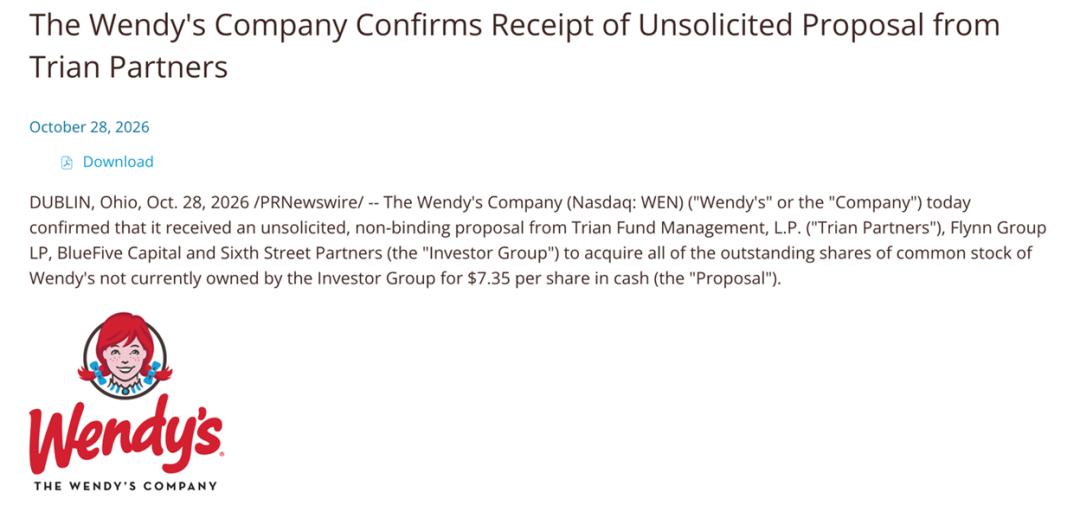
On October 28, Wendy's announced that Trian Fund, owned by Wall Street billionaire Nelson Peltz, together with other investment institutions, plans to take the company private at a price of $7.35 per share, representing a premium of approximately 20% over the closing price on the previous trading day. After the news broke, Wendy's share price rose by about 15% that day.
This buyer also has a widely recognized public identity: the father-in-law of David Beckham's eldest son.
At present, this hamburger giant with more than 7,000 stores is facing operational difficulties. In the second quarter of this year, the company's net profit fell by more than 40% year-on-year, 315 stores were closed in the first half of the year, and a large franchisee also entered bankruptcy restructuring. At the same time, Wendy's announced plans to open up to 1,000 stores in China over the next ten years, but its first store has not yet launched, and the relevant cooperation agreement has also encountered changes.
How did it end up at the point of being acquired?
In China, not many people are familiar with Wendy's, but in the United States, its iconic logo of a little girl with red hair and double ponytails is almost a household name.
In 1969, Dave Thomas opened the first Wendy's in Columbus, Ohio, and the store name was taken from his daughter's nickname Wendy. Its signature products are square beef patties and Frosty frozen desserts. In 1976, Wendy's entered the capital market; in 1984, it became popular across the United States with its "Where's the beef?" advertisement.
In the following decades, this hamburger chain kept expanding, and was long the second largest hamburger chain in the United States, second only to McDonald's.
At the end of 2025, Wendy's operated 7,397 restaurants worldwide, including 5,969 in the United States and 1,428 in overseas markets. In addition to Canada, Mexico and the United Kingdom, its brand signs can also be seen in Asian markets such as India, the Philippines and Indonesia.
However, while the brand reputation remains, its business performance is not as good as before.
According to data from market research firm Technomic, Wendy's sales share in the U.S. hamburger chain market has dropped from 11.5% in 2019 to 10.4% in 2025.
Competitors are increasing their investment. McDonald's continues to strengthen its low-cost value combo meals and App member benefits, Burger King is promoting store renovations and increasing marketing investment, and characteristic hamburger brands such as Five Guys and In-N-Out are also competing for customers.
Apart from external competition, Wendy's own operations have also encountered problems.
In August this year, the company released its second-quarter performance: revenue reached $570.6 million, up 1.7% year-on-year, but net profit dropped to $32.6 million, down 40.8% year-on-year; U.S. same-store sales fell 7%, and the profit margin of directly operated restaurants dropped from 16.2% to 13.8%.
The rising cost of ingredients and labor has brought pressure, but the problems are far more than that.
Bob Wright, who returned to Wendy's as CEO in May this year, admitted in August that the company had excessively pursued cost control and operational efficiency in the past, which undermined product quality; the preferential combo meals became more and more complicated, reducing their attractiveness to consumers, and there were also deficiencies in in-store service and marketing.
Wendy's has not tried to make changes. This year, it launched Biggie preferential combo meals at different price points of $4, $6 and $8, and adjusted its menu and breakfast business, hoping to re-attract consumers who focus on cost performance.
However, these adjustments have not reversed the operational pressure for the time being. In August, the company withdrew its full-year performance guidance, and cut its quarterly dividend from $0.14 per share to $0.07 per share.
What is more intractable than the loss of consumers is that franchisees can no longer sustain operations.
As of the end of June, among the 7,180 Wendy's restaurants worldwide, only 430 are directly operated, and about 94% are operated by franchisees. In the first half of this year, Wendy's opened 98 new stores worldwide, but closed 315, with a net reduction of 217 stores. Among them, the U.S. market alone saw a net reduction of 245 stores.
In September this year, large franchisee Meritage Hospitality filed for bankruptcy protection. This enterprise once operated more than 350 Wendy's restaurants in 15 U.S. states, had previously closed about 93 stores, and owed Wendy's more than $24.9 million in fees. On October 23, the court approved it to terminate the leases and franchise agreements of 20 to 60 underperforming stores.
Wendy's, which expanded through the franchise model for decades, now has to face the chain reaction caused by franchisees closing stores and going bankrupt.
It was at this moment that Peltz put forward the acquisition offer.
Beckham's in-laws set their sights on an old acquaintance
Nelson Peltz, who made the offer this time, is 84 years old this year. He has another identity: Beckham's in-law.
In April 2022, his daughter, American actress Nicola Peltz, held a wedding with Beckham's eldest son Brooklyn in Florida.
Compared with the high-profile Brooklyn, his father-in-law is already a well-known billionaire on Wall Street.
Peltz was born in Brooklyn, New York in 1942. In 1960, he enrolled in the Wharton School of the University of Pennsylvania, but dropped out three years later. He originally planned to work as a ski coach in Oregon, but eventually joined his grandfather's food wholesale company and started as a delivery truck driver.
After that, through a series of acquisition transactions, he became a well-known billionaire on Wall Street.
One of his most classic transactions involved the beverage brand Snapple.
In 1997, Triarc controlled by Peltz acquired the beverage brand Snapple for $300 million. After operational adjustments, in 2000, he sold the beverage business including Snapple to Cadbury Schweppes with an enterprise value of about $1.45 billion. In three years, the transaction price increased several times.
In 2005, he co-founded Trian Fund with his partners and became a well-known "activist investor" on Wall Street: buying shares of large companies with poor operation or low stock prices, striving for board seats, and then promoting business adjustments.
Famous companies such as Procter & Gamble, PepsiCo, Heinz and Disney have all been the targets of his investment or his attempts to promote reform. In 2017, he launched a fierce battle for board seats with Procter & Gamble, and finally joined the board in 2018. In 2024, he challenged Disney again, but lost the shareholder vote.
With both wins and losses, Peltz seems to have a particular preference for companies with long brand history, high popularity but operational difficulties.
Wendy's is exactly one of them.
In 2005, Trian began to invest in Wendy's; in 2008, Triarc controlled by Peltz merged with Wendy's. Since then, Peltz and his family have long participated in the company's governance.
In 2022, Trian considered taking Wendy's private, but abandoned the plan in 2023. In February this year, Peltz again disclosed that he was studying potential transactions. It was not until October 28 that the formal offer was released.
According to Wendy's announcement, the acquisition consortium includes Trian, Flynn Group, BlueFive Capital and Sixth Street Partners. Trian and its related parties already hold about 16.3% of Wendy's shares, and Flynn operates more than 340 Wendy's restaurants. The acquirer believes that Wendy's transformation requires years of investment, and privatization can provide longer-term financial support.
But not all shareholders are willing to accept the offer.
Another shareholder, Blackwells Capital, publicly opposed the acquisition offer of $7.35 per share, arguing that this price underestimated the value of Wendy's. In fact, Wendy's share price once hit a 52-week high of $10.12 on November 7, 2025, and the current acquisition offer of $7.35 per share is about 27% lower than this price. Blackwells also questioned that Peltz, who has long participated in the company's governance, bears certain responsibility for Wendy's current operational difficulties, but wants to acquire the company when its stock price is low.
At present, Wendy's has established an independent director committee to evaluate this non-binding proposal, and hired Morgan Stanley as a financial advisor. The transaction is not yet finalized.
While closing stores in the U.S., the 1,000-store plan in China has not yet started
Wendy's, which is busy closing stores in the United States, also turned its expansion attention to the Chinese market this year.
On May 8, the company announced that it had signed a franchise agreement with a large catering operator with decades of experience in the Chinese market, planning to open up to 1,000 stores in China over the next ten years. According to the company, this is the largest franchise development agreement in its history.
Who is the partner? Wendy's did not announce it, only saying that it will introduce the partner when the first store is about to open. More than five months have passed, the first store has not been launched yet, but the agreement has encountered variables first.
According to Wendy's second quarter 10-Q report, the leadership of its Chinese partner has changed, so the two sides modified the agreement, allowing either party to terminate the cooperation without liability before December 12, 2026. It is still uncertain whether the 1,000-store plan can continue to be promoted.
Wendy's has tried to enter China before. In 1982, it entered Hong Kong under the name "Deyimei", and after exiting, it re-opened stores under the name "Yundisi" in 1991. However, due to poor operation, it finally withdrew around 2000. It also encountered setbacks in the Taiwan market. Due to high pricing and competition from brands such as McDonald's and KFC, it withdrew at the end of 1999.
Now when entering the Chinese mainland, the competition will be more fierce. McDonald's, KFC and Burger King have been deeply rooted in the market for many years, and local brands such as Wallace and Tastien are also competing for customers.
According to the view of a catering industry analyst from Euromonitor International, latecomers like Wendy's need to establish a locally differentiated store operation model with controllable costs. For consumers who are increasingly focusing on cost performance, the reputation of overseas brands is no longer enough to support high prices.
Wendy's first needs to solve the problems of who will operate, how to control costs, and whether the stores can make profits.
Looking at the international catering industry, more and more old established enterprises are also adjusting their operations with the help of capital.
In 2020, Inspire Brands acquired Dunkin' Brands for about $11.3 billion; in 2024, Subway was acquired by private equity firm Roark Capital. In the same year, Burger King's parent company bought the large U.S. franchisee Carrols with an enterprise value of about $1 billion, planning to renovate the stores and gradually hand them over to franchisees for operation again.
In China, international catering brands are increasingly cooperating with local capital, or rearranging brand ownership and operation rights.
In February this year, Burger King China announced the completion of a joint venture transaction with CPE Yuanfeng, which invested $350 million to hold about 83% of the shares; in April, Starbucks announced the completion of a joint venture transaction with Boyu Capital, which obtained 60% of the equity of its Chinese retail business.
In August, Yum China spent $1.2 billion to acquire the brand ownership of Pizza Hut in the Chinese mainland from Yum! Brands, changing from a brand licensee to the brand owner.
From overall acquisition and franchisee restructuring to the introduction of local capital, the transaction methods are different, but all point to a reality: brand popularity is no longer enough to guarantee growth, who invests, who operates, and who bears risks is becoming more and more important.
Wendy's is also facing the same problem.
In the United States, it needs to improve the operation status of existing stores and help franchisees restore profitability. Privatization may win more time for long-term adjustments. In China, it needs to find the right partner and establish a store model that can make sustainable profits.
Conclusion
Peltz has dealt with Wendy's for more than 20 years. This time, he wants to buy the company directly.
But what he will take over is an old hamburger giant that is facing customer loss and operational difficulties for franchisees. In China, Wendy's ambitious 1,000-store plan has also been slow to land.
For Peltz, privatization may be a good opportunity to promote Wendy's transformation. But even if the transaction is completed, issues such as how to adjust the menu, how to set prices, and how franchisees can make profits still need to be solved one by one.
After nearly 57 years of development, the biggest problem Wendy's is facing now is still the old question: why do consumers still choose Wendy's?
This article is from WeChat official account "Rongzhong Finance" (ID: thecapital), written by Li Bingzhi, published with authorization from 36Kr.