The era of drastic subsidy rollbacks has arrived.
The "consumption-for-seating" trend sparked by Starbucks is essentially a tightening of subsidies: refusing to use rigid and fixed costs such as rent, decoration, depreciation and labor to subsidize people who do not consume and generate profits.
01
Subsidies Are Retreating Across the Board
Office workers who wake up every day to the endless stream of information haven't refreshed their feeds to get large 38-yuan-off-18-yuan food delivery coupons for a long time.
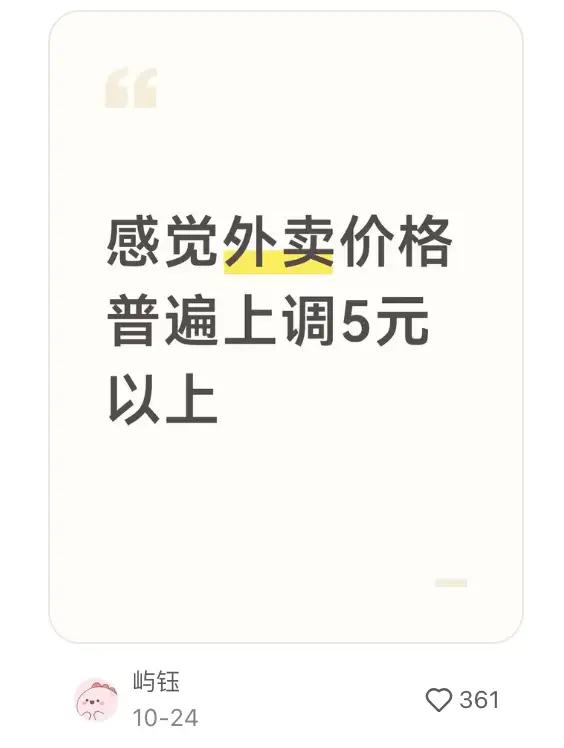
This is no illusion. The food delivery giants have unanimously chosen to call a truce in the past two quarters.
Meituan's local commerce business thus turned profitable from loss, posting a profit of 5.7 billion yuan in Q2. Its CFO Chen Shaohui also predicted that food delivery UE (unit economics) will improve significantly in Q3, at the cost of a 4%-5% year-on-year drop in average daily food delivery order volume in September.
At the height of the food delivery war, Meituan, Taobao Flash Purchase and JD.com could generate about 200 million orders a day in total. By February 2026, the total figure dropped to around 110 million. According to Goldman Sachs' calculation, the average daily order volume of the three platforms in Q2 was about 80 million, 66 million and 16 million respectively, showing a clear decline from the peak.
But this is the result of the platforms' active choice: "orders that do not generate profits" are actively screened out. Xue Bing, the head of Meituan Delivery who publicly stated long ago that "the food delivery war fuels a huge unhealthy bubble", recently happily concluded that the proportion of low-price orders below 15 yuan has halved year-on-year, food delivery prices have rebounded, and the so-called low-price bubble is fading away.
In the past few years, we have almost lived in a world wrapped in subsidies.
There are large full-reduction discounts for ordering food delivery, state subsidies for buying home appliances, you can accumulate gold coins to withdraw cash by watching short dramas, and even buying a cup of coffee can catch up with the 9.9-yuan "price revolution".
But in the second half of 2026, people will perceive from all aspects that subsidies are quietly disappearing, not as grandly as when they came.
The accounts of tea beverage stores have collapsed accordingly. The demand generated by food delivery subsidies was suddenly cut off. Luckin Coffee's same-store sales of self-operated stores in Q2 fell by 5.3% year-on-year, which has been negative for three consecutive quarters. Bawangchaji's adjusted net profit in a single quarter decreased by 22.4% year-on-year. Cotti Coffee ended its "9.9-yuan for all products without limit" campaign, raising the price of core products back to 10.9-16.9 yuan. Mixue Bingcheng recorded its first half-year profit decline since its listing (net profit down 14.7%), with double-digit drop in average store turnover.
The entire e-commerce sector has stagnated. According to a quick review of China's e-commerce industry released by Nomura on October 19, titled China e-commerce market stagnant in September, China's e-commerce sales (excluding services) only increased by 0.1% year-on-year in September, a significant slowdown from 2.2% in August. The e-commerce penetration rate in September decreased by 0.3 percentage points year-on-year to 28.7%, the first decline since July 2025.
According to Nomura's analysis, the reason is exactly that "facing the relatively cautious consumer sentiment, China's e-commerce industry has basically tightened subsidy expenditures to retain cash flow."
The sales of durable goods that were once boosted by state subsidies, such as home appliances, have also declined. In 2026, the state subsidy fund shrank from about 300 billion yuan in 2025 to 250 billion yuan, and the number of subsidized home appliance categories was reduced from 12 to 6. The adjustment of small categories has led to a recent surge in sales of smart wearable devices. However, in the total retail sales of consumer goods in the first half of the year, home appliances decreased by 7.4% year-on-year, and according to the data of AVC, the total retail sales of home appliances market in the first half of the year fell by 9.9%.
After the consumption demand in the auto market was overdrawn by the trade-in policy, the decline became more obvious. Data from the China Passenger Car Association shows that the retail sales of narrow-sense passenger cars in September 2026 was 16.18 million units, down 28.0% year-on-year; the cumulative volume from January to September was 13.334 million units, down 21.7% year-on-year.
McKinsey's 2026 China Auto Consumer Insights puts forward an observation that consumers' perception of the price war is net negative, at -5.7%. The market has entered a stage where "price cuts can no longer bring sales growth".
The latest "consumption-for-seating" trend sparked by Starbucks is essentially the same move, which is also tightening subsidies: refusing to use rigid and fixed costs such as rent, decoration, depreciation and labor to subsidize people who do not consume and generate profits.
Even Hongguo Short Drama, which used the free model, announced that it will gradually phase out the gold coin subsidies for end users. Hongguo's business model is to aggregate users' relatively low-value time and sell it to advertisers.
When AI can produce a steady stream of low-cost content supply, the tasks of acquiring new users and extending user duration can be fully completed, and even the stage of considering the "negative externality" of users being too addicted has arrived. Subsidies for users are no longer necessary.
02
The Logic Behind the Subsidy Retreat
Subsidies, to a certain extent, are a kind of "bribe" to consumers, which generates consumption demand that does not exist or should not have occurred at the present time.
When this kind of demand can be cultivated from scratch into a normal state, it is worthwhile for the subsidy provider to do so, such as the former Pinduoduo's "cut a penny" campaign, ride-hailing services, and today's Hongguo Short Drama. But if the demand drops back or even shrinks once the subsidy stops, then it is not an optimal solution, and it is often a last resort after trade-offs.
Just like the just-concluded round of food delivery war, the order volume dropped by tens of millions of orders from its peak to the truce. These tens of millions of evaporated orders are not "real demand that was accidentally injured", but low-value GMV that was wasted in empty competition between platforms.
In the short term, this can even be regarded as "a meritorious deed": enterprises used their own money to subsidize consumers, and they also got good reports of daily active users and order volume. However, in the long run, subsidies have forcibly snatched illusory demand from dine-in, offline and other channels, which is mostly a stock killing. Subsidies use real money to distort an originally healthy cash flow into a cash flow maintained by issuing coupons.
Some media once calculated that JD.com's new business dominated by food delivery spent 2.53 yuan to increase 1 yuan of revenue in 2025; Alibaba had to spend an extra 2 yuan for every 1 yuan increase in flash purchase revenue; as the defending party, Meituan had less loss per order, but lacked blood transfusion from other cash flow businesses, so it was the most injured.
The platforms stopped their subsidy wars not only because they need to spend money on the new AI battlefield, but also because they can no longer afford the burning money. After the ceasefire, Meituan's UE turned positive, and Alibaba and JD.com also significantly reduced their losses.
Large chain catering enterprises followed the general trend to develop food delivery lines. Haidilao's food delivery revenue in the first half of the year increased by 121%, and the proportion of food delivery rose from 4.5% to 9.2%. Yum China's food delivery proportion reached 54%, surpassing dine-in for the first time. Domino's China's food delivery proportion also rose year-on-year from 43.1% to 51.7%. However, after the proportion of food delivery increased, the overall gross profit margin of Haidilao and Domino's Group was pulled down.
Dine-in has a higher gross profit margin, but the consumption habit of dine-in is declining due to various factors such as the food delivery war. In September, the year-on-year growth rate of Meituan's in-store business GTV has fallen to single digits, down 13% month-on-month, of which in-store catering decreased by about 8%-9%, and in-store comprehensive services decreased by about 13%.
The "consumption-for-seating" policy implemented by Starbucks, Nayuki, IKEA and other brands further illustrates a universal business common sense: private enterprises using their own funds to subsidize and provide social welfare needs a certain profit margin to support, or the enterprise judges that it will win more profits in the future because of this.
For companies like Starbucks, when peers such as Manner, M Stand, Bawangchaji and Luckin Coffee seize the market with limited drinks of not low quality but lower prices, it not only needs to maintain the expensive third space, but also cut prices and invest more in R&D to compete.
When it is generally difficult to raise prices, or even enter a deflationary stage, the profit prospects of enterprises are at stake, and the necessity of subsidies becomes questionable.
After fierce competition, the curled-up survival mode is becoming a consensus: preserve strength, hold cash flow, serve real customers who can afford to pay, and no longer burn themselves for false scale figures.
03
The Landscape After Subsidies Recede
Speaking of which, it seems that we should be optimistic: the withdrawal of low prices and the return of prices above the cost line are exactly the "healthy price increase" we have always wanted. Your consumption expenditure is my income, and the profit effect is transmitted, shouldn't everyone be happy?
But once the mental price of tea beverages is anchored at 9.9 yuan, it is difficult to return to 15 yuan. It is difficult for sales volume and profit to return at the same time. The subsidy reduction is an external factor, and the erosion of price war on consumer psychology is an internal resistance.
Subsidies are often not only borne by the platforms, and small merchants cannot rest easy just by embracing the dividends. During the food delivery war, the China Chain Store & Franchise Association visited 33 merchants and found that merchants had to share 30%-70% of the subsidies.
Lixin Consulting surveyed 2000 catering merchants at the beginning of the year and got the data: since the subsidy war, 80% of catering merchants' net profit has declined, and 35% of them have a decline of more than 30%; 74% of merchants' customer unit price has decreased, of which 53% of merchants have a decrease of more than 10%; 39% of catering merchants began to replace raw material suppliers with lower prices.
In the industry knockout round accelerated by subsidies, merchants with poor risk resistance can hardly survive until the smoke clears.
When consumers get used to "not placing orders without subsidies", normal pricing cannot sell well. For the remaining merchants, the recovery of revenue health requires a longer period of exploration.
The same is true for the auto market. In 2025, more than 11.5 million vehicles were traded in for new ones, and 1 out of every 2 vehicles sold was a trade-in, a large number of future replacement demands were concentrated in 2025 in advance; on the other hand, the subsidy intensity shrank this year, leading to a demand vacuum period.
Moreover, some self-media found that cities with a year-on-year decline of more than 30% in September alone, such as Chengdu, Wuhan, Qingdao and Nanjing, have one thing in common: the main market force is mid-range models, which are highly sensitive to policy subsidies and price wars. After the price war breaks through the new car price system, it will form a self-reinforcing downward spiral of price expectations.
The myth of "small but unbreakable" is also breaking. Two years ago, niche brands such as lululemon, On Running, Moutai and Pop Mart seemed to be able to avoid the consumption cycle and fear no macro storm. But today, their sales and valuations are both suffering setbacks. Pursuing niche trends quickly becomes a very popular thing.
Subdivided tracks are quickly filled with capital and traffic, and supply quickly turns the niche market into a red ocean, and the aura premium will depreciate rapidly. Tracks that can take off against the trend without subsidies are also inevitably affected by the downward gravity of the market.
The source of subsidies provided by enterprises and the government in recent years is a shrinking balance sheet.
Since the beginning of this year, this balance sheet has not improved, but has become more pessimistic. In the first three quarters of 2026, household loans decreased by 1.03 trillion yuan on a net basis, and household deposits increased by 9.39 trillion yuan. GDP grew by 4.6% in the first three quarters, but consumption only grew by 1.1%, and investment even decreased by 7.2%.
In the past five years, housing prices in large and medium-sized cities have fallen by more than 40% on average, and all the A-share profit-making effect of last year has been returned this year. Residents dare not spend, enterprises dare not invest, and the fundamentals have not changed.
Subsidies adjust residents' consumption distribution, but cannot adjust consumption expectations and confidence.
The retreat of subsidies is not the starting point of recovery, it just unfolds the accounts for everyone to see. The next step is unlikely to be a "win-win" rebound, but a slow clearance. Low prices will not disappear, but it will be harder and harder to make money; price increases will not succeed immediately, but will become a survival choice for a few companies. Truly healthy consumption will only come from the gradual recovery of income, employment and balance sheets.
This article is from the WeChat official account "20 She" (ID: quancaijing_20she), written by Jia Yang, and published with authorization from 36Kr.