Urgent IPO withdrawal, Sunwoda abandons the A+H listing plan, Xiaomi and Li Auto enter the power battery sector.
Recently, Sunwoda has released a series of announcements in one go.
The key information in the announcements is as follows: terminate the issuance of H shares and listing on the Main Board of the Hong Kong Stock Exchange; approve Xiaomi's capital contribution of 1.7 billion yuan to increase the capital of its subsidiary Sunwoda EV Battery; after the capital increase is completed, Sunwoda EV Battery will no longer be included in the consolidated financial statements of the listed company.
This means that Sunwoda's "A+H" plan that has been planned for more than a year has officially come to an end. At the same time, its power battery subsidiary "Sunwoda EV Battery" has also welcomed new shareholders.
The timing of the withdrawal is quite subtle, and Sunwoda's 2026 Q3 report was disclosed on the same day. According to the latest financial report data, in the first three quarters of 2026, Sunwoda achieved revenue of 63.462 billion yuan, a year-on-year increase of 45.78%, but its net profit declined year-on-year. The net profit attributable to shareholders was 613 million yuan, a year-on-year decrease of 56.37%. It is not difficult to see that Sunwoda's business is growing larger, but the money it earns is decreasing instead.
The helmsman behind Sunwoda is Wang Mingwang, who comes from Maoming. In the latest Hurun Rich List, Wang Mingwang and his wife are on the list with a net worth of 10.5 billion yuan, their ranking has dropped by 230 places compared with the previous year, but they are still the richest people in Maoming.
Looking back on Sunwoda's trajectory in the capital market over the years, from ChiNext IPO, issuing GDR in Switzerland, spinning off subsidiaries for IPO, sprinting for "A+H", to actively pressing the terminate button, then turning around to bring in industrial capital such as Xiaomi and Li Auto, and frequently contributing to industrial funds as an LP in recent years. What we can see is that an investment territory spanning batteries, energy storage and industrial funds is emerging.
Withdraw an IPO
Let's look at the announcement itself first.
On October 28, Sunwoda held the 3rd meeting of the 7th board of directors, and reviewed and approved the proposal to terminate the H-share issuance and listing. The reason given in the announcement is very brief: "Based on the comprehensive consideration of the market environment, the company's own changes and development plans, adhering to the principle of safeguarding the interests of shareholders, after careful analysis and demonstration", the company agreed to terminate the issuance of H shares and list on the Main Board of the Hong Kong Stock Exchange.
At the same time, the company also emphasized that "the company's current operating conditions are normal. This termination of H-share issuance and listing is a prudent decision made by the company based on comprehensive weighing of various factors and the actual situation, and will not have a significant impact on the company's operating activities and sustainable development. There is no situation that damages the interests of the company and all shareholders, especially small and medium shareholders."
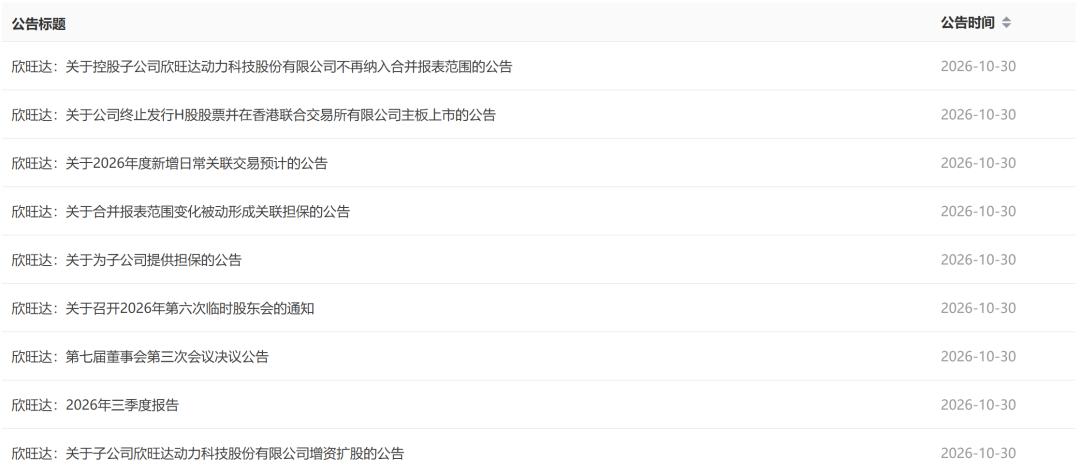
The timeline of Sunwoda's application for Hong Kong stock IPO dates back to more than a year ago.
Back in July 2025, Sunwoda's board of directors reviewed and approved the H-share issuance proposal, which was quickly passed by the interim general meeting of shareholders; at the end of July of the same year, the company officially submitted the listing application to the Hong Kong Stock Exchange. For the planning of Hong Kong stock IPO, the company stated that "it is to further promote the company's globalization strategy, build an international capital operation platform, enhance the international brand image and comprehensive competitiveness, and help the company's long-term development."
Indeed, according to the disclosed prospectus, the IPO proceeds are planned to be used to realize the company's international growth strategy, including expanding new overseas production facilities and global sales and service networks, to better reach the growing international customer group; invest in R&D to maintain the company's leading position in the lithium-ion battery industry, and further improve the company's technical capabilities.
However, the road to Hong Kong listing is not a smooth one.
According to the rules of the Hong Kong Stock Exchange, the listing application will expire if it is not completed within 6 months. On January 30, 2026, Sunwoda's first application expired after six months, and it resubmitted the application on the same day. On July 30, this updated application expired again, but the company did not resubmit it afterwards, and pressed the terminate button actively three months later.
It is worth noting that recently, not only Sunwoda is the A-share company that chose to terminate the Hong Kong stock IPO.
According to LiveReport statistics, as of July 24, 2026, 10 A-share companies have announced the termination of their Hong Kong listing plans within the year, including Linglong Tire, Unis, Ktech Power, Huahai Qingke, Wondershare, Narada Power, ENN, Huheng Bio, Nuosiland and Dayang Motor. In September, ChiNext company Hand Information also announced the termination of H-share listing, for the same reason of comprehensive consideration of the macro economy, capital market environment and its own development plan. Coincidentally, companies such as ChineseAll and BlueFocus have also successively announced the termination of their H-share listing plans recently.
The core reason why enterprises actively call off the H-share IPO is that the market absorption capacity is weakening. As shown in the figure below, since July this year, the proportion of Hong Kong new shares that fell below the issue price on the first day of listing has risen, and the proportion of these new shares whose cumulative performance fell below the listing price is nearly 80%.
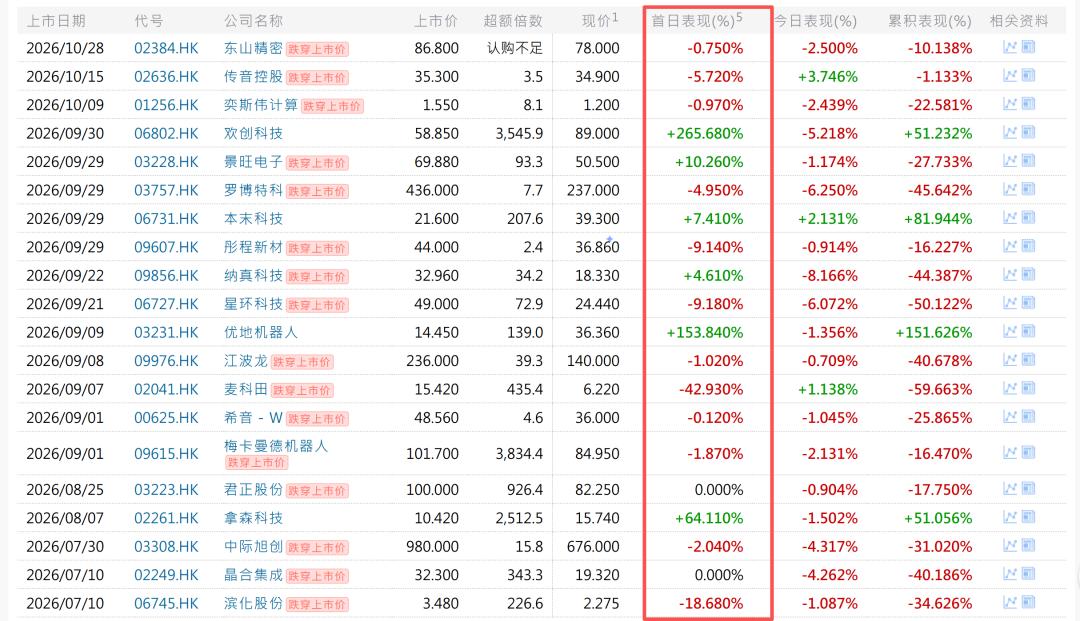
In such a market environment, even if enterprises issue shares forcibly, they will most likely have to set the price at a discount, and even face the situation of breaking the issue price. Therefore, after weighing the two options, actively terminating the H-share listing is a choice to stop losses, and also leaves room for restarting at an appropriate time in the future.
The Incubated Unicorn Welcomes New Shareholders
The heavy news of Xiaomi's capital increase to Sunwoda EV Battery came out at the same time as the news of terminating H-share issuance.
According to Sunwoda's announcement, its power battery entity Sunwoda EV Battery has introduced a new shareholder. Xiaomi, through its wholly-owned subsidiary Hanxing Venture Capital Co., Ltd., contributed 1.7 billion yuan to subscribe for about 898 million yuan of new registered capital of Sunwoda EV Battery, and will hold 5.34% of the shares after the capital increase is completed. Sunwoda and other original shareholders waive the preemptive subscription right for this round.
According to the capital increase plan, Xiaomi has become the third largest shareholder of Sunwoda EV Battery in one leap, and the entities ahead of it are Sunwoda Huizhou New Energy Co., Ltd. under Sunwoda and Li Auto.
The relationship between Xiaomi and Sunwoda EV Battery previously stayed at the level of supply chain cooperation.
In September this year, Xiaomi Auto, CALB and Sunwoda EV Battery jointly officially announced the strategic cooperation of "Xiaomi Dragon Armor Battery". On the day of the event, Wang Mingwang, founder of Sunwoda Group, said in an interview: "Our cooperation with Xiaomi is based on market demand and application scenarios. The Dragon Armor Battery has carried out systematic definition and planning for the system scenarios. Based on this top-level design, Sunwoda has set high-standard technical indicators in the whole chain of R&D, materials, technology, life, manufacturing and services, especially for the R&D of safety, reliability and product life cycle, the teams of both sides have implemented multiple penetrating management."
Xiaomi is not the first car company that has made a move on Sunwoda EV Battery.
On September 4, Sunwoda announced that Li Auto contributed 2.65 billion yuan to increase capital in Sunwoda EV Battery, subscribing for about 1.4 billion yuan of new registered capital, corresponding to 8.79% of the shares after the capital increase. Combined with the 2.60% stake previously held by Li Auto through its affiliated Chongqing Chezhiyuan Venture Capital Co., Ltd., the relevant entities of Li Auto hold a total of 11.17% of the shares, becoming the second largest shareholder.
Li Auto and Sunwoda EV Battery also have a deep origin. Liu Liguo, Senior Vice President of Whole Vehicle Electrification of Li Auto, once revealed that Sunwoda EV Battery became the battery supplier of Li Auto as early as 2017; in 2022, Li Auto increased capital by 400 million yuan through its affiliated company to participate in the Pre-A round financing of Sunwoda EV Battery. For this additional investment, Li Auto said that the investment helps to enhance its right to speak in battery technology, manufacturing quality and long-term collaboration, and promote the high-quality implementation of non-standard battery technology solutions.
Looking at the timeline, it is not difficult to see that the financing rhythm of Sunwoda EV Battery this year is quite intensive.
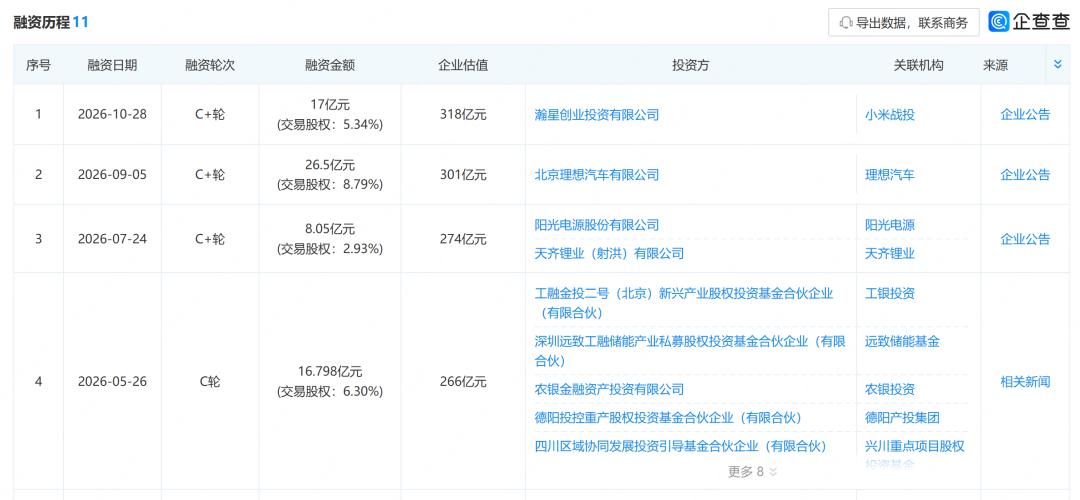
In May this year, it completed the C-round financing of 1.6798 billion yuan, introducing more than ten investors such as ICBC Financial Investment, ABC Investment and China Post Investment; in July of the same year, industrial capital such as Sungrow Power and Tianqi Lithium participated in the C+ round of 805 million yuan; Li Auto entered the game in September, and Xiaomi followed up in October... In just half a year, Sunwoda EV Battery has raised a total of nearly 7 billion yuan.
As the list of shareholders behind Sunwoda EV Battery gets longer and longer, Sunwoda's own shareholding ratio is decreasing all the way. Before Li Auto's capital increase, Sunwoda held 26.38% of the shares through Sunwoda Huizhou, which dropped to 24.06% after Li Auto's shareholding; after Xiaomi's capital increase, Sunwoda's shareholding ratio will further drop to 22.78%.
As a super unicorn incubated inside Sunwoda, the story of Sunwoda EV Battery dates back to 2023.
On the evening of July 14, 2023, Sunwoda issued an announcement that it planned to spin off its holding subsidiary Sunwoda EV Battery for listing; after the completion of this spin-off, Sunwoda's equity structure will not change, and it will still maintain control over Sunwoda EV Battery.
At the same time, Sunwoda also pointed out in the announcement: Through this spin-off, Sunwoda EV Battery, as the company's independent platform for R&D, production and sales of new energy vehicle power batteries, will achieve independent listing, and enhance its financial strength through listing financing, so as to improve the profitability and comprehensive competitiveness of its new energy vehicle power battery business.
In October 2023, the website of the China Securities Regulatory Commission disclosed that Sunwoda EV Battery has filed for listing counseling with the Shenzhen Securities Regulatory Bureau, and signed a listing counseling agreement with CITIC Securities. However, after 3 years, this IPO is still stuck at the "counseling" stage.
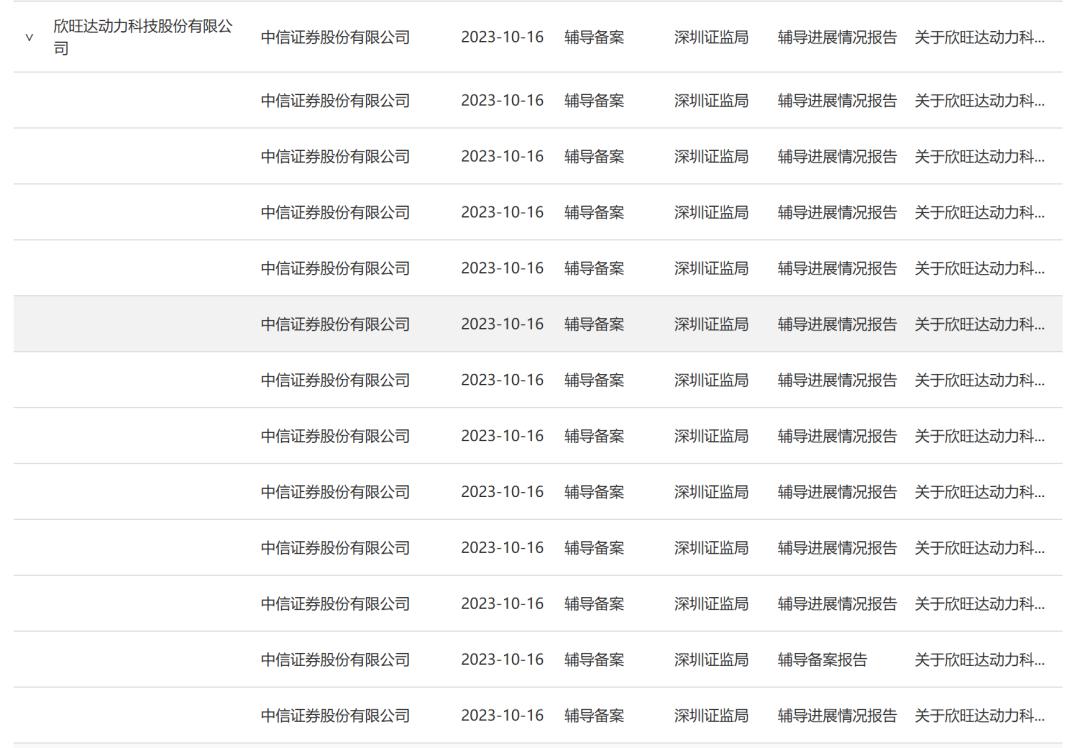
On October 13 this year, CITIC Securities issued the 12th phase of counseling work progress report, which shows that the counseling period is from July 1 to September 30, 2026.
Perhaps in the near future, the secondary market will welcome an IPO named "Sunwoda EV Battery".
Sunwoda's Investment Territory
Although it has withdrawn the H-share IPO, it does not mean that Sunwoda has stopped its pace in the capital market.
In 2011, Sunwoda successfully entered the capital market, becoming the first listed company on ChiNext that focuses on "overall R&D, manufacturing and sales of lithium battery modules". In the following more than ten years, Sunwoda's highest market value once approached 100 billion yuan, and now it is still a 10-billion-level giant despite a decline.
After being listed on A-share market, Sunwoda set its sights on Europe. In April 2022, the company started the preparation for the issuance of Global Depository Receipts (GDR). After 203 days, it completed the GDR bookkeeping and issuance pricing on the Swiss market on November 8 of the same year, issuing a total of 28.759 million GDRs at an issue price of 15.3 US dollars, raising about 440 million US dollars, with no over-allotment option arranged. On November 14 of the same year, Sunwoda was officially listed on the SIX Swiss Exchange.
After issuing GDR in Europe, Sunwoda successively planned the spin-off listing of Sunwoda EV Battery and its own H-share listing. The H-share listing was finally terminated, and although Sunwoda EV Battery's listing process has not made progress so far, it has not stopped financing. Since the beginning of this year, it has successively introduced industrial capital such as Li Auto and Xiaomi, and its valuation has been confirmed in rounds of capital increase.
In addition to financing in the secondary market, Sunwoda is also a frequent "sponsor" in the primary market.
In September 2024, Sunwoda announced that its wholly-owned subsidiary Shenzhen Qianhai Hongsheng Venture Capital Service Co., Ltd. (referred to as "Qianhai Hongsheng") planned to sign a partnership agreement with partners such as Zhuhai Xinghang Xincheng Investment Consulting Partnership (Limited Partnership) (referred to as "Xinghang Xincheng") and Zhaoqing XPeng New Energy Investment Co., Ltd. (referred to as "XPeng Investment") to jointly invest in Guangdong Xinghang Phase I Venture Capital Fund Partnership (Limited Partnership), whose manager is Guangdong Xinghang Xinchuang Private Fund Management Co., Ltd. (referred to as "Star Voyage Capital").
Among them, XPeng Investment subscribed 300 million yuan, Kaide Investment subscribed 150 million yuan, Qianhai Hongsheng and Xinlian Investment each subscribed 15 million yuan, and Xinghang Xincheng subscribed 1 million yuan. Star Voyage Capital was initiated and established by XPeng Motors as the cornerstone investor, focusing on startups in the fields of intelligent electric vehicle industry chain, climate technology and cutting-edge technology.
In June 2025, Sunwoda cooperated with Star Voyage Capital again. Qianhai Hongsheng contributed 27 million yuan to participate in the establishment of Qingdao Xinghang Xinneng Venture Capital Fund, holding 49.91% of the shares, and the fund invests in Haier New Energy under Haier. For the investment purpose, Sunwoda said that the wholly-owned subsidiary jointly investing in the establishment of the partnership with professional investment institutions is to carry out industrial investment under the premise of reasonably controlling risks by leveraging the resources and advantages of professional institutions in the fields of electric vehicles and new energy, so as to enhance the company's competitiveness and investment returns.
Data from Qichacha shows that Sunwoda has invested in 11 funds so far, and the number of direct investment projects is as many as 57.
