Why can't a "big business" emerge from hundreds of millions of young people living alone?
Recently, the viral app "Sileme" that rose to fame at the beginning of the year, after going through numerous controversies, changed its name to "ZaiMe ZaiMe" and began to focus on serving elderly people living alone. The software system is divided into Version 1.0 and Version 2.0: Version 1.0 costs 99 yuan per year, and Version 2.0 costs 199 yuan per year. Purchased centrally by the government, the system is available for free installation and use for elderly people living alone.
Compared with its previous positioning targeting young people living alone in first- and second-tier cities, the renamed "ZaiMe ZaiMe" has clearly switched its target user group. Interviews by Lanjing journalists show that its current users are mainly people aged 60 and above; reports from Luzhong Morning News also confirm that this app has clearly adjusted its application orientation.
The shift of focus from young people to the elderly is actually quite reasonable.
Over the past years, young people living alone have always been the absolute protagonist in the narrative of the "solitary economy": single-person meals, mini home appliances, emotional companionship, self-service consumption... Almost all innovations in relevant tracks revolve around young people's demand for self-pleasure, carrying inherent premium traffic. Even the predecessor of "ZaiMe ZaiMe" went viral among young people through internet memes.
But times are different now. As the rapidly expanding silver-haired group has become the next core protagonist in the solitary economy, players in this track have successively shifted from the youth traffic market to the rigid demand market of elderly services. The positioning transformation of "ZaiMe ZaiMe" may once again reveal a harsh truth:
The commercial value of young people living alone is depreciating at an accelerated rate.
The "Monetization Illusion" in the Youth Track
Of course, the number of young people living alone is not necessarily smaller than that of the elderly.
According to the 2024 estimated data from the *New Solitary Era Report* released by Shell Research Institute, the total number of young and middle-aged people aged 20 to 50 living alone is about 110 million, of which the group aged 20 to 39 living alone is about 83 million. Calculated based on data from the Ministry of Civil Affairs and the National Bureau of Statistics of China in early 2026, the number of single adults in China has reached 282 million, accounting for 25.1% of the total adult population, and the scale is very likely to exceed 300 million by the end of 2026.
On platforms like Douyin and Xiaohongshu, "living alone" once became a key traffic symbol for amateur content creators to grow their accounts.
Opening a video with the line of "XX age + occupation + slogan for living alone" paired with vlogs of daily life covering food, work, skincare and fitness often gains thousands or even tens of thousands of views. The Bilibili lifestyle UP creator "Aunt Soda Water" got more than 13,000 likes for her video *Living Alone for 6 Years, Life on My Own Is Really Relaxing*.
Against this trend, single-person meals, small home appliances, emotional companionship, trendy toy blind boxes... All kinds of self-pleasure consumption for people living alone have remained popular in the consumer market for years, growing increasingly fierce, and it seems that in the whole young group, consumption has no other meaning except pleasing oneself.
This is indeed the case. According to the calculation of research reports from institutions including JPMorgan Chase, the market size of the single economy covering food, clothing, housing, transportation, leisure and entertainment has approached the 10-trillion-yuan level. However, such a huge market scale does not mean that enterprises, the whole industry and entrepreneurs can easily enter the market and realize profits smoothly.
If the broad-caliber 10-trillion-yuan market is split into multiple vertical tracks of daily consumption such as food, entertainment and daily supplies, the huge traffic of young people living alone is more like a monetization illusion amplified by internet narratives.
First, let's answer the most basic question: How much money do the new generation of consumers actually have in their pockets?
Survey data from iiMedia Research shows that the new generation of consumers is mainly composed of young people with middle income. Those with monthly income of 5001-10000 yuan account for 53.73% as the main group; those with monthly income of 3001-5000 yuan account for 25.31%; those with monthly income of 3000 yuan and below account for 5.12%. While those with monthly income of 10001-20000 yuan account for 13.66%, and the high-income group with monthly income above 20000 yuan only accounts for 2.18%, adding up to only about 15% of the total.
Then look at the expenditure structure. Rigid demand still takes up the largest proportion: most people allocate 31%-50% of their monthly budget to catering, housing, transportation and daily necessities; while spending on self-pleasure items, digital tech products and experience services is mostly controlled within 30% as flexible budget; more than half of the people set aside 11%-50% of their income for savings and wealth management.
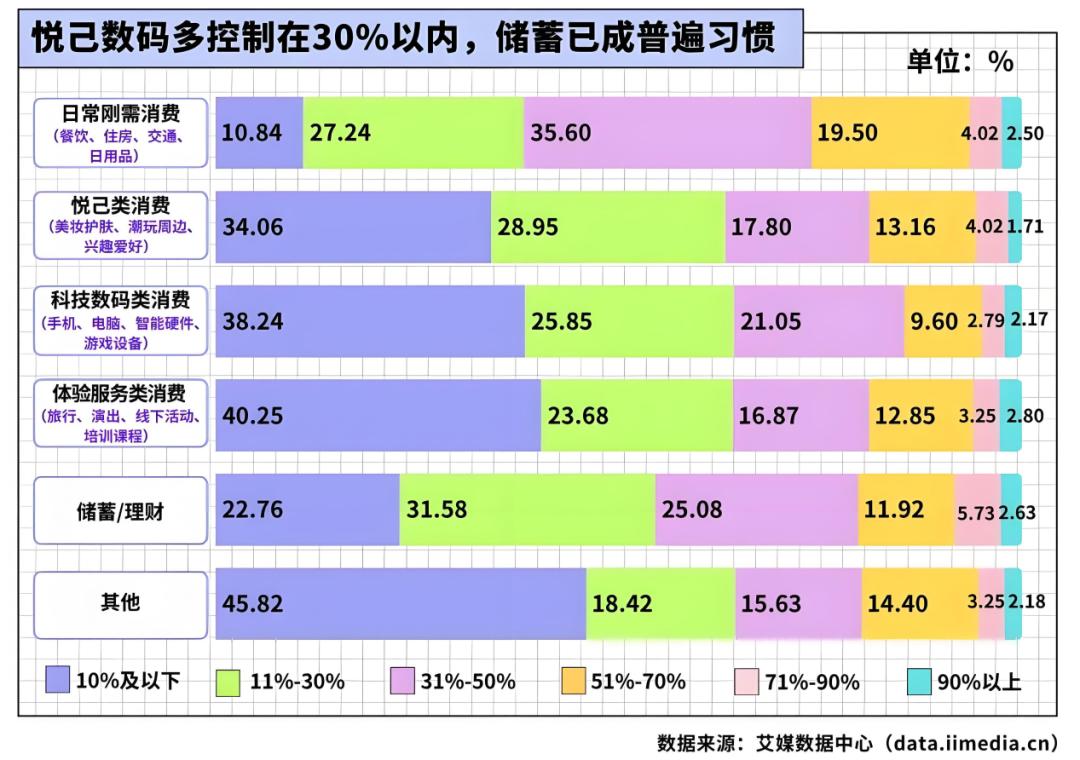
The not-so-ample disposable budget has caused some industries targeting young people to fall into profit difficulties.
The first to bear the brunt is the "single-person meal" track that first became popular in the solitary economy landscape in the early days. As the most frequent and rigid consumption scenario for young people living alone, "single-person meal" was once expected to reconstruct the catering industry, but the subsequent reality completely broke the previous beautiful illusions.
Take small hot pot as an example. A large number of small hot pot stores emerged around 2024. Data from Qichacha shows that as of December 2024, the number of registered small hot pot enterprises across the country exceeded 24,000, with an annual growth rate of 33.5%, far higher than the 3.7% growth rate of the overall hot pot market. A large number of these stores began to close down after 2025.
It is reported that the life cycle of many new small hot pot stores is only 3 to 6 months. Even the leading brand Xiabu Xiabu could not escape this dilemma: this brand that started its business with "single-person hot pot" has suffered consecutive losses for five years since 2021, with a total accumulated loss of more than 1.5 billion yuan. It closed 138 stores in 2024 and 56 stores in 2025.
The same plot is also playing out in the mini home appliance track.
Data from AVC (Ove Cloud) shows that the retail sales of domestic kitchen small home appliances reached 63.3 billion yuan, with a year-on-year increase of only 3.8%. The increment was almost entirely driven by the rise in average unit price (+11.4%), while the sales volume barely changed. The overall growth of the industry is weak, and most enterprises have seen their growth rate slow down or even decline.
If the consumer tracks can still maintain survival by relying on large sales volume, tool and service products can hardly find a sustainable payment model among young people.
Even though the practical value of AI is rising sharply at the current stage, the *Youth Lifestyle Report* shows that using AI for free is still the mainstream among young people. The survey results show that the largest proportion of respondents "often use free functions", and the proportion in various categories generally exceeds 55%.
This feature of "high traffic, low payment willingness" will be amplified more obviously when applied to low-frequency niche products. For startups, once the free traffic dividend is exhausted and they enter the stage of paid customer acquisition, the cost of acquiring a single customer will easily exceed the revenue generated from that single customer.
This is probably the fundamental reason why platforms like "ZaiMe ZaiMe" collectively choose to transform.
Admittedly, young people living alone are excellent traffic carriers and topic generators, who are good at creating hotspots, popularizing new concepts and giving birth to new tracks, but they are not high-quality paying groups. Under the defensive savings mentality, their consumption budget tilts to immediate emotional satisfaction, and they always maintain a certain degree of restraint on long-term payment for tools and services.
The trillion-yuan market is also extremely fragmented.
The youth solitary economy that seems to be full of opportunities everywhere turns out to be mostly illusionary businesses that only gain public attention but hardly make profits after you step into it.
Young People No Longer Believe in "Delicate Solitary Life"
Why is the market of young people living alone so huge?
One key reason is that as the topic of "living alone" on the internet remains highly popular, businesses have carefully built a picture of delicate life, as if every young person living alone lives in a studio apartment with French windows, and uses beautiful coffee machines and breakfast machines early every morning to pay the premium for a sense of ritual and self-pleasure experience.
Data shows that "single-person meal" has remained highly popular for a long time on platforms like Xiaohongshu, and the change of the concept of living alone also started from here. Most videos or graphic contents show wooden-style single dining tables, retro mini refrigerators, single-person hot pot at bar counters, and nights with aromatherapy paired with projectors, with core keywords including "healing, self-pleasure, sense of ritual, exclusive feeling"...
But is the reality really like this?
Putting aside the stereotyped delicate samples on social networks, the survival status of the vast majority of young people living alone is actually different from what businesses imagine. Especially after 2026, more and more young people begin to reject the "delicate solitary life" deliberately created by businesses, and turn to pursue freedom, comfort and cost performance.
The *2026 Insight into Solitary Life: Unlock New Scenarios for Eating, Accommodation and Entertainment* released by Qiangua Data shows that the popularity of the topic "solitary life" has increased by more than 400 million in nearly 90 days, but the style of content on social platforms has changed. Young people abandon the delicate lifestyle and present various "back-to-original" scenes, such as sleeping in a messy "dog nest", eating directly at the table, lying down casually on the kitchen island...
Data shows that the number of notes about free and real solitary life has increased by more than 110% year-on-year in the past 3 months. Contents about imitating animals, eating and lying down casually can get hundreds of thousands of likes per single note. On Xiaohongshu, topics related to "fit for myself" have accumulated more than 6.26 million discussions, with a total view count exceeding 2.04 billion.
It seems that the internet narrative about solitary life has ushered in an interesting "reversal". Compared with a cup of hand-brewed coffee after getting up early, large barrels of drinking water have become essential household goods; compared with neat fabric sofas, the "human dog nest" that allows people to curl up and lie down freely has gained the highest level of home well-being...
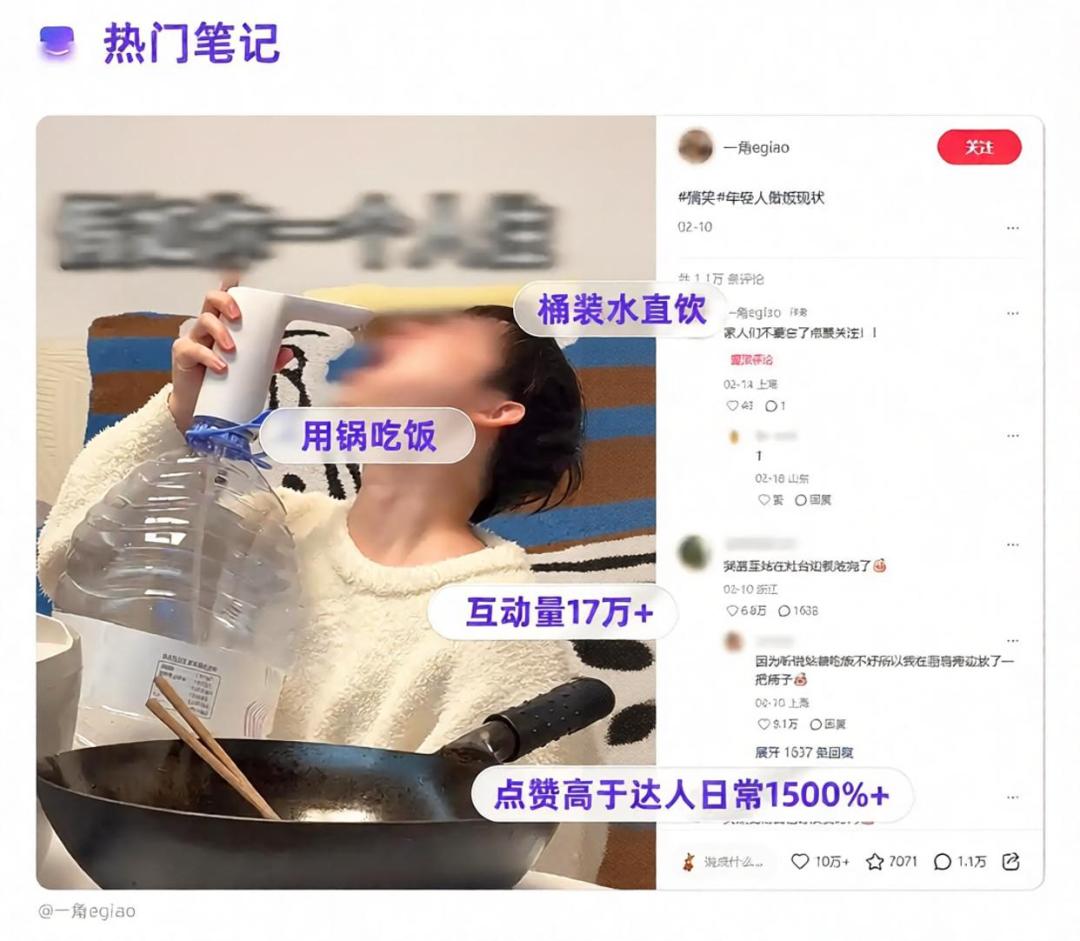
Various consumption data also confirm this point. The *In-depth Analysis of the Catering Industry in 2026* from Yuanzhan Huiku shows that the proportion of catering orders below 30 yuan rose to 62% in 2025. The *2025 China Consumer Trend Report* from Nielsen IQ shows that the domestic second-hand transaction volume surged by 187% in the past year.
In the past few years, the production right of solitary life content was in the hands of brands and creators, but the vast majority of young people living alone in the real world simply cannot live the way businesses expect. This "contrast" is more worrying for a large number of businesses that pour into the solitary track than the decline of revenue data.
After all, in the past era of "delicate solitary life", the monetization logic of the whole track was fixed: creating concepts, pursuing good-looking appearance, hyping topics, and earning premiums, to gain traffic dividends through the narrative of living alone. But when young people no longer pursue the internet-style solitary life, it is still an unknown question whether this set of logic can still work.
Of course, a new round of narrative traps will come soon.
Nowadays, "back-to-original solitary life" and "life fit for myself" have become new traffic codes, and a group of businesses have quickly changed their marketing words to continue hyping new concepts. Data from Qiangua Data shows that a series of brands including Heytea, Synear, Fotile and Faroro are seizing the opportunity of the "new solitary life" era and appearing on various social platforms one after another.
This is ultimately a recurring commercial game. The solitary economy has been popular year after year, and concepts have been updated round after round, but in the real world, young people who are actually living alone never seem to be the protagonists of this game.
Is the Ending of "Entrepreneurship" in the Solitary Track the Middle-aged and Elderly Market?
If we expand our vision from the pure consumer market to the whole entrepreneurial circle in the solitary track, it is not difficult to find that various solitary service projects represented by "ZaiMe ZaiMe" eventually flow to the silver-haired group. This is not an absurd situation unique to "ZaiMe ZaiMe". In the smart solitary life industry alone, almost all products from online software to smart hardware are developed around the elderly.
The convergence trend is particularly obvious in the online tool track.
In 2026, the silver-haired home service platform "Monian Guangying" officially launched commercial verification; the former Xiaotiancai team developed elderly-oriented hardware to enter the home care track; "Huan Zai Ma", an AI tool for monitoring the safety status of elderly people living alone, is seeking seed round financing; Shuangpai Robot, an enterprise of age-adaptive smart travel robots, announced the completion of Series A+ round financing...
The reason for this transformation, besides the difference in commercial value of the two generations of people living alone, also lies in the huge difference in their internet behavior habits. Young people are digital natives with many alternative choices, get tired of new tools quickly and have low willingness to pay. While the middle-aged and elderly have high learning cost for internet products, strong user loyalty, and are willing to pay for labor-saving tools.
It is reported that the number of registered users of "ZaiMe ZaiMe" after transformation has reached 700,000, and the product abandonment rate is only 3% to 5%.
The same tool may be a fresh toy for young people living alone, but it may become a necessity for the elderly. This leads to completely different commercial monetization methods for products targeting young people and products targeting the elderly in the solitary economy. In the youth market, topics and traffic are crucial. In the elderly market, the solitary economy is essentially a service business.
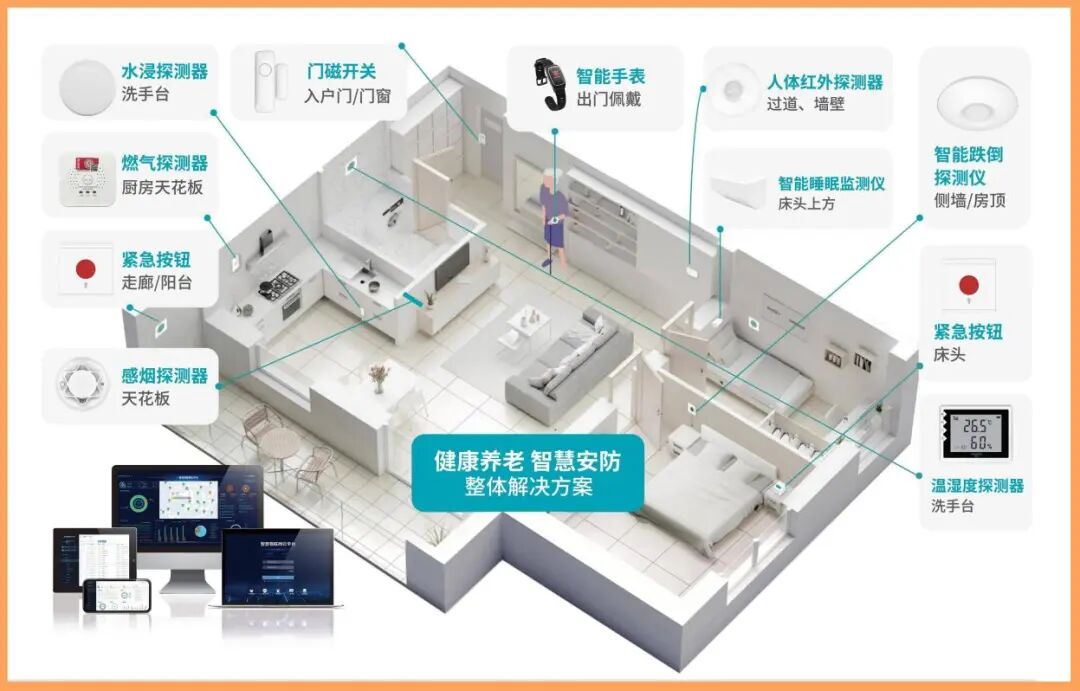
For service-oriented businesses, the evaluation criteria are different from the youth track from the very beginning.
Compared with the topic popularity that attracts young people, elderly care services for people living alone attach great importance to rigid demand. Data from the elderly care survey shows that 54.35% of the elderly care most about the health monitoring function, 60.69% of the elderly think online medical consultation is the most helpful, and 37.73% of the elderly list "fast response and timely problem solving" as their primary demand.
These demands combined directly raise the entry threshold of the elderly care track for people living alone. This is probably why platforms like "ZaiMe ZaiMe" did not dare to enter the silver-haired elderly care track vertically in the early stage, but chose to target the pain points of contemporary young people living alone and gain traffic through internet memes.
However, although the consumption power of the silver-haired group is being released at an accelerated