SpaceX and Tesla are joining forces, Elon Musk is ready to go all-in.
The world's richest man's one remark has once again turned the entire Silicon Valley tech circle upside down.
On October 27, Bloomberg broke a piece of news that is enough to rewrite the history of human business: Elon Musk's SpaceX and Tesla are studying a potential merger through a special committee.
Once the deal is closed, a super giant spanning the earth and space with a total market value of over 3 trillion US dollars will officially emerge.
However, this merger also carries the risk that Elon Musk may end up shooting himself in the foot.
As is known to all, SpaceX, which builds rockets and Starlink, is deeply tied to the U.S. military and NASA, holding a large number of sensitive national defense and aerospace contracts; while Tesla, which manufactures electric vehicles, is a global-facing consumer goods company that relies on the global supply chain and large overseas markets.
Logically, only by drawing a clear line between these two companies can they make money safely respectively. Now Musk is putting a sensitive U.S. aerospace giant and a consumer company that sells cars globally under the same "household register", which is purely asking for trouble.
Not only will it face extremely strict national security and anti-monopoly reviews, but it will also actively push Tesla to the muzzle of geopolitics... Could it be that Musk thinks he doesn't have enough regulatory troubles right now?
However, even though he clearly knows there is a minefield ahead, this is a risky move that Musk has to take at the moment.
Car manufacturing can no longer satisfy Tesla
Of course, if you look at Tesla from the perspective of traditional car manufacturers, it has no motivation to merge with SpaceX at all; but Tesla today has long positioned itself as something far more than a traditional carmaker.
On October 21, Tesla announced that production of the Optimus humanoid robot has started at its factory in Fremont, California. This production line was previously used to manufacture electric vehicles. Elon Musk said that the output of Optimus is expected to reach 20,000 units per week by the end of 2027. At the same time, Tesla is advancing the Cybercab driverless taxi project and continuing to develop the FSD autonomous driving system.
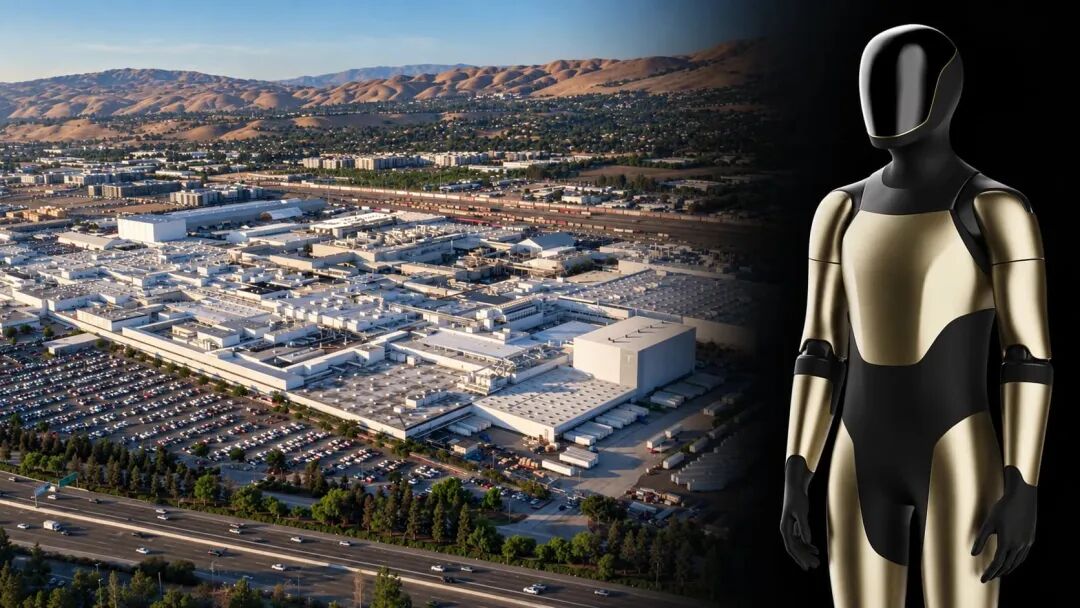
All these moves actually point to the four extremely popular buzzwords right now: Physical AI. Beyond car manufacturing, Tesla also wants to prove that AI can truly control vehicles, robots and other devices in the real world. And this precisely requires massive amounts of chips and computing power.
The Terafab project jointly promoted by Tesla and SpaceX is exactly the hardcore intersection of the two companies in this link.
According to the project plan released by SpaceX, Terafab aims to integrate advanced logic chips, memory chips, packaging and testing into the same manufacturing system, with the long-term goal of producing chips corresponding to 1 terawatt of computing power every year. According to the schedule announced by Musk, the project plans to manufacture the first test chip from May to June 2027, and strive to achieve mass production in the third quarter of 2028.
These chips will serve two different types of needs: one is for Tesla vehicles and Optimus robots, and the other is for space environments, providing support for SpaceX's future orbital computing infrastructure.
That is why, from Tesla's perspective, the reason for merging with SpaceX is very simple: I need computing power, and after merging with SpaceX, the two sides can better integrate resources to build factories and manufacture chips together to produce more computing power.
It is understandable that Tesla manufactures chips to endow vehicles and robots with stronger autonomous capabilities, but why is a rocket company like SpaceX also trapped in this computing power frenzy and unable to extricate itself?
SpaceX, an AI company that can launch rockets
In fact, if you trace back to the source, SpaceX might have become an "AI company" earlier than Tesla. At least at the official level, as early as February this year, it acquired xAI, and brought AI businesses such as Grok and data centers under its wing; since then, Elon Musk has been emphasizing that SpaceX is an AI company.
According to the company's financial report for the third quarter of 2026, the revenue of the SI department where the AI business is located reached 7.56 billion US dollars, a year-on-year increase of 830%; in the same period, the revenue of the connectivity business including Starlink was 5.25 billion US dollars, and the revenue of the aerospace business was 1.77 billion US dollars. The SI department has become SpaceX's largest revenue segment.
The revenue growth of this segment mainly comes from cloud services and computing power leasing. In addition to serving its own Grok, SpaceX also sells computing power to Anthropic, which is led by Dario Amodei.
Don't look at Musk fighting against opponents in the public opinion field, in fact, he is the biggest landlord of computing power for his top rivals.
With the increase in data center investment, SpaceX's computing capacity had reached 1.7 gigawatts by the end of September. In the third quarter, the SI department added about 6.7 billion US dollars in year-on-year revenue, mainly from cloud service agreements, the acquisition of AI programming tool Cursor, and the growth of models and software applications such as Grok.
However, the small profits earned from computing power leasing are trivial compared to the huge real capital expenditure SpaceX needs to invest in expanding its computing power.
SpaceX's capital expenditure in the third quarter was as high as 19.593 billion US dollars, of which 16.444 billion US dollars was invested in infrastructure construction related to the AI business. The company expects that capital expenditure in the fourth quarter will rise to 35 billion to 40 billion US dollars, and by the end of 2026, the computing power capacity will expand to 2.5 to 3 gigawatts.
Apart from capital, the supply of power equipment is also slowing down the expansion speed. To solve the power gap of AI data centers, SpaceX even started to prepare production facilities in Bastrop, Texas, to manufacture blades and guide vanes for large gas turbines by itself. Musk said that this move is expected to shorten the deployment time of gas turbines by up to 18 months.
From grabbing chips and building self-operated computer rooms to manually manufacturing generator parts, SpaceX is continuously extending its tentacles to the upper reaches of heavy industry. Tesla needs to embed AI into cars and robots, while SpaceX is expanding the infrastructure that supports AI operation. The two companies' demands for chips, energy and computing power are also increasingly closely intertwined.
After computing power, the competition turns to intelligence
Putting these fragments together, Elon Musk's ambition is finally fully revealed: From Tesla's cars and robots, to SpaceX's rockets, Starlink and data centers, and then to the jointly advanced Terafab, he wants to take full control of all resources required for AI from chip manufacturing to practical applications.
Maintaining such a huge tech empire, the capital pressure is obviously a reality that cannot be ignored. Financial reports show that SpaceX's capital expenditure in the first nine months of 2026 reached 48.1 billion US dollars, with a free cash flow of nearly negative 35 billion US dollars; Tesla achieved a positive free cash flow of 1.88 billion US dollars in the same period, and also needs to continue to invest funds in the R&D of cars, robots and chips.
The appeal of the merger lies in upgrading the cooperation between the two sides from individual projects to the resource arrangement of the entire company.
How much to invest in chip R&D, where to build computing power facilities, and what hardware is needed for cars and robots can all be coordinated around common needs; after the two companies merge into one, capital and assets can also be arranged faster and more smoothly under the structure of the same company.
In the end, rockets are responsible for transportation, Starlink provides connectivity, data centers provide computing power, and chips provide underlying hardware. Putting all these resources together, Musk can run two businesses at the same time: selling infrastructure services to external parties, and supporting his own AI products and machines internally.
But to make its own products win the competition, model capability is still a link that needs to be strengthened.
In September, SpaceX's AI business released Grok 4.7. But on the Terminal-Bench list that measures whether an agent can independently complete complex end-to-end tasks, Grok 4.7 paired with Grok Build scored 37.6%, ranking 10th on the list at that time; in the same period, Opus 5 paired with Claude Code scored 53.9%, and GPT-6 Sol paired with Codex scored 49.4%.
This gap is related to the competitiveness of Grok and Cursor in the AI programming and agent market. SpaceX can lease computing power to rivals to earn infrastructure revenue; but if it also wants to win customers with its own models and development tools, Grok has to deliver stronger task performance.
Tesla's cars and robots also have their own intelligence challenges to overcome. Cars need to judge dynamic changes on the road, and robots need to understand real objects and complete continuous movements. All these capabilities need to be solved through models, data and practical training, and chips and computing power are only part of the investment.
Computing power solves the problem of how large a scale AI can run, while model capability determines what these computing power can ultimately achieve.
In the final analysis, Elon Musk is pushing for the merger of the two giants at the risk of geopolitical risks, but what really determines the upper limit of this system is how strong intelligence these machines can eventually possess.