Shunwei Capital, GL Ventures and other investors have invested hundreds of millions of yuan, and the brain-computer company focused on developing "neural worm" has arrived.
By | Liu Lingguo
Edited by | Hai Ruojing
Drill a tiny hole in the skull, and multiple fibrous electrodes "crawl" towards multiple brain regions under the guidance of a magnetic field. This dynamic electrode technology called "NeuroWorm" was published in the main issue of *Nature* in September 2025, developed by the team led by Liu Zhiyuan from Shenzhen Institute of Advanced Technology, Chinese Academy of Sciences.
In the same year, Liu Zhiyuan founded the brain-computer interface company Junrou Tech. Exclusive information from *Hidden Tide* shows that within one year of its establishment, Junrou Tech has completed three rounds of financing, with a total amount reaching hundreds of millions of yuan. The previous round of financing was led by Shanghai Jiuhe, and followed by the National Innovation Center of High Performance Medical Devices; the latest angel+ round was invested by Shunwei Capital, GL Ventures, and Agibot, etc.
In September, Neuralink helped a speechless ALS patient say "I love you" to his wife again with the power of "mind". Brain-computer interface is gradually moving from decoding motion and language to "mind reading", and the requirement for collecting signals across multiple brain regions and the whole brain has become particularly prominent. However, most of the existing invasive electrodes are still limited to a single brain region.
The technical route of Junrou aims to make the electrodes cover more brain regions while minimizing implantation trauma as much as possible.
Invasive electrodes can clearly hear the "whispers" of brain neurons, but their positions are fixed after implantation, and the signal collection range is limited. According to Liu Zhiyuan's explanation, if the traditional scheme wants to cover more brain regions, it may need to increase the number of skull openings. "Just imagine drilling 30 holes in the skull, it will become a 'honeycomb'. The size of implantation trauma is directly related to how many people are willing to accept implanted brain-computer interfaces."
The "NeuroWorm" technology of Liu Zhiyuan's team is a very soft and stretchable fibrous electrode, which is formed by rolling a planar electrode array, with a magnetic control unit at the "head".
During implantation, the bundle of neurofibrous electrodes passes through a small skull hole with a diameter of about 1 cm. Under the manipulation of the doctor on the external magnetic field equipment, it is guided to move forward and turn in the brain, and then reach multiple target brain region sites. After that, the electrode head penetrates into the brain tissue to collect deep signals; the electrode points left above the dura mater monitor the cerebral cortex signals.
This is the core of Junrou Tech's first-generation brain-computer interface technology. According to the introduction, its first-generation brain-computer interface system has completed part of animal experiments, and is expected to launch IIT (Investigator-Initiated Trial) in 2027.
From static to dynamic, the electrodes are given the ability to move inside the skull. The next question is: where to go? Active response is a more imaginative technological leap for subsequent generations of "NeuroWorm".
Liu Zhiyuan told *Hidden Tide* that Junrou's first-generation products focus on dynamic delivery. After the head-end electrode is implanted into the brain tissue, the delivery system will be removed during the operation, and it will be linked with medical imaging to realize automatic closed-loop control of multiple brain regions; the second-generation and later versions of "NeuroWorm" will independently "find their way" based on the nerve signals collected in real time.
"Start with the end in mind" is the idea that Liu Zhiyuan repeatedly mentioned in the interview.
He believes that complex human activities such as cognition, memory and emotion all rely on the collaborative work of multiple brain regions. In the future, when brain-computer interface moves towards human-computer integration, it will definitely move towards multi-brain region and even whole-brain signal collection. Therefore, Junrou has taken multi-brain region signal collection as a key focus from the very beginning, and now plans to start with medical scenarios such as epilepsy and depression.
This route is related to Liu Zhiyuan's 14 years of research experience. In 2012, after graduating with a master's degree, he joined Shenzhen Institute of Advanced Technology to start researching flexible electrodes for brain-computer interface; then he went to Nanyang Technological University to pursue a doctorate in materials science and engineering. After returning to China in 2019, he continued to promote the research on dynamic electrodes. He is currently a researcher at Shenzhen Institute of Advanced Technology, Chinese Academy of Sciences, and the executive dean of the Institute of Artificial Intelligence, Shenzhen University of Technology.
Talking about his personal entrepreneurial goals, Liu Zhiyuan mentioned the crops in his hometown in Northeast China. His hometown reminds him that the older generation have fulfilled their duty of farming; as a scientific researcher, he also wants to fulfill his duty of making academic innovations from 0 to 1 and then promoting the achievements to the industry.
The following is the edited dialogue between *Hidden Tide* and Liu Zhiyuan.
It's Time
Hidden Tide: You started researching neural electrodes in 2012. Did you have a connection with Charles Lieber at the very beginning?
Liu Zhiyuan: 14 years ago, after I graduated with a master's degree and entered Shenzhen Institute of Advanced Technology, Chinese Academy of Sciences, I followed Professor Yu Zhe to do research. Professor Yu was a postdoctoral fellow of Charles Lieber, who is a very pioneer in the field of neural electrodes, so I came into contact with flexible electrodes at a very early stage.
During that period, I developed one of the earliest soft and stretchable gold conductive films in China, and also published papers on recording cortical EEG with such electrodes. Later, during my PhD study at Nanyang Technological University in Singapore, I came into contact with two tutors in the fields of chemistry and materials: Academician Chen Xiaodong from Nanyang Technological University, Singapore, and Academician Bao Zhenan from Stanford University, USA. My thinking gradually broadened, and I began to think from the perspective of materials how to give electrodes more possibilities.
Based on the accumulation of both neural electrodes and new materials, Junrou's "NeuroWorm", our original dynamic electrode technology, was finally born.
Hidden Tide: Why did you choose to start your business at the end of 2025?
Liu Zhiyuan: After I returned to China after graduating with a doctorate in 2019, while promoting the research of dynamic neural electrodes, I verified the prototype, biological safety and other aspects to prepare for industrialization. Last year, the dynamic electrode results that our research group had studied for five years were published in *Nature*. The technology, team and capital environment were relatively mature, so we began formal corporate operation.
Technology accumulation is one aspect, and it is also rare to meet good entrepreneurial partners. In 2024, my co-supervised PhD student Peng Qianbi also had the intention to start a business together. She has both technical ideals and practical spirit.
Hidden Tide: The brain-computer interface investment was hot in 2025, which is also a contributing factor?
Liu Zhiyuan: In fact, capital became hot in the second half of 2024, but we were not in a hurry to establish the company at that time. Because the *Nature* research had not been published, which meant we could not prove that we had the original technology in our hands.
Coincidentally, the market was even hotter in 2025. Our research was also recognized by top international experts, we had full confidence, and it was the right time.
Hidden Tide: Some existing invasive brain-computer interface companies have entered clinical trials and obtained certificates, while Junrou is still in the animal experiment stage. Are you worried that you joined the track too late?
Liu Zhiyuan: We have been planning for a long time, and we are taking a completely original technical route. At present, all companies hope to solve the problem that signal collection cannot cover the whole brain region, but no scheme that is ahead of ours has come out. In this sense, we are actually ahead of the curve.
Make the Electrodes "Move"
Hidden Tide: Your electrode technology is named "NeuroWorm". What problems does the dynamic electrode aim to solve?
Liu Zhiyuan: We want to achieve both minimal invasiveness and whole-brain coverage at the same time. Minimal invasiveness determines whether brain-computer interface can be accepted by more healthy people; covering the whole brain region determines the amount of information interaction between human and computer, as well as the "ceiling" of the functions that can be finally realized.
In the traditional way, with one skull opening, the electrode can only be implanted in a relatively limited and fixed brain region. To make the electrodes cover multiple brain regions at the same time, multiple holes may be needed. A monk has 6 points on his head, just imagine drilling 30 holes, the skull will become a "honeycomb". No matter how powerful the product function is, it cannot be popularized.
Our solution is "dynamic delivery": only one small hole is drilled in the skull, and through magnetic control delivery technology, multiple fibrous electrodes are sent to different brain regions respectively, pierced into the brain tissue to collect neural signals.
Hidden Tide: What does the "NeuroWorm" dynamic electrode look like roughly?
Liu Zhiyuan: Our electrode is a "one-dimensional" fiber "rolled" from a two-dimensional planar electrode array, with a diameter of about 196 microns, and multiple independent channels are integrated along the length direction. The circular cross-section can reduce the possible cutting of tissue when the electrode moves, while retaining the multi-point signal collection capability.
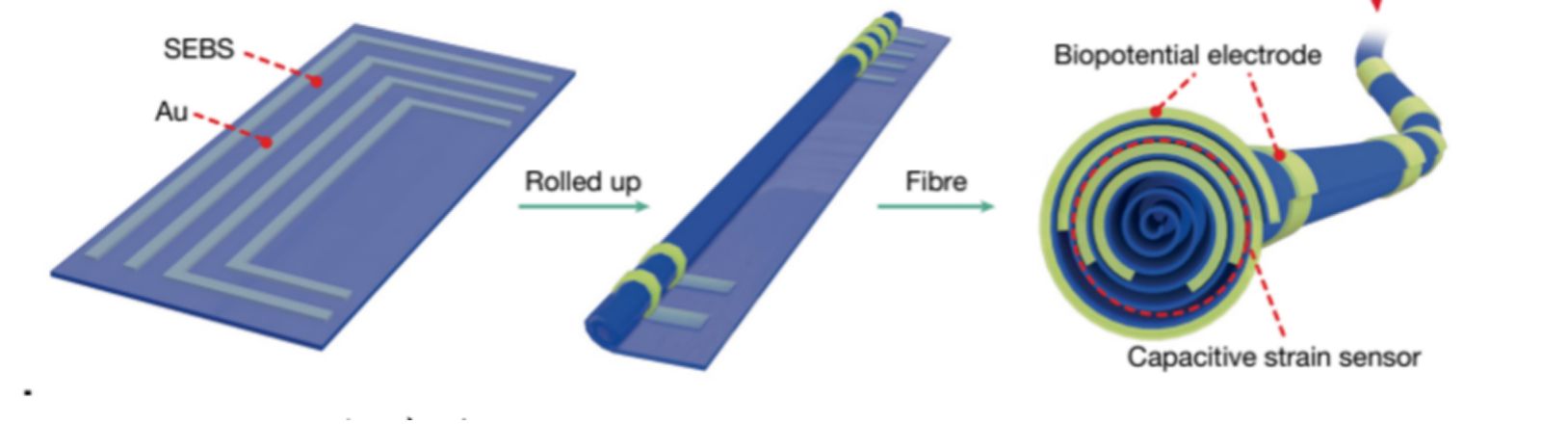
Schematic diagram of the NeuroWorm processing technology
Hidden Tide: How to make the electrodes move and reach the place they should go?
Liu Zhiyuan: We added magnetic components to the electrode head, and applied power to the electrode based on magnetic control technologies such as attraction and repulsion between magnetic fields, to pull it to the designated brain region site. The advantage of magnetic control is that the skull and brain tissue will not significantly attenuate the magnetic field.
In terms of operation, we will combine medical imaging to judge the delivery site, encode the external space magnetic field and the electrode magnetic field through automated mechanical equipment, and guide the fibrous electrode to move along the top of the dura mater by changing the direction and intensity of the magnetic field. After the electrode reaches the target brain region, the head end will penetrate into the brain tissue to collect deep signals; the electrode points left above the dura mater can monitor cortical signals.
Hidden Tide: Will the movement of electrodes in the skull damage brain tissue?
Liu Zhiyuan: Any invasive electrode entering the brain tissue will bring certain implantation trauma. Our dynamic electrode technology pursues minimal invasiveness as much as possible in multi-brain region implantation. The peristalsis time of the electrode in the brain parenchyma is very short and the speed is controllable, which can reduce brain damage to the maximum extent.
Hidden Tide: Most implanted brain-computer interface companies choose PI (polyimide) material for flexible electrodes, why do you choose SEBS (styrene-ethylene/butylene-styrene block copolymer) and SIBS (styrene-isobutylene-styrene block copolymer)? Will the cycle for new materials to be approved for human implantation be very long?
Liu Zhiyuan: "Flexibility" and "softness" are not exactly the same. We want to make electrodes that are both flexible and soft.
Take paper towel and sponge as examples, both are "flexible" and can be bent; but the paper towel will be damaged when pulled hard, while the sponge can rebound after being stretched and squeezed, because the sponge is relatively "softer". Softness corresponds to an indicator in materials science, elastic modulus. Generally speaking, the elastic modulus of SEBS and SIBS is three to four orders of magnitude lower than that of PI, and the lower the value, the "softer" it is.
Brain tissue pulsates slightly with breathing and blood flow. If the implanted electrode has insufficient stretching and rebound capabilities, there may be mechanical differences between the two, increasing the risks of electrode displacement and signal attenuation.
SEBS and SIBS, as soft and stretchable electrode substrates, when deformed, the hundreds-nanometer-scale gold conductive film processed on their surface has a special micro-nano structure, which will not break easily during stretching, and can maintain the stability of signal transmission. SEBS and SIBS also have good biocompatibility, which is the basis for long-term implantation of electrodes.
Unmapped Territory, Signal as Guide
Hidden Tide: Is Junrou's entrepreneurial goal also to realize human-computer integration?
Liu Zhiyuan: Without a doubt. We have confidence and faith. When the number of electrode channels is large enough, the coverage of brain regions is wide enough, and two-way information communication is realized, at a certain node, brain-computer integration will give rise to new intelligence, which is the "ChatGPT" moment of human-computer integration we envisioned. Taking the invasive and whole-brain region route is also for this goal.
My judgment is that in about ten more years, some clues of human-computer integration will emerge.
Of course, we have to start with medical scenarios at the moment. Based on the strict regulatory standards of medical devices, we will continuously verify and improve the safety of products to lay a solid foundation. On the other hand, in order to achieve the goal of human-computer integration, we need to collect whole-brain region data as much as possible, and medical scenarios also provide a realistic entry for data acquisition.
Therefore, we will give priority to considering diseases involving multiple brain regions, such as epilepsy and depression. At present, our brain-computer interface system has completed part of animal experiments, and it is expected to launch IIT (Investigator-Initiated Trial) next year.
Hidden Tide: Human understanding of various brain regions is still very limited, and many pathogenesis mechanisms are not yet clear. How do you know which brain region to send the electrode to?
Liu Zhiyuan: At present, many brain implantation and regulation technologies are also difficult to completely determine the implantation site before surgery. For example, DBS (Deep Brain Stimulation) has been applied for many years, and many diseases are still in the stage of exploring specific mechanisms and optimal stimulation positions.
On the contrary, dynamic electrode technology provides a new possibility. We first implant the electrode into the pre-judged target brain region, and then based on the signals collected by the electrode in real time, we "find the way" while gradually creeping to more valuable sites.
We hope to finally realize "one person, one electrode" in the future, and the delivery position, number of channels, etc. are matched according to individual conditions.
Brain-computer interface technology is becoming a "pioneer" to explore the brain. The breakthrough of neuroscience mechanism research and the development of brain-computer interface complement each other and move forward in coordination.
Hidden Tide: If the flexible electrode has the ability to move in the brain tissue, does it mean that the electrode can find a suitable position by itself according to the signal?
Liu Zhiyuan: This is exactly what Junrou's subsequent generations of products will achieve.
In the future, with the assistance of AI decoding, medical imaging, sensing technology and other technologies, the electrodes will be allowed to independently control and actively respond based on the collected neural signals. On the premise of avoiding risk areas such as blood vessels, find more suitable sites.
In order to realize the "ChatGPT moment" of human-computer integration, the intelligence of the "machine" is necessary. Of course, which generation of products can finally achieve active response with good safety and effect depends on factors such as the improvement speed of the number of channels and the richness of information interaction.
Hidden Tide: Invasive brain-computer interface is currently only for a small number of patients, how does Junrou accumulate a sufficient amount of data?
Liu Zhiyuan: I have discussed this issue with some doctors. Taking epilepsy as an example, at present, only patients with severe and drug-resistant epilepsy will accept invasive treatment, while patients with mild and moderate epilepsy often think it is not worth taking the risk. Even if drug resistance has appeared, they tend to continue taking medicine or "endure it".
In the future, when brain-computer interface is more minimally invasive, the safety of treatment and clinical benefits are more clear, the cost-performance ratio of efficacy-risk will be greatly improved, and patients will re-calculate this account. When more patients are willing to accept implantation, the amount of data we collect will also increase accordingly.
This is a non-linear accumulation process.