Having snapped up two bankrupt factories at rock-bottom prices, the couple behind Hengli Group has forged a wealth empire valued at 302 billion yuan.
Buying two bankrupt factories at the bottom of the market, the Hengli couple has built a wealth empire worth 302 billion yuan
A Jiangsu couple from the traditional manufacturing industry has become the biggest dark horse this year.
On October 27, Hurun Research Institute released the Hurun China Rich List 2026. Chen Jianhua and Fan Hongwei, founders of Hengli Group, ranked among the top 10 for the first time with a fortune of 302 billion yuan, taking the 6th place nationwide and retaining the title of the richest people in Jiangsu. Over the past year, their wealth increased by 112 billion yuan, up 59%, with the wealth increment second only to Zhang Yiming.
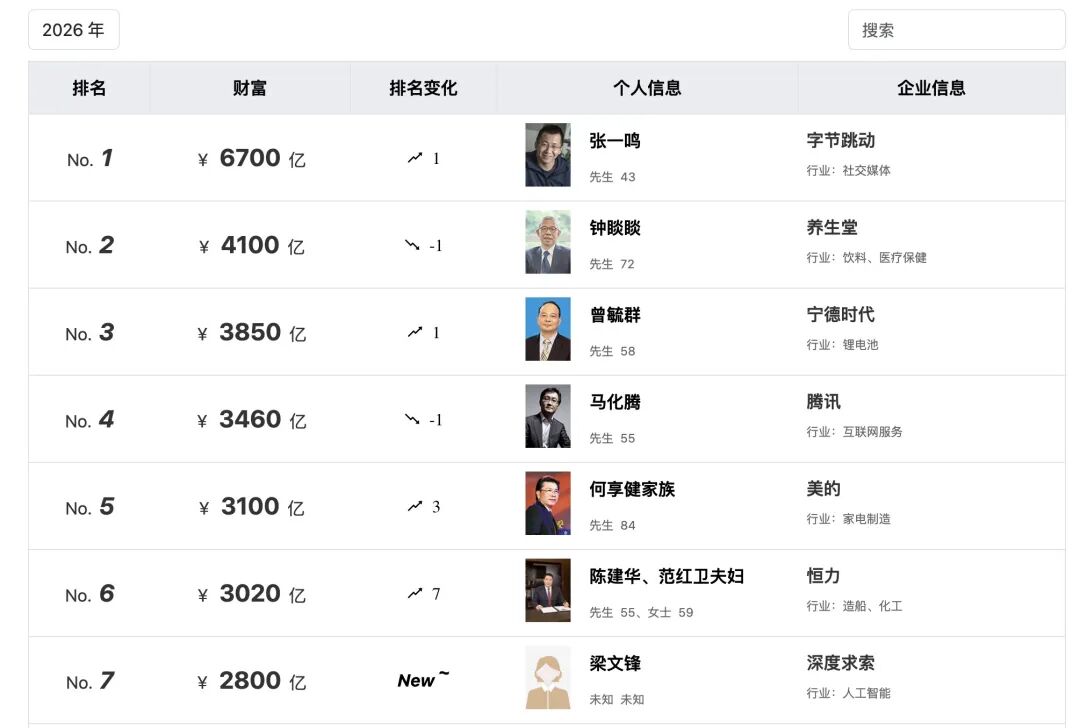
Released in October 2026 · Hurun China Rich List
On the Hurun Global Rich List released in March this year, the couple ranked 52nd in the world with a fortune of 250 billion yuan.

Released in March 2026 · Hurun Global Rich List
Judging from this year's list, wealth creation driven by AI has become the main theme. Liang Wenfeng, founder of DeepSeek, ranked 7th on his debut on the list, and Chen Tianshi, founder of Cambricon, also made it to the top 10. Compared with these new tech upstarts, the wealth of Chen Jianhua and Fan Hongwei mainly comes from manufacturing sectors including textiles, petrochemicals and shipbuilding.
From taking over a dying weaving mill with 3.69 million yuan to holding a total wealth of 302 billion yuan, how did this Jiangsu couple get to where they are today?
302 Billion Yuan, "The Most Unexpected Power Couple"
"The biggest surprise for me this year is Chen Jianhua and Fan Hongwei of Suzhou Hengli," Hurun stated in the list announcement.
In fact, Chen Jianhua first appeared on the Hurun China Rich List back in 2005, with a personal fortune of 850 million yuan. In 2015, Chen Jianhua and Fan Hongwei ranked 49th with 30 billion yuan. This year, their wealth has reached 302 billion yuan, jumping from 13th last year to 6th on the ranking.
What is more intuitive than the wealth figures is the current scale of Hengli Group.
According to the Top 500 Chinese Private Enterprises 2026 released by the All-China Federation of Industry and Commerce in September this year, Hengli Group ranked 3rd nationwide with an operating revenue of 899.069 billion yuan in 2025, second only to JD and Alibaba. Among the top 500 private manufacturing enterprises in China, Hengli even surpassed Huawei and BYD to take the first place.
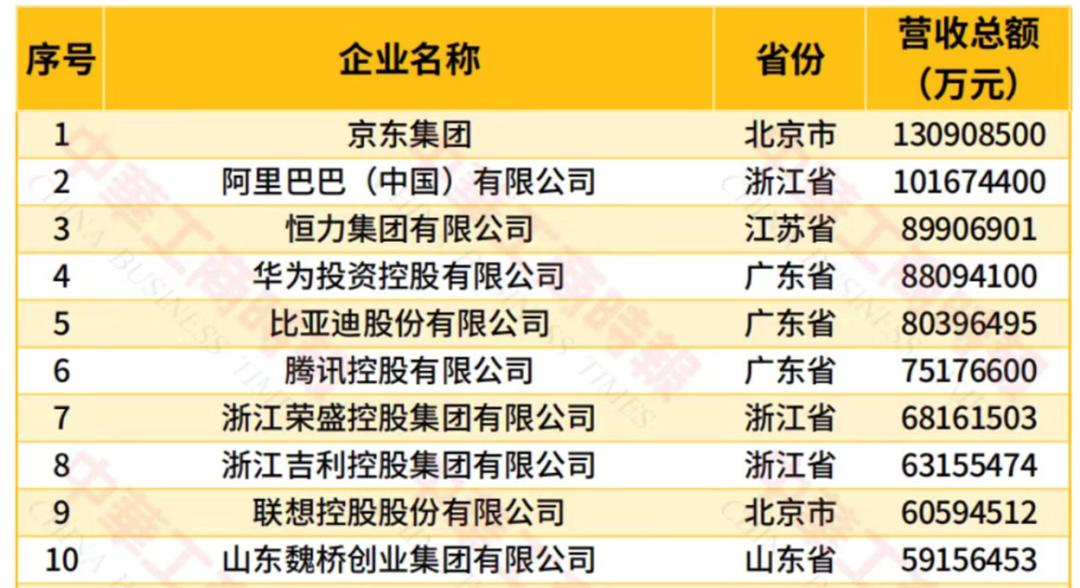
Top 500 Chinese Private Enterprises 2026
Starting from a textile mill, Hengli has now formed an industrial layout centered on petrochemicals, chemical fibers, new materials and shipbuilding, while the Hengli system has also expanded into real estate, hotel tourism and trading businesses.
Hengli currently owns two A-share listed companies: Hengli Petrochemical (600346.SH) and Songfa Co., Ltd. (603268.SH).
Hengli Petrochemical is mainly engaged in oil refining, chemical industry and new material production, with an annual crude oil processing capacity of 20 million tons and an annual PTA production capacity of 16.6 million tons. Its products are widely used in clothing, packaging, automobiles, home appliances and other fields.
Songfa Co., Ltd. completed its restructuring in 2025, transforming from a ceramic manufacturing enterprise to a shipbuilding enterprise. It mainly produces large oil tankers, bulk carriers, container ships, etc., and has the production capacity of marine engines.
According to the financial report, Hengli Petrochemical's revenue in the first three quarters was 151.075 billion yuan, down 4.01% year on year; but its attributable net profit to shareholders was 10.256 billion yuan, up 104.20% year on year. The revenue has declined slightly, but the net profit has doubled.
The growth of Songfa Co., Ltd. is even more rapid. In the first three quarters of this year, the company achieved a revenue of 37.774 billion yuan, up 221.25% year on year; its attributable net profit to shareholders was 6.673 billion yuan, up 424.87% year on year, and the shipbuilding business is becoming a new growth point for Hengli.
The "Counterattack" of Two Old Factories
In 1994, 23-year-old Chen Jianhua spent 3.69 million yuan to buy a dying town-run weaving mill in Nanma Town, Wujiang, Jiangsu.
Chen Jianhua was born in Wujiang, Jiangsu. He dropped out of school at the age of 13 due to poor family conditions, once worked as a bricklayer, and later earned more than 2 million yuan in a few years by doing silk business. To raise enough money for the acquisition, he also borrowed a part of the funds.
His wife Fan Hongwei originally worked as an accountant in a local textile enterprise, then resigned to start a business with Chen Jianhua. From 1994 to 2001, she served as the general manager of Wujiang Chemical Fiber Weaving Factory. After that, she participated in the operation of the chemical fiber business, and has served as the chairman of Hengli Petrochemical since 2016.
Step 1: 3.69 Million Yuan to Revitalize the Old Factory
In the 1990s, China's township and village enterprises were undergoing market-oriented reform, and a number of collectively-owned enterprises with operational difficulties began to seek a way out. Wujiang Chemical Fiber Weaving Factory was one of them.
When Chen Jianhua took over, the factory only covered an area of 3.3 mu, had 27 employees, and was burdened with a large amount of triangular debts.
To reverse the situation, he required sales to be settled in cash as much as possible to reduce credit sales, while updating equipment, reforming management, and insisting on paying salaries on time on the 15th of every month.
The effect appeared quickly. In 1995, the factory made a profit of over 10 million yuan, and in 1996 the profit further increased to more than 27 million yuan.
In just two years, Chen Jianhua revitalized the dying old factory.
Step 2: Counter-cyclical Capacity Expansion Amid the Financial Crisis
In 1997, the Asian financial crisis broke out, impacting the textile industry, and many enterprises cut back on production.
However, Chen Jianhua judged that the demand for textiles would eventually recover, and chose to continue investing. In early 1998, he purchased 306 advanced water jet looms. Then when the market further slumped, he added another 500 units taking advantage of the falling equipment prices.
As the textile market gradually picked up, Hengli expanded its production capacity with the newly added equipment, and the scale of the enterprise grew rapidly. According to Chen Jianhua's recollection, around 1999, the number of water jet looms had increased from 88 units in the early days of entrepreneurship to 6,000 units.
With the expansion of the weaving scale, raw material supply became a new problem. At that time, some high-quality polyester yarn in China relied on imports, and had to be purchased from Japan, South Korea and other places. To reduce dependence on external supply, Chen Jianhua decided to produce chemical fibers on his own.
In 2002, Hengli invested 2.2 billion yuan to build a chemical fiber project, and formally established Hengli Group in 2003.
But the production of polyester requires PTA, and the production of PTA is inseparable from the more upstream PX. Therefore, Hengli continued to expand upstream along the industrial chain.
In 2010, Hengli built a PTA production base on Changxing Island, Dalian. In December 2015, the refining and chemical integration project with an annual crude oil processing capacity of 20 million tons started construction, and was fully put into operation in 2019. The following year, the 1.5 million ton ethylene project was also put into operation.
After that, Hengli continued to expand its chemical new materials business, producing polyester films, engineering plastics and other products through its subsidiary Kanghui New Materials, and laid out the lithium battery separator sector.
From weaving to oil refining, it seems to span multiple industries, but behind it is the same logic: to master upstream raw materials, reduce costs, and reduce dependence on external supply.
Step 3: Two Acquisitions to Obtain A-share Listing Platforms
As the industrial scale expanded, Hengli also began to develop with the help of the capital market.
In 2015, Hengli Group acquired 29.98% equity of the listed company Dahua Group for about 1.17 billion yuan, and then injected its chemical fiber assets into the listed company through major asset restructuring. In 2016, the restructuring was completed, and Hengli thus obtained its first A-share listing platform.
In 2018, Hengli acquired 29.91% equity of Songfa Co., Ltd. for an agreed price of about 820 million yuan, becoming its controlling shareholder.
However, Songfa Co., Ltd. was mainly engaged in daily ceramics and education business at that time. Hengli was initially interested in its "ceramics + education" model, not to deploy the shipbuilding sector.
But this investment did not meet expectations.
With the intensifying competition in the ceramic industry and the policy adjustment of the off-campus training industry in 2021, Songfa Co., Ltd. suffered losses for four consecutive years from 2021 to 2024. In 2023, the company once tried to acquire the controlling stake of Anhui Levante New Energy, a power battery enterprise, but the transaction was terminated because the two parties failed to reach an agreement on key matters.
Step 4: 1.729 Billion Yuan to Buy the Bankrupt Shipyard
In 2022, Chen Jianhua set his sights on a large idle shipyard that had been unused for many years on Changxing Island, Dalian.
This shipyard was originally invested and constructed by South Korea's STX Group, with large dry docks, wharves, workshops and production equipment. Affected by the previous downturn in the shipbuilding market and the operational problems of the enterprise, the relevant enterprises fell into bankruptcy, and the assets were not taken over after multiple rounds of auctions.
Shipbuilding requires huge investment, old facilities need to be repaired, and the production team needs to be rebuilt and orders obtained. But what Hengli valued was exactly these industrial facilities that would cost huge amounts of money and take a long time to rebuild.
In July 2022, Chen Jianhua and Fan Hongwei established Hengli Heavy Industry through their investment company. In the same month, Hengli Heavy Industry won the bidding for the relevant bankrupt assets of the 13 former STX Dalian enterprises for 1.729 billion yuan, and the total cost of asset acquisition including taxes and fees was about 2.11 billion yuan.
After buying the shipyard, the real test just began.
Chen Jianhua recalled in an interview with CCTV Finance's "Economic Half Hour" that when he first took over, the roads in the factory area were sinking, and the weeds grew waist-high. Due to the lack of shipbuilding experience, Hengli could not get external orders at first, and could only build ships for its own subsidiaries.
In March 2023, Hengli started construction of its first 61,000-ton bulk carrier, which took 385 days and was delivered in April 2024, and then chartered by its own subsidiary. As its shipbuilding capacity was verified, orders from external shipowners gradually increased.
At the same time, Hengli also began to build marine engine production capacity to reduce the dependence of key equipment on external supply.
To restore production of the old shipyard, Hengli invested far more than the initial acquisition amount. By the end of September 2024, Hengli had invested a total of about 3.211 billion yuan for the renovation of old facilities and the addition of new production assets.
As the shipbuilding business gradually got on the right track, Songfa Co., Ltd., which was in urgent need of transformation, also ushered in new opportunities.
In October 2024, Songfa Co., Ltd. announced a major asset restructuring plan, planning to divest its original ceramic business and inject 100% equity of Hengli Heavy Industry. In May 2025, the transaction was completed, Hengli Heavy Industry became a wholly-owned subsidiary of Songfa Co., Ltd., and Songfa Co., Ltd. was thus transformed into a shipbuilding and high-end equipment manufacturing enterprise.
This restructuring not only brought new main business to Songfa Co., Ltd., but also gave Hengli Heavy Industry an A-share financing platform.
At this time, the global shipbuilding industry entered a new boom cycle. After years of industry downturn, some shipyards withdrew from the market. With the renewal of old ships and the increase in demand for new ships, shipbuilding capacity could not keep up quickly.
The shipyard that Hengli took over and repaired just caught up with the market recovery.
According to the 2026 semi-annual report of Songfa Co., Ltd., in the first half of this year, the company newly received 207 ship orders, exceeding the 115 orders for the whole year of 2025; at the same time, it delivered 40 ships, and the ship delivery plan has been scheduled until 2030.
Of course, shipbuilding is still a heavy-asset business, and future profits depend on order delivery and cost control.
Looking back at Hengli's development over the past 30 years, Chen Jianhua made several counter-cyclical moves, following a similar logic: looking for opportunities in the industry trough, and then converting assets into production capacity through improving operation and continuous investment. From weaving, chemical fiber to oil refining and shipbuilding, Hengli has always been supplementing the key links in the industrial chain.
Now, the next generation of Hengli has also begun to participate in the operation.
Chen Yiting, the daughter of Chen Jianhua and Fan Hongwei, has served as the vice chairman of Hengli Group; Chen Hanlun, their son born in 2001, took office as the director and general manager of Songfa Co., Ltd. in 2025, participating in the management of the shipbuilding business.
Traditional Manufacturing Still Shows Strong Competitiveness
AI is creating a new group of wealthy people, but on this year's Hurun China Rich List, entrepreneurs from the traditional manufacturing industry also performed remarkably.
The He Xiangjian family of Midea ranked 5th with a fortune of 310 billion yuan, up 12% year on year; the wealth of Li Shuirong of Rongsheng Holdings increased by 34% to 80.5 billion yuan, ranking 63rd; the