The production of Japanese cars in China has fallen to 40% of its peak volume.
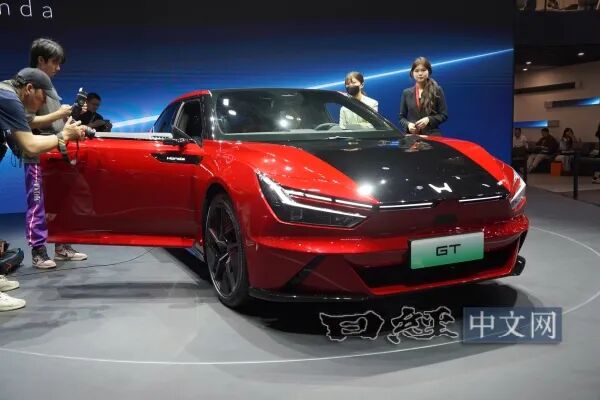
The sale of the "GT" model under "Ye", Honda's all-electric vehicle brand launched for the Chinese market, has been postponed indefinitely
Nikkei has compiled the production volumes of four Japanese automakers in China, among which Honda saw the sharpest decline, down roughly 90% from its 2020 peak. Forecasts indicate that the output of the four Japanese automakers will drop by a further 47% by 2030. Japanese automakers are seeking to transform China into an export base……
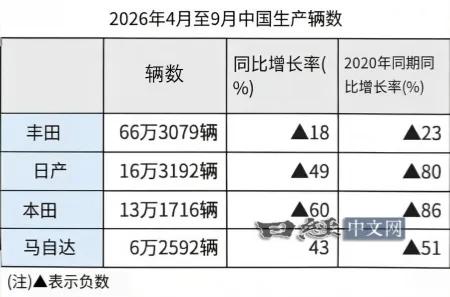
The production volume of Japanese automobiles in China is declining sharply. The cumulative output of the four automakers from April to September, announced on October 29, reached 1,020,579 units, down 32% year on year, and 63% lower compared with the peak level recorded in 2020. Due to the sharp shrinkage in demand for gasoline-powered vehicles, Honda's production has fallen by roughly 90%, and its sluggish sales situation is worsening.
Nikkei (Chinese version: Nikkei Chinese) compiled the production data of four enterprises including Toyota and Nissan Motor that have production bases in China. The output has dropped to the lowest level since 2008, down nearly 1.8 million units in just 6 years from the peak of about 2.8 million units in 2020.
Honda recorded the largest drop, with its output falling to 131,716 units, down 60% year on year and roughly 90% from its 2020 peak. In recent months, its year-on-year production decline has hovered around 70%, with monthly output ranging between 10,000 and 20,000 units.
Nissan's output stood at 163,192 units, down 49% year on year and 80% lower than its peak level. Toyota's output reached 663,079 units, down 18% year on year and 23% compared with 2020. Mazda's production rose 43% year on year, but it is still 52% lower than that in 2020.
The gasoline-powered vehicle market has shrunk by 60% compared with 2020
China's new car market saw a 22% year-on-year decline from January to September. This is mainly driven by economic stagnation coupled with the cuts in purchase subsidies for new energy vehicles such as battery electric vehicles (EVs).
The further blow came from the rise in crude oil prices caused by the escalating tensions in the Middle East. Excluding new energy vehicles, new car sales dropped by more than 30% from January to September, with a 60% decline compared with the same period in 2020. Currently, the main products of Japanese automakers are still gasoline-powered vehicles including hybrid vehicles (HVs), so they are significantly impacted by the shrinking market.
Honda's sales in China from April to September fell 48% year on year to 161,372 units. Nissan saw its sales drop 46% year on year to 182,854 units, dragged down by the sharp decline of its core gasoline-powered model "Sylphy".
In the EV segment that is continuously attracting users of gasoline-powered vehicles, Japanese automakers have not demonstrated competitiveness. Honda's EV sales from April to September dropped 62% year on year to only 2,991 units. Affected by sluggish sales, the launch of its flagship EV "GT" originally scheduled to hit the market before December 2025 has been postponed indefinitely.
Nissan's EV sedan "N7", launched in April 2025, saw its sales from April to September drop 76% year on year. Although the model performed strongly in the initial stage after its launch, the new car effect is hard to sustain in China's market where new models are continuously rolled out.
In the 2000s when China's automotive market was expanding, Japanese automakers built new factories or expanded existing ones in China one after another, making it an important market on par with North America. However, since 2020, along with the shift to new energy vehicles, local enterprises such as BYD have risen. As sales of traditional fuel vehicles decline, the market share of Japanese cars has dropped sharply, and their production volume has fallen back to the level before the expansion.
Expected to halve further by 2030
As if forced by automakers, Japanese auto parts enterprises that entered the Chinese market have also scaled down their businesses. On October 20, Koito Manufacturing announced that it will dissolve and liquidate its Chinese subsidiary that manufactures automotive lamps. Although some enterprises are trying to expand their business for local automakers, the price competition with local auto parts manufacturers is extremely fierce.
U.S. research firm Mobility Global forecasts that the production volume of the four Japanese automakers in China will drop by 47% from 2025 levels to 1.6 million units by 2030.
However, it is not easy for them to withdraw from the Chinese market easily. In Toyota's global sales for the 2025 fiscal year, China accounted for 17%, while the proportion for Honda is 18% and 21% for Nissan. For the three automakers, the size of the Chinese market is second only to the United States, and the importance of the Chinese market remains prominent.
Seeking a way out by transforming into an export base
China is not only the world's largest automotive market, but also takes a leading position in the competition for autonomous driving and electrification technologies. For Japanese automakers, China has also become a key market for accessing advanced technologies.
Japanese automakers are pinning their hopes for survival on improving the efficiency of their production and sales systems and transforming China into an export base. On October 8, Toyota announced that it has signed a new strategic cooperation framework agreement with GAC Group, a large state-owned Chinese automotive enterprise, and FAW Group. It will restructure its two local joint ventures to further promote the electrification and intelligentization of automobiles.
Nissan plans to expand its exports from China to overseas markets. It has already started exporting to Mexico, and will expand its business to Central and South America and Southeast Asia in the future. Mazda will also launch EVs manufactured in China across global markets including Europe and Australia.
Competition with Chinese enterprises is also intensifying overseas. In September, the Chinese government issued guidelines on the overseas business of automotive enterprises, requiring enterprises to abide by laws and regulations and establish high-quality after-sales service systems. This move shows that China is devoting nationwide efforts to enhancing the brand image of Chinese automobiles and actively exploring overseas markets.
Even Nissan and Honda, which once had huge influence in the Chinese market, are now finding it increasingly difficult to survive. Japanese automakers are forced to carry out fundamental adjustments to their China operations.
The global production volume of 8 Japanese passenger vehicle manufacturers, compiled on October 29, reached 11,643,060 units, down 1% year on year, marking a year-on-year decline for the second time in two years. Among them, Japan's domestic production rose 2% year on year to 3,970,154 units, while overseas production fell 3% year on year to 7,672,906 units.
This article is from the WeChat Official Account"Nikkei Chinese" (ID: rijingzhongwenwang), written by Sota Tanaka, Moe Matsumoto and Itsuki Miyake, and published by 36Kr with authorization.