Microsoft's single-quarter revenue reached 610 billion yuan, reaping a whopping 66.7 billion yuan driven by OpenAI, and its Azure business surged by 48%.
Zhidx, October 29 report: Microsoft today released its Q1 financial results for fiscal year 2027 (corresponding to Q3 of the 2026 calendar year), with both revenue and net profit achieving strong growth that exceeded Wall Street expectations.
Among them, Microsoft's quarterly revenue reached 92.3 billion US dollars (approximately 6.152 trillion yuan), a year-on-year increase of 19%. Its GAAP net profit was 36.6 billion US dollars (approximately 2.44 trillion yuan), a year-on-year increase of 32%, and diluted earnings per share stood at 4.92 US dollars (approximately 33 yuan), up 32% year on year. Excluding the impact of the investment in OpenAI, Microsoft's non-GAAP net profit was 36.4 billion US dollars (approximately 2.426 trillion yuan), representing a year-on-year increase of 18%, with diluted earnings per share at 4.89 US dollars (approximately 33 yuan), up 18% year on year.
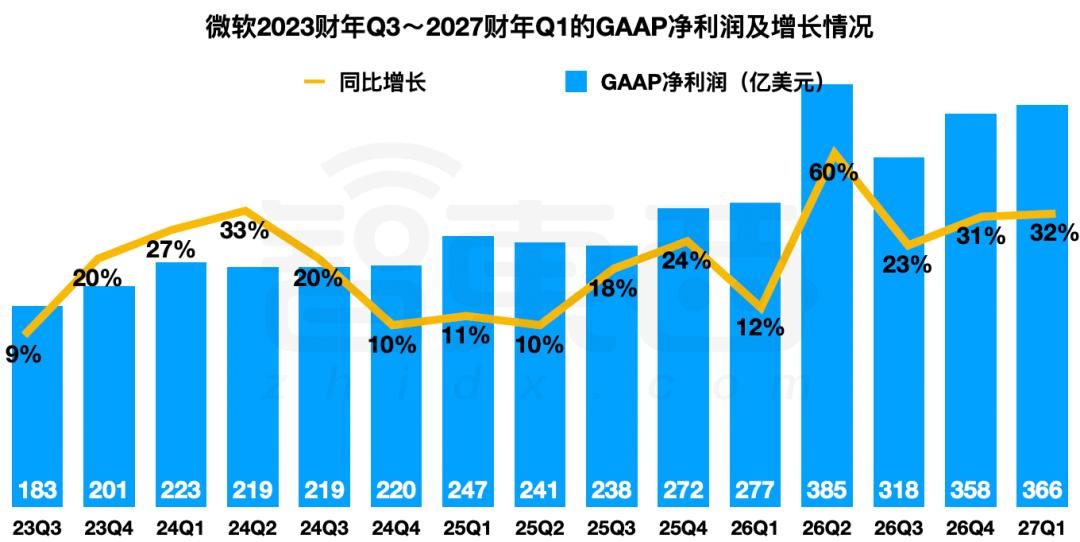
Microsoft's GAAP net profit and growth trend from Q3 of fiscal year 2023 to Q1 of fiscal year 2027 (charted by Zhidx)
There are three key highlights in this Microsoft earnings report:
The cloud business is its core pillar: Microsoft's Azure cloud computing business posted a 48% year-on-year surge in revenue this quarter, reaching 33.2 billion US dollars (approximately 2.213 trillion yuan), which surpassed analysts' estimate of 32.84 billion US dollars (approximately 2.189 trillion yuan). Microsoft CEO Satya Nadella also revealed that the company added 24 new data centers across five continents this quarter.
Revenue Microsoft generated from OpenAI this quarter accounted for nearly 11% of its total revenue, amounting to 10 billion US dollars (approximately 667 billion yuan), including revenue sharing payments.
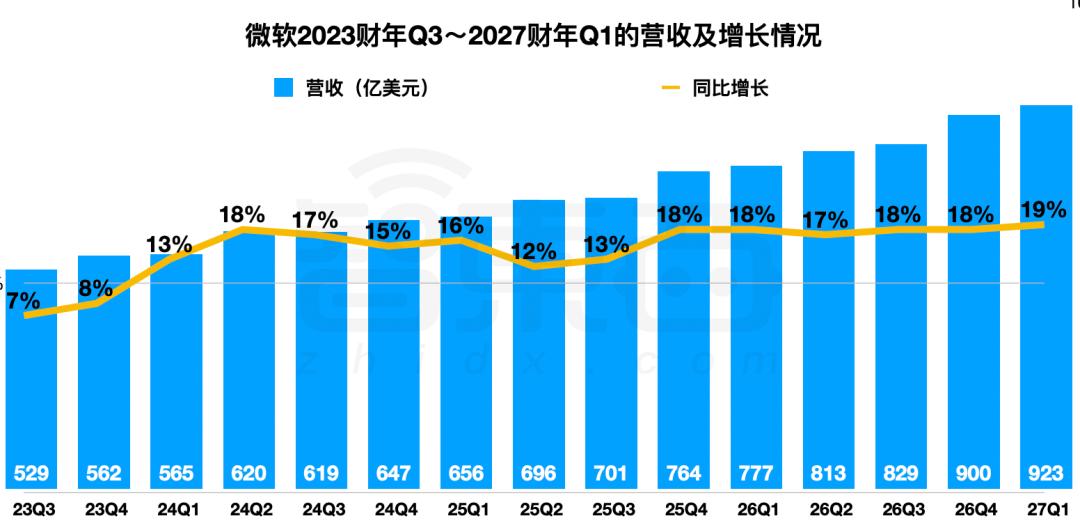
Microsoft's revenue and growth trend from Q3 of fiscal year 2023 to Q1 of fiscal year 2027 (charted by Zhidx)
Microsoft's capital expenditure this quarter fell short of expectations. Its previous forecast was 50 billion US dollars (approximately 3.333 trillion yuan), while the actual expenditure reached 45.2 billion US dollars (approximately 3.013 trillion yuan).
Microsoft executives revealed the performance guidance for Q2 of fiscal year 2027 during the earnings call. They estimate that the overall revenue range for Q2 of fiscal year 2027 will be 96 billion to 97.1 billion US dollars, with a year-on-year growth rate of 18% to 19%. Among them, the revenue of the Agents and Infrastructure segment will range from 80.1 billion to 80.7 billion US dollars, representing a year-on-year growth rate of 24% to 25%, and capital expenditure is expected to exceed 50 billion US dollars.
As of 7:30 a.m. today, Microsoft's after-hours price rose by as much as 4.97%, hitting 557.39 US dollars per share (approximately 3715.62 yuan).
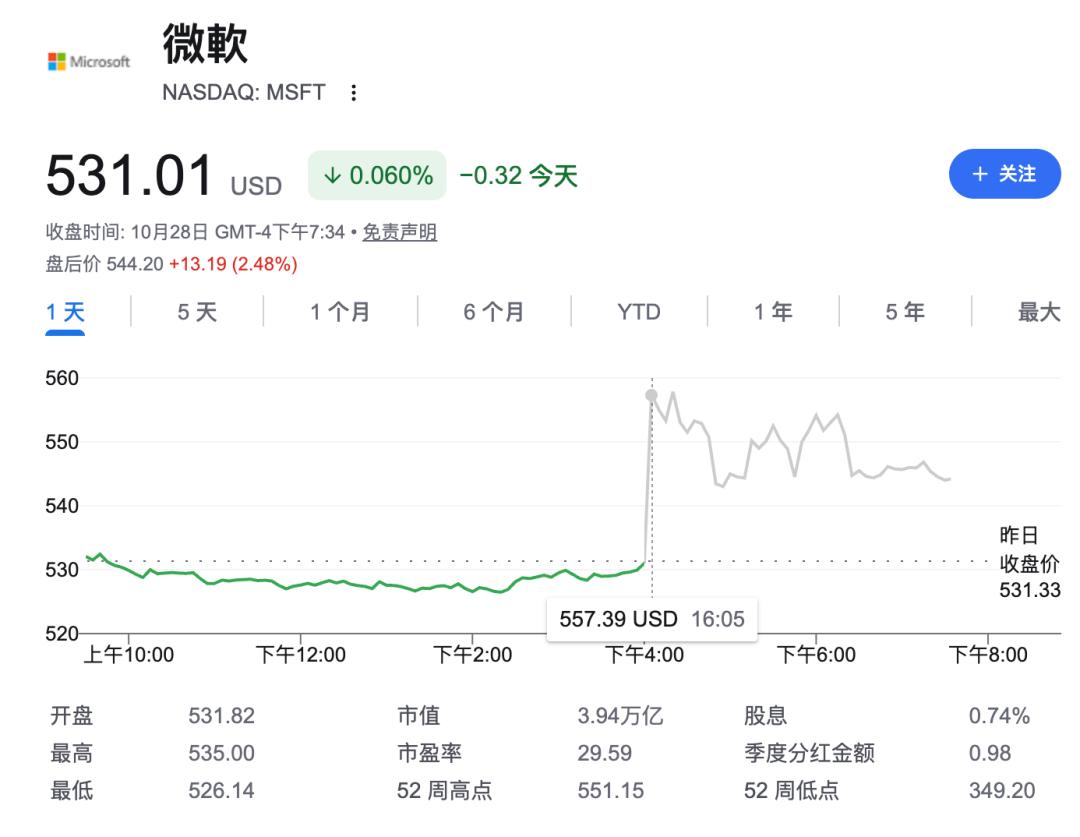
Changes in Microsoft's stock price
01. Microsoft's cloud business surged 48%, free cash flow in the first quarter exceeded analysts' expectations by 600 billion
In September this year, Microsoft announced a major adjustment to its earnings report structure for the first time since 2015, dividing its business into two segments: Agents and Infra, and Devices and Consumer.
The Agents and Infrastructure segment includes Azure cloud and Microsoft 365 cloud products, productivity software and server licensing, industry solutions, cutting-edge businesses and support services; the Devices and Consumer segment covers search and advertising, Xbox, device sales revenue, and revenue from selling Windows operating system licenses to device manufacturers.
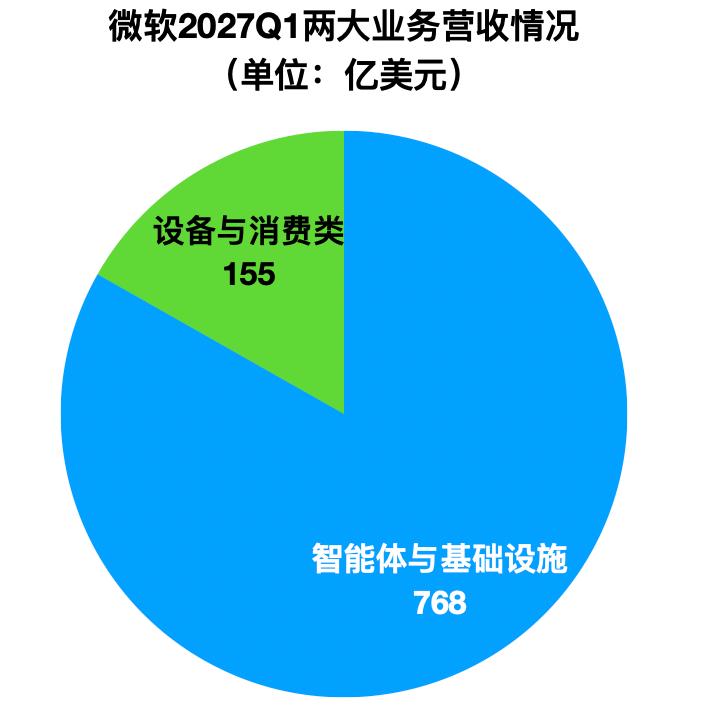
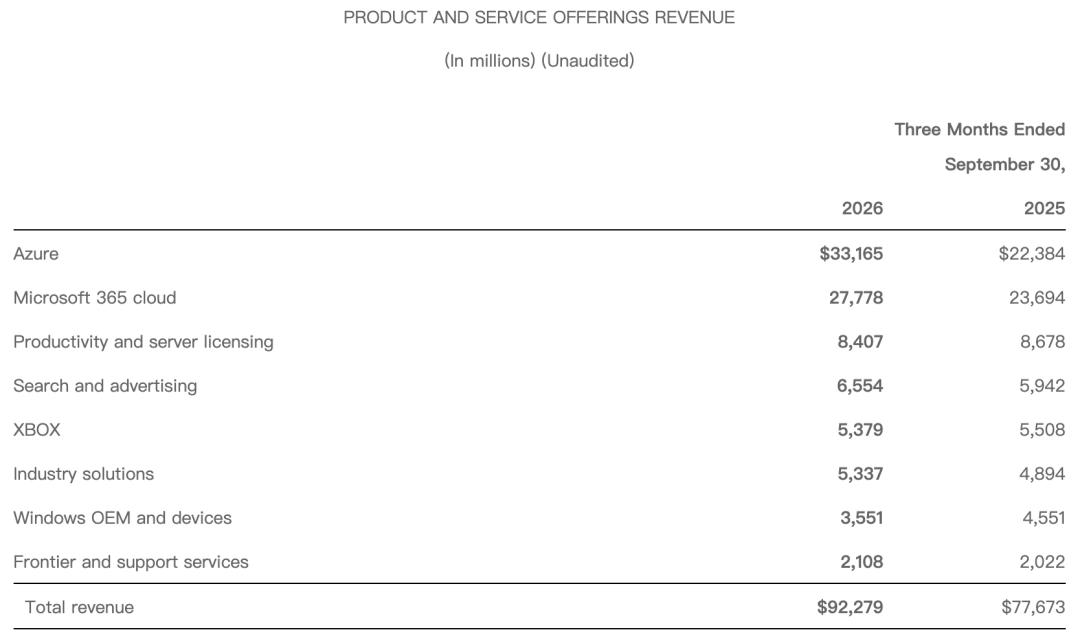
In Q1 of fiscal year 2027, Microsoft's Agents and Infrastructure business generated revenue of 76.8 billion US dollars (approximately 5.12 trillion yuan), up 25% year on year, with an operating profit of 40.5 billion US dollars (approximately 2.7 trillion yuan); the Devices and Consumer business posted revenue of 15.5 billion US dollars (approximately 1.033 trillion yuan), a year-on-year increase of 3%, with an operating profit of 5.4 billion US dollars (approximately 360 billion yuan).
Among specific departments, Microsoft Azure's revenue reached 33.2 billion US dollars (approximately 2.213 trillion yuan), up 48% year on year; Microsoft 365 cloud products generated 27.8 billion US dollars (approximately 1.853 trillion yuan), productivity software and server licensing 8.4 billion US dollars (approximately 560 billion yuan), industry solutions 5.3 billion US dollars (approximately 353 billion yuan), and cutting-edge businesses and support services 2.1 billion US dollars (approximately 140 billion yuan). Microsoft executives revealed in the earnings report that Azure's growth momentum comes from Foundry and the improved monetization capability of CPUs.
In addition, Microsoft's search and advertising business generated 6.6 billion US dollars (approximately 440 billion yuan), Xbox 5.4 billion US dollars (approximately 354 billion yuan), and revenue from selling Windows operating system licenses to device manufacturers reached 3.6 billion US dollars (approximately 240 billion yuan).
Microsoft's total capital expenditure this quarter amounted to 45.2 billion US dollars (approximately 3.013 trillion yuan). Among them, capital expenditure on property and equipment purchases reached 39.4 billion US dollars (approximately 2.626 trillion yuan), expenditure on acquiring companies, intangible assets and other assets hit 397 million US dollars (approximately 2.6 billion yuan), and investment expenditure stood at 5.4 billion US dollars (approximately 354 billion yuan).
As of September this year, Microsoft's cumulative capital expenditure has reached 118.1 billion US dollars (approximately 7.873 trillion yuan). This means that to achieve its full-year target of 175 billion US dollars (approximately 11.7 trillion yuan) set this year, Microsoft needs to invest at least 56.9 billion US dollars (approximately 3.793 trillion yuan) in the last three months of this year.
Microsoft executives explained during the earnings call that the reason is the delay in delivery of third-party computing resources originally scheduled for the first quarter. About 3/4 of the capital expenditure is invested in short-term assets such as CPUs and GPUs, including higher memory and storage costs for continuous investment in infrastructure to support customers in building and scaling AI applications, and the remaining expenditure goes to long-term assets.
Microsoft's cloud gross margin declined year on year to 66%, mainly because the revenue structure tilted toward Azure, while the gross margin of Azure and other product lines improved, forming a partial offset.
As of September 30, 2026, its free cash flow in the first quarter reached 18.6 billion US dollars (approximately 1.24 trillion yuan), about 10 billion US dollars (approximately 667 billion yuan) higher than analysts' expectations.
02. Foundry has more than 120,000 customers, Microsoft has completed the pre-training of MAI-Base-2
In addition, Nadella shared a lot of information about the usage of Microsoft's AI tools during the earnings call.
First of all, for Copilot, Nadella revealed that the number of automated tasks completed by Copilot has doubled since July, the daily active users increased by nearly 50% quarter on quarter, and the year-on-year growth rate exceeded 4 times. 90% of Copilot queries use the automatic mode, which dynamically allocates tasks between different models to balance performance, speed and cost.
He added that this growth has driven large-volume purchases, and the number of customers with more than 50,000 Copilot seats has increased year on year. Just last week, Volkswagen announced plans to deploy Copilot for more than 330,000 employees, which is one of the largest deployment projects in Europe so far.
At present, Microsoft's business model is expanding from a pure subscription model to a model that includes pay-as-you-go consumption, further expanding the total addressable market (TAM) and average revenue per user (ARPU). This quarter, the number of Copilot customers using pay-as-you-go billing and actively consuming computing credits increased by more than 75%.
In the field of software development, all mainstream code agents have been connected to GitHub. In the past six months, the number of AI-generated PR (pull request) has increased by 5 times; currently, more than 1/3 of the PRs on this platform are initiated and created by agents.
Nadella said that Microsoft Foundry, the company's enterprise one-stop AI application and agent development platform, has become an increasingly important engine for its growth. At present, Microsoft's Foundry has more than 120,000 customers, and the corresponding revenue has more than tripled year on year.
In the last quarter, OpenAI models achieved major upgrades, which directly benefited Azure OpenAI. It can cooperate with the built-in multi-model selection capability of Foundry to help customers build solutions. Today, the number of customers building agent solutions with multiple models has increased 4 times year on year; the revenue brought by open-source models on Foundry has increased 9 times year on year.
In terms of self-developed models, Microsoft's goal is to improve the input-output ratio of cutting-edge models, that is, to launch models with comparable capabilities within 3-6 months after the release of top-tier leading models, while the training cost is only a small part of the latter, so as to pass on this cost advantage to customers.
Microsoft Decision 1 is Microsoft's brand-new decision-making model, which outperforms both large language models and other dedicated decision-making models in terms of latency and performance. More than 4,000 customers have adopted it since its first month of release. Nadella revealed that Microsoft has recently completed the pre-training of MAI-Base-2, which outperforms other open-source weight models in its evaluation, and its training computing efficiency is 4-12 times higher.
With new computing resources coming online one after another, in the next stage, Nadella believes that the core drivers of Microsoft's future growth include the improvement of Azure's internal computing resource utilization, the decline in unit cost, and the ability to tap more layered monetization capabilities on each workload relying on Fabric, Foundry and Copilot.
The idea is to make the computing power of the unified computing pool more efficient through various optimizations, which involves the underlying hardware of data center construction, the entire set of operation specifications for computing power commissioning, and how to schedule and adapt various optimized workloads on its infrastructure.
03. Conclusion: Heavy investment in computing power brings Microsoft a remarkable earnings report
Nadella mentioned in the statement that Microsoft is helping enterprises build intelligent capabilities that they can independently control, winning orders by virtue of the security and reliability of agents, and transforming these innovations into a wide range of landing applications.
In addition, Microsoft has launched a series of low-cost models to provide customers with more affordable options. Microsoft's earnings data this time is remarkable, and it is expected that Azure's growth rate will remain at a high level of 49%-50% in the next quarter, which proves that it has sufficient order reserves.
However, it is worth noting that even so, the huge capital expenditure brought by the continuous expansion of computing power is still a variable hanging over the profitability of these cloud vendors.
This article is from the WeChat official account "Zhidx" (ID: zhidxcpm), written by Cheng Xi, edited by Li Shuiqing, and published by 36Kr with authorization.