Seagate: Nothing Left But to Step on the Gas for Price Hikes, Has HAMR Faltered in Cost Reduction?
Seagate released its first-quarter financial results for fiscal year 2027 (ending September 2026) after US stock market hours on the morning of October 28, 2026, Beijing Time. The key points are as follows:
① Total revenue: Beat expectations, but the upside beat is narrowing
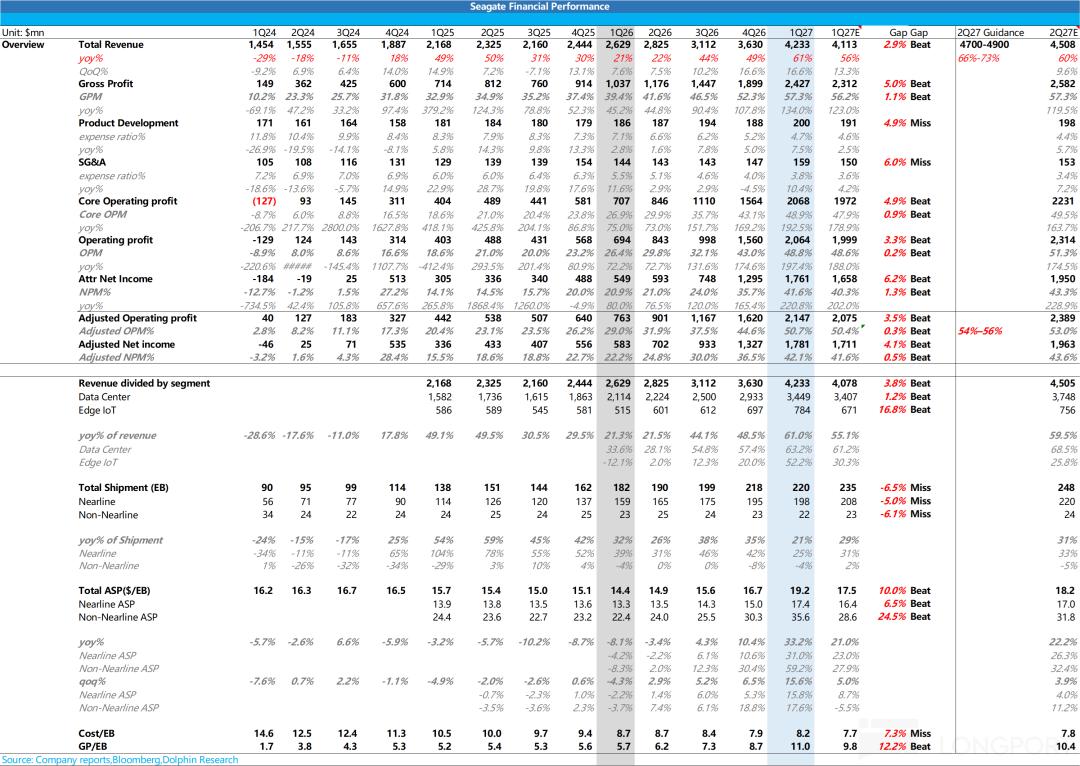
Seagate's revenue in this quarter hit $4.23 billion, up 61% year-on-year, exceeding the top end of its guidance ($4.2 billion) and market consensus ($4.11 billion). However, the magnitude of the upside beat is shrinking: revenue beat the midpoint of guidance by 5%-7% in the previous two quarters, but only 3% this quarter, lower than that of Western Digital (around 6%).
Breaking down the price-volume relationship: Shipments hit the brakes, while prices step on the gas
a. Shipments "hit the brakes": Total shipments in this quarter reached 220EB, up only 1% quarter-on-quarter; nearline HDD shipments stood at 198EB, up 24% year-on-year (42% year-on-year in the previous quarter), roughly in line with Western Digital's shipment growth (+22% YoY), about 10EB lower than the market expectation of 208EB.
The slowdown in nearline HDD shipments is not driven by weak demand: the management attributes this to the "stockpiling" of Mozaic 4: multiple CSP and enterprise OEM customers will complete certification in the next one or two months, and the company has prepared products for them in advance (inventory days rose from 83 days to 97 days). Shipments are expected to jump again in the December quarter, and the long-term compound annual growth rate of EB will remain at around 25%.
This reflects Seagate's strategic choice: all HDD manufacturers are not adding new unit production capacity, and EB growth can only be achieved by increasing the capacity per drive. Seagate has locked in the 10-platter architecture, using HAMR to increase the per-platter capacity from 3TB to 4TB and 5TB, with almost no additional platters and heads for each generation, so it achieves the most thorough cost reduction; the tradeoff is that shipments will show a "step" pattern during generation transition, and volume can only pick up after new products are certified by more customers.
b. Prices "step on the gas": The average price per TB of HDDs in this quarter is around $19.2, up 16% quarter-on-quarter and 33% year-on-year, marking the first time that the year-on-year increase exceeds that of Western Digital (+28%).
The price increase mainly comes from the rolling renewal of long-term agreements: the spot price increase over the past year is realized centrally as contracts are renewed, and the company also passes on the rising cost of outsourced components to customers.
In addition, the shipment pause during the HAMR generation transition and the nearline supply that is largely locked in through CY28 have created tight supply, putting Seagate in a more active position in pricing negotiations. However, the price increase this quarter incorporates both concentrated contract renewal and cost pass-through, which is a phased "stepping on the gas". Judging from the guidance for the next quarter, the unit price increase will fall back to single digits.
② Gross margin hits a new high, but this time it is entirely driven by price hikes
Seagate's gross margin in this quarter is 57.3%, up 5 percentage points quarter-on-quarter, hitting a new record, slightly higher than market expectations (56.2%); but it is still 0.5 percentage points lower than Western Digital (57.8%), and the market-expected "overtake" did not materialize.
From the cost side, the market originally expected that continuous cost reduction from HAMR would allow Seagate to overtake Western Digital in gross Western Digital can only "add platters" (11 platters → 12 platters → 14 platters) via ePMR before HAMR matures, and each additional platter incurs costs for one more platter and two more heads.
In the previous quarter, Seagate's year-on-year decline in cost per TB (16%) was roughly twice that of Western Digital's 8%, and the gap in gross margin between the two narrowed from Western Digital leading by 3-4 percentage points in the past to 2 percentage points; this quarter the gap further narrowed to 0.5 percentage points but no overtake was achieved, and HAMR's cost advantage was temporarily offset by generation transition losses.
Seagate's cost per TB in this quarter is around $8.2, up about 3% quarter-on-quarter, and the year-on-year decline narrowed from around 16% in the previous quarter to 6%. The main reasons are: a. Outsourced components are much more expensive than a year ago, eroding the cost reduction from in-house manufactured heads and media; b. Scrap and yield losses during the Mozaic 4 ramp-up will take "one or two quarters" to return to the level of older products. In other words, the driver of gross margin this quarter has shifted from "cost reduction + price increase" to "price increase covering cost growth".
③ Guidance: Higher than expected, but implies a falling unit price increase
Seagate expects revenue in the next quarter to be $4.7-4.9 billion, representing a roughly 13% quarter-on-quarter increase based on the midpoint, 6.5% higher than consensus expectations; EPS guidance is $9.20, 9% higher than expectations. Although the guidance beats expectations, the upside is smaller than Western Digital's (revenue guidance 11% above expectations, EPS 20% above expectations).
The management stated that next quarter's growth "comes partly from EB and partly from price". It is expected that shipments will jump again in the December quarter as Mozaic 4 completes customer certification. According to Dolphin Research's calculation, if shipments rise to 230-240EB (+5%-9% QoQ), the quarter-on-quarter increase in average price per TB will only be around 4%-8.5%.
In terms of profitability, the company guides Non-GAAP operating margin for the next quarter to be between 50% and 55%, trending towards 55%. Back-calculated from the EPS guidance, the implied gross margin is around 60%, up about 2 percentage points quarter-on-quarter, higher than market expectations (59.0%).
However, the management clearly stated that the gross margin improvement "currently mainly comes from prices": the company will gradually pass on the rising cost of outsourced components to selling prices when visibility improves. Cost reduction from in-house manufactured heads and platters is proceeding as planned, but is partially offset by rising outsourced component costs, leading to a significant narrowing of the decline in comprehensive cost per TB.
④ Business breakdown: Data center business is stable, Edge IoT beats expectations driven by price hikes
Data center revenue reached $3.45 billion, up 63% year-on-year, basically in line with expectations, and its proportion in total revenue continued to rise to 81.5%. As AI evolves from training to inference and Agent scenarios, enterprises have begun to purchase high-capacity drives, and demand is expanding.
The management emphasized that inference and Agent applications will continuously generate data that needs to be retained and reused, and cloud storage demand is growing "a little faster than expected", and the supply-demand gap may continue to widen. After NAND price hikes, the per-GB price gap between SSD and HDD has expanded to 15-25 times, and "SSD replacing HDD" does not pose a threat for now.
Physical AI has not directly contributed to demand yet, but the management believes that scenarios such as autonomous driving need to save data to backtrack decisions, which may bring new storage increments at the edge end in the future.
Edge IoT (consumer end) revenue reached $780 million, up 52% year-on-year, higher than market expectations of $670 million. However, its shipments only stood at 22EB, down 3% quarter-on-quarter, and the average price per TB rose 18% QoQ (higher than the 16% increase of nearline HDDs).
Dolphin Research believes that long-term agreements mainly cover nearline supply, with less locked volume for non-nearline products, whose pricing is more aligned with spot prices and adjusts faster. The combination of falling volume and rising price also indicates that under limited production capacity, Seagate prioritizes supply to nearline customers, and proactively gives up some low-value orders via price hikes.
⑤ Expenses remain largely stable, operating leverage is fully released
Seagate's operating expenses are around $360 million, almost unchanged in two years, while revenue has doubled, pushing the expense ratio down to around 8.5%.
Operating profit in this quarter hit $2.07 billion, up 197% year-on-year, with an operating margin of 48.8%, higher than market expectations of 48.6%. About 88% of incremental revenue is converted into gross profit, almost all of which falls into operating profit. The Non-GAAP operating margin guidance for the next quarter is close to 55%, continuing to rise by about 5 percentage points quarter-on-quarter.
⑥ Cash flow and returns: Deleveraging is wrapping up, share buybacks are accelerating
Free cash flow reached $1.48 billion, up 246% year-on-year, hitting a new all-time high; capital expenditure in this quarter was $210 million, accounting for only 5% of revenue. The management stated that a 4%-6% intensity is sufficient to support 25% EB growth — this is the core of HDD's "light capital" attribute: capacity expansion is achieved by increasing areal density rather than building new factories.
This is the biggest difference between HDD and original storage manufacturers: Micron's quarterly capital expenditure exceeds $10 billion, more than half of which is used to build factories; Seagate's full-year capital expenditure is less than $1 billion, but it can support EB growth of over 25%. As a result, HDD supply is easier to be "controlled" by manufacturers — the real bottleneck of supply first lies in manufacturers' willingness, followed by the expansion of components such as heads, glass substrates and lasers, rather than capital.
In terms of returns, deleveraging is largely completed: the company paid down $1.26 billion of debt this quarter, and another $750 million in October, reducing the debt principal to around $1.6 billion. It is expected to turn net cash by the end of the year, and has regained investment-grade rating.
Share buybacks in this quarter reached $400 million, far exceeding expectations ($150 million), and the dividend was raised by about 3% to $0.76 per share. The management stated that it will significantly increase buybacks starting from the March quarter, and gradually return to the model of returning 75% of free cash flow to shareholders.
Calculated based on the roughly $7.3 billion free cash flow in FY27, 75% return corresponds to about $5.5 billion per year, equivalent to about 3.6% of the current market cap (around $151.4 billion), more than twice the annualized pace of this quarter (around 1.5%). However, the shareholder return ratio is still lower than that of SK Hynix and SanDisk, providing relatively limited support for valuation.
Dolphin Research's overall view:
Seagate's performance this quarter is "price beats expectations, volume misses expectations". Revenue, gross margin and EPS all exceed the top end of guidance, and next quarter's guidance also beats expectations. But after Western Digital delivered "full upside beats", the market has higher requirements: whether gross margin can overtake Western Digital, and whether guidance can significantly beat expectations — Seagate failed to deliver on both.
More critically, shipments barely grew quarter-on-quarter, and cost per TB rose instead of falling. "HAMR improves density and reduces cost" was Seagate's core differentiated logic, which was not reflected in the figures this quarter.
The management added two points on the earnings call: a. Adding more platters has no technical barriers, but continuing to use the 10-platter platform does not require replacing mechanical components and tooling, and customer certification only needs to verify the technical generation transition itself; b. There is "no significant cost increase" from one HAMR generation to the next, and the cost reduction per TB from 4TB per platter to 5TB per platter "can basically be calculated directly".
In other words, HAMR's cost reduction path remains clear, but the pace of cost reduction depends on the generation transition rhythm: the shipment pause during new product certification and scrap losses during the ramp-up are one of the important reasons for the pressure on shipment volume and cost side this quarter.
As Dolphin Research stated in its deep dive "The HDD that was once written off, why has it become the 'data terminal' of AI?", this round of HDD recovery is not a simple cyclical rebound: on the supply side, Seagate and Western Digital adhere to the discipline of "prioritizing profits over market share", meeting demand by increasing per-drive capacity instead of expanding production lines, so that cost reduction dividends are retained in manufacturers' hands; on the demand side, the most aggressive phase of NAND erosion has passed, nearline HDDs have become the "terminal" for AI data, and NAND price hikes have further widened the price gap.
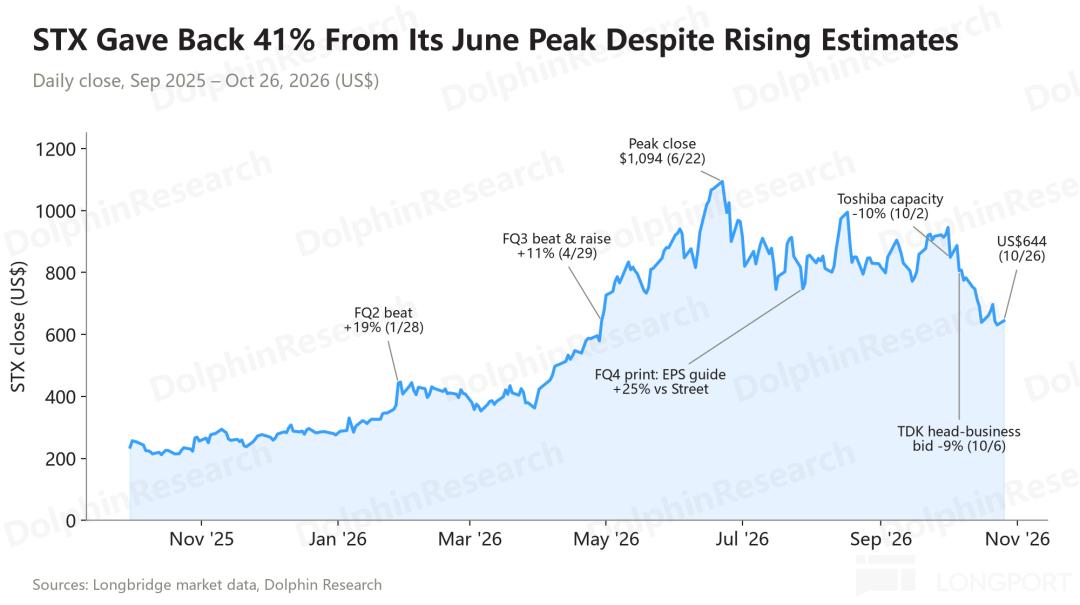
But this discipline was challenged for the first time in early October: Toshiba announced that it would nearly double its HDD production capacity before FY2027, and news came out that Seagate and Toshiba were competing for TDK's head business. The tacit understanding that "the three oligopolies will not expand production" was questioned, and Seagate's share price fell from $946 on October 1 to $644 on October 26, a drop of about 32%.
After the earnings release, the share price fell to around $631 (-5.5%) in after-hours trading, pulling back about 45% from the July high. This is exactly the same as Western Digital's situation where the share price still fell the next day after its earnings fully beat expectations — the market no longer pays for "upside beats" itself, but focuses on supply discipline, shipment rhythm and the sustainability of price hikes.
As the market focus shifts from "how much more can prices rise" to "how long will the good times last", Seagate has the following key points to watch:
1) Supply disruption (Toshiba and TDK): Toshiba plans to invest about 60 billion yen to expand its Philippine factory, and increase HDD production capacity (calculated by capacity) by nearly double by the end of FY2027 compared with FY2025. Nikkei reported that its medium-term market share target is 30% (currently around 11%); then news came out that Seagate and Toshiba are competing for TDK's HDD head business.
Dolphin Research believes that Toshiba's capacity expansion has limited short-term impact:
① The investment is mainly used to restart idle equipment and resolve testing bottlenecks, not to build new factories;
② The scale cannot fill the gap — even if capacity doubles, the new increment in two years will be less than 150EB, while the industry's supply gap this year and next year is about 300-400EB;
③ There is a generation gap in products — Toshiba's current data center HDDs are still dominated by 24-28TB models, and HAMR mass production will be available in about two years;
④ Toshiba adopts a pure assembly model, relying entirely on TDK for heads, and purchasing platters and glass substrates from external suppliers, so its capacity expansion is constrained by suppliers.
Seagate's management did not respond directly on the earnings call: it only emphasized that launching meaningful HDD production capacity to the market "is far more complicated than just plugging in a few machines, with difficulty levels several orders of magnitude higher", and Seagate's product supply will remain tight before CY28; it also did not confirm the