Epic M&A
According to a Bloomberg report citing people familiar with the matter in the early hours of Beijing time, Marvell Technology is in advanced talks to acquire Lumentum, a leading optical component giant, and the deal is expected to be officially announced as early as next week.
For reference, Lumentum currently has a market capitalization of about 83 billion US dollars, while Marvell's market capitalization is about 221 billion US dollars.
If the deal is finally closed, it will rank among the top 10 mergers and acquisitions in the global technology and telecommunications M&A history. Driven by the news, the stock price performance of the two companies in the after-hours market showed a completely opposite divergent trend.
Lumentum closed at $913.95 per share on Wednesday. After the news came out, its after-hours price rose to a maximum of $1,018, an increase of more than 11%. In contrast, Marvell's stock price fell from the closing price of $251.65 to $230.5, a decline of 8.4%.
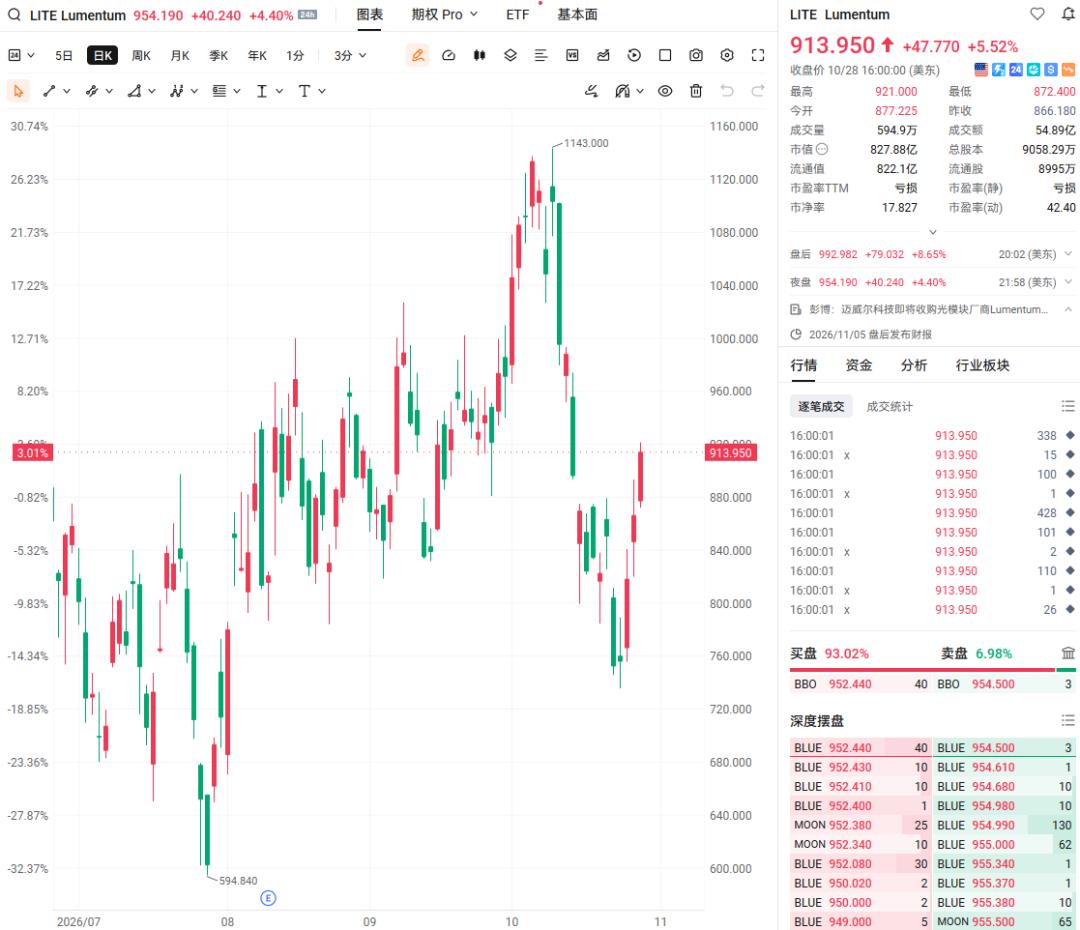
(Lumentum stock price trend; Futu NiuNiu)
Looking back at the market performance since the beginning of this year, Lumentum has accumulated an increase of 148%, while Marvell has nearly tripled its stock price. However, in the same optical communication industry chain, the capital market's expectations for the two are facing an extreme contrast between the buyer's premium pursuit and the seller's discounted selling.
The core demand of Marvell's large-scale M&A this time is directly aimed at the scarce production capacity schedule in Lumentum's hands. According to the information previously disclosed by its CEO Helston, the company's current optical device production capacity has been fully sold out, and the order scheduling has been extended to the beginning of 2029.
Among them, 70% of the demand for some products cannot be met next year, and some categories will still have a 30% structural gap until 2028. The production ramp-up period for new production lines generally takes three to five years to release production capacity. Strong financial report data confirms the extreme shortage in the industry.
In the latest fiscal quarter, Lumentum achieved revenue of 1.01 billion US dollars, a year-on-year increase of 109%, non-GAAP gross margin was as high as 50.4%, and operating profit margin reached 36.6%.
Although the company has been making every effort to expand production in recent years, the production capacity of its factory in the Tokyo metropolitan area has been increased to 12 times the original level, and it plans to add 350 million US dollars in capital expenditure. However, in the face of the explosive market demand, the speed of production capacity expansion still cannot hide the white-hot competition for orders.
The buyer's strategic intention is clear. As the data center architecture evolves from GPU to switch at an accelerated pace, the value of the optical interconnection link is rising geometrically. Whoever masters the supply of core light sources can offer cloud manufacturers accurate delivery dates that competitors cannot match.
However, the large-scale M&A across different magnitudes poses a severe test to the buyer's financial fundamentals. As of the latest fiscal quarter, Marvell's cash and cash equivalents on the book were 3.92 billion US dollars, which is a drop in the bucket for the target with a market value of 83 billion US dollars. The equity dilution and financial leverage expectations brought by huge financing directly constitute the catalyst for the after-hours stock price decline.
Marvell's stock price has nearly doubled this year, and it just spent 3.25 billion US dollars to acquire Celestial AI at the end of last year. The capital scale of this transaction is 25 times larger than the previous one.
In terms of revenue volume, Marvell's operating revenue in the last fiscal year was 8.19 billion US dollars, while Lumentum's was 3.014 billion US dollars. Although the combined revenue of the two sides will exceed the 10 billion US dollar mark, there will be significant earnings per share dilution pressure during the transaction integration period.
The capital market has given completely opposite pricing logic to both parties of the transaction from the very beginning: the seller's shareholders have locked in the deterministic M&A premium, while the buyer's investors are digesting the heavy integration risk.
Institutions such as Bernstein hold relatively positive views, believing that after Marvell acquired Celestial AI to supplement its photonics technology at the end of last year, if it can fully integrate Lumentum's light source assets into its system, it will build a strong vertical integration barrier.
However, the negative feedback on the immediate transaction level of the market is more direct, and institutional investors obviously place more safety margin on the health of the buyer's balance sheet.
Looking at the long industrial cycle, the competitive units in the optical communication field are undergoing fundamental changes.
In the past, the core barrier of the industry lay in the performance breakthrough of a single DSP or a single laser, while the current business model is evolving into a game of the complete optical interconnection solution.
Broadcom has built a moat with a comprehensive platform that integrates switching chips and optical devices, and NVIDIA also invested 2 billion US dollars each in Lumentum and Coherent respectively in March this year, directly locking in scarce upstream production capacity through long-term procurement commitments.
As computing power giants have personally stepped in to control upstream strategic resources, the strategic weight of optical devices in AI infrastructure has substantially increased.
For China's domestic optical module industry chain, this change has brought about a complex ecological reconstruction. The high-speed optical module solutions of Zhongji Xuchuang and Eoptolink have long been deeply dependent on Marvell's DSP chips, and a considerable part of the EML and CW lasers they need are purchased from Lumentum. These two core devices originally belonged to two independent suppliers.
With the advancement of the potential merger between Marvell and Lumentum, the depth of industry chain binding will be reshaped. After the transaction is completed, the game pattern faced by downstream module manufacturers at the negotiation table will be more concentrated. If DSP and light sources belong to the same interest entity, their bargaining power and delivery date allocation rights may be compressed.
At the same time, this further highlights the urgency and strategic value of China's domestic light source chip industry chain.
Local enterprises such as Source Photonics and Changguang Huaxin have deployed similar laser chips, and Accelink Technology, as a scarce domestic sample of vertically integrated manufacturing, in the macro context of highly concentrated upstream supply chain, the logic of domestic substitution and asset revaluation has been further strengthened instead.
Goldman Sachs optimistically predicts that the global optical module market size will rise to 67.7 billion US dollars in 2026, and is expected to reach 148.5 billion US dollars in 2028. The highest expectation has been raised by 115% compared with the previous one, and its core logic lies in the continuous expansion of the downstream AI application market.
However, the final realization of future profits is highly dependent on the actual progress of production capacity implementation. Once the growth rate of global AI capital expenditure slows down marginally, the huge goodwill impairment and asset depreciation pressure will directly impact the buyer's financial statements.
At present, the transaction is still in the negotiation stage, and the specific official announcement time, consideration structure and global antitrust review cycle are still uncertain. The financial risks ultimately borne by shareholders on both sides are pending the implementation of details, but the M&A news itself has completed a round of in-depth expectation pricing in the capital market.
In essence, the consideration of 83 billion US dollars buys a scarce production capacity schedule that is extended to the beginning of 2029, and its underlying bet is still that the global AI capital expenditure cycle can continue for the next three years.
The part that can be truly converted into performance will become a solid fundamental support, while the unfulfillable expected risks will eventually be deposited in Marvell's financial statements in the form of goodwill and asset depreciation.
This article is from the WeChat official account "Gelonghui APP" (ID: hkguruclub), written by Aragorn, and authorized for release by 36Kr.