As over half of its revenue relies on CATL, what are the chances that Kunlun New Materials will successfully get listed on the Hong Kong Stock Exchange?
Kunlun New Materials' long journey to get listed has ushered in new progress.
Huaxia Energy Network has learned that recently, the China Securities Regulatory Commission (CSRC) disclosed the "Filing Notice for Kunlun New Materials' Overseas Issuance and Listing and Full Circulation of Unlisted Domestic Shares". According to the notice, the company plans to issue no more than 154,159,500 overseas-listed ordinary shares and list on the Hong Kong Stock Exchange (HKEX).
In January this year, Kunlun New Materials first submitted its listing application to the HKEX. After the first application expired, the company resubmitted the application on August 21. Now, with the completion of the overseas listing filing, Kunlun New Materials has taken another step forward in its listing process.
In fact, Kunlun New Materials has been pursuing this listing dream for several years. As early as June 2023, the company made a sprint for the ChiNext board of the Shenzhen Stock Exchange. However, it withdrew its A-share IPO application in less than a year, and the listing plan failed.
Now that the Hong Kong stock listing filing is completed, can Kunlun New Materials fulfill its capital market dream this time?
A Bumpy Road to Listing
Kunlun New Materials' listing journey once had a rather lively opening.
Before Kunlun New Materials officially submitted its A-share listing application, multiple capitals entered the market one after another, and the company's valuation rose accordingly. In August 2021, December 2021 and December 2022, Kunlun New Materials successively received capital increases of 90.5 million yuan, 450 million yuan and 110 million yuan, totaling about 651 million yuan. Calculated based on the share price of each round of capital increase, its post-investment valuation climbed from about 600 million yuan to about 3 billion yuan all the way.
In June 2023, Kunlun New Materials launched an impact on the ChiNext board of the Shenzhen Stock Exchange, planning to raise 1 billion yuan, all of which will be invested in the project with an annual output of 240,000 tons of lithium-ion battery electrolyte.
However, before the enthusiasm of capital could be turned into the listing bell-ringing, the industry trend changed.
From 2021 to 2022, the demand for new energy vehicles grew rapidly, the electrolyte was once in short supply, and enterprises expanded production one after another. But as new production capacity was released gradually, industry prices fell and competition intensified.
In the first half of 2023, the average sales price of Kunlun New Materials' electrolyte dropped to 34,600 yuan per ton, which was more than half lower than the 71,800 yuan per ton in 2021. In the same period, operating revenue and net profit decreased by 21.46% and 45.33% year-on-year respectively. In addition, the company's capacity utilization rate also dropped from 91.65% in 2022 to 72.33% in the first half of 2023.
Against this background, Kunlun New Materials even planned to raise funds on the A-share market to expand production. Whether the new production capacity can be digested has become a concern of the industry. At the same time, Kunlun New Materials' low R&D investment has also attracted attention. The Shenzhen Stock Exchange's review inquiry at that time required the company to explain whether the low R&D investment could maintain technological advancement and market competitiveness.
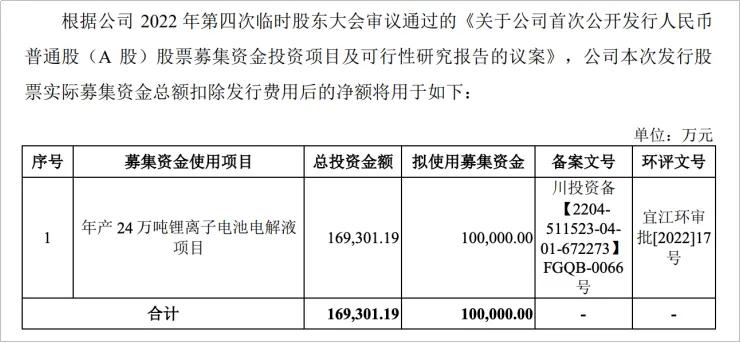
Funds Raised Investment Projects in the ChiNext Prospectus
On May 17, 2024, as Kunlun New Materials and its sponsor withdrew the application, the Shenzhen Stock Exchange terminated its IPO review, and the A-share listing plan was put on hold.
However, the failure in the A-share market did not extinguish Kunlun New Materials' ambition to go public. A year and a half later, Kunlun New Materials decided to move in a different direction to continue its pursuit, so it submitted a listing application to the HKEX in January this year.
CATL Dependency
According to the current prospectus, in the first half of this year, Kunlun New Materials achieved an operating revenue of 1.972 billion yuan, a year-on-year increase of 209.8%, and its half-year revenue has exceeded the full-year revenue of last year; the net profit attributable to shareholders reached 128 million yuan, compared with a loss of 7.866 million yuan in the same period of the previous year.
Behind the sharp surge in Kunlun New Materials' performance, there is a name that cannot be ignored — CATL (SZ: 300750).
The Hong Kong stock prospectus refers to the company's largest customer as "Group A". Combined with its registered place, listing place and the information disclosed in the previous A-share prospectus, this enterprise is clearly CATL.
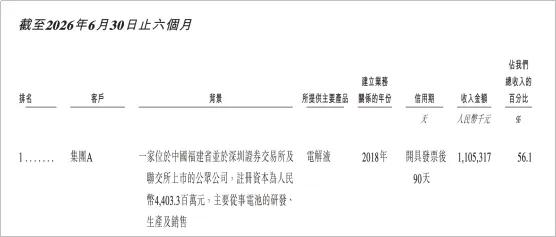
Details of Kunlun New Materials' Largest Customer in the First Half of the Year
As early as 2018, the two sides have started cooperation. According to Kunlun New Materials' prospectus, the revenue contributed by CATL accounted for 60.1%, 59.3% and 48.4% respectively from 2023 to 2025. In the first half of this year, the revenue contributed by CATL reached 1.105 billion yuan, accounting for more than half again, reaching 56.1%.
What is more noteworthy is that Kunlun New Materials' dependence on CATL also extends to the procurement side.
In the first half of this year, Kunlun New Materials purchased raw materials such as additives from CATL for an amount of 518 million yuan, accounting for 27.7% of the total procurement amount, making CATL the largest supplier of Kunlun New Materials. The company explained that in order to meet the formula requirements and quality standards of this customer, it needs to purchase specified raw materials from it.
While purchasing raw materials from CATL, it sells products to CATL at the same time. This in-depth cooperation brings order and technical synergy, but also means that Kunlun New Materials is closely linked with the same giant in sales, raw material selection and other links, which carries certain risks.
Speeding up to Catch Up with Industry Leaders
In the electrolyte industry, although Kunlun New Materials ranks high, there is still a noticeable gap compared with the two leading players, Tianci Materials (SZ: 002709) and New Zebang (SZ: 300037).
Calculated based on the electrolyte revenue in 2025, Kunlun New Materials ranks third among global independent electrolyte suppliers, with a market share of 3.6%. In the same period, the shares of Tianci Materials and New Zebang reached 26.8% and 11.8% respectively.
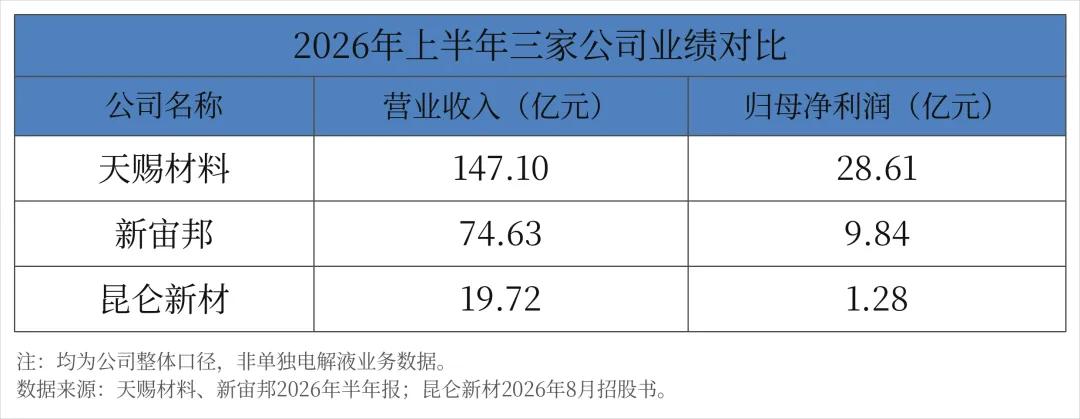
Performance Comparison of Three Major Electrolyte Enterprises in the First Half of the Year
In the first half of this year, Tianci Materials' operating revenue is about 7.5 times that of Kunlun New Materials, and its net profit is 22.4 times that of Kunlun New Materials; New Zebang's operating revenue is about 3.8 times that of Kunlun New Materials, and its net profit is about 7.7 times that of Kunlun New Materials. It can be seen that there are still obvious scale and profit gaps between Kunlun New Materials and the two leading enterprises.
Tianci Materials' advantage is first reflected in its more complete industrial chain layout. Focusing on the electrolyte business, the company has supported the production of key raw materials such as lithium hexafluorophosphate, new electrolytes and additives, and strengthened its cost advantage through the synergy between self-produced raw materials and production links.
New Zebang has a more diverse business portfolio. In addition to battery chemicals, the gross profit margins of electronic information chemicals and organic fluorine chemicals both exceeded 50% in the first half of this year, providing strong support for overall profitability.
Facing the gap, Kunlun New Materials is also accelerating its catch-up, and large-scale production expansion is one of the important steps.
According to the plan disclosed in the August prospectus, the annual electrolyte production capacity of the company's Yichang production base and Jining Production Base II is 100,000 tons and 150,000 tons respectively. The new production capacity added by these two plans alone exceeds the existing annual production capacity of 180,000 tons. After the construction of the new production base or the expansion of production capacity projects are completed, Kunlun New Materials' annual electrolyte production capacity will exceed 500,000 tons.
If it is successfully listed, Kunlun New Materials will obtain more resources to support its catch-up, but the tough battle to catch up with the industry leaders is still ahead.