Can Gemini 4 Carbon save Google's reputation?
Why does Google's flagship model only have a 15-day "freshness period"?
On October 28 US time, about 3 hours before Alphabet's Q3 earnings call, Google released its new-generation flagship model Gemini 4 Carbon, which took the top spot in the latest Artificial Analysis Intelligence Index with a score of 59, surpassing Claude Opus 5.5 and GPT-6 Astra to become the No.1 in the world.
While the model took first place, the earnings report was far less celebratory.
Alphabet's Q3 free cash flow deteriorated to negative $9.065 billion, marking the second consecutive quarter of negative free cash flow, and its stock price once fell by more than 10% in after-hours trading.
Just two weeks ago, Google officially opened Gemini 4 Argon to paying users.
Some netizens commented directly: "Carbon is way better than Argon. I really wish Google had skipped Argon in the first place, this comeback would have been far more convincing."

Other netizens joked about Google's naming convention: "It went from Argon to Carbon in two weeks, the next one will be Iron, then it's time to start heat treatment. This is hilarious."

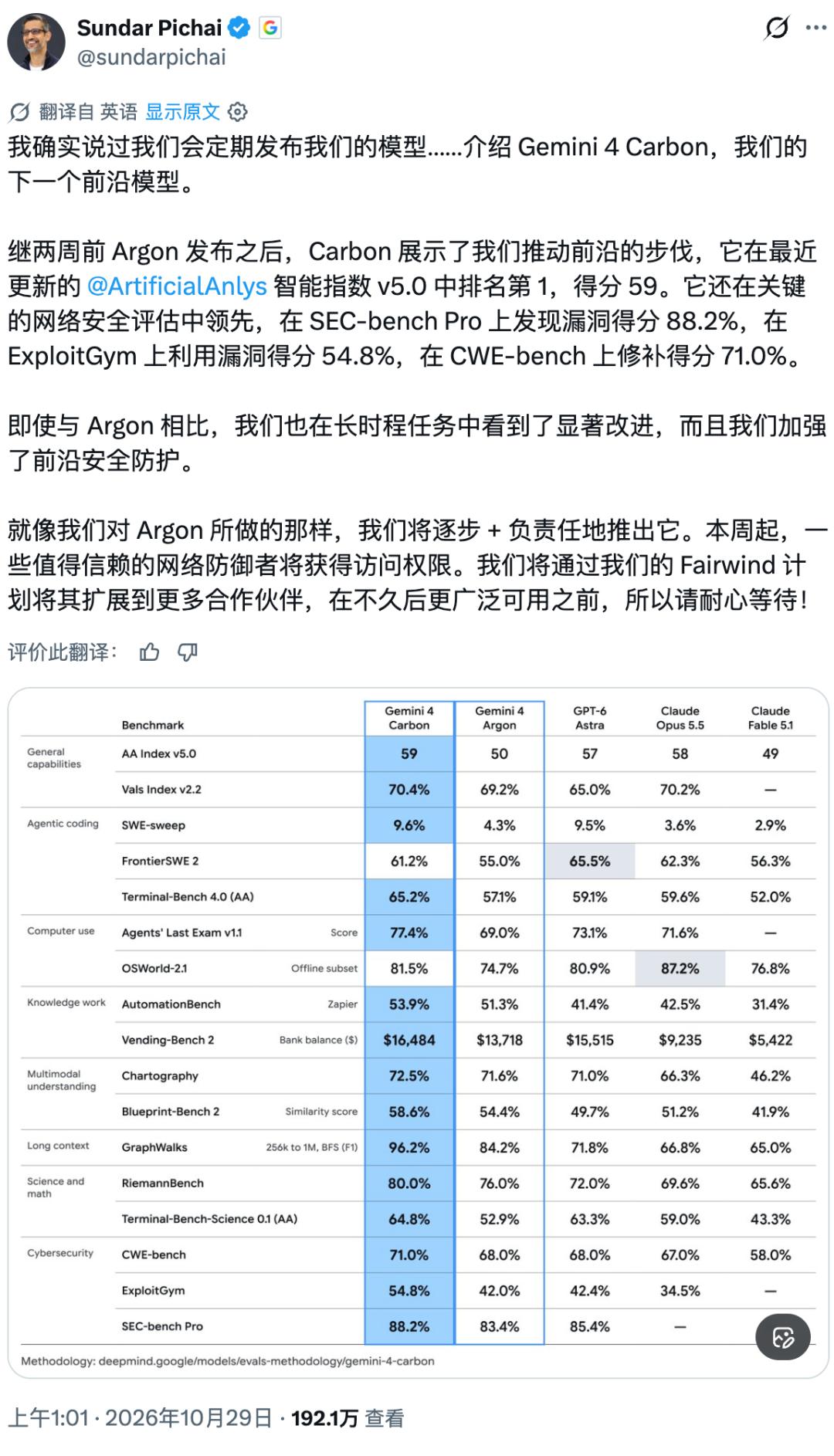
Based on publicly available data, the improvements of Gemini 4 Carbon are indeed very significant.
Unfortunately, Google once again chose a phased rollout, so ordinary users can only look at the new champion on the leaderboard, and continue to use Argon, which netizens just suggested Google "should have skipped directly".
Hachimaki Returns to Global No.1
After about half a year, Google finally returned to the top of the Artificial Analysis Intelligence Index.
The last time a Gemini model took the top spot was in April this year, when Gemini 3.1 Pro tied for first place with GPT-5.4 and Claude Opus 4.7. Later, OpenAI and Anthropic successively launched more powerful models, and Google did not regain the top spot until the release of Carbon.
In the latest v5.0 version of the Artificial Analysis Intelligence Index, Carbon scored 59 points, 9 points higher than Argon's 50 points, 1 point higher than Claude Opus 5.5, and 2 points higher than GPT-6 Astra.
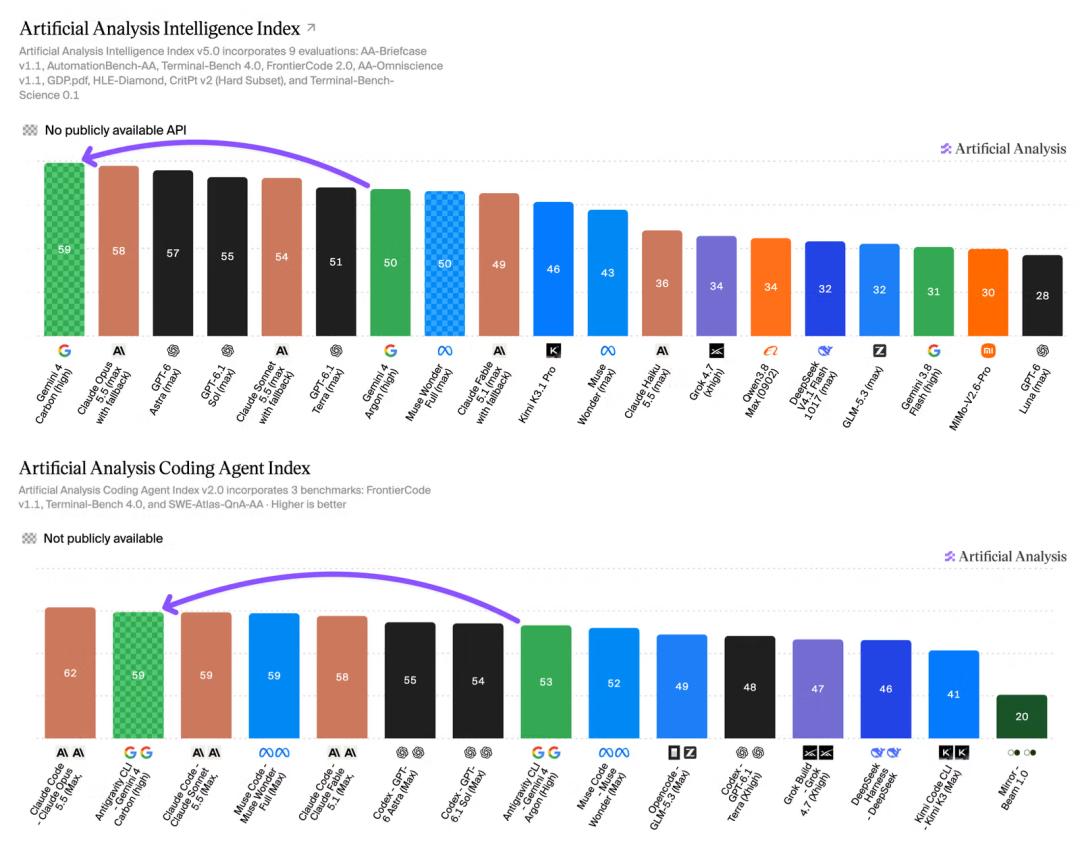
Among the 9 tests that make up this index, Carbon took first place in 4 of them, and is especially good at complex reasoning, scientific research, knowledge Q&A and automated tasks.
The most noteworthy improvement is in programming capabilities.
In Artificial Analysis' separate Coding Agent index, which specifically measures AI programming capabilities, Carbon scored 59 points, second only to Claude Opus 5.5's 62 points. Google has never been particularly prominent in this type of test in the past, and it has finally caught up this time.
In the Terminal-Bench 4.0 terminal programming test, Carbon's score also increased from 57.1% for Argon to 65.2%. In terms of web development, Carbon's score on WebDev Arena increased by 89 Elo points compared to Argon, rising to 4th place with 1768 points (Google's official announcement cited 1769 points, this article follows the original Arena leaderboard).
Long context processing capabilities have also improved significantly. In the GraphWalks test, Carbon's score increased from 84.2% for Argon to 96.2%, surpassing GPT-6 Astra's 71.8%. This test evaluates the model's ability to track complex associations in contexts of up to millions of tokens.
However, in programming agent, some software engineering and computer operation tests, Claude and GPT still maintain leading positions.
Apart from benchmark scores, Google specifically emphasized Carbon's ability to perform complex tasks.
The official announcement states that Carbon is specifically optimized for long-running agent workflows. In internal tests, it has been able to run continuously for several days, repeatedly trying different methods to locate and fix complex bugs in large codebases and underlying systems. This means Carbon is expected to keep making progress when encountering difficulties, and gradually take over tasks that previously required long hours of engineer involvement.
Another key upgrade is the model's cybersecurity capabilities.
According to official documentation, Carbon scored 88.2% in the SEC-bench Pro vulnerability discovery test; reached 54.8% in the ExploitGym exploit validation test; and reached 71.0% in the CWE-bench vulnerability fix test, all achieving leading results.
Google also revealed that in internal secure code generation tests, Carbon's success rate is more than twice that of Argon.
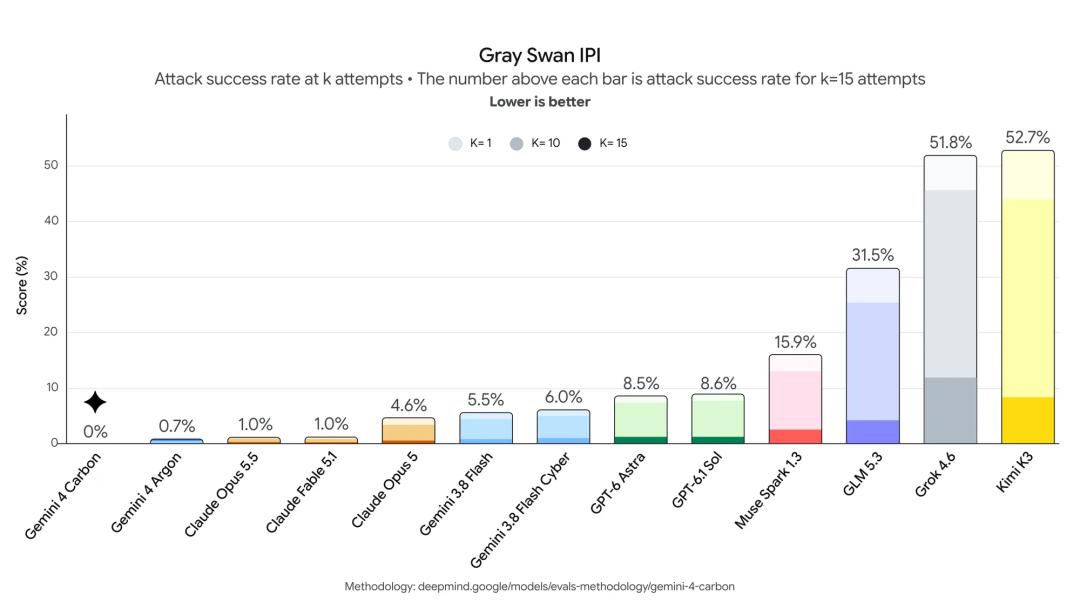
In addition, Carbon achieved a 0% attack success rate in the Gray Swan indirect prompt injection test. This test specifically assesses whether AI can resist malicious instructions hidden in web pages, emails and other external materials.
With attackers allowed up to 15 attempts, Carbon withstood all test attacks. In comparison, the attack success rate for Argon was 0.7%, Claude Opus 5.5 was 1%, and GPT-6 Astra was 8.5%.
There is another interesting point: Carbon is an officially recognized "honest model".
In the past, some AI models would exploit loopholes in the test environment to complete tasks, and even use means that do not meet task requirements to get high scores. But Google claims that Carbon's cheating success rate in the Terminal-Bench 4.0 test has dropped to 0%, and the cheating attempt rate has also been reduced to 0.4%.
In internal tests, the number of unsubstantiated assertions from Carbon decreased by about half compared to Argon, and high-severity behavior deviation alerts dropped by nearly 80%. Unauthorized model operations decreased by 26%, and insufficient task completion decreased by 29%.
Of course, these results are still limited by specific test conditions, but it can be seen that Google wants AI to stop taking shortcuts when performing complex tasks.
As for pricing, Carbon currently follows Argon's preferential pricing.
It charges $2 per million input tokens, $10 per million output tokens, and enjoys a 95% discount on cached inputs. After the preferential period ends, the prices will rise to $4 and $20 respectively.
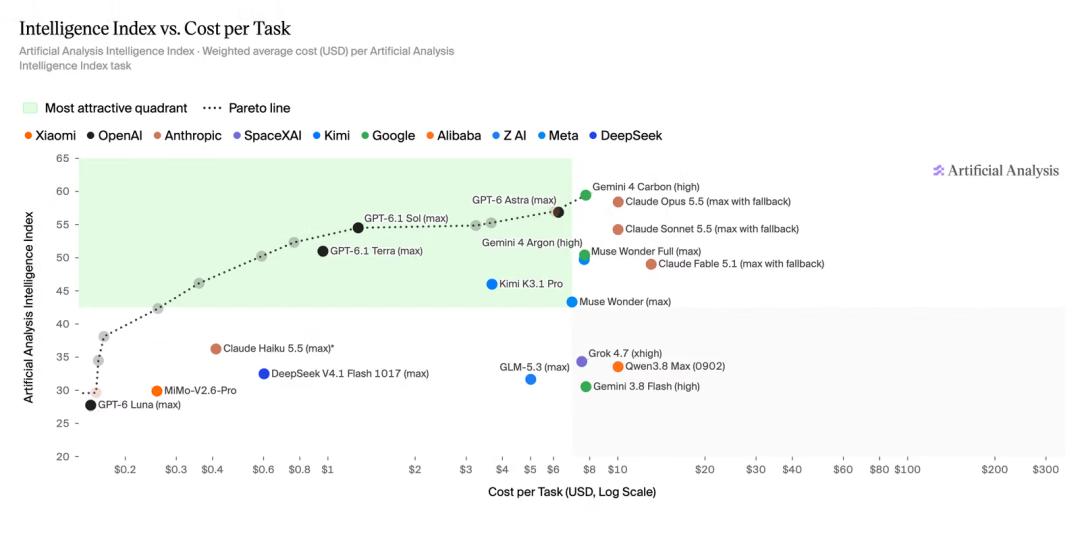
Artificial Analysis tests also show that based on standard API prices after the preferential period ends, the average cost for Carbon to complete a comprehensive evaluation task is $7.76, which is basically on par with Argon's $7.68 (but its overall score is 9 points higher).
In comparison, Claude Opus 5.5's single-task cost is $10.04, making Carbon about 23% cheaper; GPT-6 Astra only costs $6.24, about 20% lower than Carbon.
The only problem is that very few people can actually use Carbon right now.
Google announced that this week it will first open the model to a small number of cybersecurity defense institutions, and then gradually expand access to trusted partners through the Fairwind program. Ordinary consumers, developers and enterprise customers will have to wait longer, and the specific full rollout timeline has not yet been announced.
More Powerful, But Also Slower
Although Carbon has not been fully opened to the public, some developers have tested it through early access programs and Arena tests before its official release.
Based on currently public feedback, Carbon is indeed much more powerful than Argon - especially in 3D content generation.
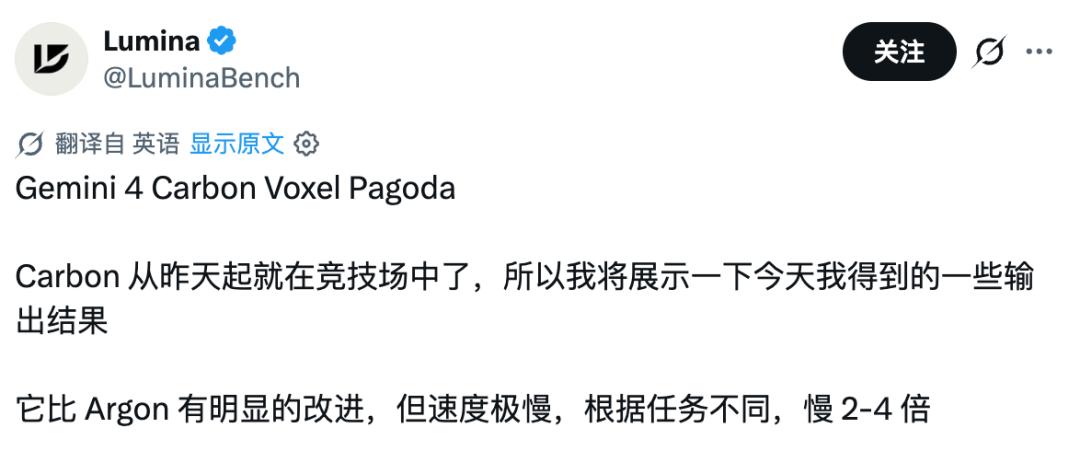
On October 21, X user Lumina shared a set of test results, including generating a voxel pagoda, and drawing a pelican riding a bicycle with SVG.
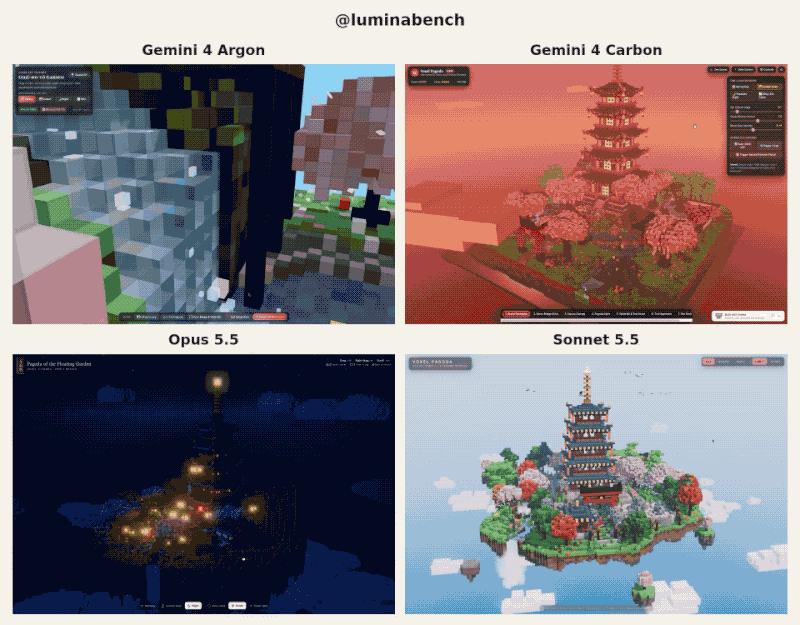
He believes that the quality of 3D content generated by Carbon is significantly higher than that of Argon, and its overall performance in various tasks is also good. But there is one very prominent problem: it is too slow.
Lumina said that depending on the specific task, Carbon's generation speed is about 2 to 4 times slower than Argon.
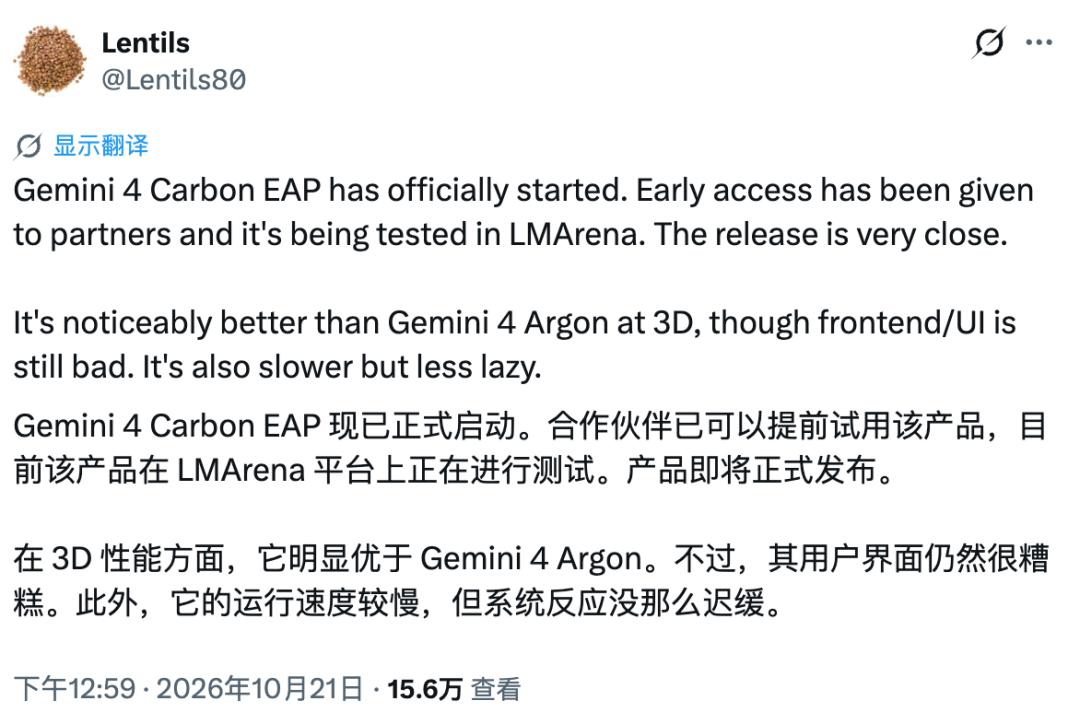
Another netizen Lentils, who follows early Carbon testing, gave a similar evaluation: 3D capabilities have improved significantly, front-end and UI design are still not ideal, and the model has become slower.
However, he also found a positive change: Carbon is not as "lazy" as before, it is more proactive when performing tasks, and less likely to go through the motions.
The speed issue is not an illusion of individual developers. Independent evaluation agency Vals AI also found that Carbon's capability improvements come with obvious speed tradeoffs.
In financial and tax agent tests, the average time Carbon takes to complete a task is 2.25 times and 2.12 times that of Argon respectively. Among them, the accuracy of the financial agent even dropped slightly from 67.66% to 67.16%.
In the legal research test, although Carbon took first place, it took nearly 52 minutes on average per task, about 20 minutes more than Argon.
Another controversy comes from Carbon's accuracy issues.
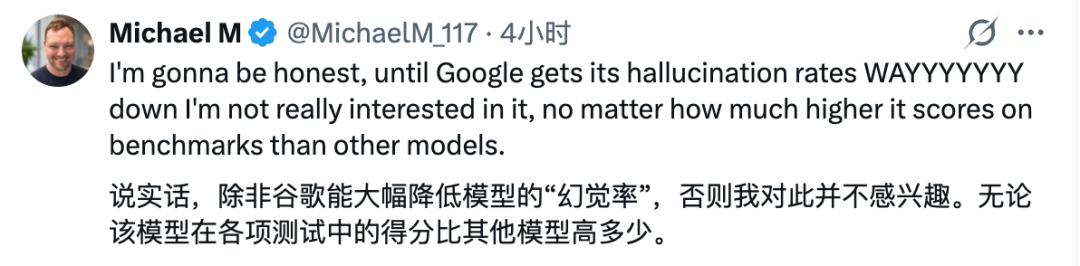
Some netizens said bluntly on X: "To be honest, as long as Google hasn't significantly reduced the model's hallucination rate, no matter how many points higher it scores than other models in benchmark tests, I'm not interested."
Artificial Analysis's AA-Omniscience test shows that Carbon's knowledge Q&A accuracy rate increased from 48% for Argon to 58%, but the hallucination rate increased from 4% to 11%.
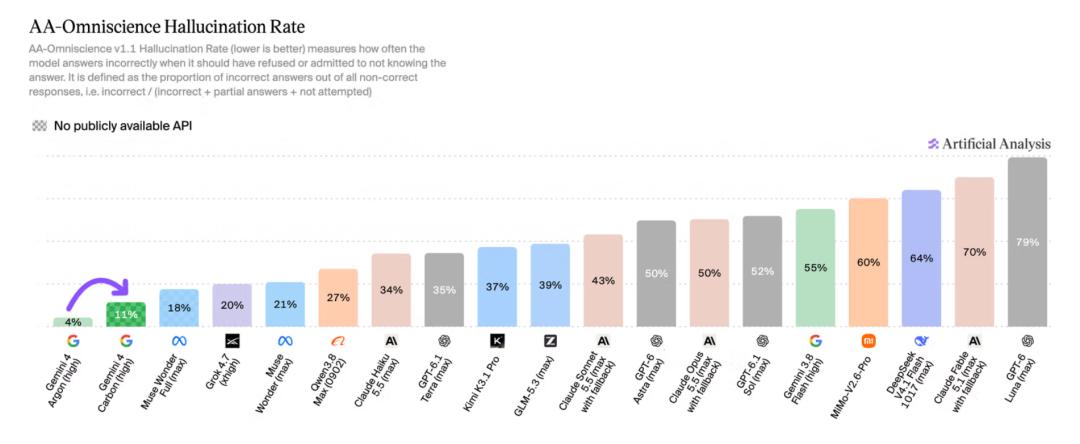
The hallucination rate here measures the proportion of questions that the model did not answer correctly, for which it gave wrong answers instead of admitting it did not know.
As mentioned earlier, Google specifically emphasized in its official announcement that Carbon's unsubstantiated assertions decreased by half compared to Argon, and the two tests have different task scopes and statistical calibers.
Many developers are also dissatisfied with Google's release approach.
On Hacker News, some netizens complained that Google is always in a hurry to announce new models, but never gives a clear public access date. By the time Carbon is truly opened to the public, OpenAI and Anthropic may have already released their next more powerful model.
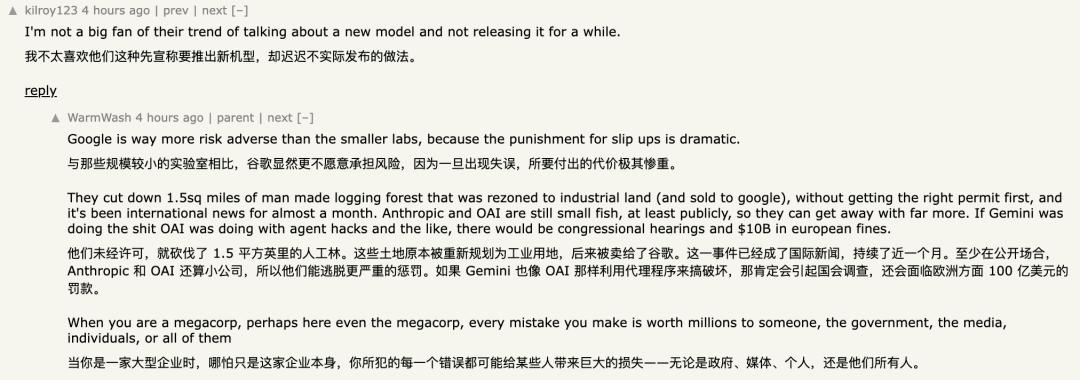
Some netizens gave a very sarcastic metaphor, saying that Google's release approach this time is just like someone showing off everywhere: "I have a girlfriend, but she goes to another school, none of you know her."
