AI Video: Did Runway Stage a Stunning Comeback?
Open today's capability ranking list of video generation models, the top-ranked models all come from tech giants such as Google, ByteDance, Kuaishou and other large manufacturers. Three years ago, Runway, an unavoidable name in the AI video track, is no longer in the first echelon.
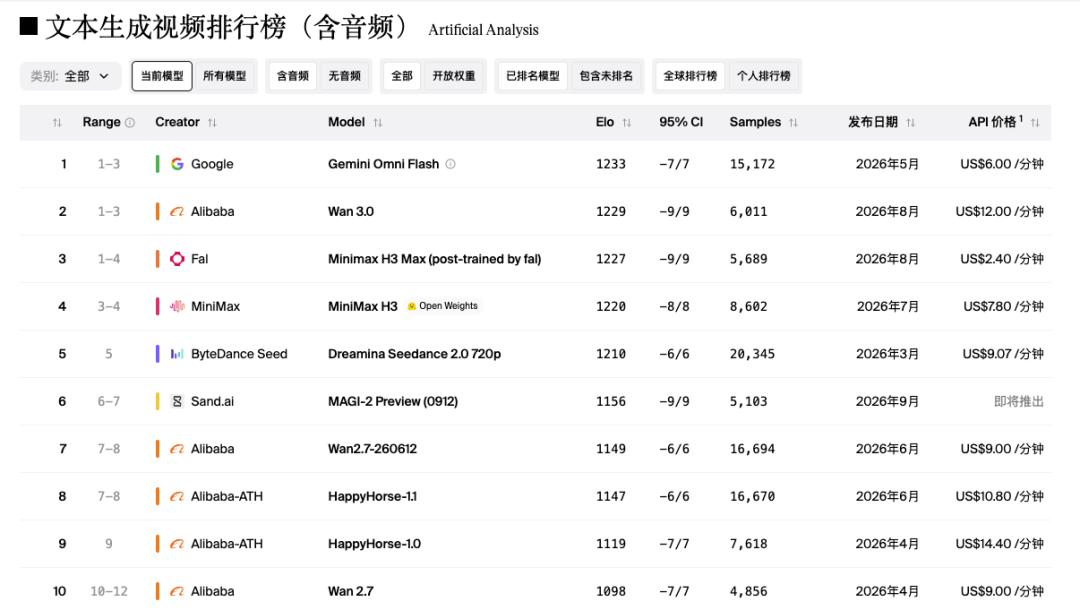
On the Artificial Analysis ranking list, Runway's latest model Gen4.5 can no longer rank in the top 10 | Image Source: Artificial Analysis
Last December, Gen-4.5 briefly topped the Artificial Analysis list, but its ranking quickly slipped and was overtaken by models from other large manufacturers. It has not launched any new models for more than half a year since then.
In stark contrast, Runway's business scale is quietly expanding. In early September, Anastasis Germanidis, co-founder and CEO, announced a set of data on LinkedIn that the ARR has approached 200 million US dollars, almost doubling in half a year compared with 100 million US dollars in April. Data from AppMagic also confirms this trend, the monthly revenue from mobile terminals alone has risen from less than one million US dollars last September to 2.7 million US dollars in the latest nearly 30 days, which is enough to squeeze into the global Top 3.
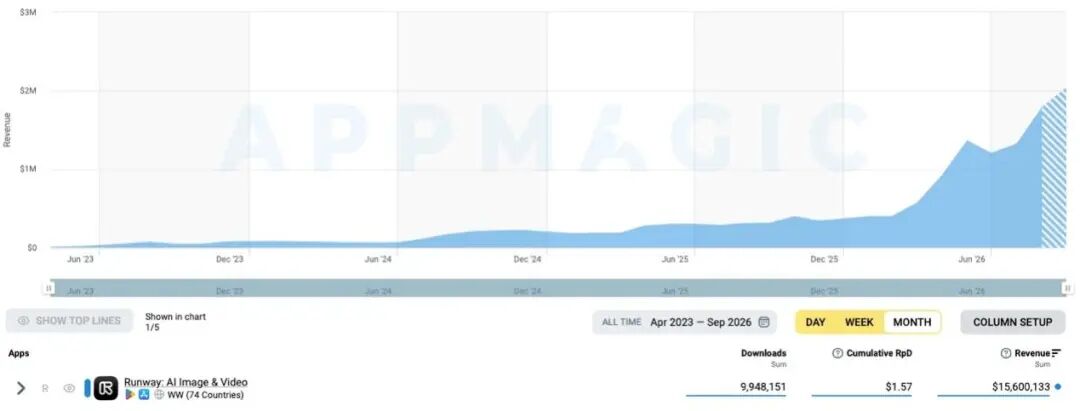
Runway Revenue Trend | Image Source: AppMagic
Models Fall Behind, Products Break Through
We reviewed the growth data of Runway in the past six months, and found two obvious inflection points.
The first one was in May. AppMagic shows that Runway's downloads and revenue rose simultaneously this month, corresponding to the launch of a model named Aleph 2.0, which does not generate videos from scratch, but "modifies videos".
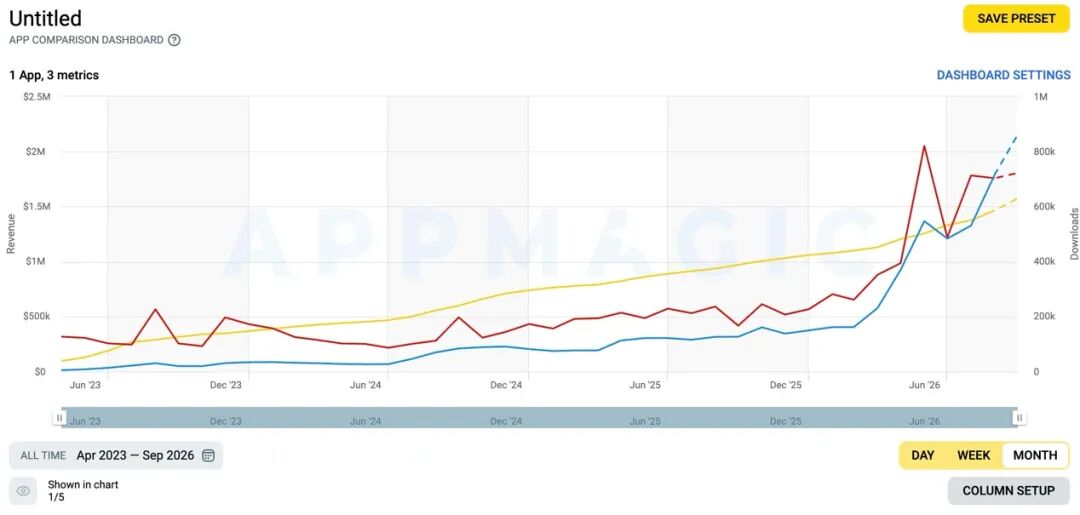
Runway Downloads, Revenue, RPD, red line for Download, blue line for Revenue, yellow line for RPD | Image Source: AppMagic
According to the introduction on the official website, the core capability of Aleph 2.0 is to understand the picture content of existing videos, modify the specified elements according to user instructions while keeping other pictures, actions and scenes unchanged; users can also edit a single frame first and then apply it to the whole video, and it also supports synchronous modification/replacement of subjects or backgrounds in multiple shots.
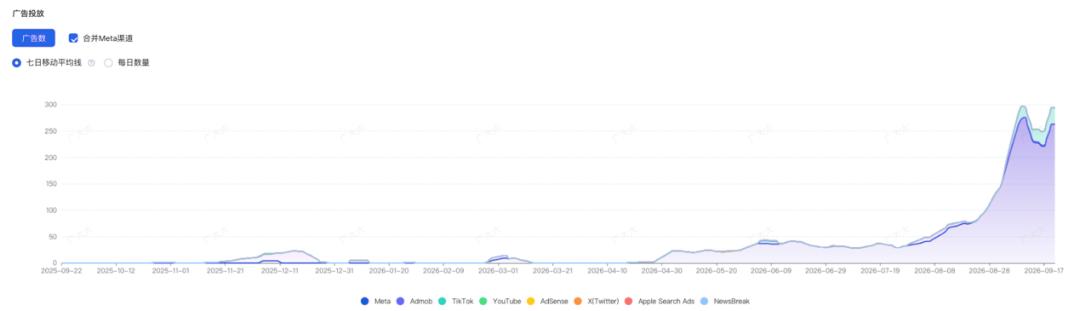
Number of Advertising Materials | Image Source: GreatBigAds
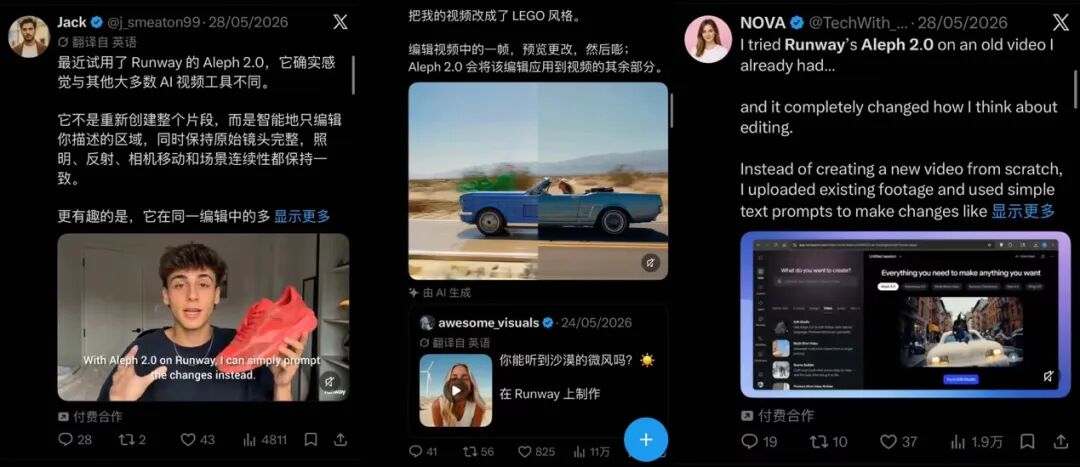
Combined with the placement data provided by GreatBigAds, the number of Runway's materials in May was less than 50, far lower than the recent placement level. But in the same period, a large number of bloggers on X posted videos reviewing Aleph 2.0. At the time point when the new model was just launched, Runway adopted the strategy of "focusing on social media promotion, supplemented by small-scale advertising placement". After implementing this strategy, the download volume reached its peak in May, and then fluctuated in June and July. | Image Source: X
Runway built a highly spreadable selling point around this capability, "modify videos with one sentence": upload a complete video, enter "add a panda on the shoulder", and a panda will appear in the picture while everything else remains the same. In May, a large number of bloggers on X spontaneously reviewed Aleph 2.0 and brought the first wave of downloads. After the advertising placement was expanded at the end of August, it promoted the second wave of growth. The two waves adopted different strategies, but the core selling point is the same: video modification.
Although it shifted from generation to modification, Aleph 2.0 is still independently developed by Runway. But in the overall core design, Runway has long been the same as other model aggregation products, no longer focusing on self-developed models exclusively (ps: At present, only a few top products like Kling still only provide their own models).
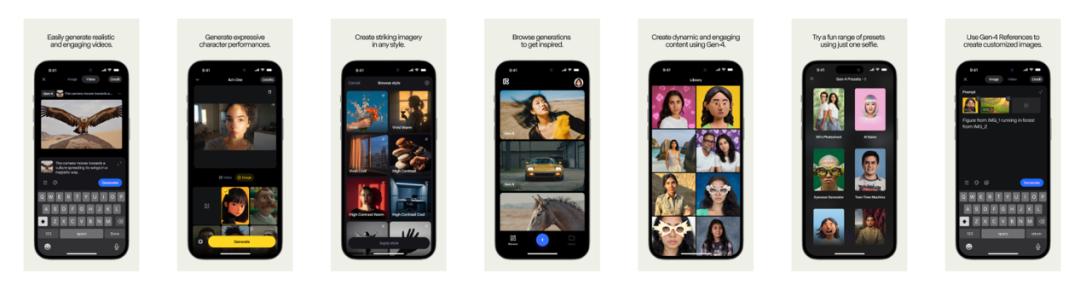
After experiencing the current version of the App, we found that the product form has undergone fundamental changes. Compared with the screenshots of the version at the end of 2025, the self-developed model Gen-4 used to be the facade, but now the default video model in the App has been replaced by Seedance 2.0, and the image generation model has been replaced by "GPT Image 2". The model selection interface aggregates mainstream generation models on the market. Gen-4.5 can still be manually switched back, but it is no longer the default option.
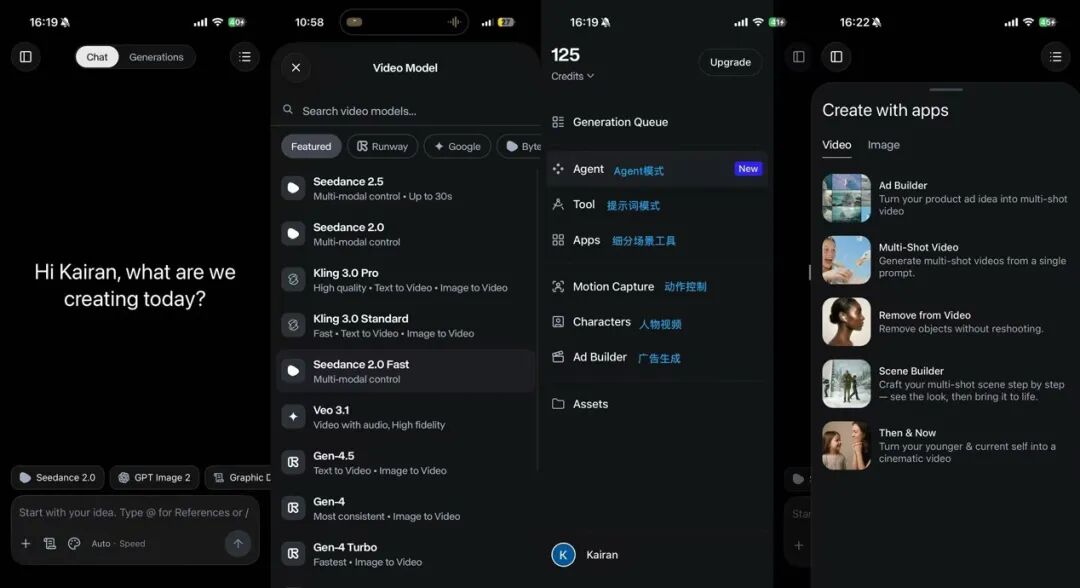
Agent mode page (Figure 1), model selection (Figure 2), function selection (Figure 3), Apps for vertical demands (Figure 4). The Apps include advertising generation, multi-shot video generation with one sentence, shot list confirmation before video output, removing objects in the picture without reshooting, making characters move according to real performers' actions, and talking head videos, etc.
Previous Runway promoted user-facing features such as 90s-style portrait shooting, AI hairstyle design, and style filters. The revised product is more like an Agent-centered creation tool: Agent is the conversational generation mode, Tool is the traditional prompt mode, and Apps for vertical scenarios such as advertising generation, shot list video production, action control, and talking head videos form the third section.
Among the AI video products we are continuously tracking, the products that can generate revenue (making money has many interpretations, positive profit is the most fundamental, which is different from simply having revenue, to be precise) roughly follow two paths.
One path targets ordinary users, driven by templates, bringing downloads and revenue through "single-point function + social media explosion". The popular features such as "pet and baby dance" at the beginning of this year and "baseball scene special effect" in May all belong to this path. The other path targets professional creators and small B users in advertising and marketing, providing one-stop creation capabilities through model aggregation + Agent, represented by products such as Higgsfield whose ARR has reached 1 billion US dollars, OpenArt, Pollo.ai, etc., whose ARR is also above tens of millions of US dollars.
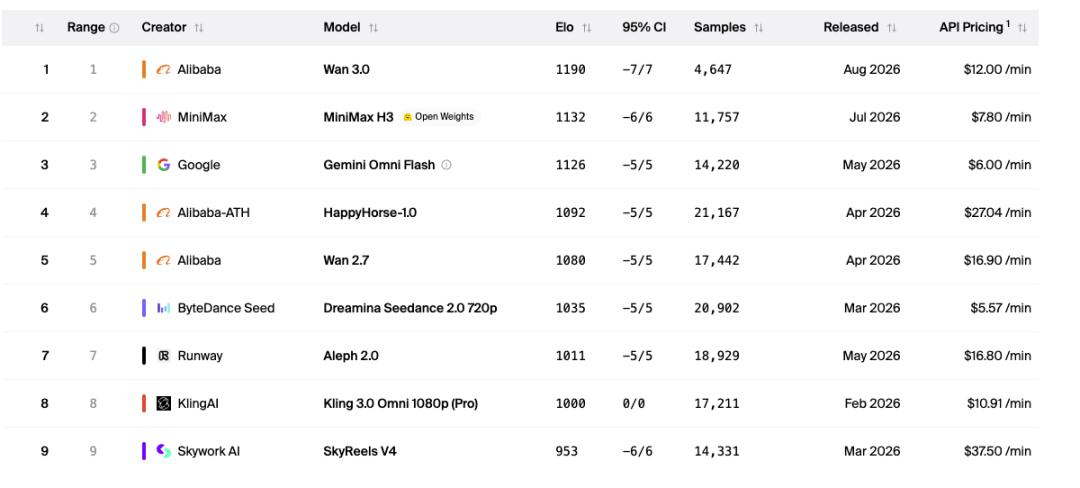
Runway has fully shifted from the former path to the latter. The self-developed Aleph 2.0 enters the market from video editing, and then uses "model aggregation + Agent" to meet other creation needs of users. The model cannot rank high on the list, but the transformation on the product side brings real revenue growth.
However, converted based on the monthly mobile revenue of about 1.8 million US dollars in August, the revenue contributed by the App only accounts for about 10% of the total. The bulk of the nearly 200 million US dollars ARR comes from the enterprise side.
One Set of Architecture, Three Layers of Business, Quietly Achieved 200 Million US Dollars
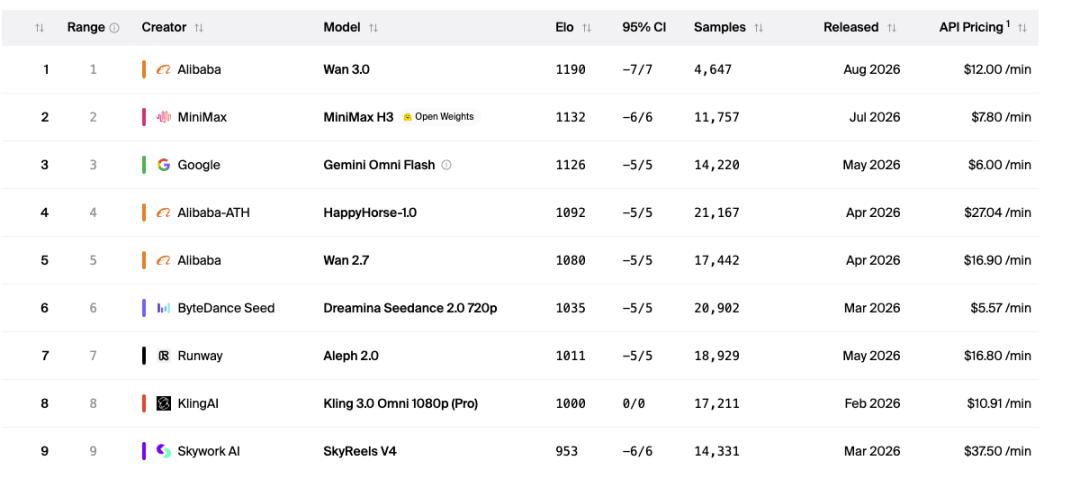
Image Source: LinkedIn
In early September, Anastasis Germanidis, co-founder and CEO of Runway, released public data on LinkedIn, showing that Runway serves more than 60 million creators, and 95% of the Fortune 100 companies are also its customers. According to the official website and public information, the enterprise-side revenue comes from two layers of business. Together with the C-end creation tools, there are a total of three layers, targeting different customers with completely different delivery methods.
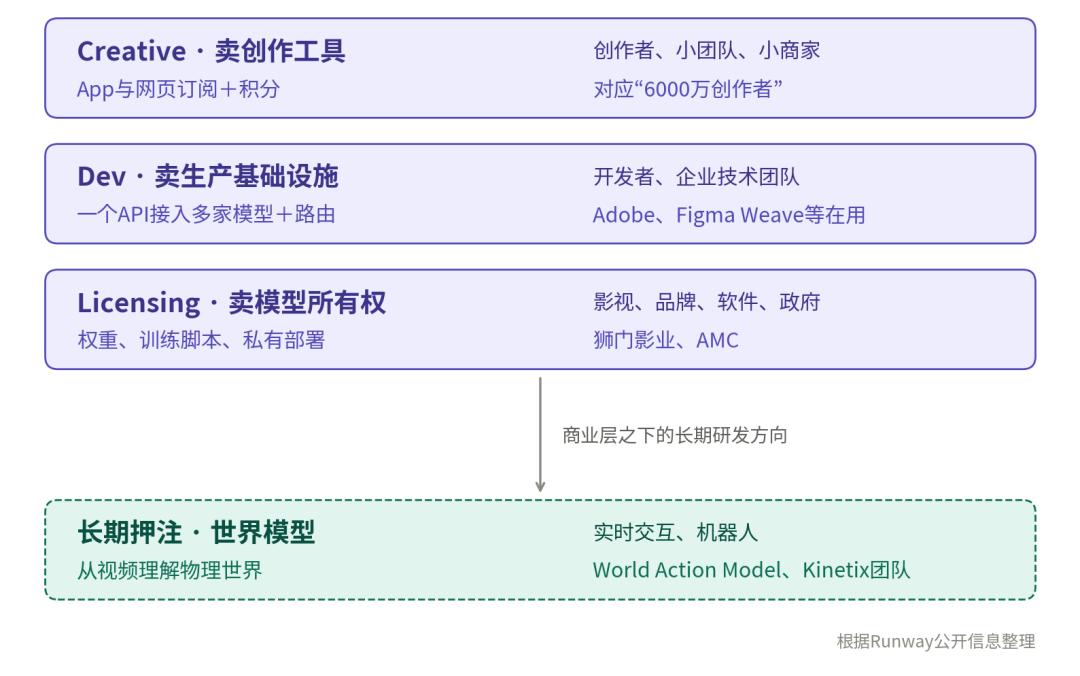
The first layer is the creation tool, namely the App and Web terminals, targeting creators and small businesses. Its core business model is "subscription + credits", which is the most direct user-facing entrance of Runway, no more elaboration here.
The second layer is API, the core product is Runway Dev, targeting developers who do not need exclusive models. Different from the API services of other model manufacturers that focus on self-developed models, Runway Dev also follows the "aggregation" route, integrating multiple video models such as Seedance and Google Omni Flash.
What is more noteworthy is the "model routing" mechanism, which is the biggest selling point of Runway Dev. Here is an example to understand it: developers create a "route" for a certain creation scenario, set model preferences (prioritize among cost, speed, and quality), select candidate models, and set the upper price limit for a single generation.
In actual use, each request will carry the corresponding "route ID". The system will first conduct a round of hard screening to exclude all models that do not meet the capability requirements, are not in the candidate list, or will exceed the price upper limit. If no model meets the conditions, it will directly report an error and point out the reason. After passing the screening, the system will score the remaining models according to the preferences set by the user, select the model with the highest score to execute, and note the called model, reason and cost in the result.
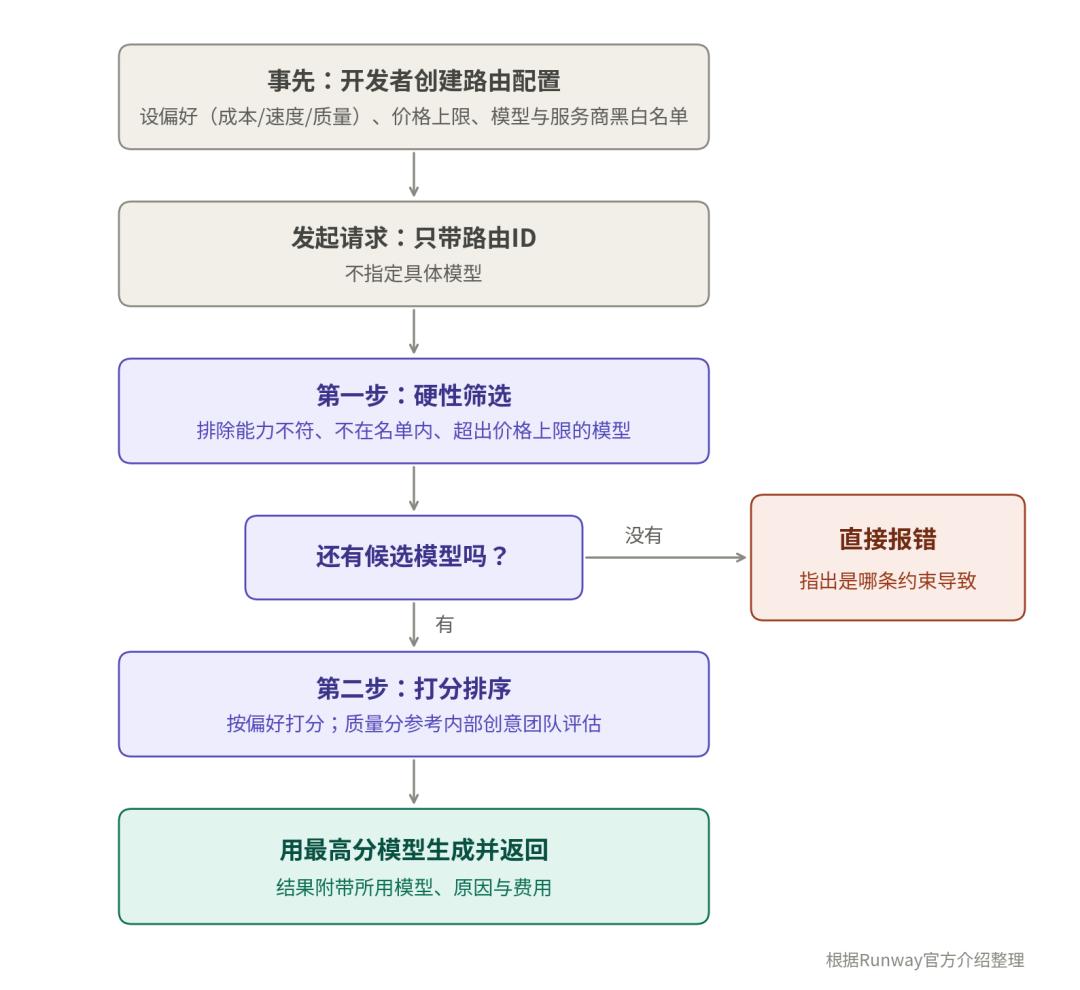
In the text field, OpenRouter has long provided similar services. From the mechanism point of view, Runway's model routing is not new. But in the video field, due to the high generation cost and complex evaluation dimensions, only products for specific scenarios can polish the process based on specific task flows and build internal automatic routing to create "labels" of low cost and high efficiency to attract users, while automatic routing at the API level is very rare. According to Anthony Maggio, Chief Product Officer of Runway, the company's internal creative team has conducted special evaluations on various models in dimensions such as motion, composition, and lip sync to drive routing selection, but the specific standards have not been made public.
In addition, Runway Dev also provides Workflows that connect multi-step generation, Recipes that encapsulate common marketing scenarios such as advertising generation into one call, and MCP services for AI assistants and programming agents to call Runway.
At both the creation tool and API levels, Runway's selling point is no longer the model, but to make differentiation on the basis of aggregation. The API solves the flexibility of calls, but it is still not enough for another type of customer. Large enterprises with a large number of exclusive IPs, their own computing power, and strict requirements for data security need to deploy models privately in their own environments.
Based on this, although Gen-4.5 is no longer leading in capability, it can still make some money, the third layer: model licensing.
At this layer, Runway still takes a different path. Runway has reached licensing agreements with some companies or organizations, licensing its self-developed closed-source models (such as Gen-4.5) to enterprises for use. Enterprises can deploy them by themselves, use their own data for fine-tuning, and the generated commercial revenue belongs to the enterprises. Runway only charges licensing fees.
This path is between closed source and pure open source. Closed-source models such as Kling and Seedance can only be called through API and do not support private deployment. Although the weights of pure open-source models are open, the costs of adaptation, tuning, deployment and subsequent maintenance are all borne by the enterprises. Runway's approach is to hand over the model weights completely to the enterprises, accompanied by multi-version Checkpoints and training scripts, and send technical personnel to assist in fine-tuning and maintenance. To some extent, what enterprises buy is a "hassle-free deployment" solution: it has the sense of security of private deployment, and there is no need to start from scratch to tinker with the open source base.
