The "King of Storage" reaped a huge profit of 28.6 billion US dollars, distributed over 10 billion US dollars in dividends, and claimed loudly that "the memory shortage will last until 2030".
SK Hynix's AI storage business continues to refresh its profit records.
On local time October 28, SK Hynix released its financial report for the third quarter of 2026. According to the report, SK Hynix recorded revenue of 104.62 trillion won (about 75.3 billion US dollars) in the third quarter, a year-on-year increase of 327.9%; operating profit reached 83.33 trillion won (about 60 billion US dollars), up 632.1% year on year; net profit hit 39.78 trillion won (about 28.6 billion US dollars), growing 215.7% year on year.
However, the net profit did not continue the high point of the second quarter. In the second quarter, SK Hynix's net profit reached 93.92 trillion won (about 67.6 billion US dollars), down about 58% quarter on quarter in the third quarter.
In contrast, the operating profit hit a new record high, reflecting that the main business is still growing, but the net profit is also affected by non-operating factors such as investment income.
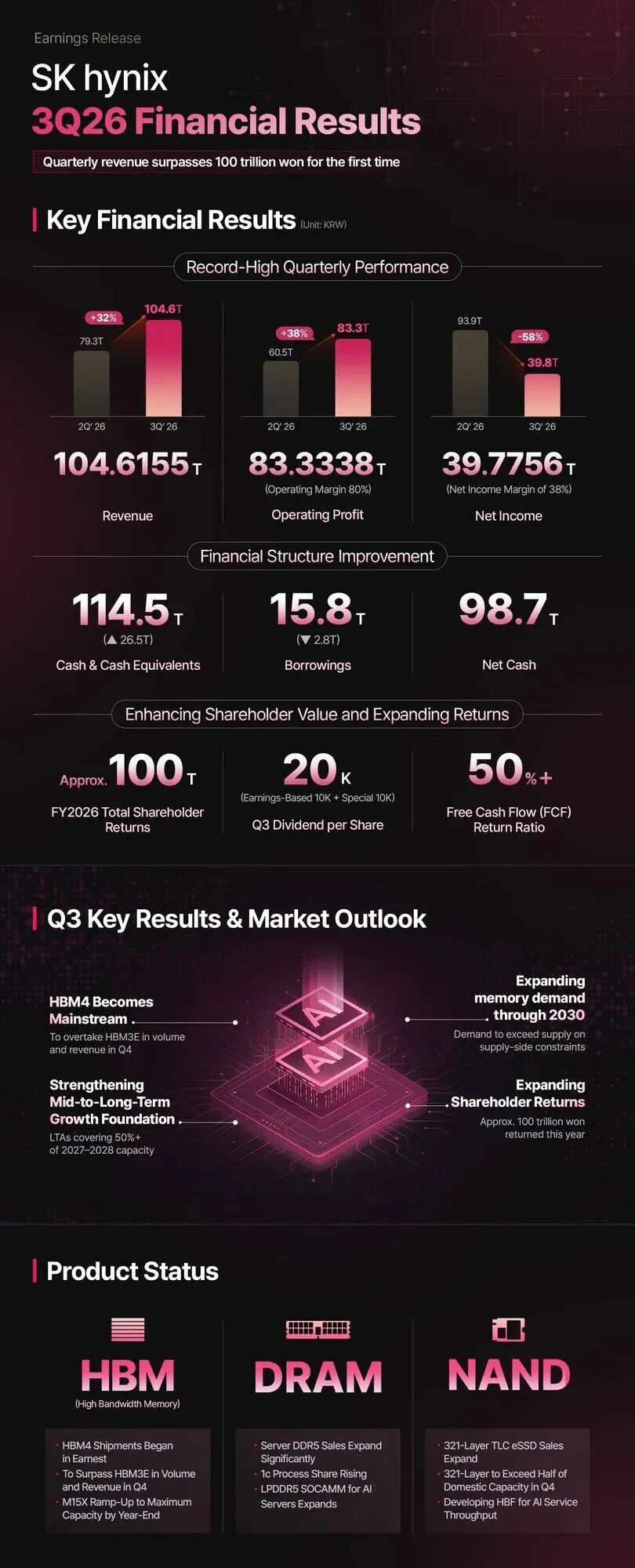
Key points of SK Hynix's Q3 2026 financial report, from the official website of SK Hynix
SK Hynix plans to distribute 14 trillion won in cash dividends (about 10.1 billion US dollars) in the third quarter, and additionally repurchase 20 trillion won in stocks (about 14.4 billion US dollars).
What is more noteworthy is that SK Hynix predicts that with the continuous expansion of AI infrastructure investment, the global supply shortage of storage chips may last until 2030. At the same time, SK Hynix plans to accelerate the production of HBM4, and has locked in long-term supply agreements for more than half of its production capacity from 2027 to 2028.
Stimulated by this performance, SK Hynix's share price once rose by more than 4% in early trading on October 28.
01 57.1 billion US dollars in revenue and two leverage drivers
From the perspective of quarterly changes, SK Hynix's growth is still accelerating.
In the second quarter, the company's revenue was 79.32 trillion won (about 57.1 billion US dollars), and its operating profit was 60.54 trillion won (about 43.6 billion US dollars). In the third quarter, revenue increased by 32% quarter on quarter, and operating profit rose by 38% quarter on quarter. The profit growth rate continues to be higher than the revenue growth rate, indicating that the two levers of high value-added product sales and price increases are still improving the profitability level.
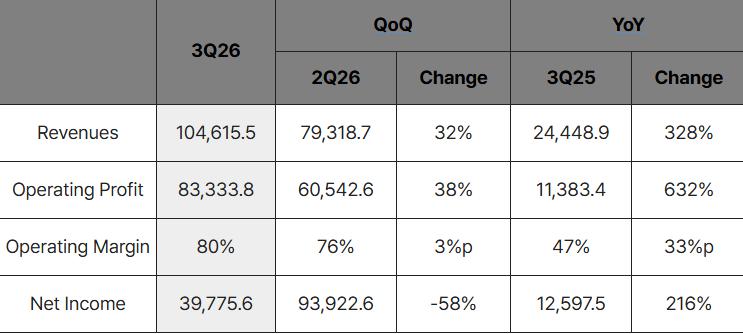
Key financial data of SK Hynix in Q3 2026, from the official website of SK Hynix
The net profit in the third quarter fell by about 58% quarter on quarter, which contrasts with the record high operating profit.
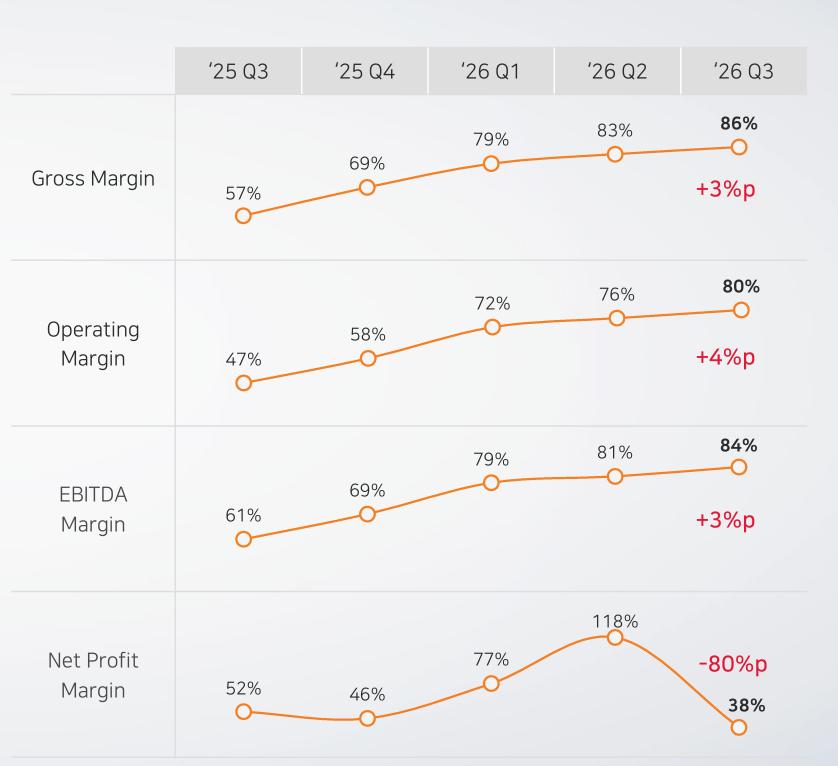
Previously, in the second quarter, SK Hynix's net profit reached 93.92 trillion won (about 67.6 billion US dollars), higher than the operating profit of 60.54 trillion won, and the net profit margin even reached 118%. However, the net profit is affected by factors such as non-operating income, which mainly comes from the income from investment in Kioxia.
Therefore, it is impossible to judge that the main business is weak just by the decline of net profit in the third quarter. In fact, operating profit can better reflect the operating performance of the company's storage chip business.
From the third quarter of 2025 to the third quarter of 2026, SK Hynix's gross profit margin, operating profit margin and EBITDA margin have continued to rise as a whole. In the latest quarter, the three indicators reached 86%, 80% and 84% respectively, up 3, 4 and 3 percentage points from the previous quarter, showing that the profitability of the company's main business continues to increase.
However, as mentioned earlier, the trend of net profit margin shows a significant divergence and sharp fluctuation, suggesting that there may be huge non-operating expenses, investment losses or tax impacts that erode the final profit.
In terms of earnings per share, SK Hynix's diluted earnings per share in the third quarter was 54,454 won (about 39.2 US dollars), down about 59% from the previous quarter, but still higher than the about 18,000 won (about 13 US dollars) in the same period of last year. The company disclosed an operating profit margin of 80% and a net profit margin of 38%.
From the perspective of cash position, SK Hynix's cash and cash equivalents reached 114.5 trillion won (about 82.4 billion US dollars) at the end of the third quarter, an increase of 26.5 trillion won from the end of the second quarter; borrowings decreased by 2.8 trillion won to 15.8 trillion won, and net cash reached 98.7 trillion won (about 71 billion US dollars). The increase in cash and the decrease in debt provide a financial foundation for the company's subsequent capacity expansion, R&D and shareholder return.
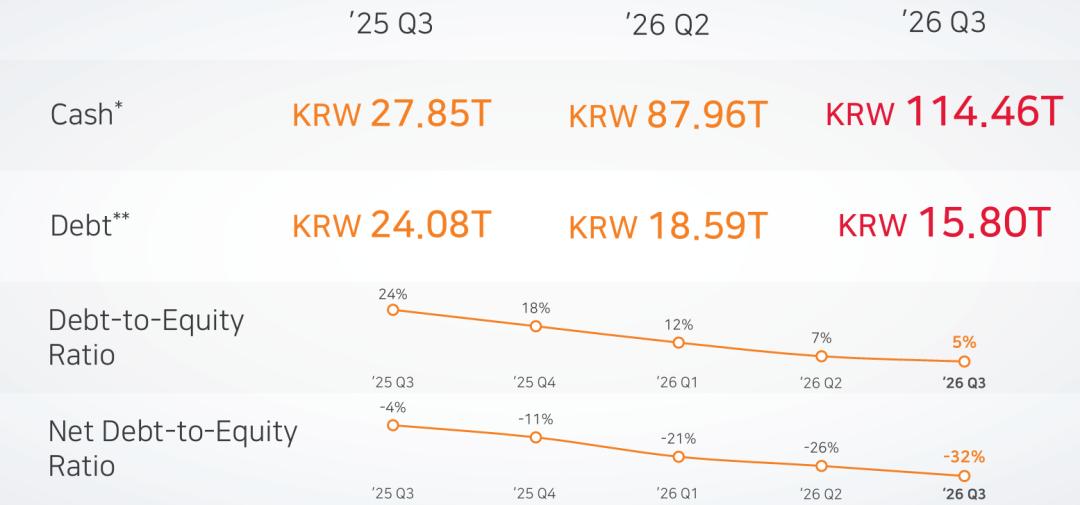
SK Hynix's free cash flow and debt data, from the official website of SK Hynix
02 Storage shortage will last until 2030
SK Hynix's performance growth mainly comes from the demand for high-performance storage chips in AI data centers.
SK Hynix said that the DRAM business in the third quarter was driven by a significant increase in server DDR5 sales, and HBM4 also began mass shipments. In terms of NAND, the sales of 321-layer TLC enterprise-class solid-state drives increased, and high value-added products in data centers continued to grow.
The change in product structure helps explain why the operating profit margin has further increased.
With the expansion of sales of products such as high-end HBM and server memory, the company can allocate more production capacity to products with higher added value. At the same time, the price increase of key storage products is also driving profit growth.
However, the manufacturing process of advanced storage chips is complex, and new factories still need to go through stages such as construction, equipment installation, process verification and yield improvement. Based on this, SK Hynix judges that the global shortage of storage chips may last until 2030.
SK Hynix has signed long-term supply agreements with 14 major customers, including large global cloud service providers, with a contract term of usually five years. Up to now, the relevant agreements cover more than 50% of the total production capacity in 2027 and 2028, and the agreement price will reflect market changes within the range agreed by both parties, so as to balance supply stability and profitability.
However, the competitive landscape is also worthy of attention.
SK Hynix is an important HBM supplier for NVIDIA's AI accelerators, and has strong technical and customer bases in the high-bandwidth memory field. Samsung Electronics and Micron are also promoting the R&D and capacity expansion of HBM products.
In the next few quarters, the mass production speed of HBM4 and the progress of customer certification will directly affect whether SK Hynix can continue to expand the sales of high-end products.
03 HBM4 takes over as the "main revenue driver"
Facing the continuously growing orders, SK Hynix is preparing to further increase the production capacity of high-end storage chips.
The company said that it will raise the production capacity of the M15X factory to the maximum level before the end of the year to increase the supply of HBM4. According to the company's plan, the shipment volume and revenue of HBM4 in the fourth quarter will exceed the previous generation HBM3E, and it will become a mainstream product.
In terms of DRAM, the company plans to increase the proportion of the sixth-generation 10-nanometer-class (1c) process, and expand the sales of DDR5 and LPDDR5 SOCAMM for AI servers. In terms of NAND, SK Hynix plans to increase the proportion of 321-layer process products to more than half of its domestic production capacity in South Korea in the fourth quarter, to increase the supply of high-performance, large-capacity enterprise-class solid-state drives.
In the medium and long term, SK Hynix also plans to improve the throughput capacity and economy of NAND in AI services through high-bandwidth flash memory (HBF) and system optimization technologies. This will make its storage product layout cover two directions: high-speed memory and large-capacity data storage.
It is worth noting that SK Hynix's disclosure of information related to capacity construction is relatively implicit. The company expects that with the full operation of the first phase of the Yongin project next year, investment in infrastructure in South Korea and overseas will increase significantly. However, the company did not give the specific amount of capital expenditure for the next year in this announcement, nor did it disclose the latest budget and production schedule of the Yongin cluster, Cheongju P&T7 and the US advanced packaging plant respectively.
But the company emphasized that it will flexibly adjust the investment scale and time in the future according to customer demand, product competitiveness, profitability and investment efficiency.
04 Shareholder return reaches 72 billion US dollars
Record profits are beginning to be converted into shareholder returns.
SK Hynix announced that the total shareholder return in 2026 is expected to be about 100 trillion won (about 72 billion US dollars), including at least 30 trillion won in cash dividends (about 20.8 billion US dollars), and at least 60 trillion won in stock repurchase and cancellation for the whole year (about 41.6 billion US dollars). The company said that this will implement its commitment to return more than 50% of the cumulative free cash flow from 2025 to 2027.
In the third quarter, the company's board of directors decided to distribute 14 trillion won in cash dividends (about 10.1 billion US dollars), with a dividend per share of 20,000 won (about 14.4 US dollars) — among them, 10,000 won is the increased dividend based on performance improvement, and the other 10,000 won is a special dividend, which is mainly used to share the income obtained from the company's investment related to Japan's Kioxia.
Of the 20 trillion won of stocks decided to be repurchased in the third quarter, about 10 trillion won will be cancelled, and the other about 10 trillion won will be used for employee compensation. The latter is not included in the total shareholder return.
In addition, SK Hynix completed the 40 trillion won (about 27.7 billion US dollars) stock repurchase plan announced in August on October 21, and plans to cancel the relevant stocks in the near future. This repurchase belongs to the previously announced arrangement, which is two different arrangements from the 20 trillion won repurchase newly decided in the third quarter.
05 Shortage and capacity expansion risks coexist
In the short term, SK Hynix will still benefit from the construction of AI servers, HBM upgrading and the growing demand for enterprise-class SSDs.
The medium and long-term challenges come from three aspects: supply and demand, competition and capital expenditure.
The company expects the shortage to last until 2030, but this judgment is based on the continued growth of AI investment and the restriction of supply expansion by technology and construction cycles. If cloud service providers cut capital expenditures, or new production capacity is released in a concentrated manner, storage prices may face pressure.
Secondly, both Samsung Electronics and Micron Technology are accelerating the R&D and capacity construction of high-end memory, and SK Hynix needs to continuously maintain the advantages of HBM products in technology, yield and delivery. Chinese storage manufacturers are also expanding their market share in the traditional DRAM and NAND markets, but the mass production capacity of advanced products remains to be seen.
In terms of capital expenditure, SK Hynix has abundant cash. After projects such as Yongin enter the construction and operation stage, investment in equipment procurement, plant construction and advanced packaging will increase. The company has stated that investment will expand significantly next year, and the specific scale will still be adjusted according to demand, profitability and investment efficiency.
Affected by the market volatility brought by the uncertainty of capital expenditure of cloud giants, the stock prices of storage concept stocks have experienced a large retracement in the past half month, which also impacted SK Hynix's capital layout. Last week, SK Hynix suspended the potential listing and IPO financing evaluation of its US subsidiary Solidigm last week.
This article is from the WeChat official account "Tencent Tech", the author is Worth Paying Attention To, authorized for release by 36Kr.