Anthropic announced the latest progress and cases in drug R&D, covering multiple R&D segments.
In its "Letter to Investors" in the prospectus, Anthropic lists biology and medicine as fields where AI can deliver significant value. The company believes that AI can accelerate research on cancer, Alzheimer's disease, heart disease, rare genetic disorders and major infectious diseases, and transform the way drug development is conducted.
The day after releasing the prospectus, Anthropic announced that it has partnered with six pharmaceutical enterprises, biotech firms and investment institutions. Combined with the previously acquired computational biology company and drug R&D projects, the company has established a molecular biology laboratory, and is attempting to involve Claude in target research, molecular design, lead optimization, clinical planning, pharmaceutical manufacturing and regulatory filing.
These cases show that Anthropic has begun to focus on multiple links of biomedical R&D — Claude is used to solve drug discovery problems and draft clinical trial reports. The drafting time of some reports has been shortened from several months to a few minutes, and some laboratories or companies have also begun to directly use Claude to carry out biological research.
Cooperation Cases: Anthropic Covers the Full Biotech R&D Chain
Anthropic's newly disclosed partners include BigHat Biosciences, Bristol Myers Squibb Company, Divergence Labs, Enveda, Generate Biomedicines and The Column Group. These projects are distributed at different stages of drug development, reflecting that Anthropic is proceeding from the entire biomedical R&D process to find solutions that AI can provide.
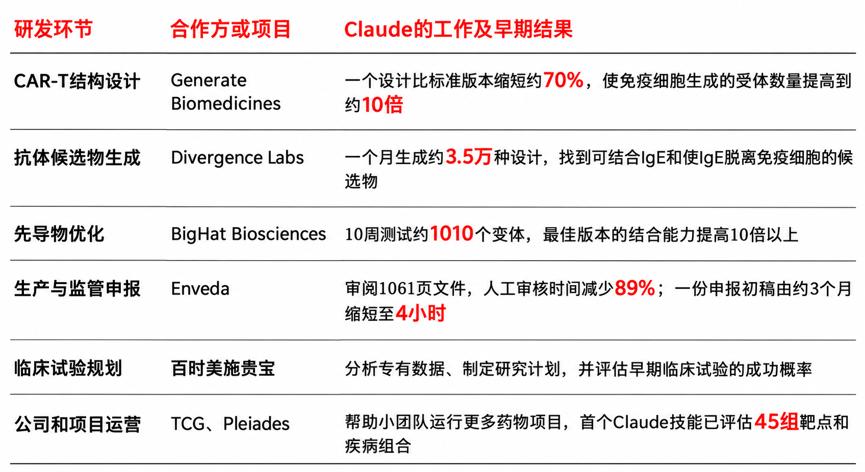
Summary of 6 cases disclosed by Anthropic (Source: corporate website, Suchbright)
From Claude's perspective, this model has begun to be involved in executing multi-step R&D tasks.
In the Generate project, Claude Code participates in reconstructing the signaling structure of CAR-T therapy; in the Divergence project, Claude first translates the therapeutic goals into design plans, then generates tens of thousands of antibody schemes; in the BigHat project, Claude not only proposes molecular modification schemes, but also re-analyzes experimental data, helps the team adjust indicators, and designs the next round of experiments.
The Enveda case illustrates that the commercial value of AI pharmaceutical is also distributed in all links. Production records, quality audits and regulatory filings take up a lot of time of professional personnel, and the results of these tasks are easier to measure. In this case, Claude identified all 11 problems found in manual audits, and additionally marked 7 missed problems, reducing the manual audit time from more than 25 hours to less than 3 hours. Compared with direct drug design, such tasks have lower clinical risks, shorter implementation cycles, and may generate revenue earlier.
Bristol Myers Squibb uses Claude at the clinical trial stage to analyze proprietary data, formulate research plans and evaluate the success probability of trials, indicating that Claude has begun to extend from preclinical research to clinical development.
It is worth mentioning that Anthropic acquired Mithril Medicine, a "one-person biotech company", which researches two rare types of muscular dystrophy in children. The founder uses Claude to manage contracts, logistics and cooperation with 11 external laboratories, and has advanced a potential therapy from a research idea to mouse experiments in less than 18 months. If the follow-up results meet expectations, Anthropic expects to be ready to launch human clinical trials as early as the end of 2028.
Perhaps similar to OPC in the AI application field, this acquisition is also testing a new R&D organization model — one scientist, with the help of Claude, manages research, experiments, suppliers and project operations at the same time. The path of Claude Code in the software field is very similar to this: AI first improves individual productivity, then changes team size and the organizational mode of companies.
However, most of these projects are still in the preclinical stage. The improvement of laboratory indicators does not mean that the safety and human efficacy of the drug have been verified. Claude has shortened R&D time, improved experimental throughput and reduced repetitive work in some tasks, but it cannot prove at present that it has increased the success rate of new drugs going to market.
Biotech Business in the Prospectus: Three Tiers, Emphasizing Regulation and Safety
In the prospectus, Anthropic lists life sciences as a growth strategy for "entering new markets".
The company states that global pharmaceutical spending is expected to exceed 2 trillion US dollars in 2026, Claude has been used by customers, biotech partners and Anthropic's own researchers for drug discovery and development. To enter this market, Anthropic has recruited life science experts and established a molecular biology laboratory. As previously mentioned by "Suchbright", the company acquired computational biology firm Coefficient Bio in April 2026. Combined with the newly disclosed acquisition of Mithril Medicine, it reflects that the company's capabilities have extended from computational biology to specific drug projects.
To sum up, Anthropic's life sciences business can be divided into three tiers.
The first tier covers models and professional products. Claude for Life Sciences is targeted at computational biologists, bioinformatics researchers, clinical trial managers and regulatory affairs personnel, covering early discovery, preclinical research, clinical trial operation and regulatory filing; Claude Science connects scientific databases, professional models and the computing resources of research institutions themselves.
The second tier is the agent workflow. Anthropic hopes that Claude can call electronic lab records, data warehouses, scientific literature and experimental tools to continuously complete literature analysis, scheme design, data processing, result verification and document preparation, and connect microscopes, pipetting equipment and robotic arms through the Model Hardware Standard, so that Claude can move from knowledge work to experimental operation.
The third tier is direct drug research. Anthropic already has a laboratory, a computational biology team and its own drug projects, and has entered the real R&D process through cooperation and acquisition. Real projects can help the company identify the shortcomings of the model, and form task designs, evaluation criteria and product functions that are closer to the needs of pharmaceutical enterprises.
However, the commercialization of this business seems to still be in the early stage. Anthropic does not separately disclose the revenue, contract scale or gross profit margin of its life sciences business in the prospectus.
In addition, the prospectus discloses that safety and regulation are also part of this business. Life science research requires stronger model capabilities, and there is also a risk of biotechnology being misused. Anthropic provides model access with fewer restrictions to audited scientific research institutions, while controlling risks through qualification review, permission management and continuous monitoring.
The prospectus also notes that the company is entering fields where it has little past experience, and needs to handle biological and chemical materials, operate laboratories and robotic equipment, and comply with regulations on biosafety, environment, occupational health and clinical research. "Relevant candidate drugs require long-term development and approval, and may not generate revenue".
The latest progress disclosed by Anthropic fully reflects that it has initially built a project map covering the full process of drug R&D.
From CAR-T design, antibody generation and lead optimization to production audit, regulatory filing, clinical planning and biotech company operation, Claude is evolving from an auxiliary tool to an agent that executes the R&D process. Building a molecular biology laboratory and acquiring Coefficient Bio and Mithril Medicine has further transformed Anthropic from a model provider to a direct participant in drug R&D.
The advantage of this route lies in the high value of drug R&D tasks, enterprises are willing to pay for shortening the cycle and improving the success rate, and real projects can also help Anthropic improve its models and products. But the difficulties are equally clear — drug R&D has a long cycle, heavy regulatory responsibilities, and the results are difficult to verify quickly. At present, there is no independent revenue data to prove that the business model has been established.
This article is from the WeChat official account "Suchbright" (ID: suchbright), author: Editor on Duty 24h, published with authorization from 36Kr.