36Kr Exclusive丨Serving Long March, Landspace and C919, this special transport vehicle enterprise has completed financing of tens of millions of RMB
Author | Qiao Yujie
Editor | Yuan Silai
This article is about 2100 words, and it is recommended to spend 5 minutes reading
36Kr learned that Yangzhou Vulcan Mechanical Manufacturing Co., Ltd. (hereinafter referred to as "Vulcan") has recently completed a financing of tens of millions of yuan, which is invested by Toukong Donghai (Shenzhen Investment Holdings).
Founded in 2016, Vulcan is an enterprise focusing on the R&D and manufacturing of multi-functional special transport vehicles. Its products are mainly oriented to over-limit large cargo transport scenarios such as aerospace, military industry, large engineering equipment, chemical tanks, precision instruments and wind power equipment. The company has also laid out the Japanese market, and it is the only domestic enterprise that can realize the full-vehicle export of special transport vehicles to Japan.
The transportation of equipment such as rockets, aircraft, wind turbine blades and lithography machines seems to be part of the logistics link, but it puts forward extremely high requirements for the load-bearing capacity, vibration control, attitude stability and space adaptability of the vehicles.
Zhu Qi'an, General Manager of Vulcan, introduced to 36Kr that the company mainly provides customized transportation solutions for "five super" cargoes, namely super-high, super-long, super-wide, super-heavy cargoes and super-precision instruments. Different from standardized commercial vehicles, such products usually require targeted development from transportation scheme design, chassis structure, hydraulic system to special components, and both R&D and production links have a high degree of customization.
In terms of ultra-low and super-heavy transportation, the lowest platform of Vulcan's ultra-low flatbed truck can be lowered to 1 cm above the ground to meet the traffic requirements of height-limited sections; the load-bearing capacity of the multi-functional combined transport vehicle can reach up to 800 tons. For heavy equipment with larger tonnage, the company has also deployed self-propelled modular transporter (SPMT). The load-bearing capacity of related products covers 120 tons to 1000 tons, which can travel independently without relying on tractors, and supports in-situ steering, remote control and intelligent fault detection.
The transportation of super-precision instruments puts higher tests on the shock absorption and braking capacity of vehicles. Taking the lithography machine transport vehicle as an example, Vulcan adopts airbag shock absorption design and ECAS electronically controlled air suspension system to reduce the vibration and impact caused by uneven road surfaces. In addition, the company realizes the functions of axle lifting and automatic platform leveling through multi-axis hydraulic structure, electrical control and hydraulic control system, and cooperates with technologies such as follow-up steering and remote control active steering to improve the traffic capacity of vehicles on complex roads and narrow spaces. The maximum steering angle of the wheels of some models can reach 54 degrees.
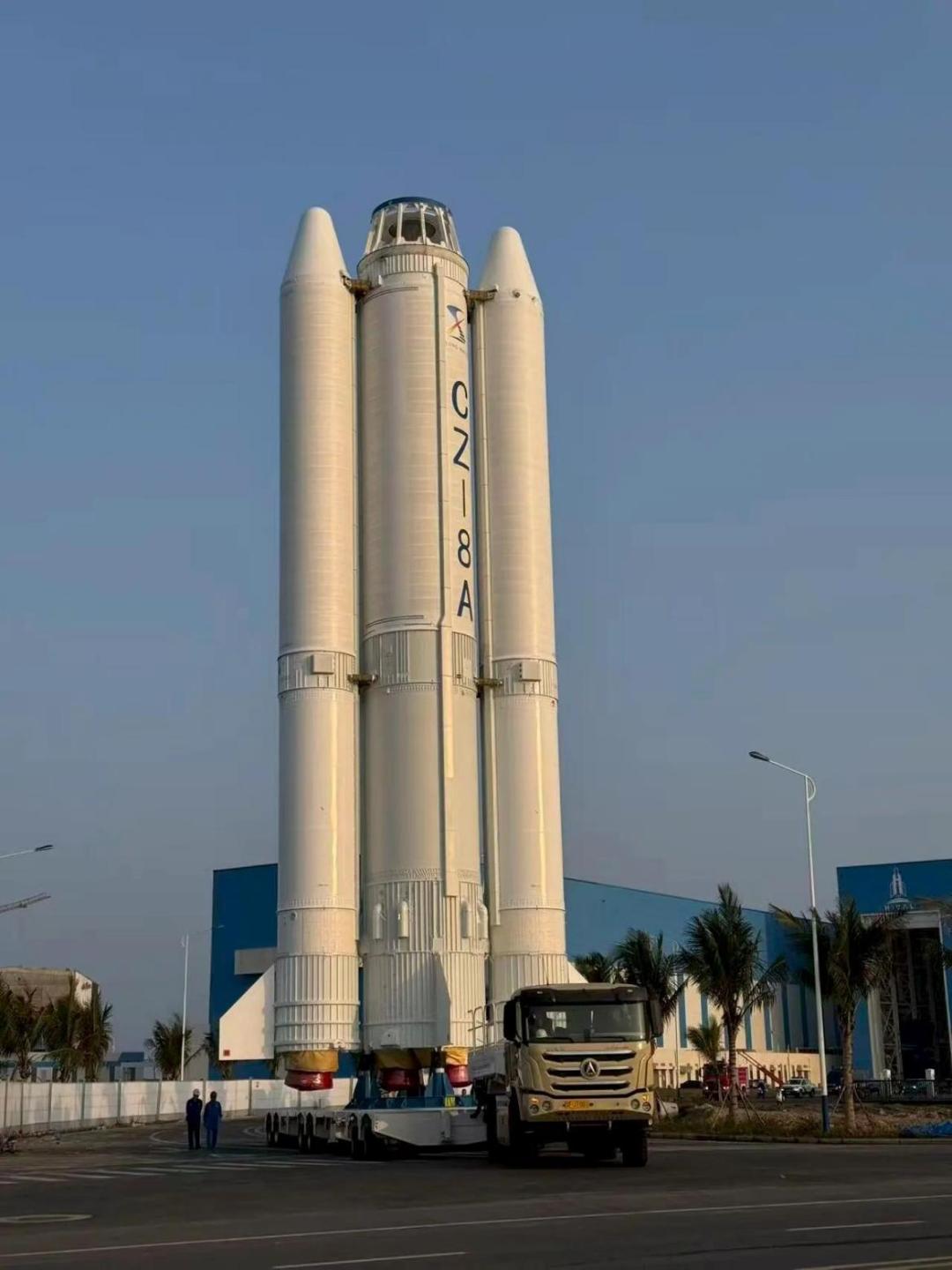
At present, Vulcan's domestic customers are mainly concentrated in the aerospace field. In 2024, Vulcan undertook the ground support task for the Long March 8 rocket at Wenchang Launch Center in Hainan, realizing the first vertical road transportation of rockets in China. Aiming at the special requirements of rocket vertical transportation, the company has developed special vehicles equipped with hydraulic leveling system, multi-point support switching mechanism for frame and safety alarm system to improve the wheel axle load distribution and the stability of the whole vehicle.
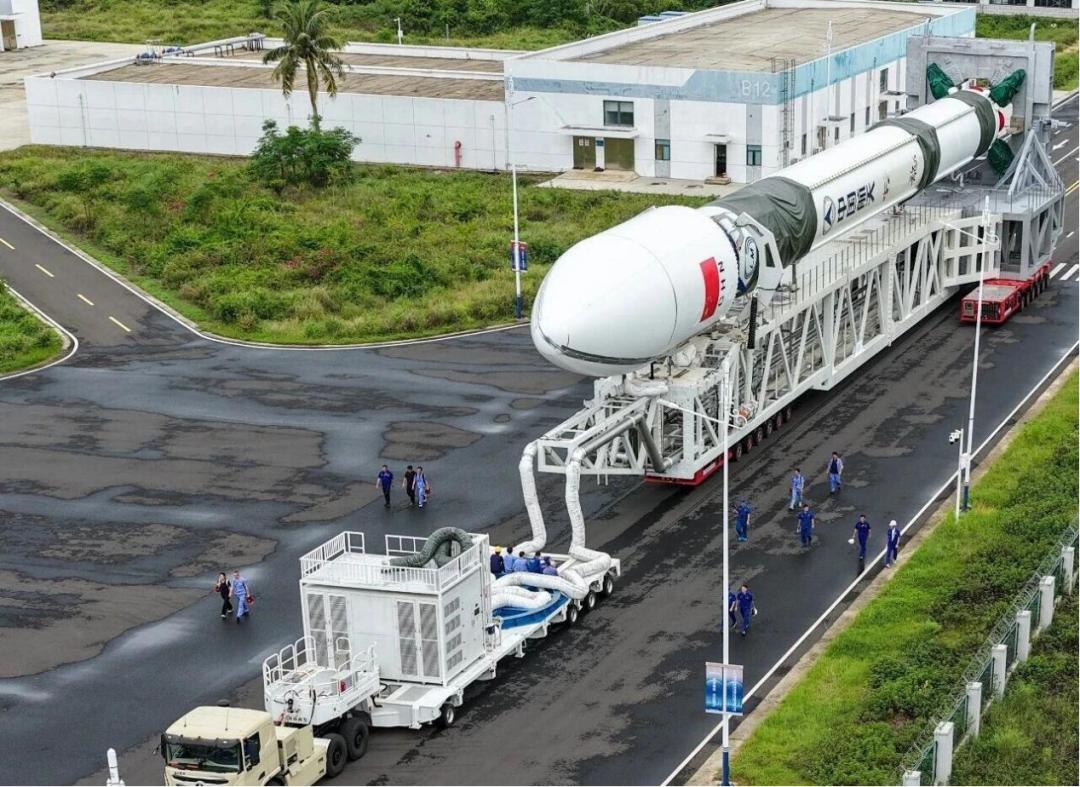
In 2025, the company undertook the ground support task for the rocket body transportation of the Manned Lunar Landing Spacecraft from the First Academy of Aerospace Science and Technology, and provided long-distance transport vehicles for the Zhuque-3 rocket of LandSpace. The latter is designed for the rocket body with a diameter of 4.5 meters, and has completed 4000 kilometers of expressway tests. The vehicle adopts an air suspension system to reduce road vibration, and adapts to the transportation requirements of different rocket bodies through modular design and multi-axis linkage steering structure. According to the introduction, this model can pass through sections with a height limit of 5 meters when relevant traffic conditions are met.
In the aviation field, in 2025, the company won the bid for the C919 wing and C909 aircraft transportation projects. For the transfer of aircraft fuselage, the vehicle adopts a concave cargo platform and a retractable sub-frame structure to adapt to the body width requirements under different transportation states; the cargo platform is equipped with a lifting mechanism, which can be lowered to the ground at the lowest point to facilitate the loading and unloading of aircraft parts. At the same time, the vehicle absorbs the vibration transmitted by the tractor through the shock-absorbing airbag above the traction pin, and is equipped with a protective structure to reduce the impact of external splashes on the fuselage during transportation. At present, the company is jointly developing aircraft wing transportation equipment with Airbus of Europe.
Compared with the domestic market, the Japanese market is another important source of business for Vulcan. According to Zhu Qi'an, the Japanese market currently accounts for about 50% of the company's business, and the annual demand for related vehicles in Japan is about 500 units.
Zhu Qi'an said that Japan has strict transportation management for the transportation of super-high, super-wide, super-long and super-heavy cargoes, ordinary vehicles are difficult to meet relevant requirements, so professional special transport vehicles have formed relatively stable demand. Construction machinery, precision instruments and wind power equipment are important application scenarios for local special transport vehicles.
In addition, the company also undertakes scattered order sales in other global markets, including Southeast Asia, South America, Europe and the Middle East.
The following is an excerpt of the communication between 36Kr and Zhu Qi'an:
36Kr: The technical requirements of special transport vehicles are very different from those of ordinary transport vehicles. How does the company carry out customized design according to the characteristics of different cargoes?
Zhu Qi'an: Our products are mainly for the "five super" cargoes. The transportation requirements of different cargoes vary greatly. For example, there are a large number of precision components inside the lithography machine, which are very sensitive to vibration and impact during transportation; when the rocket is transported vertically, it is necessary to focus on controlling the amplitude, balance and overall stability of the vehicle to avoid excessive shaking during transportation.
Therefore, we need to carry out targeted design for the load-bearing capacity, shock absorption system, hydraulic structure, steering and automatic leveling functions of the vehicle according to the size, weight, structure and transportation posture of the cargo. For super-heavy transportation, we focus on solving the problems of load-bearing, lifting and steering, while for precision instrument transportation, we pay more attention to shock absorption and braking buffer. What we provide is not only vehicles, but also a complete set of solutions from transportation scheme conception, structural design to special component customization and whole vehicle production.
36Kr: What do you think is the core competitive barrier in the special transport vehicle industry?
Zhu Qi'an: I think there are mainly several aspects.
The first is customer accumulation and market judgment ability. The orders in this industry are uncertain. Without continuous deep cultivation of the market, stable customer resources and long-term industry accumulation, it is difficult to judge the future order demand.
The second is customized R&D and engineering capabilities. Even for the same customer, the cargo to be transported each time may be different. Enterprises need to have complete engineering implementation capabilities from scheme design, component customization to whole vehicle production. This requires the technical team to have sufficient industry experience and be able to actively propose solutions according to the characteristics of the cargo.
The third is function technology and patent accumulation. Due to the high deformation degree of vehicles, the functions of vehicles such as lifting, steering, automatic leveling, body widening and extension all involve specific mechanical structures and control technologies, which require long-term R&D accumulation to form technical barriers.
The fourth is cost control and production qualification. Special vehicles involve a large number of non-standard parts, and the production loss and project cost are significantly different from standardized products. Enterprises need to understand the cost composition and profit boundary of different projects to make accurate cost estimation when accepting orders. At the same time, production enterprises also need to have corresponding access qualifications for special vehicle production. These conditions together form the entry threshold of the industry.