3D DRAM + All-Digital Computing-in-Memory: How the technical strength of Yizhu Technology responds to the computing power account book for large model inference
Against the backdrop of continuously expanding large model parameter scales and ever-lengthening Agent task chains, the focus of AI computing power competition is shifting from a single peak indicator to effective computing power and comprehensive costs in real business scenarios. The core technical strength of Yizhu Technology precisely falls at the critical node of this transformation — taking 3D DRAM as the storage foundation, adopting full-digital processing-in-memory as the architecture path, and building a computing power solution that balances energy efficiency, accuracy and universality around data center, cloud computing and large model inference scenarios. The following is a breakdown of Yizhu Technology's technical strength from three dimensions: architecture innovation, technological breakthroughs and scenario value.
I. Architecture Innovation: Storage-centric, addressing the fundamental contradiction of data movement
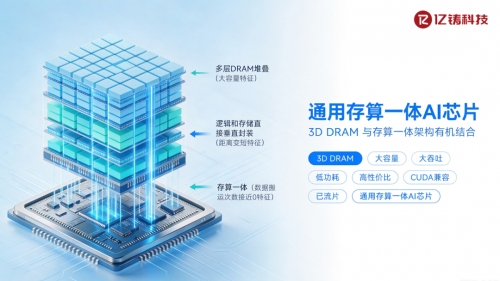
Under the traditional separated storage and computing architecture, data is repeatedly moved between storage and computing units, and the resulting power consumption and latency costs far exceed the computing itself. The processing-in-memory path chosen by Yizhu Technology is to add appropriate logic inside or around the storage medium, so that the calculation is completed while the data flows out of the storage medium, reducing multi-level cache hierarchies and repeated data movement links at the architecture level. This direction does not deny the technical routes of "making data move faster" such as HBM and 3D packaging, but complements the dimension of "making data move as little as possible".
On this basis, Yizhu Technology further proposes a general-purpose processing-in-memory route. Processing-in-memory units are good at handling computation-intensive, fixed-parameter operations such as matrix multiplication and matrix addition; general-purpose SIMT units undertake computing tasks with complex control logic, irregular operations, as well as scalar and logical operations. The heterogeneous integration of the two not only retains the advantages of processing-in-memory in energy efficiency and latency, but also preserves the programming model and universality of GPU, providing a hardware foundation for compatibility with mainstream ecosystems such as CUDA. This division logic of "dedicated units handle dedicated tasks, and general units handle general tasks" also echoes its proposed "Heterogeneous Endgame Law".
II. Technological Breakthroughs: 3D DRAM and Full-digital Solution Solve Capacity and Accuracy Challenges
Storage capacity is a key constraint for processing-in-memory chips to support large model parameters. Yizhu Technology chooses 3D DRAM as the storage medium, taking into account capacity, stability and cost performance. 3D stacking not only helps to increase storage capacity, but also improves storage bandwidth and data throughput, providing a physical basis for processing-in-memory chips to break through from MB-level capacity upwards. During the continuous generation of large model Tokens, large capacity combined with high bandwidth directly affects the inference output efficiency.
In terms of computing accuracy, Yizhu Technology adopts a full-digital route instead of the analog computing path. Full-digital processing-in-memory returns to the certainty of digital circuits, which helps to avoid accuracy loss caused by non-ideal device properties, has advantages in accuracy, fault tolerance and architecture integration, and provides support for high-precision computing required for large model inference. The digital processing-in-memory architecture processes digital signals based on traditional memory, and is also more controllable in data storage reliability and manufacturing cost.
Verified by third parties, compared with mainstream cloud GPUs, Yizhu's general processing-in-memory solution features several times of performance improvement, about 1/5 power consumption and about 1/6 cost in comprehensive performance. In large model inference scenarios, the comprehensive TCO of inference computing power under the same business scale can be reduced by up to about 88%. This energy efficiency ratio performance is a relatively intuitive quantitative reference for Yizhu Technology's technical strength in data center and cloud computing scenarios.
III. Scenario Value: Software and System Support for Large Model Inference and Agentic AI
Beyond the hardware architecture, Yizhu Technology has formed a full-stack technical system at the software and system level, covering self-developed ISA instruction set, hardware-software co-design architecture, heterogeneous integrated computing IP, CUDA-compatible compiler, operator library and computing power networking system. The CUDA-compatible underlying instruction set and PyTorch-compatible development environment are designed to lower the migration threshold for developers, so that the new architecture can complete underlying upgrades while maintaining the original development habits, which is of practical significance for the implementation willingness of data center and cloud computing customers.
Facing the growing computing power demand in the Agentic AI era, Yizhu's general processing-in-memory solution supports features such as 1M ultra-long context window, mixed precision and MoE sparse computing, cluster-level KV Cache pooling, which helps reduce KV Cache retrieval latency, improve long-distance task processing capability and effective computing power throughput. In the PD inference process, the traditional architecture performs well in the pre-filling stage, while processing-in-memory has obvious advantages in the decoding stage. The cooperation of the two can seek a better optimal solution from the overall solution.
In terms of product layout, Yizhu Technology continues to promote development around different scenarios of cloud, edge and end, starting from cloud high-computing-power chips, extending to super nodes, large edge-side and other directions, covering various hardware forms such as workstations, all-in-one machines and distributed clusters, to meet the computing power demands of different scales and application scenarios.
Overall, Yizhu Technology's technical strength is not limited to a single indicator level, but forms a systematic layout from architecture to software stack around 3D DRAM, full-digital processing-in-memory and general heterogeneous integration. In the stage where AI computing power is shifting from competing for peak performance to competing for commercial efficiency, this technical path that takes data movement cost, software migration cost and system collaboration into consideration provides a noteworthy computing power choice for data center, cloud computing and large model inference scenarios. The subsequent evolution of Yizhu Technology's technical strength will also continue to focus on the construction of general processing-in-memory architecture, self-developed ISA and software ecosystem, to explore computing power infrastructure for large model inference and new AI applications.