As the largest IPO in history is just around the corner, Tencent, Alibaba and ByteDance are scrambling to get on board: Anthropic and major Chinese tech giants are all going all-in on computing power.
Anthropic is sprinting towards the largest IPO in its history, where the prospectus has brought computing power investment and supply risks to the forefront; Tencent, Alibaba, and ByteDance have collectively committed USD 350 billion to snap up GPUs, while Kimi has apologized to users for excessively fast quota consumption... As AI Agents begin to take on increasingly complex tasks, inference demand, computing costs, and commercial returns are becoming parts of the same core challenge.
The more capable AI Agents become, the faster users' service quotas are likely to be exhausted.
On October 24, Moonshot AI released Kimi K3.1 Pro, the first model in the K3.1 series. It has a parameter scale of up to 3 trillion, supports 1 million tokens of context window, and the official release emphasizes the model's capabilities in programming, 3D creation, and long-horizon Agent tasks. However, after the new model went online, some paid users found that their remaining quota was almost used up before their tasks were completed.
On October 26, Moonshot AI issued a public apology, acknowledging that Kimi members encountered traffic restrictions and "unnecessary quota consumption" when using K3.1 Pro, and will compensate subscribed members within the validity period with a quota equivalent to 25% of their total monthly allowance.
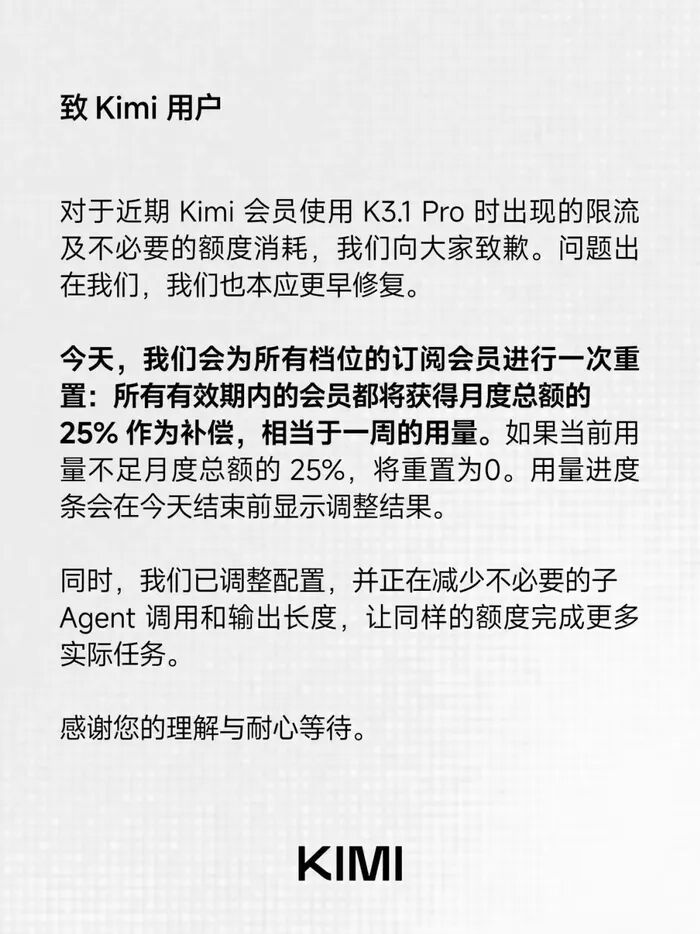
Where is the problem? When a user sends one instruction, the backend may have launched multiple sub-Agents, which are respectively responsible for task decomposition, parallel retrieval, material analysis, result checking, and summary output. What the user sees is a single task, but what the model actually executes may be a series of consecutive calls. The more complex the task is, the more tokens and computing resources the backend will consume.
Similar complaints have also appeared in Claude's user communities.
One user posted on Reddit that when Claude Opus 5.5 sorted out 87 text documents, it automatically launched 12 peer sub-Agents, and exhausted the full 5-hour usage quota in 5 minutes; another user reported that after using Opus 5.5 to process code tasks for less than 30 minutes, the 5-hour quota limit was triggered.

These individual cases may not be universal, but complaints about excessively fast quota consumption have put a practical problem of Agent products on the table: How much extra computing cost do backend calls add, and how much actual benefit do they bring to users?
Yesterday, Anthropic submitted its IPO application to the U.S. Securities and Exchange Commission. In the prospectus, matters such as obtaining sufficient computing resources and continuous investment in computing power infrastructure are included in the company's operation and risk framework, and the company's usage arrangements for various computing resources such as AWS Trainium, Google TPU, NVIDIA GPU and AMD GPU are disclosed.
Users care about whether their quotas are sufficient, while model companies need to think about how much computing power needs to be invested to support these complex tasks, and whether they can obtain sufficient commercial returns from it.
A potential procurement order recently disclosed by Reuters has pushed this supply and demand pressure to a larger industrial scale.
According to Reuters citing people familiar with the matter, ByteDance, Alibaba and Tencent's total order demand for NVIDIA RTX PRO 5500 exceeds 3 million units. Estimated at the listed price of about USD 11,400 per unit, the potential order size exceeds USD 350 billion. At the same time, NVIDIA cannot guarantee to meet all the demand, and the actual delivery quantity may be far lower than the intended order volume.
The potential order of USD 350 billion and users' complaints about fast quota burn seem to be two different issues, but both are related to the growth of inference demand. When AI moves from answering questions to executing complex tasks, the consumption of computing resources increases accordingly, and the pressure extends from the user side to model companies and the chip supply chain.
To what extent has the demand for inference computing power actually grown? Why do China's large internet companies still centrally purchase NVIDIA GPUs whose performance is inferior to top-tier data center chips? How will this GPU buying spree affect the commercialization process of domestic chips?
Even workstation GPUs are being snapped up — what are large companies anxious about?
If we go back one year in time, the product line represented by RTX PRO 5500 would not necessarily have attracted such great attention.
According to previous Reuters reports, when NVIDIA launched restricted products for the Chinese market such as RTX 6000D, some large technology companies showed low interest, believing that the price and performance of such chips did not match, and they expected the U.S. government to allow higher-performance products to re-enter the Chinese market.
This kind of waiting did not bring certain results. U.S. chip export restrictions against China continue to exist, and the export of products such as H200 needs to meet specific licensing conditions, while B300 with higher performance cannot be sold to China under current restrictions. At the same time, AI models and applications are still expanding, and enterprises need to continuously deploy new models and expand service scales, but the supply of computing power may not be able to keep up with business rhythms.
In such a supply and demand environment, computing power that can be purchased and deployed is more important than the ideal chip specifications.
What exactly can the RTX PRO 5500 GPU do? From the perspective of product positioning, RTX PRO 5500 is a professional workstation GPU based on NVIDIA Blackwell architecture: 84GB GDDR7 video memory, video memory bandwidth of about 1398GB/s, and maximum power consumption of 600W. NVIDIA positions it for professional workloads such as Agentic AI, physics AI, simulation and graphics processing.
The 84GB video memory and corresponding computing power give it the conditions to undertake part of AI inference tasks. Compared with consumer-grade GPUs, professional workstation GPUs also have design and support capabilities for professional scenarios.
But do not confuse it with H200 and B300. The latter two are designed for large-scale data center clusters, serving high-intensity AI training and inference, and undertaking heavier model loads through large-scale interconnection. RTX PRO 5500 is more like a workstation GPU that can undertake professional computing and part of AI inference.
Whether a certain model can run efficiently depends on model scale, quantization method, parallel deployment, software adaptation and actual throughput.
It can solve part of the computing demand, but it cannot be regarded as a direct substitute for high-end data center GPUs just because of its 84GB video memory. Reuters cited people familiar with the matter saying that Chinese enterprises purchase this batch of GPUs mainly for AI inference.
Inference takes place after the model training is completed: a user question, a code generation, an enterprise knowledge base query, or even the continuous call of multiple models when an Agent executes a task, will generate inference computing demand.
Training is like centralized construction, while inference is like daily water supply. Model training usually concentrates a large amount of computing power to complete parameter updates in a relatively concentrated period of time; inference follows the usage of products. The more users, the more frequent calls, and the more complex the tasks, the more continuous computing supply the model service needs.
After Agents move from "answering questions" to "executing tasks", the inference volume will be amplified layer by layer. A single user request may be split into multiple links: retrieving materials, decomposing tasks, calling tools, generating results, and checking results. The concern of enterprises has also changed from "whether there are enough GPUs to train models" to "whether models can run continuously, stably and economically".
This explains why a product with performance inferior to top-tier data center chips will still be snapped up by large manufacturers.
What are these GPUs specifically used for? We have verified with Tencent and ByteDance regarding the purchase quantity, deployment scenarios and alternative solutions. Tencent said it was not clear, and ByteDance and Alibaba did not respond as of press time.
The existing information is not sufficient to break down this order into the specific business plans of the three enterprises respectively: it cannot be confirmed that ByteDance is definitely purchasing for Doubao, and Alibaba is definitely for Qwen. The respective purchase volumes, deployment locations, and whether they have been determined to be used with domestic chips remain to be confirmed.
What can be confirmed is the industrial application direction. Theoretically, such GPUs can undertake online services of small and medium-scale models, part of internal enterprise AI applications, Agent task execution, and professional computing workloads with certain requirements for video memory. For specific tasks, it is also necessary to evaluate parameter scale, quantization schemes, concurrent requests and latency requirements. Some businesses may also adopt multi-GPU deployment, but multi-GPU efficiency and cost cannot be directly deduced from single-GPU specifications.
Inference does not completely exclude training. Workstation GPUs can be used for development, testing and part of lightweight fine-tuning; but in this procurement, Reuters points the main purpose to AI inference. In the absence of more evidence, it is not appropriate to interpret it as large manufacturers are snapping up top-tier pre-training computing power.
As for why they have not fully turned to domestic chips, the answer lies in the software ecosystem, existing clusters, migration costs and deployment efficiency. Purchasing NVIDIA products does not mean that the three companies do not use domestic chips; it may just be a supplement to the existing computing power system. What is more worth asking is how much enterprises are willing to pay for available inference computing power, and what scale they judge the future demand will rise to.
Moreover, we need to make it clear that the order size of USD 350 billion does not mean that NVIDIA has obtained confirmed income of the same amount.
According to Reuters reports, the relevant demand from Chinese customers exceeds 6 million units; NVIDIA expects that the global production of RTX PRO 5500 in 2027 may not exceed 3 million units. The company also needs to balance different product lines and allocate more production capacity to the next-generation Rubin platform.
Even if all procurement intentions are fulfilled, delivery will be constrained by production capacity. For buyers, locking in supply in advance is to seize future resources. Even if the final delivery quantity is much different from the initial demand, getting a part of the order may also supplement computing power, support capacity expansion, or adjust the load of existing clusters.
How much locking in supply is worth depends on contract terms, final transaction price, specific delivery quantity, and whether the product can be deployed as planned. For the capital market, these are the information that needs to be continuously tracked to judge the order value.
For NVIDIA, this order shows that even if some high-end products are subject to export restrictions, the Chinese market still needs its product ecosystem and computing capabilities. As for how much actual revenue the demand can be converted into, it also depends on subsequent deliveries.
For the entire industry, supply capacity has begun to affect the speed at which enterprises deploy AI services. Chip performance remains important, and uncertainties in procurement and delivery are becoming realistic variables in the competition for computing power.
Purchasing GPUs is just the beginning — the commercial accounting of AI inference is the main event
The USD 350 billion procurement intention is sufficient to reflect large manufacturers' expectations for future computing power demand, but it cannot directly prove that China's AI inference is already in a state of full shortage.
IDC data shows that in the first half of 2026, the shipment volume of AI accelerators in China was about 2.008 million units. Among them, NVIDIA's shipment volume was about 678,000 units, accounting for 34% of the market; Huawei's shipment volume was 572,000 units, accounting for 28%. Alibaba's subsidiary T-Head accounts for 7%, Cambricon accounts for 5%, Baidu Kunlunxin accounts for 4%, and Haiguang accounts for 3%.
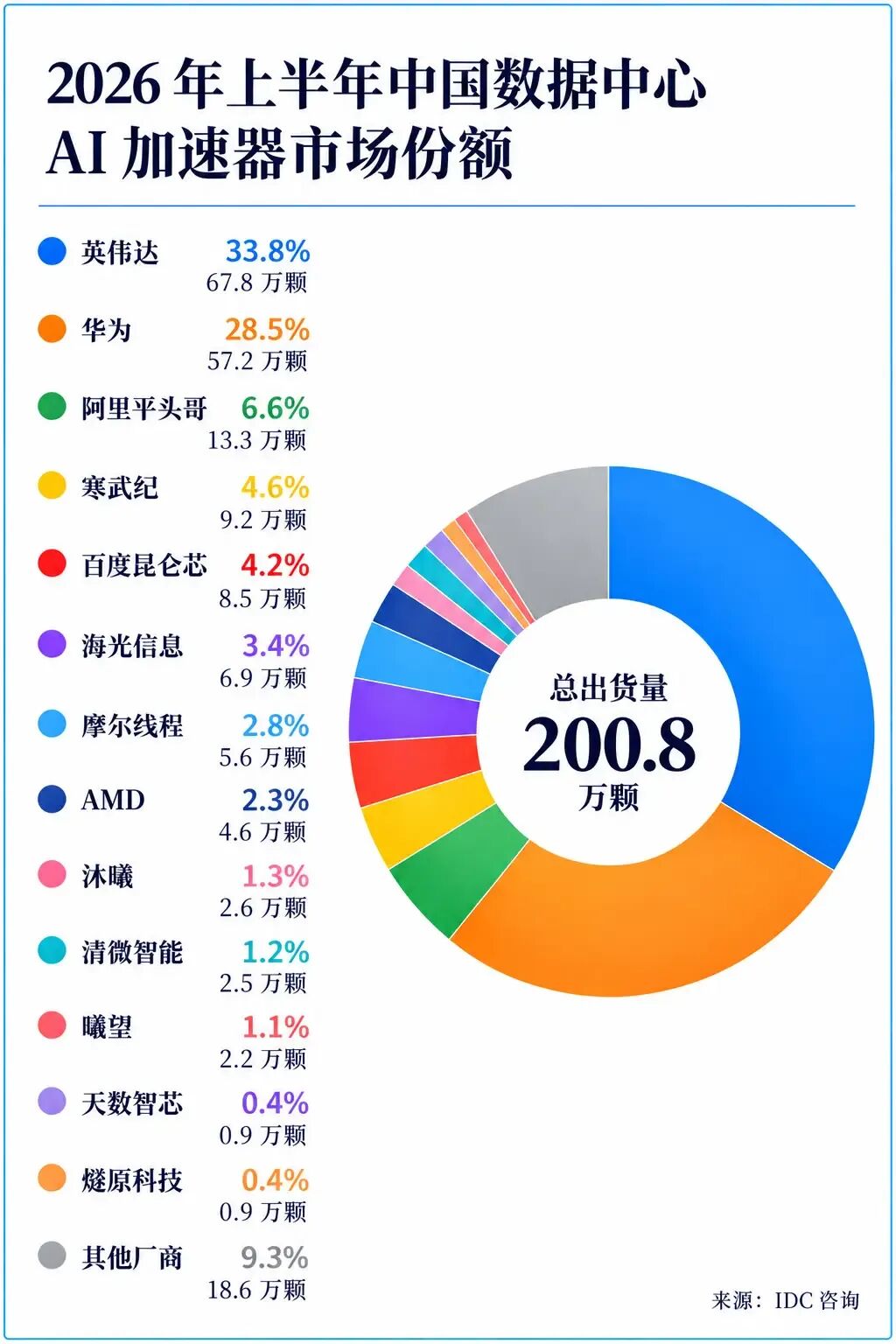
In the same period, China's GPU shipments fell 26% year-on-year to about 991,000 units, while the shipments of other types of AI accelerators increased by nearly 80% to about 1.016 million units, exceeding GPUs. IDC predicts that the overall shipment of AI accelerators in China will grow by 19% in 2026, while GPU shipments may drop by 9%.
The demand for AI computing resources continues to grow, and the supply structure is also adjusting. Beyond GPUs, other types of AI accelerators are gaining more market share, and the shipments of domestic manufacturers are increasing accordingly.
Therefore, This round of GPU buying spree cannot be simply understood as all types of computing power are in short supply. What enterprises really need is computing resources that can run target models, meet concurrency and latency requirements, and can be deployed in time.
The video memory, bandwidth, computing power and software support of chips will affect whether the model can run and its operating efficiency; after entering actual business, servers, networks, scheduling and operation and maintenance also need to be considered. Even if the theoretical computing power of the two chips is similar, the actual throughput, response latency and total cost may be very different.
For enterprises that need to launch model services quickly, procurement time is also important. After the chips arrive, model adaptation, system deployment and business testing still require investment. If migrating existing systems requires a large amount of engineering transformation, time and cost will affect the final choice.
This is also one of the reasons why NVIDIA products are still attractive. NVIDIA's long-accumulated CUDA ecosystem, operator libraries and development tools bring engineering convenience to its products. Enterprises can continue to use part of their existing development and operation and maintenance experience, reducing uncertainties in the migration process.
However, even if the chips arrive smoothly, enterprises still need to consider whether the new computing power can bring sufficient business revenue.
Assuming that the entire batch of chips is finally procured at the amount of USD 350 billion, only amortizing the equipment procurement amount evenly over five years corresponds to an annual equipment cost of about USD 7 billion. This calculation only illustrates the magnitude of the investment, and does not represent the actual procurement contracts, payment rhythms or accounting treatments of the three enterprises.
Moreover, chips are only part of the cost of AI infrastructure. Servers, network equipment, data centers, power, heat dissipation and operation and maintenance will all generate corresponding expenditures. After the equipment is in place, if the utilization rate is insufficient, the unit computing cost may be high; if the model service has low charging standards and low user payment rates, the new computing power may not necessarily bring sufficient revenue.
Conversely, if an enterprise's AI services already have a large number of paying users, or the new computing power can significantly improve service quality and expand call scale, then investment in computing power may also help the enterprise form new revenue sources.
Therefore, to judge whether this procurement is cost-effective, several operating indicators need to be considered: the comprehensive cost per million tokens, the effective throughput of a single GPU, the utilization rate of computing power, the paid call volume of AI services, and whether the related business revenue can cover depreciation and operation and maintenance expenditures.
Different enterprises have different return paths. Cloud vendors can obtain revenue directly by selling computing power and model services; platform enterprises with consumer-grade AI products may obtain returns indirectly by improving user retention and promoting advertising or transaction conversion. The commercial value of the latter may not be directly reflected in the revenue of AI products, but it also needs to be verified through actual operating data.
The link from procurement intention to chip delivery, and then to business revenue and profit is completed, so that USD 350 billion has a clearer commercial meaning.
Under the GPU buying spree, how can the computing power dividend of domestic substitution be realized?
This order took place during a period when U.S. chip export policies against China continued to adjust. The sales restrictions for different products are not the same. Only by understanding these rules can we understand why large manufacturers are snapping up GPUs and what kind of competitive environment domestic chips are facing.