Medical AI Diagnosis: Why Is It So Difficult to Become an Independent Business?
Over the past 28 months, the market has completed a full round of stress tests on popular stocks related to "medical AI diagnosis": Tempus has retraced by about 35% from its all-time high; the sharp valuation retracement prompts us to re-examine the real commercial bottlenecks of "medical AI diagnosis".
Based on 212 AI-related medical device registration certificates publicly disclosed in China from the beginning of 2020 to September 2026, as well as the original policy texts, this paper analyzes the core commercial bottlenecks of AI diagnosis layer by layer along the three commercialization gates of "productization — registration certificate — price project approval".
Productization: Regulatory requirements stipulate that the design logic of AI products must be based on medical guidelines and be specific to vertical indication fields. General large model products in the DeepSeek mode are difficult to be recognized by regulators, which reflects the respect for the seriousness of medicine and clear boundaries of responsibility.
Registration Certificate: Standalone software or software components embedded in medical devices (with the medical device remaining as the registration subject) are the only two forms of AI product registration recognized by regulators. The commercialization of AI diagnosis can only be realized by selling software or selling device hardware. The DeepSeek-style business model dominated by API interfaces cannot obtain the admission ticket to the medical industry yet.
Price Project Approval: Without the support of independent medical service output, regulators will not set independent prices for AI diagnosis. The highest treatment for AI diagnosis in the price system is only an extended item that "does not add extra price". The channel for AI diagnosis to create a second revenue generation curve for enterprises is closed.
Even setting aside the aforementioned policy restrictions, in the market "perception", hospitals still find it difficult to pay for AI diagnosis separately, because AI diagnosis does not provide a new service "from 0 to 1" for the departments, but is an intelligent upgrade of the existing software capabilities of equipment manufacturers: hospitals regard it as a negotiation chip, manufacturers regard it as a competitive barrier, and the real role of AI diagnosis is a "defensive asset" for manufacturers to maintain market share and price level, rather than a revenue-generating tool.
The long-term breakthrough of medical AI diagnosis may still need to wait for the DeepSeek moment after more accumulation in the industry. However, in the short term, we may adjust our thinking to turn "insignificant efficiency improvement" into "quantifiable productivity":
Either convert efficiency into income, significantly shorten report turnaround time, improve inspection throughput, so that the contribution of AI directly enters the department's income statement; or go to scenarios with scarce doctors to be "productivity itself", for primary care, physical examination, and large-scale screening, where AI is not an assistant, but the only affordable productivity; or jump out of the medical insurance payers, and find customers who pay for data and services in the budgets of physical examination institutions, pharmaceutical companies, and commercial insurance.
01 Background: Value Return of Popular AI Diagnosis Stocks
Over the past 28 months, the capital market has used real money to conduct a complete round of stress test on the "medical AI diagnosis" commercial narrative of popular stock Tempus.
In June 2024, Tempus went public at $37, and its price fluctuated sharply in the first six months. In August, its intraday price doubled to $77, approached $80 in November, and plummeted 46% in a single month in December.
The real trigger point was January 2025: it was disclosed that the Pelosi family, known as the "stock god on Capitol Hill" in the United States, bought call options on January 14, and the AI health assistant Olivia was released in the same period. On January 21, its price soared 35.5% in a single day, hitting the largest single-day increase since its listing; on February 14, its intraday price touched $91.45, and then quickly pulled back to $56.
After that, driven by the $200 million oncology foundational model agreement between AstraZeneca and Pathos and consecutive quarterly performances that exceeded expectations, its price hit an all-time high of $104.32 in October 2025, with a market value of about $18 billion. Later, even with positive news such as the disclosure of positive quarterly EBITDA and the position building by Duan Yongping, the stock price continued to fall. Until September, after the PRISM2 paper was gradually disclosed to be published in *Nature Medicine* and the cooperation agreements with Moderna and Merck were reached, the stock price rebounded to around $68, still down about 35% from its all-time high.
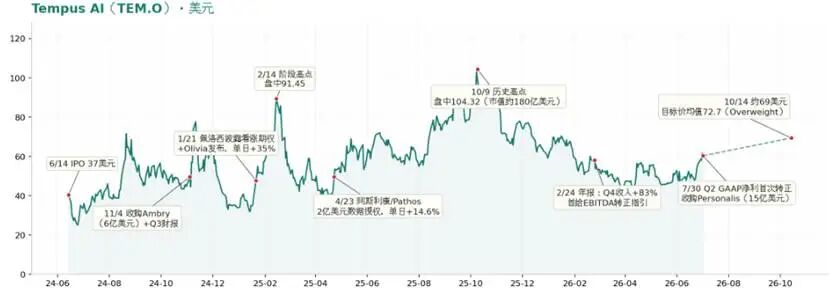
Figure: Historical closing price of Tempus AI, Source: Drawn from public materials
The following is the reference of NVIDIA's closing price trend:
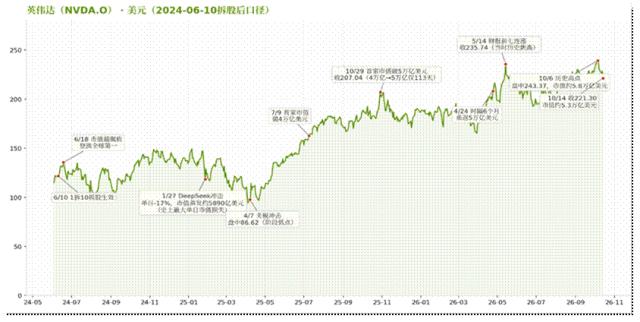
Figure: Historical closing price of NVIDIA, Source: Drawn from public materials
02 Current Status of Medical AI Applications: Significant Structural Differentiation Under the Glitz
According to the sorting of public materials, the commercial application directions of medical AI mainly involve the following seven categories:
1. Medical Imaging AI: Imaging-assisted diagnosis;
2. Diagnostic AI: Testing-assisted diagnosis;
3. AI Pharmaceutical R&D: Target mining, etc.;
4. Medical Large Model: Medical record quality control, evidence-based Q&A, etc.;
5. Surgical Robot AI: Surgical positioning and navigation, etc.;
6. Office AI: Doctor/hospital office assistance, etc.;
7. Chronic Disease Management for Patients: C-end physical examination interpretation, home chronic disease management, etc.
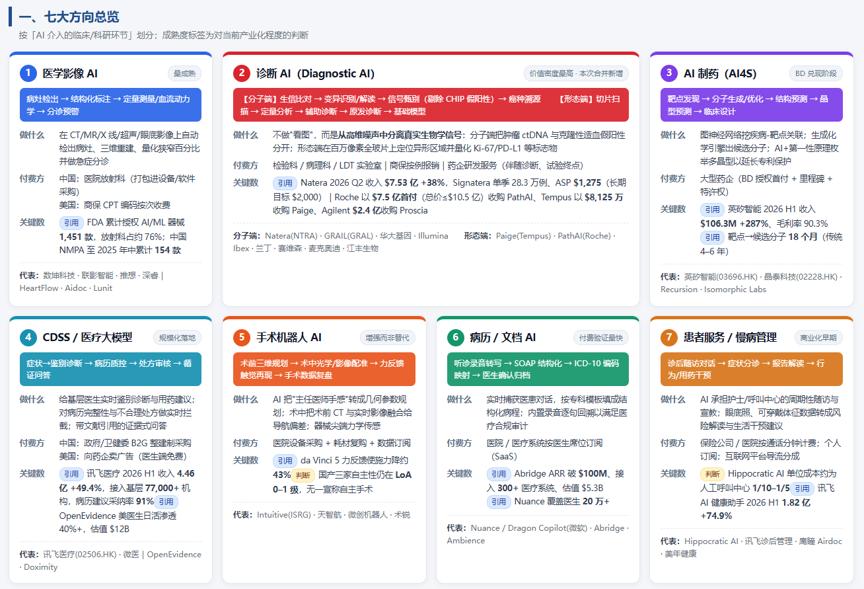
Figure: Overview of commercialization directions of medical AI, Source: Sorted from public materials, click to view the large image
The above are only application directions from the perspective of case classification; if we switch to the perspective of certificate acquisition, we will see very different results.
We counted 212 medical device registration certificates (including 174 Class III certificates) with AI (or artificial intelligence) contained in the product name or product content publicly disclosed from the beginning of 2020 to September 2026 — diagnosis-related certificates account for 91%, 177 of which are applied to imaging diagnostic AI, accounting for 84% exclusively, and all are software products; followed by in-vitro diagnostic AI applications, with 14 certificates, accounting for 7%.
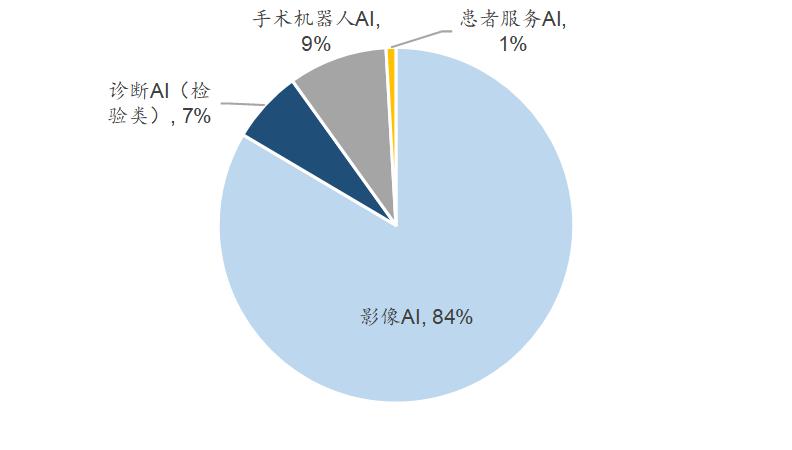
Figure: Distribution of domestic AI-related medical device certificates from early 2020 to September 2026, Source: Sorted from public materials
03 Three Commercialization Gates for Medical AI Diagnosis
In the previous chapter, we saw that from the perspective of case classification, medical AI has seven tracks, which are lively and scattered; but from the perspective of "certificate acquisition", 177 of the 212 registration certificates fall into imaging diagnosis, accounting for 84% exclusively. This 84% is not an accidental technical preference, but the result of policy guidance in the medical industry.
To understand it, we must first understand the logic chain of medical product marketing.
The medical track is an industry with strong policy intervention, the commercialization path of any medical product cannot escape the standardized path that has been framed by the system — productization (enterprises and regulators) → product certificate (National Medical Products Administration) → price project approval (National Healthcare Security Administration) (after price project approval, the product does not necessarily enter the medical insurance list synchronously, and the link of entering medical insurance to expand the commercial scale will not be expanded in this paper, nor will it affect the analysis of the underlying logic of the industry in this paper).
The value of medical AI must take standardized medical products as the carrier and pass through three gates to realize large-scale monetization in the medical industry:
Productization is the premise of all commercial promotion, and medical services that have not completed standardized packaging cannot enter the subsequent product registration and price project approval process (ICL is not within the scope of discussion in this paper);
Only after obtaining the medical device registration certificate approved by the National Medical Products Administration can enterprises sell to hospitals in compliance;
Only when the product is included in the price project approval guidelines of the National Healthcare Security Administration can hospitals charge patients in compliance and reasonably purchase enterprise products.
I. Productization: Auxiliary Product Design Following the Logic of Medical Guidelines in Vertical Fields
In terms of productization, the National Medical Products Administration always adheres to the auxiliary positioning of AI diagnosis and the product design principle of "supported by medical guideline logic".
In June 2026, the Center for Medical Device Evaluation of the National Medical Products Administration once again clarified in the *Guiding Principles for Registration Review of Clinical Evaluation of Artificial Intelligence-Assisted Diagnostic Medical Devices (Draft for Comments)*: "Artificial intelligence software can only assist physicians in diagnosis... Physicians are responsible for clinical diagnosis results" and "product design must be based on medical guidelines".
The seriousness of medicine does not allow a thing with vague responsibility boundaries and unclear functional connotations to become a product in the medical system — AI capabilities must be encapsulated into standardized products with clear capability boundaries, controllable responsibility risks and repeatable delivery, rather than a service, a model interface or a prompt.
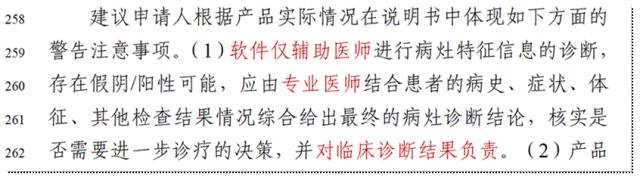
Figure: Original Text ① of *Guiding Principles for Registration Review of Clinical Evaluation of Artificial Intelligence-Assisted Diagnostic Medical Devices (Draft for Comments)* in June 2026, Source: Center for Medical Device Evaluation, National Medical Products Administration
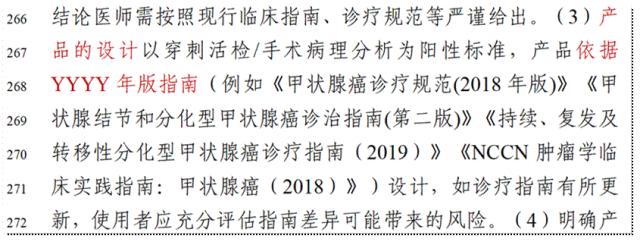
Figure: Original Text ② of *Guiding Principles for Registration Review of Clinical Evaluation of Artificial Intelligence-Assisted Diagnostic Medical Devices (Draft for Comments)* in June 2026, Source: Center for Medical Device Evaluation, National Medical Products Administration
II. Registration Certificate: The Only Two Forms of Standalone Software or Embedded Medical Devices
In terms of registration certificates, the National Medical Products Administration has always limited the only two product registration forms — standalone software, or software components embedded in medical devices (the medical device remains the registration subject).
As early as March 2022, the *Guiding Principles for Registration Review of Artificial Intelligence Medical Devices* issued by the National Medical Products Administration clarified the scope of application for declaration of AI medical devices — "including Class II and Class III artificial intelligence standalone software and medical devices containing artificial intelligence software components (including in-vitro diagnostic medical devices)". The certification form of AI products has thus been locked into two types: declared as standalone software, or embedded in medical devices and declared with the medical device as the main body.
Until 2025, the National Medical Products Administration issued the *Announcement on Issuing Measures to Optimize Full Life Cycle Supervision and Support the Innovative Development of High-end Medical Devices*, the regulatory tone was loosened — "carry out research on the management attributes and categories of new functions, new technologies and new modal products such as medical large models, artificial intelligence medical devices, medical image preprocessing, and process optimization software, and dynamically adjust the product management categories in a timely manner according to the maturity of technology development".
But the loosening of attitude does not mean the loosening of principles — according to the latest *Guiding Principles for Registration Review of Artificial Intelligence Medical Devices (2026 Revised Version) (Draft for Comments)* released in September 2026, the registration form of AI products is still locked in the two forms of standalone software and embedded components.
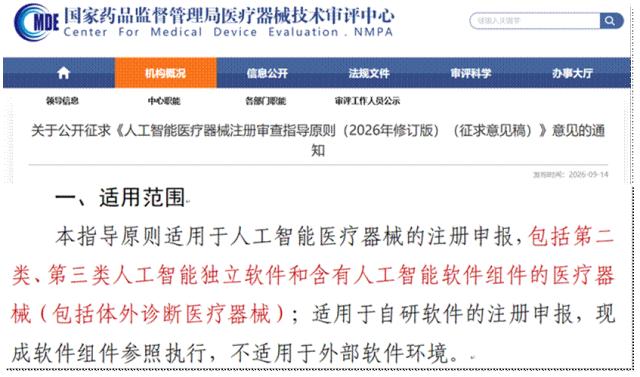
Figure: Original Text of *Guiding Principles for Registration Review of Artificial Intelligence Medical Devices (2026 Revised Version) (Draft for Comments)* in September 2026, Source: Center for Medical Device Evaluation, National Medical Products Administration
III. Price Project Approval: Extended Item Status Without Independent Charging Qualification
In November 2024, AI was written into the price project approval guidelines for the first time, but the document clearly does not grant it the status of independent charging and extra price increase.
At that time, the National Healthcare Security Administration simultaneously printed and distributed three *Trial Guidelines for Project Approval of Medical Service Price Items* for radiological examination, ultrasonic examination and rehabilitation. For the first time, AI content was written into the project approval guidelines — all three guidelines uniformly add an extended item of "artificial intelligence-assisted diagnosis" under the main item, and clarify that "extended item refers to a type of sub-item under the same item that only expands the applicable scope of the price item without additional price increase when provided in different ways or applied in different scenarios, and the price of the sub-item is implemented according to the main item".
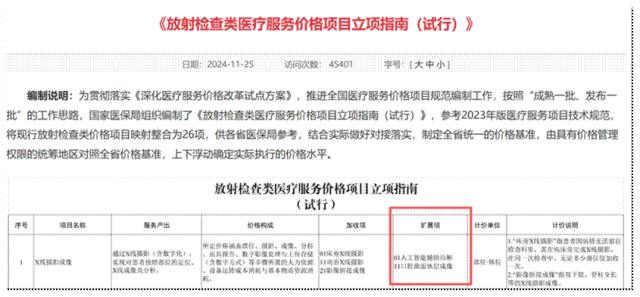
Figure: Original Text of *Trial Guidelines for Project Approval of Medical Service Price Items for Radiological Examination* in November 2024, Source: National Healthcare Security Administration
In the same period, the National Healthcare Security Administration released an official interpretation article, giving the reason: "In the case that there is no independent medical service output and the quality and effectiveness of assisted diagnosis are difficult to