AI spent 88 hours writing the proof, humans spent 7 weeks reading it, and mathematicians have begun to understand OpenAI's proof of the Millennium Prize Problem.
On September 8, OpenAI released a proof, claiming that it had solved the Navier-Stokes Millennium Prize Problem.
This problem focuses on a set of equations that describe the motion of fluids.
Approximately 10,000 AI agents, 88 hours, 166 pages.
It took the AI less than 4 days to finish writing it.
Nearly 7 weeks after the paper was released, humans began to understand its line of reasoning.
On October 26, mathematician Scott Armstrong posted a long thread on X.
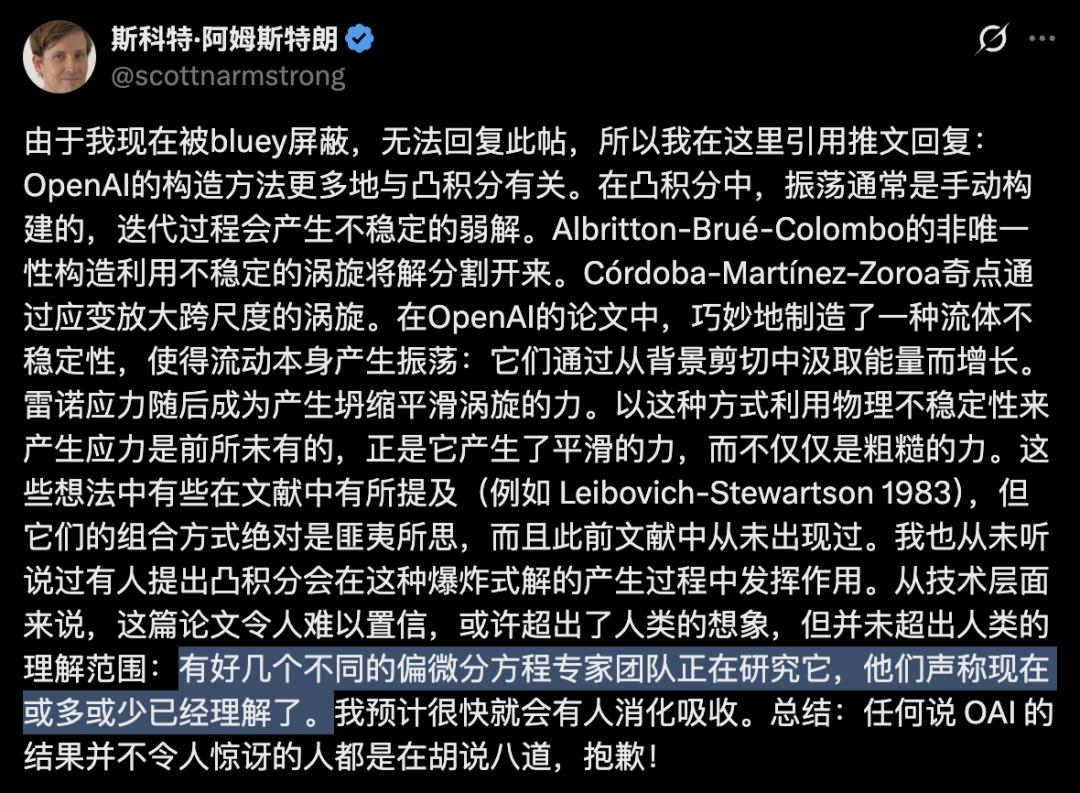
According to his account, several groups of partial differential equation experts who are studying this proof have basically grasped the ideas behind it.
Professional peers are starting to see clearly the problem-solving method used by the AI.
His evaluation is as follows:
It may go beyond the scope that humans could originally conceive, but it does not exceed human comprehension.
Armstrong is a research director at the French National Centre for Scientific Research and a professor of mathematics at the Courant Institute of New York University.
He himself researches fluid turbulence, so he is a true expert who can see the core logic behind the work.
This time, the AI was responsible for expanding the boundaries of imagination, while humans were responsible for understanding it.
In this relay race, humans have just finished the first leg.
However, understanding the line of reasoning and confirming that the entire proof is completely correct are two different things.
The second half of the Millennium Prize Problem is only just beginning now.
AI Submits Its Paper in 88 Hours, Humans Cannot Understand It At First
Let's go back seven weeks ago.
OpenAI used an unreleased new model to mobilize about 10,000 agents to tackle the problem simultaneously.
Over 88 hours, they exchanged about 2.7 million messages back and forth, generating roughly 130 billion tokens.
After another 17 hours, GPT-6 Astra translated the proof into the Lean language for machines to check line by line.
This assignment that shocked the mathematics community cost millions of dollars just in computing power bills.
The proof was submitted, but almost no one could understand it.
On October 14, the journal *Communications Physics* under Nature published an editorial.
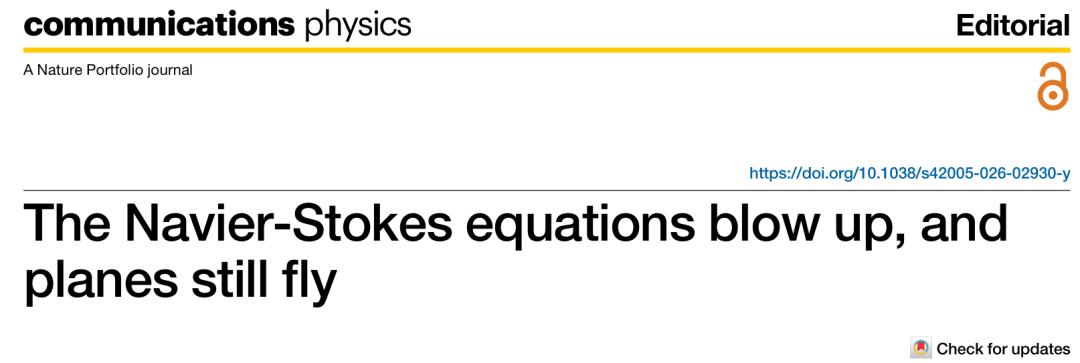
Communications Physics editorial: The equations "explode", but planes still fly as usual.
The author wrote: Experts believe it is correct, but no one has truly understood it yet.
In the past, humans set the problems, and AI could not answer them.
Now AI submits the paper, and humans cannot understand it.
"What's So Surprising About This?"
Doubts soon emerged.
A netizen named Joel Fish believes that this result is "reasonable and expected".
In his view, the model has already learned massive amounts of literature during training.
He also estimated that OpenAI spent about 15 million US dollars on computing power for this work.
If this sum of money was used to hire mathematicians to focus on the research, it is not impossible to get the same result.
Armstrong wanted to reply in the discussion thread, only to find that he had been blocked by a netizen.
He simply quoted and reposted the content, and posted a long paragraph of refutation.
The last sentence was very blunt: Anyone who says this result is not surprising is talking nonsense.
After the rebuttal, he politely added a line of "sorry!"
What the two sides are really arguing about is whether the AI has put forward genuinely new ideas.
To answer this question, we first need to see what ideas the AI came up with.
Let Water Stir Itself
Try stirring a cup of coffee first.
When the vortex is stretched, the liquid in the cup will spin faster and faster, and become thinner and thinner.
It is just like a figure skater pulling their arms in, the rotation speed increases sharply.
The viscosity of the liquid keeps applying the brakes, gradually dissipating the energy of the vortex and turning it into heat.
On one side, the stretching is stepping on the accelerator, on the other side, the viscosity is stepping on the brake.
For nearly a hundred years, mathematicians have been asking a question:
Can stretching beat the braking effect, making the speed rush to infinity within a limited time?
This is the "explosion" of fluid, mathematically called a singularity.
OpenAI claims to have constructed such a scenario.
A cup of still water is gently pushed by a smooth external force.
The vortex at the center shrinks smaller and smaller, the speed gets faster and faster, and finally rushes to infinity.
If the speed is infinite, wouldn't the energy also go off the charts?
The total kinetic energy of the whole cup of water has always been finite.
The logic is not hard to understand: the tiny mass of water that spins the fastest is also shrinking nonstop.
Just like a drop of water on the tip of a needle, no matter how fast it spins, its mass is only very small.
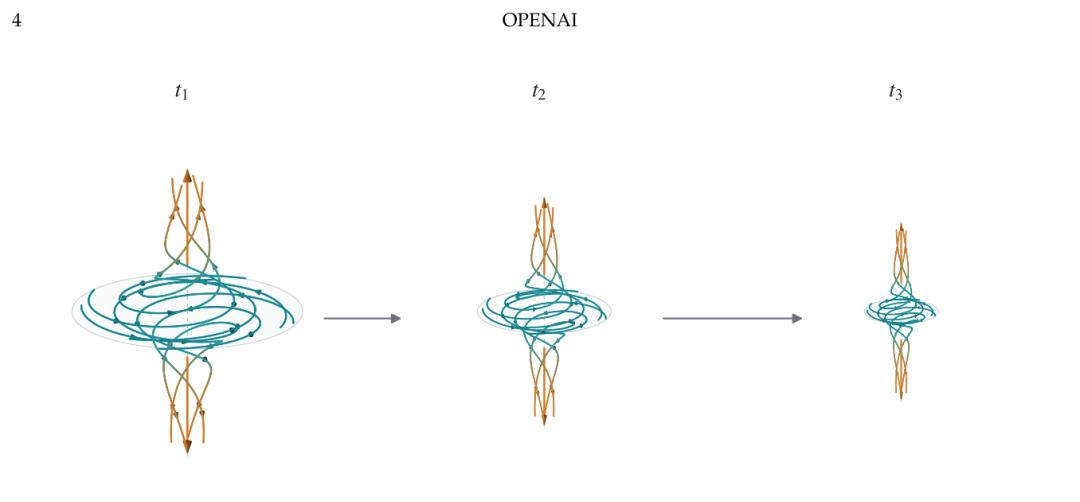
The core of the vortex shrinks gradually, the aspect ratio is processed with exaggerated effect.
The difficulty lies in that this external force must always be mild, without any sudden strong push.
If the thrust itself is infinite, it is not surprising that the water "explodes" accordingly.
That is equivalent to throwing a firecracker into the cup, then claiming that the coffee exploded by itself.
This is exactly where the trouble lies.
If you simply draw a continuously shrinking vortex and substitute it into the equation for calculation, the external force required to maintain it will also rush to infinity.
What can we do to solve this problem?
The method in the paper is to add a series of rhythmic small fluctuations (oscillating pulses).
These small fluctuations push the water flow (momentum transport), which exactly cancels out the force that is about to get out of control.
The remaining small deviations are then fixed little by little.
This sounds like patching, so a question arises: where do these patches (oscillations) come from?
Before OpenAI, mathematicians had already tried several approaches.
The first approach is called "convex integration".
Mathematicians manually built layers of tiny oscillations to create some peculiar solutions, for example, energy appears out of nowhere in the water flow.
The second approach comes from three mathematicians Albritton, Brué and Colombo.
They used an unstable vortex to make the water flow start from exactly the same starting point, but end up with two completely different outcomes.
The third approach comes from Spanish mathematicians Córdoba and Martínez-Zoroa. They keep pulling to amplify the rotation of the vortex level by level.
At first, the outside world thought the AI followed this line of approach.
But multiple groups of experts interviewed by *Scientific American* said that after careful inspection, the method is not the same.
Armstrong pointed out the key point: the AI's proof is most similar to convex integration.
The difference is that the oscillations in convex integration are created manually by humans.
But the AI lets the water create them by itself.
It designed a kind of fluid instability, making the water flow likely to "lose stability" at any time.
Adjacent water layers move at different speeds, one fast and one slow, just like wind blowing over the water surface will raise ripples.
This speed difference will spontaneously generate small fluctuations.

The upper and lower layers of air flow move at different speeds, one fast and one slow, rolling the clouds into a row of spray, this is exactly the phenomenon of "speed difference generating fluctuations". (Image source: UCAR)
The thrust generated by the small fluctuations in turn pushes the central vortex to shrink tighter and tighter.
In the past, mathematicians stirred the water manually, but this time, they let the water stir itself.
In Armstrong's view, using the fluid's own instability to "generate force" has no precedent before.
It is precisely because of this that the external force created by the AI is smooth enough to meet the strict requirements of the problem.
Armstrong admitted that some of these ideas appeared in literature as early as 1983.
But combining them in this way is "absolutely crazy", which has never been seen in any literature before.
He has never heard of anyone thinking that convex integration can be used to create such blow-up solutions.
In this process, the AI did not invent new tools.
It just used the old tools left by humans, and took a path that humans had never taken before.
Those who say AI can only repeat the training data can first answer a question:
Since all the materials exist in the literature, why didn't humans take this path?
After Understanding the Reasoning, What Else Needs to Be Checked
Humans' "digestion" of the proof has already produced public results.
In late September, mathematician Lei Zhen from Fudan University and his collaborator Xiao Ren released a preprint of interpretation.
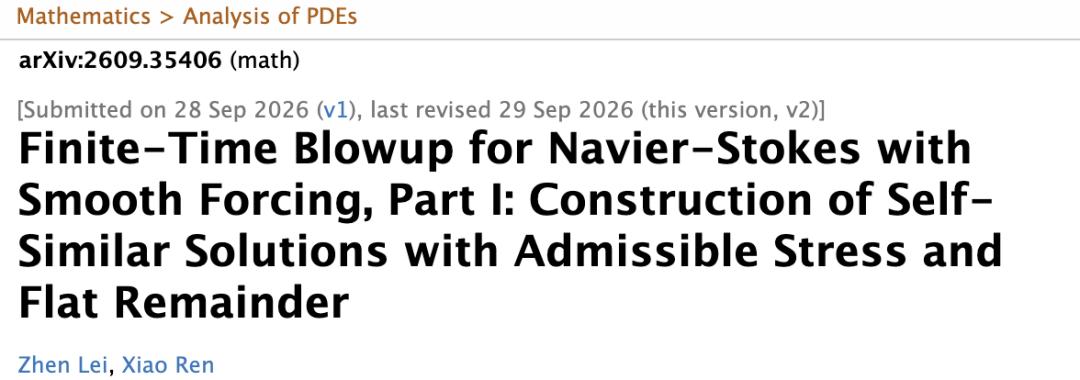
They rewrote the part that constructs the flow profile in OpenAI's original manuscript, striving to make it understandable for peers.
They stated in the paper that OpenAI's work is a major progress on the Navier-Stokes Millennium Prize Problem.
The AI submitted a draft, and humans started to write teaching materials for it.
However, understanding the reasoning is only the first step.
Another task is to check whether the original paper is consistent with the Lean version.
Lean is a kind of proof assistant.
After writing mathematical propositions and derivations into formal language, it can check whether each step of reasoning is valid.
But the machine only checks the content it receives.
It is just like checking a translated manuscript: even if the translation is smooth, you still need to confirm whether it has changed the original meaning.
On October 6, three researchers Bastounis, Circelli and Hansen published a preprint, pointing out that there are differences between some statements and derivations in the original manuscript and the Lean version.
They also stated at the same time that they did not judge whether OpenAI's written proof is correct.
Therefore, this doubt cannot be simplified to "the proof has been overturned".
It requires clarifying one thing: what conclusions of the original manuscript can the machine-verified content guarantee?
The machine can ensure that there is no miscalculation in each step, but it cannot guarantee that the problem statement has not been copied incorrectly.
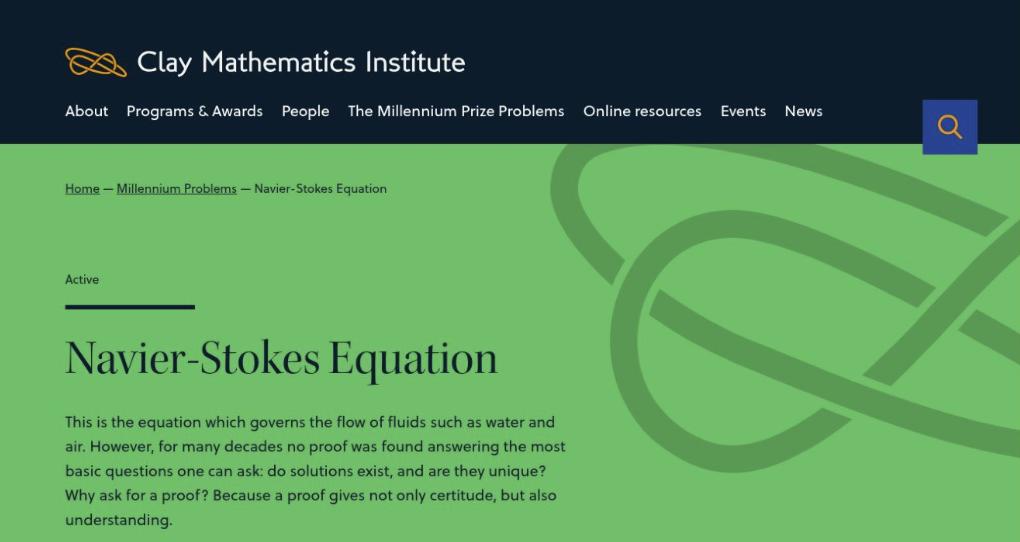
Up to now, the Clay Mathematics Institute still lists this problem as "Active" and "In Progress".
OpenAI also stated that it does not intend to claim the 1 million US dollar prize.
In The Second Half, What Assignments Are Left For Humans
Some people may ask: Can this set of methods be extended to scenarios without external force?
This is a good question, but do not treat it as "the other half that has not been finished".
The four propositions listed by the Clay Mathematics Institute, proving any one of them counts as a valid solution.
What OpenAI claims to have completed are exactly the two propositions that allow smooth external force.
The scenario without external force is the next new target.
According to the analysis in the new paper by Constantin and other researchers, this construction cannot be directly extended to the scenario without external force.
To conquer it, brand new ideas are probably still needed.
At the moment, humans still have three assignments to complete.
The first one is a complete, easy-to-read explanation, so that peers do not need to guess the intention of each step from scratch;
The second one is item-by-item verification and comparison explanation, to clarify which parts have been checked and which parts still need explanation;
The third one is to extract the methods in the proof and apply them to other problems.
Only in this way can an AI-generated answer give birth to new research.
The cost of the AI's leg of the relay is easy to calculate: 88 hours, 10,000 agents, millions of US dollars.
But the cost after humans take over the baton is very hard to calculate: understanding, verification, and clear explanation, each step requires experts to invest a lot of time.
But without this leg completed by humans, the answer submitted by AI is just a test paper that no one dares to use and cannot be used.
From the announcement on September 8 to today, seven weeks have passed, and some mathematicians have begun to understand the reasoning behind the proof.
Next, they need to turn this proof into knowledge that the next researcher can continue to use.
When AI can think faster than humans, the speed at which humans understand, verify and pass on knowledge will also begin to determine how fast science can develop.
In the second half of the Millennium Prize Problem, the main test is for humans.
References:
https://twitter.com/scottnarmstrong/status/2114412308185100522
https://openai.com/index/navier-stokes-solution/
https://www.nature.com/articles/s42005-02930-y