WeChat has more than 100 million monthly active users, and the short drama track has evolved from a monopoly dominated by a single player to a head-to-head rivalry between two major competitors.
A product with 143 million monthly active users has quietly embedded in your WeChat.
According to the latest data from QuestMobile, as of August 2026, the monthly active users of Tencent's Green Bubble short drama mini-program has surged to 143 million, officially crossing the 100 million user threshold. What is more staggering is its growth rate: in the first week of October, the weekly active users reached 89.68 million, up 44.1% compared with the first week of September. This product was only renamed from "WeChat official short drama mini-program" to "Green Bubble" in July, and in just three months, its weekly active users have approached 90 million.
Let's make a comparison across the entire track: ByteDance's Hongguo Short Drama had 168 million daily active users on its standalone app in July, and 356 million monthly active users in May, which has exceeded the sum of daily active users of Tencent Video, iQiyi, Youku and Mango TV. In terms of sheer scale, Green Bubble still lags far behind. But it is worth noting that it is just a mini-program embedded in WeChat so far, with no standalone app, no extensive hard advertising, and it has reached this figure in only three months relying solely on the entrance in the search bar and traffic diversion from Channels. The 1.4 billion user base of WeChat is truly unmatched.
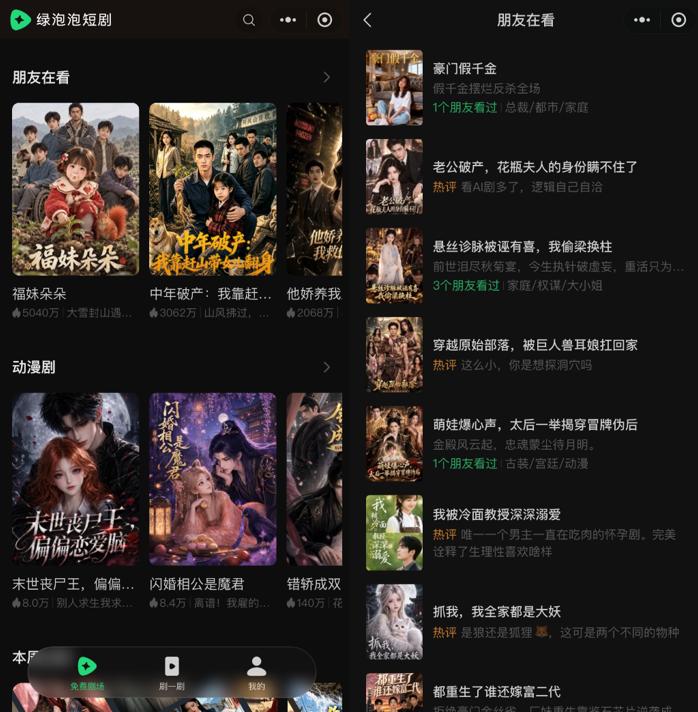
However, few people have noticed that this is already the fourth time Tencent has entered the short drama track.
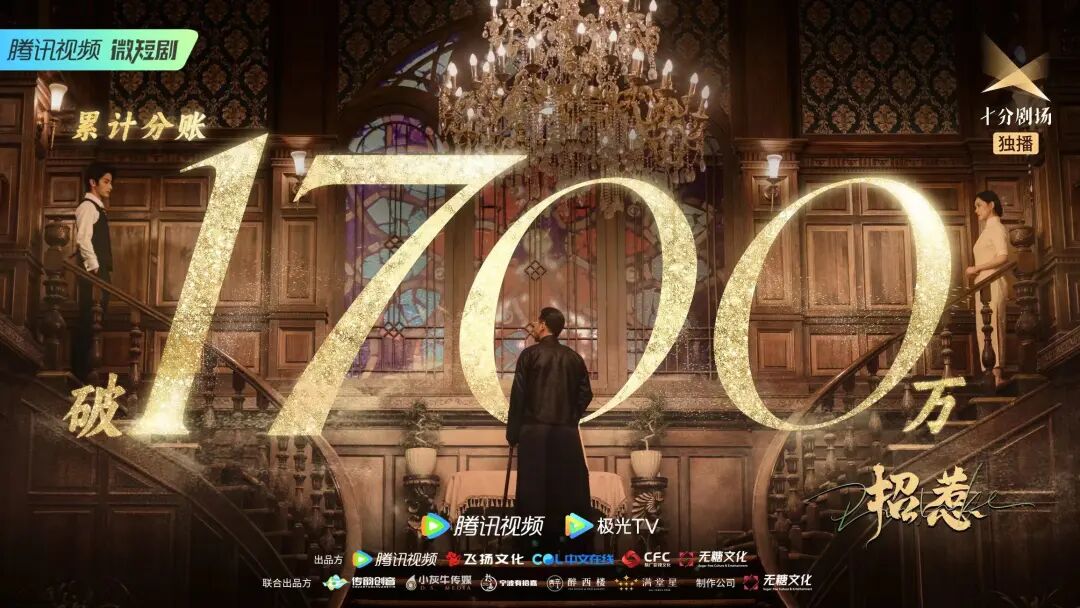
The first attempt was at the end of 2021, when Tencent Video launched the "Theater of Excellence" with a high-quality content strategy, and even created a hit drama *Provoke* that generated over 20 million yuan in revenue sharing. However, as it was just a channel page within the long video app, users never developed the mindset of "coming here specifically to watch short dramas". The second attempt was "Mars Short Drama Community" in early 2025, which aimed to build an independent product to test the free ad-supported model, but it failed to gain traction. The third attempt was the WeChat short drama mini-program launched last June, which aggregated third-party content, but its traffic performance was consistently below expectations. After three failed attempts, Tencent has long been the role of "setting off early but arriving late" in the short drama track. Ma Huateng himself has publicly talked about the impact of short dramas on long video platforms, but the products under his leadership failed to seize the opportunity.
Why does Green Bubble seem different this time? Because its strategy has been completely overhauled.
Hongguo follows the standalone app route: users download it specially, open it specially, and watch whatever the algorithm recommends, immersing themselves in short dramas for two hours at a time. Green Bubble takes the opposite approach — it is embedded directly in WeChat, no download is required, and users can watch it with a simple search. When a WeChat message comes in, users can minimize the player to a floating window and reply to the message while continuing to watch; when they scroll across a clip on Channels, they can click to jump directly to the full episode. The entire process never leaves the WeChat ecosystem.
The deeper difference lies in the distribution logic. Hongguo relies on ByteDance's mature interest recommendation algorithm: if you love domineering president-themed dramas, it will push you hundreds of such dramas, making it harder and harder for you to stop scrolling. Green Bubble is backed by WeChat's social connection chain — what your friends are watching, what dramas are shared in groups, and what links are posted in official account articles are all distribution channels. One is the algorithm finding users, the other is users bringing in other users.
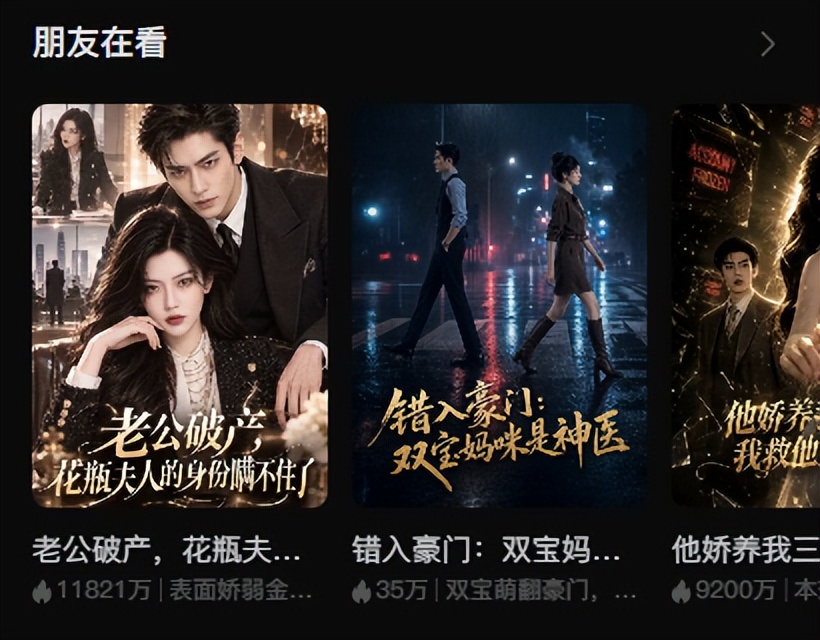
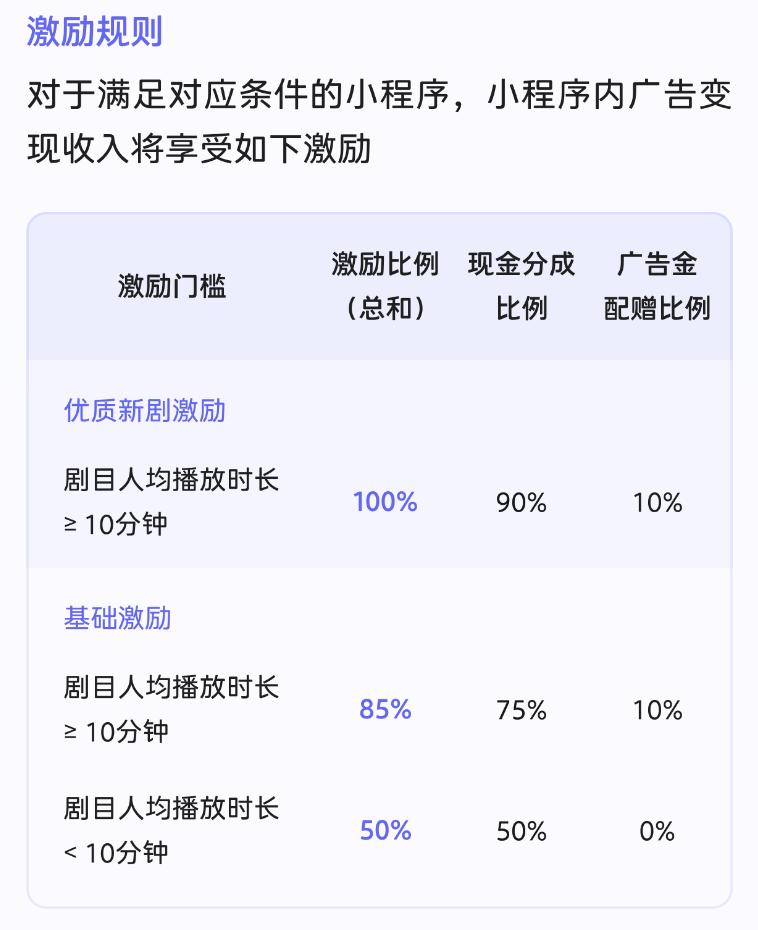
The content strategy is also very straightforward: Tencent does not produce its own dramas, it only builds the platform. All episodes come from third-party producers, the platform is responsible for providing traffic and realizing revenue through advertising, and then distributes the profits. Moreover, this revenue sharing policy is extremely aggressive: for new dramas participating in joint distribution, as long as the average viewing duration per user is no less than 10 minutes, producers can enjoy up to 100% revenue incentive, of which 90% is cash sharing and 10% is advertising credit matching. Note that the assessment threshold is not based on play volume, but on average viewing duration per user. This means Tencent has made it clear that if you make high-quality dramas that users are truly willing to watch, Tencent will not take a penny of profit, and give all the revenue to you.
This move is even more notable in the whole industry. Almost at the same time, ByteDance is tightening its policies: it is rumored that Hongguo will adjust its revenue sharing rules in November, and the revenue per 10,000 views has dropped from 100 yuan at its peak to 5 to 10 yuan, the share for small and medium-sized producers has been compressed to single digits, and the platform will take 60% to 70% of the advertising revenue first. With one side advancing and the other retreating, content producers can easily make their choice: they will move to the side that offers more money and more lenient policies. Tencent is using real money to snatch high-quality dramas.
But problems also follow, and none of the pitfalls that users have complained about on Hongguo over the past year can be avoided by Green Bubble.
The most obvious one is advertisements. Both of them adopt the IAA ad monetization model, and the most criticized point of Hongguo is that advertisements are becoming more and more frequent. Some users reported that a forced advertisement pops up every four or five episodes, and they have to watch it for at least 5 seconds before they can skip it, which completely breaks the rhythm of watching dramas. A survey by China National Radio last year also mentioned that advertisements on short drama platforms are becoming more and more accurate, targeting products you have viewed before. Since Green Bubble also makes money by inserting advertisements, this logic has been written into its product genes from day one. Now that the number of users has just exceeded 100 million, the ad load rate is still in a restrained period. No one can predict how this curve will change when the commercialization pressure rises.
Looking further ahead, all the pitfalls that Hongguo has stepped on will appear in front of Green Bubble one by one. In May this year, Hongguo was criticized and became a trending search after launching the VIP membership system — the annual membership costs 260 yuan, which is more expensive than the membership of long video platforms such as iQiyi, Tencent Video, Youku and Mango TV. Where did the promised "free drama watching" go? The vice president of Douyin came out to make an emergency response overnight, saying that the core free model remains unchanged, and VIP is just an optional ad-free service. But users did not buy it, and the label of "cutting leeks" was attached. Later, it was rumored that the coin-based drama watching welfare program was fully shut down, and even the small rewards users got from watching dramas were taken back.
The essence of these incidents is that after a free short drama platform reaches a certain scale, there will inevitably be a conflict between commercialization and user experience. Green Bubble now has just exceeded 100 million monthly active users, and is still in the sweet period of rapid user expansion, and the 100% revenue sharing policy is also a limited-time offer. When the user base further expands and the content library is enriched, Tencent cannot keep operating without making profits forever. Increasing ad density, paid high-quality content, and membership systems — these options will be put on the table sooner or later. At that time, no one can guarantee whether Green Bubble will change from "free high-quality dramas at your fingertips" to "endless annoying advertisements".
Tencent has made four attempts, and the first three failed to make much waves. This time, with the support of WeChat's user base and the aggressive subsidy strategy, it has achieved a brilliant start. But the short drama business has never been a game that you can win just by having traffic and subsidies. After users have been educated by Hongguo, their patience for the next free short drama platform is far less than you might imagine.