Regulators have rolled out a string of intensive measures to rectify the "lowest price across the entire network" practice, and all the gameplay of this year's Double 11 has completely changed.
The Double 11 campaign reports have not yet dominated social media feeds, but the trend of the e-commerce industry has already shifted.
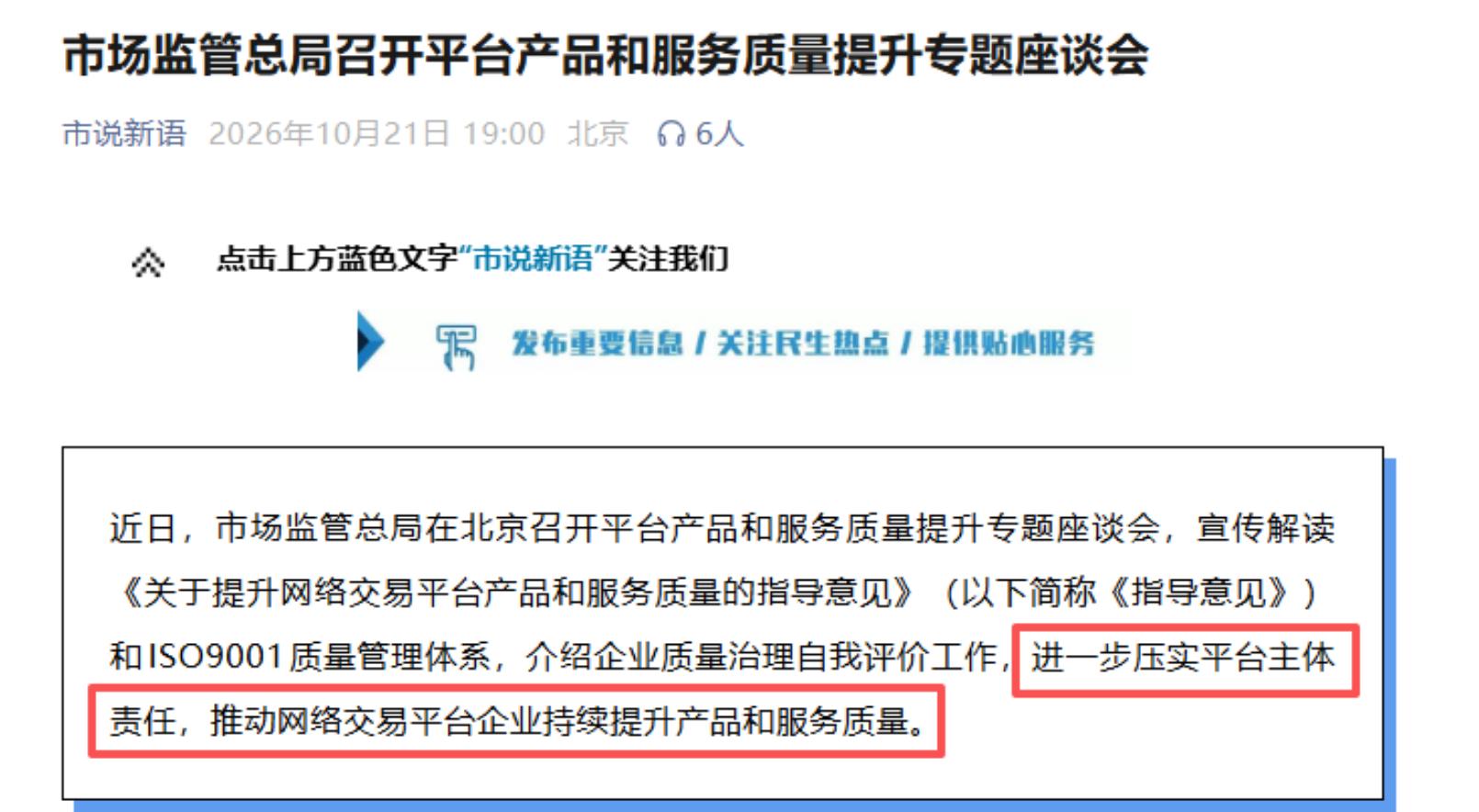
Recently, the State Administration for Market Regulation held a special symposium on improving the quality of platform products and services, with representatives from JD, Taotian, Pinduoduo, Douyin, Kuaishou, Xiaohongshu, Vipshop and Dewu attending the meeting. At the meeting, the *Guiding Opinions on Improving the Quality of Products and Services on Online Trading Platforms* and the ISO 9001 system were interpreted. The wording was not harsh but the direction was clear: under scenarios such as livestream commerce, instant retail and social e-commerce, quality and safety risks are "more complex and hidden", and counterfeit and shoddy goods, mismatched products and false publicity "still occur from time to time". The meeting required platforms to act as "gatekeepers", improve their quality management systems in accordance with the 2026 task list, explore the compilation of quality governance index reports, and guide high-quality consumption with "high-quality information".
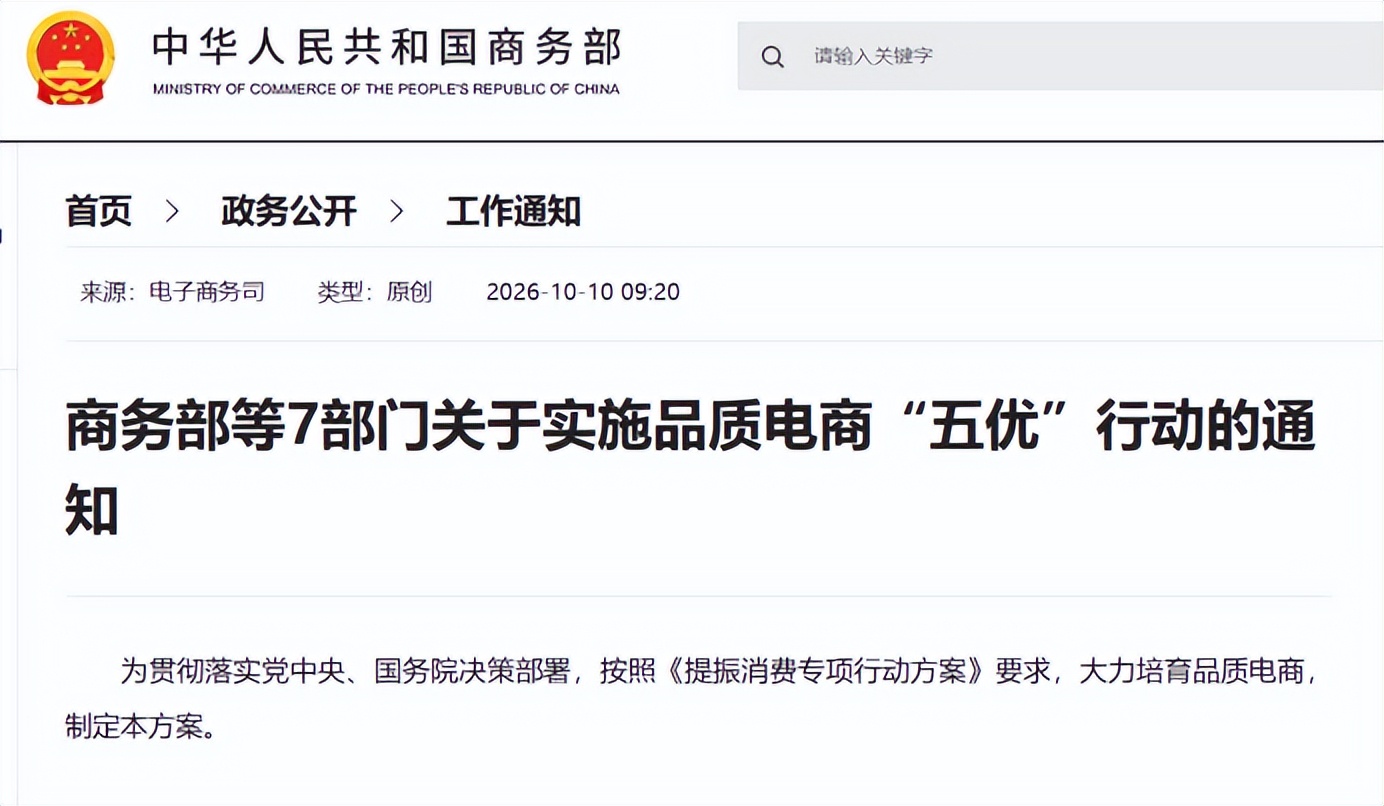
This is not an isolated warning. Ten days ago, seven departments including the Ministry of Commerce issued a notice on the "Five Excellences" action for quality e-commerce, and the 14th of the 15 measures directly specified to rectify disorderly competition such as "automatic price following" and "lowest price across the network", and standardize commission deduction and merchant rating. On March 23, the Beijing Municipal Market Regulation Bureau, together with two other departments, interviewed 12 platforms, and the first type of problem notified was the infringement of merchants' independent operation rights: unauthorized participation in promotions, price monitoring by technical means, and requirement to sell at the lowest price across the network; on February 13, the State Administration for Market Regulation interviewed 7 enterprises including Alibaba, Douyin, Baidu, Tencent, JD, Meituan and Taobao Flash Purchase. The fines were not lenient: 7 platforms were fined 3.597 billion yuan for "ghost food delivery". By the end of August, 29,000 cases of inferior and low-quality products had been investigated and dealt with across the country, and the Ctrip case for the first time identified the "lowest price across the network" as illegal.
The platforms responded faster than ever before. The changes are reflected in this year's Double 11 gameplay: JD has canceled pre-sales and started selling spot products, focusing on "official direct price cuts, discounts for single items"; Tmall has removed cross-store full reduction and changed to official category-specific direct price cuts; Douyin has abandoned pre-sales and adopted "instant discount" or "direct discount for one item". When asked whether it will return to "crude 50% off across all platforms", Jialuo, President of Tmall, replied "impossible", and the top priority this year is consumer experience. After being interviewed on June 11 for false promotion publicity and non-standard rule publicity, the "Billion-yuan Subsidy" on JD's homepage was changed to "Super Subsidy", "Billion-yuan Supermarket" was changed to "Subsidy Supermarket", and the word "Billion-yuan" was removed from entries such as "Billion-yuan Agricultural Subsidy" at the same time. The Internet Society of China also released a self-discipline initiative, prohibiting mandatory "lowest price across the network" and mandatory activation of "automatic price following".
The reason why the regulation is being strengthened at this moment is clearly shown in consumer data. The *2026 Report on Consumer Satisfaction of Livestream E-Commerce*, based on 3201 questionnaires, shows that 49.27% of respondents believe that "counterfeit and shoddy goods or passing off inferior products as high-quality ones" is the most prominent problem, 35.80% reported false publicity or exaggerated efficacy, and 62.39% encountered "unclear responsibilities and mutual buck-passing". CCTV exposed a fake agricultural assistance livestream room that used soybean oil to pass off as walnut oil, making sales of 3.1 million yuan in half a year; the day after "Aus Yummyum" was exposed for fabricating its origin, Douyin, Taotian and Xiaohongshu were interviewed by three departments. The 618 public opinion analysis of the China Consumers Association also pointed out new variants: AI false evaluation, livestream clip editing, fake marketing content creation, and "raising prices first then lowering them".
The price side is equally problematic. In the case notified by Beijing, the merchant received only 1.25 yuan for dumplings priced at 18 yuan; hotels were installed with "price adjustment assistants" that automatically cut prices when detecting lower prices from competitors, and traffic restriction would be imposed on those who did not cooperate. The suppressed costs eventually led to mismatched products: the "ugly apples from Zhaotong, Yunnan" consumers bought were shipped from Shandong; the return rate of women's clothing is generally 50%-60%, and it exceeds 80% in some livestream rooms. In the first half of this year, consumer associations across the country received 985,928 complaints.
At present, the pre-sales of Double 11 have been fully launched, and batches of parcels are on the way one after another. There are fewer arithmetic puzzles for combining orders, and the quality of the products will be clearly known the moment you unpack them.