"Much of the existing research work is no longer meaningful": The Tsinghua scientific research community discusses how to conduct scientific research with AI
Nobel laureate Richard Feynman: "Don't fool yourself — and you are the easiest person for you to fool."

Text | Li Jiaxing

What Is Worth Choosing?
"If I say something wrong, you need to understand your president: a lot of research work has long been meaningless. You must be fully aware of this, and truly do meaningful research instead of wasting your time."
When talking about scientific research, President Li Luming dropped the polite remarks for opening addresses and showed the straightforwardness of a scholar.
On October 9, a forum initiated by the student AI4S Association at Tsinghua University gathered Nobel laureates, academicians and professors from multiple disciplines to discuss the research progress of AI4S.
Here, there is no IPO, no valuation, no exit cycle. There are only academic reports, pages of experimental data, and unsolved scientific problems.
In his view, future scientists will no longer be merely people who operate instruments or conduct synthesis. They will increasingly become people who: "Raise important questions, define goals, evaluate evidence, identify unexpected discoveries, connect knowledge across different fields, and decide which directions are worth exploring."
Nobel laureate Professor Omar Yaghi is facing a material world that is almost inexhaustible.
Professor Yaghi's research field is reticular chemistry, which constructs different reticular materials by adjusting the composition and geometric configuration of building units. Professor Yaghi estimates that the chemical space of reticular materials he discusses can reach 10 to the power of 3000.
"We can never make all of them, nor can we even calculate all of them."
Professor Yaghi left the question to the young people in the audience, and also to himself: What is worth choosing?
"We are making choices all the time: choosing which problem to study, which experiment to carry out, and which unexpected observation to follow up. But these choices largely rely on intuition. Intuition can be very powerful, but it can also be biased, incomplete, or wrong.
When you face ten possibilities, intuition may help you go a long way; but when you face 10^3000 possibilities, intuition is not enough."
He therefore proposed "Selection Science", which studies what is worth pursuing and what to do next when possibilities far exceed exploration capabilities.
Professor Yaghi also described how this kind of choice will enter the laboratory. In the research institution established at Tsinghua University, his team is building an autonomously operating laboratory: artificial intelligence proposes material schemes, robotic systems synthesize and characterize these materials, experiments generate reliable data, the results are fed back to the model, and then the system decides what experiment to carry out next.
This is very different from the laboratories familiar to many people when they received education.
Such systems will be distributed in countries and regions with strong scientific research strength, such as Italy, Spain, the United Kingdom, North America and Singapore.
At this point, Professor Yaghi further depicted his vision. "Imagine that thirty such research institutions are connected to each other, continuously obtaining reliable data and inputting the data into our artificial intelligence model. Such a model is expected to become the best model in the world and promote scientific progress."
In his vision, what the laboratory needs to care about is no longer just how many experiments have been completed. He raised a more thought-provoking question: "Does this experiment make the next one better?"

Data: Not Only Feasible, But Also Credible
After listening to the reports of several teams, I noticed that they all spent a lot of space talking about basic databases.
Professor Gao Xiangyu is an associate chief physician at Peking University Cancer Hospital, who has long been engaged in gastric cancer research.
Professor Gao said straightforwardly: All my students and our colleagues who are working on oncology now are using a very important database — the TCGA from the United States. This database has been in use every day since it was built in the 1990s.
According to his introduction in the report, there are about 1 million new cases of gastric cancer worldwide every year, of which about 400,000 occur in China.
"This is our own cancer in China, and we need to study it ourselves."
But in his view, foreign databases may not fully reflect the conditions of Chinese patients. He took the gastric cancer molecular typing study published by TCGA in *Nature* in 2014 as an example: the study divided gastric cancer into four molecular subtypes, and the part that can really guide treatment may mainly be the MSI-H patients.
Not only in the medical field, but domestic research teams in mechanics, energy, geology and other fields are also trying to build their own basic databases.
I found an interesting point in the academic reports: everyone uses different methods to build databases.
Professor Gao used photos to explain the limitations of existing data: "Most of the current databases are single points, which I call snapshot. For example, I take a photo today, and it looks like this at this moment, but it may be different between this moment today and the same moment tomorrow."
The actual process is the same: after a patient receives treatment, their condition changes accordingly, and they may later experience recurrence and receive re-treatment. If only the data from one examination is retained, researchers will find it difficult to see the whole process clearly.
"What we are emphasizing now is full-process multi-point sampling."
When talking about follow-up visits, Professor Gao Xiangyu talked about the patients in his outpatient clinic, many of whom have kept in touch with him for a long time. In the report, Professor Gao emphasized the advantages of his team in establishing the database: continuously tracking patients during long-term diagnosis and treatment, and accumulating treatment and follow-up records.
These records will eventually be attributed to the same person. He proposed the "one person, one file" mechanism, which links clinical information, images and texts, multi-omics data and follow-up records. In this way, researchers can compare what changes have taken place in patients before and after treatment, and find the relationship between these changes and curative effect and prognosis.
Professor Xu Zhiping also found the same thing about the dynamics of data.
Professor Xu Zhiping is a professor in the Department of Engineering Mechanics at Tsinghua University and the director of the Institute of Solid Mechanics, who is mainly engaged in theoretical research.
In his research on mechanical materials, he found that at the beginning, it is very simple to judge whether a material is good or bad, which can be quickly screened through experiments. But in actual use, factors such as temperature and load will affect the performance of the material, and internal damage may gradually occur.
This professor engaged in theoretical research stated his concern from the very beginning: "One is feasibility, and the other is credibility."
He took the creep experiment as an example. The long-term performance of materials at high temperature may take several years or even decades of experiments to observe. If you want to judge whether the service life of a nuclear power plant can be extended, researchers cannot wait for decades to give an answer.
"But how do we know what will happen to a nuclear power plant 100 years from now?"
Professor Xu Zhiping explained that one approach is to increase the experimental temperature to make the change happen faster, then find the physical correspondence between different temperatures, and use short-term experiments to help understand the long-term performance at lower temperatures.
"You can do a very short high-temperature experiment, and apply the data to the low-temperature scenario over a very long period of time."
The same idea is also used to connect simple systems and complex systems. Xu Zhiping introduced that they first construct a large amount of physically reasonable data in simple systems, let the model learn the relationships among them, and then apply the model to more complex structures. As the system expands gradually, a chain of "physical transfer" is established.
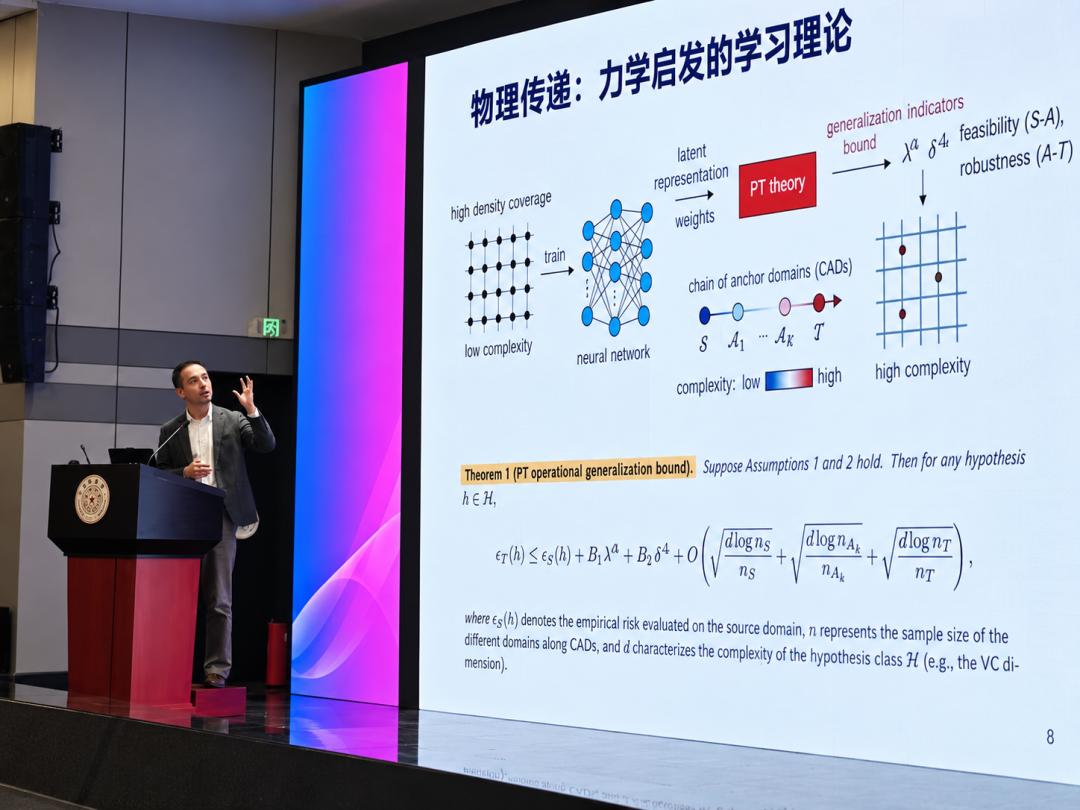
Professor Xu's Physical Transfer Theory
What needs to be transferred here is the physical relationship contained in the data. It is easier to obtain data for simple systems. With the help of models, researchers apply these relationships to complex problems that are difficult to fully observe, and then evaluate the scope and error of such inferences.
For the data generated by machine learning, Xu Zhiping reminded that the visual similarity of the generated data cannot guarantee its physical rationality.
Professor Xu Zhiping showed two cell images in his report: one is from the experiment, and the other is generated by the model. The generated image tries to be close to the appearance in the experiment.
"The generated data seems to be expected to look very similar, but it does not seem to be so similar."
Xu Zhiping explained that to understand the physical laws behind the images, it is not necessary to track the position of each pixel. What is more important is to identify key structures and their changing characteristics over time. For example, after data dimensionality reduction, it is also necessary to check whether it retains the information that should be retained.
Xu Zhiping divided the evaluation into two parts: how far the inference can be extended from the simple system and whether the data is sufficient is the feasibility; how far the inferred result is from the final actual result is the credibility. Both the amount of data and the complexity of the model need to be taken into account in this judgment.

Abnormal Data That Needs to Be Identified in Advance Is Precisely Difficult to Collect Directly
After calculating more data, there is still one thing to do: judge whether these data can be used. This step is especially indispensable in industrial sites.
Academician Sun Lili from Sinopec reminded when talking about the database: "Data errors will be amplified step by step along the chain, and the further downstream you go, the more serious the problem may be."
She was talking about the application of data after it enters engineering. Deviations in the data on which process design is based may affect the calculation of heat transfer and other processes, which in turn leads to higher investment, energy consumption and emissions; for petrochemical plants with high temperature, high pressure, flammable and explosive properties, deviations may eventually involve accident risks.
Reading this, I remembered a sentence from Amazon's antibody research introduction: "A model fine-tuned on data from one laboratory will quietly inherit the measurement bias of that laboratory."
Amazon's research team tried to use AI to predict the properties of antibodies, helping researchers judge which candidates are suitable for further development. The problem they encountered was that there were differences in the methods of processing samples and conducting experiments in different laboratories, and the model might also learn these measurement differences. In a simulation test, after adding measurement bias, the correlation between the model's prediction and the actual value decreased significantly.
The team's solution was to show the model the samples and results that had been measured in the same laboratory before predicting a new antibody, so that it could adjust the prediction based on evidence. In the above simulation test, the version using this method maintained the original high correlation level.
This makes it easier for me to understand Academician Sun Lili's question: The data itself has its source, and it is also necessary to explain whether it can continue to be used after leaving the original conditions.
Academician Sun Lili pointed out that large-scale engineering plants operate year after year, and the data should theoretically be continuously accumulated. But in her view, many records such as today, tomorrow, the beginning of the year, and the end of the year all reflect similar normal states.
What engineering personnel hope to achieve is that "as soon as certain indicators change slightly, I will know where the problem is" — to identify the problem before the abnormality continues to develop.
"Who can let the plant run at the boundary of explosion?" She asked rhetorically, "High temperature, high pressure, flammable and explosive, that may cause an accident, right?"
Those abnormal data that most need to be identified in advance are precisely difficult to collect directly.
Production early warning just needs to understand these changes. Academician Sun Lili introduced that her team used simulation to construct data in the work of production operation prediction and early warning, to supplement the information that is difficult to obtain in industrial plants and experiments. The database construction paths she proposed also include integrating existing data, targeted supplementary measurement, and using AI to generate data.
The supplemented data cannot be mixed and used directly. I found that all the on-site reports emphasized the establishment of a credible evaluation mechanism for the data.
Academician Sun Lili did not elaborate on the specific evaluation mechanism in the report. Professor Xu Zhiping showed the relevant evaluation formula; readers who are interested in his theoretical research can further read the relevant papers:
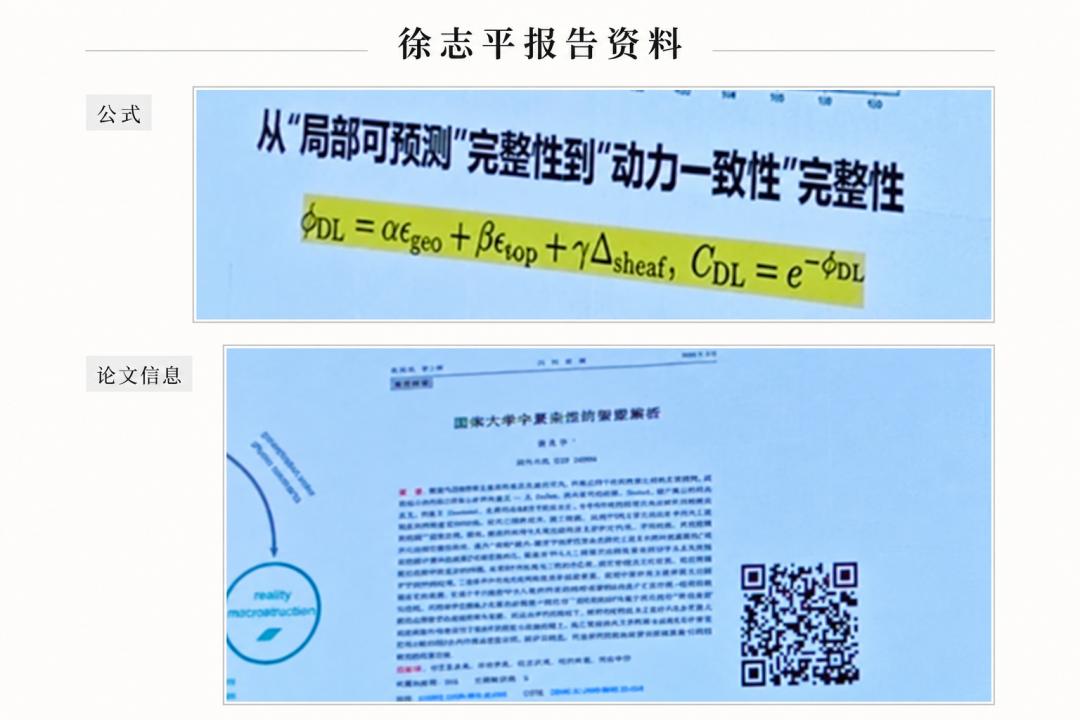
Professor Xu's Report Materials
After listening to these reports, what I remember instead are several things that slow down research: continuing to follow up a patient, checking the basis of a prediction, confirming where a piece of data can be used.
These works remind me of the "Hubble Legacy Field" announced in 2019, which brings together nearly 7,500 exposures over 16 years from different teams. Researchers unified and sorted out the scattered observations, stitched together a cosmic picture containing about 265,000 galaxies, and left these data to later researchers.
AI is making a lot of research faster. But those data that are