How does Walmart develop AI for its e-commerce business?
Continuously optimize consumer experience, continuously improve merchant operations, and open up access under appropriate conditions.
This is the 104th issue of Narrowcast Weekly. In this issue, we focus on four key points of Walmart's exploration of AI in e-commerce and their reference significance.
Walmart has been actively experimenting with AI in e-commerce. Over the past year, while improving its in-house shopping assistant Sparky, it has also integrated external AI tools such as ChatGPT, Gemini, and Muse. Its latest move is to start preparing unified identities, interfaces and usage rules for more Agents.
On October 21, Walmart unveiled Agent Profiles, Agent Gateway and agent shopping rules for external AI agents. Customers will be able to create independent profiles for different Agents, set spending limits, approve each transaction individually, and revoke authorization at any time. The Profiles program is scheduled to launch in November, while the Gateway is currently in the early invitation-only testing phase.
This means that Walmart's AI exploration has entered a new stage: moving from entry access and integrating shopping and other behaviors to exploring open frameworks and rules for cooperation with external AI.
Compared with Amazon, which emphasizes its own entry and has stronger platform attributes, Walmart has always been more open to external AI. Amazon currently still restricts unauthorized external Agents from accessing its ecosystem.
Walmart's exploration can therefore provide more references for retail enterprises that do not have entry advantages in the AI era. Its demonstrative value is mainly reflected in how a retail enterprise with strengths in commodities, physical stores, membership systems and fulfillment networks reorganizes its capabilities to continue playing a role in the new AI entry landscape. This is also a common problem that domestic e-commerce platforms and retail enterprises will face amid the increasingly blurred boundary between retail and e-commerce.
We believe that to understand Walmart's e-commerce AI exploration, four key points need to be grasped. The first two correspond to the transformation of consumer experience and business operation tools respectively, while the last two involve its entry selection and industrial positioning in the AI era.
Continuously transform consumers' in-app AI shopping experience
From one-stop shopping in hypermarkets to online ordering and in-store pickup, Walmart has always been committed to providing consumers with shopping experiences that meet their current needs, and it is also one of the earlier adopters of changes in the AI era.
In June 2025, Walmart launched Sparky, a conversational AI assistant, which is similar to Taobao's early Taobao Wenwen, the current Qiangwen shopping assistant, and Meituan's Xiaotuan.
Sparky initially supported product Q&A, review aggregation, comparison and scenario-based recommendation; later, it gradually expanded to image-based shopping, organizing shopping plans containing multiple products, assisting checkout and handling customer service issues.
Walmart U.S. CEO Dave Guggina shared a colleague's usage experience in September this year: he took a photo of his poorly growing lawn and asked Sparky for help. Based on the photo and his needs, Sparky recommended grass seeds, lawn growth supplies, fertilizers and other products, helping him build a complete shopping cart that included items he had not originally thought of.
Or, when a consumer asks Sparky to make a healthy, high-protein one-week diet plan, it can not only provide recipes and corresponding ingredients that support one-click adding to the shopping cart, but also identify the ingredients the customer has purchased online and in-store recently to help avoid duplicate purchases.
Sparky's improvement on transaction results is also significant. Walmart's CEO said on the earnings call in August this year that customers who shop with Sparky spend 40% more per order than those who do not use it.
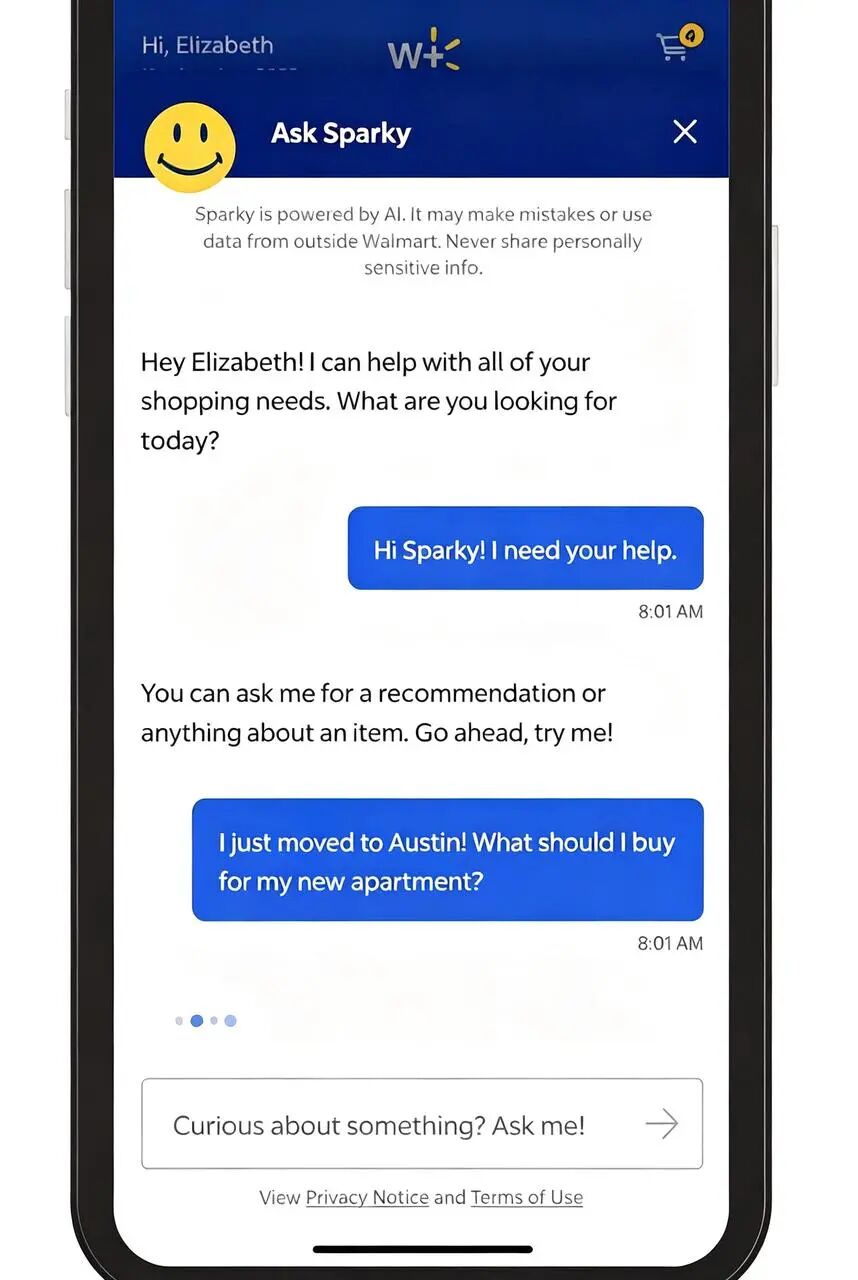
These consumer-facing AI experiences are inseparable from a series of digital explorations Walmart has made in the Internet era.
It built its official website in 1996; supported online ordering and in-store pickup in 2007; merged its grocery and general merchandise shopping apps in 2020, and launched the membership service Walmart+ in the same year, allowing consumers to use the same set of shopping entrances, accounts and related services when buying food, daily necessities and toys.
In 2024, it launched a generative search function for iOS users, which was known as "the evolution of the search box" at that time. Consumers can enter terms with life scenarios and vague needs in the search box, and the search results will better understand consumers' intentions and present cross-category products that fit the scenarios according to the intentions.
These explorations from the official website to intelligent search have given Walmart a head start in transforming consumers' shopping experience in the AI era.
Turn retail experience into retail infrastructure for entrances
Behind the optimization of consumer shopping experience is Walmart's years of accumulated retail operation capabilities. As early as the 1970s, it began to digitize inventory, sales and supply chain. Entering the AI era, these operational data and experiences need to be organized into content that AI can understand and use. This line of work brings the evolution of retail enterprises in business operation tools.
In March 2025, Walmart launched Wally, an AI operation product for its internal merchandising team, which supports data analysis, product performance diagnosis and operation Q&A.
To enable Wally to understand Walmart's data, the company specially built a semantic layer to sort out the meaning and statistical caliber of its own operational data.
The change it brings is similar to this: in the past, the buyer in charge of bread who wanted to understand the demand for high-protein food had to retrieve store, channel and product reports separately, but now he can ask Wally questions, which summarizes and analyzes relevant data to provide reference for product selection.
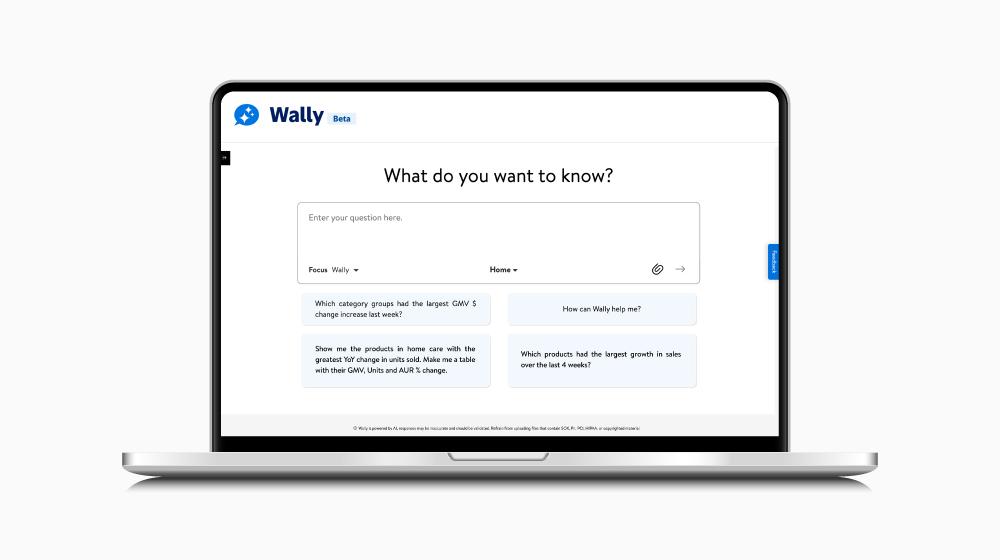
The key point here is that the data already exists, but AI still needs to correctly understand the meaning of products, channels and operational indicators before it can apply them to specific problems. Building a semantic layer is also to organize the long-accumulated operational knowledge of the enterprise into knowledge that AI can use.
Another problem is that as more and more Agents are developed by various teams, even if each of them is useful, it will increase the burden on users to find and switch between tools. Last July, Walmart consolidated scattered Agents into four types of entrances for consumers, employees, partners and developers, with the entrances calling the professional tools behind them, so that users do not need to know which tool hides a specific task.
From sorting out operational data and knowledge to organizing scattered tools into services, Walmart is continuously promoting the digitization and AI transformation of its overall retail operation capabilities. This is also the foundation for it to bring retail capabilities to more AI entrances.
Choose openness
Synchronized with the improvement of internal shopping experience and operation tools, Walmart is also actively connecting with external AI.
Compared with Amazon's restriction on unauthorized external Agents, Walmart has always been more open. It cooperated with Google on voice shopping as early as 2017, allowing customers to connect their Walmart accounts and use Easy Reorder to find products they have bought before.
After the emergence of generative AI and task-executable Agents, this connection began to advance to deeper shopping services. Last October, Walmart announced its cooperation with OpenAI to allow customers to buy Walmart products in ChatGPT; this January, it announced its cooperation with Google to bring Walmart and Sam's Club's products, accounts and membership services into Gemini.
In the new shopping partners of Muse announced by Meta this September, Walmart is also prominently listed.
This difference in choice is related to the different operational priorities and entry strategies of Walmart and Amazon. Both sides have self-operated products, third-party merchants, membership systems and fulfillment systems, but Amazon has stronger entry attributes and emphasizes more control over the shopping process; for Walmart, external personal AI assistants may become new channels for it to reach new customers and provide services.
Daniel Danker, Executive Vice President of AI Acceleration, Products & Design at Walmart, mentioned in a conversation in March this year: Customers are already used to buying food and daily necessities at Walmart every week, but new entrances can allow Walmart to participate in shopping demands for more categories such as electronics, beauty, apparel and home goods.
This also better explains why in the cooperation list announced by Muse in September, in addition to Walmart, there are also retail enterprises such as Best Buy, Gap, Sephora and Wayfair — they also need new channels, new traffic and new consumers brought by AI.
The choice of openness is also related to Walmart's understanding of its own position as a retailer. AI can take over more and more work of search, recommendation and information matching, but the work of getting all products ready, delivering them on time, or allowing customers to pick up goods nearby and handle after-sales services still requires real accounts, inventory, physical stores and fulfillment networks. Walmart has precisely accumulated capabilities in the latter through continuous online-offline integration. This gives it differentiated participation value when facing entry changes.
Prevent being reduced to a pipeline through operational capabilities and open frameworks
Of course, Walmart will not allow itself to become a fulfillment pipeline for external AI. Its openness is also conditional: it allows external AI to discover and recommend products, and allows the shopping process to occur in the external environment, but it will retain its participation in subsequent product organization, accounts, transactions and services, and consolidate its existing position by building a more complete open framework to avoid being pipelined.
In March this year, Danker observed that the conversion rate of directly checking out products through ChatGPT in the early stage was about one-third of that of products that required redirecting to the Walmart website to purchase. He believed that an important reason was that checking out each item separately broke consumers' habit of adding items to the cart one after another and checking out all at last.
Subsequently, Walmart allowed Sparky to enter the external AI chat environment to continue consumers' original shopping process on Walmart. After consumers get shopping inspiration from external AI, they can connect their Walmart accounts to synchronize their existing shopping carts and membership rights, without having to start all over again as "new customers" every time.
This is equivalent to external AI taking charge of demand discovery, while Walmart uses its own accounts and retail services to connect the subsequent shopping process. This not only makes the consumer shopping experience more coherent, but also allows Walmart to continue to use historical purchase records to accumulate long-term service relationships.
Moreover, in the Walmart shopping interface opened within entrances such as ChatGPT, Walmart can still participate in product recommendation and sorting. Such attempts preserve its space for product operation and commercialization, reducing the possibility of being reduced to a pure transaction pipeline — which has very important reference value for domestic e-commerce and retail enterprises.
According to Walmart's disclosure, it has begun testing advertisements in Sparky.
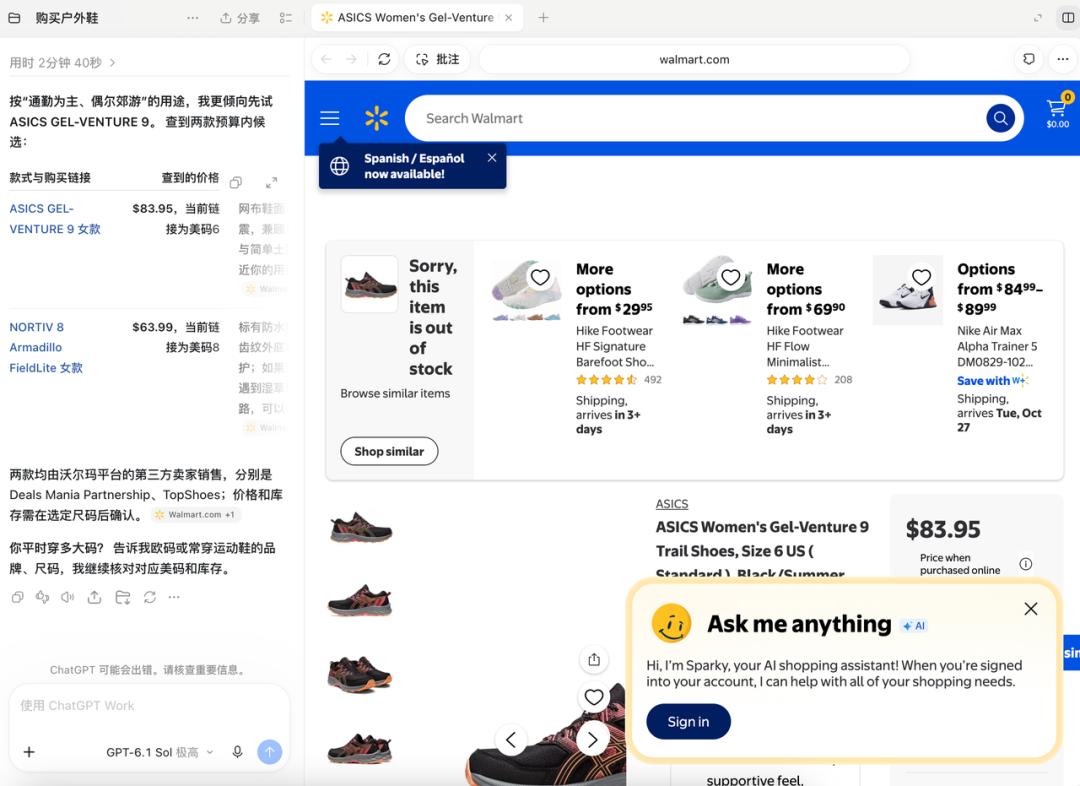
When you make a shopping consultation in ChatGPT, Sparky will pop up automatically in the Walmart link attached to the answer
Another key move for Walmart to prevent pipelining is that it is testing and building an open framework suitable for its own business. This is also an attempt for it to seize industrial positioning in the AI shopping era.
Sparky's entry into the external environment has allowed Walmart to continue to undertake the shopping process and customer relationships. The newly launched Agent Profiles, Agent Gateway and agent shopping rules in October aim to build an open framework where customers grant agency rights, retailers continue long-term user service relationships, and external Agents call shopping capabilities under agreed conditions.
Agent Profiles can create profiles associated with customers' accounts for different Agents, Agent Gateway is responsible for providing a unified shopping interface, and the agent rules stipulate what these Agents can and cannot do.
According to the announced plan, customers can set spending limits for different Agents, require approval for each transaction, and revoke authorization at any time; Agents can only access information required for the task and permitted by customers, cannot obtain bank card information or modify payment methods; Walmart can help Agents find products that consumers often buy, but does not need to give them the complete purchase history.
This means that, first of all, Agents do not need to recognize pages, click buttons and fill in information like humans, but can directly call product, shopping cart and order services, reducing errors caused by relying on web operations; secondly, retailers can distinguish which Agent an order comes from, and users can also set permissions for different Agents.
More importantly, for retailers, the long-accumulated customer relationships and purchase records can continue to play a role within their own systems. External Agents can get the results needed to complete the tasks, but do not need to take the entire purchase history. In this way, even if customers change Agents, they can continue to use the shopping records and related services accumulated by retailers, so Walmart does not have to be bound to a certain Agent.
It is worth noting that when Walmart divides the rights and responsibilities boundaries for AI, it also sets requirements for itself. One of them is the commitment not to set personalized prices based on personal information, urgency or willingness to pay. The announcement on October 21st emphasized again: "We price products, not people".
This is also an important enlightenment for domestic e-commerce and retail enterprises: The key to cooperation between enterprises and external AI is not only to build a smooth shopping link, but also to consider how to make the most valuable consumer behavior data and user assets continue to accumulate and play a role in their own hands.
Of course, the reason why Walmart can build such a framework and why external AI is willing to access and comply with it is closely related to Walmart's own digital system construction, as well as its differentiated competitiveness in products and services.
Just as Danker gave the answer when explaining why AI platforms recommend Walmart: rich product supply, competitive prices, fast delivery and trust — these are also the basic skills of all retail enterprises. Walmart's attempt is to let these basic skills continue to play a role in the AI era, and make itself continue to be the preferred choice.
This article is from the WeChat official account "Narrowcast", author: Narrowcast, published with authorization from 36Kr.