Old Ma has raised another 40 billion yuan to buy cards. Is the "light" coming back?
At noon on October 23, five optical module companies listed on the A-share market collectively released announcements on their operating conditions, all explaining the same thing: production is normal, orders are sufficient, and no major changes have taken place in the industry.
During the previous month, the stocks of optical module companies plummeted sharply. Innolight fell by 37.19%, Eoptolink dropped by 43.51%. No player could stay unaffected amid the broad downturn. The two companies are still delivering products to overseas data center clients, yet their share prices have already tumbled by a large margin.
However, Elon Musk continued to ramp up investment at this time. On October 25 US time, Elon Musk announced that SpaceX has secured $40 billion in debt financing to purchase GPUs, with the equipment expected to be delivered mainly in the first and second quarters of 2027. Reuters added in its report that it was not clear at the time whether the pricing of this financing had been finalized.
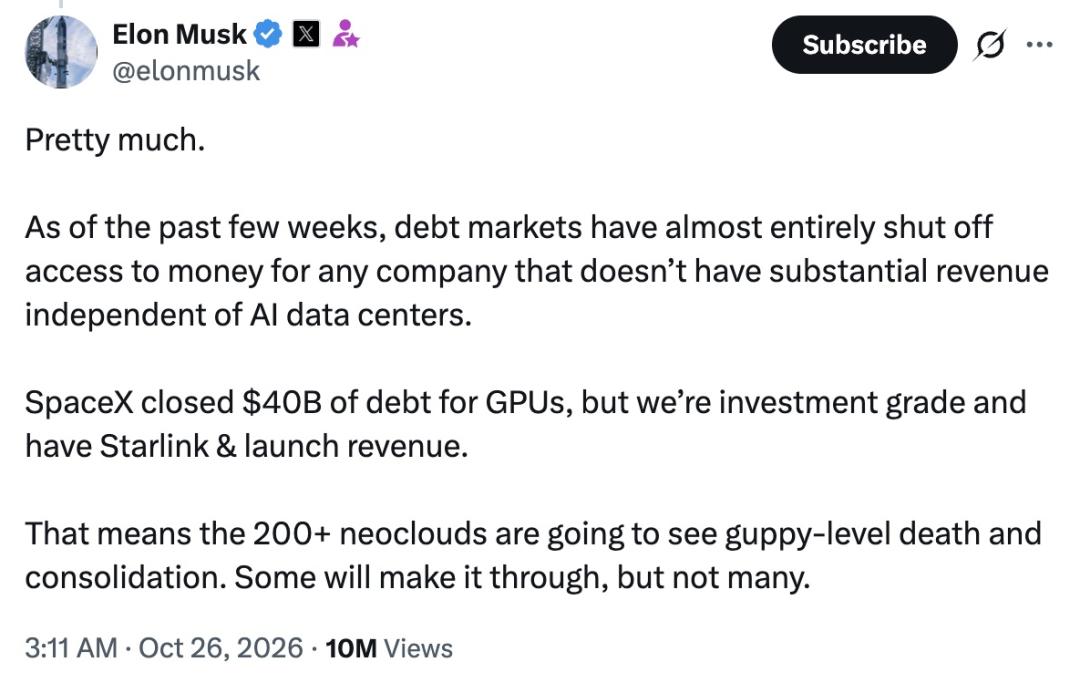
Musk posted on social media that SpaceX raised $40 billion in financing to procure GPUs
While the computing power stocks are falling, Musk is still making large-scale purchases of chips. It easily leads people to wonder: if clients are still procuring, is the market overly pessimistic?
But procurement also relies on financing. Companies such as Amazon and Google invest in model developers, who in turn purchase computing power from them. The capital provided by suppliers supports clients' large orders. These orders correspond to real equipment and services, but may also amplify the market's estimate of future demand. The growth and bubble of the AI industry can occur in the same round of expansion.
Computing Power Continues to Expand, Orders Need to Be Reassessed
According to the announcement released by Innolight on October 23, major overseas clients have placed orders for 2027, and some key clients have even provided demand guidance for 2028. Demand guidance refers to clients' estimation of future needs.
The growth of Innolight is directly tied to overseas data center construction. To enable GPUs to work in synergy, massive volumes of data need to be transmitted between servers and switches. The optical modules produced by the company are responsible for photoelectric signal conversion. Clients' expansion of clusters and improvement of connection speed will bring new procurement demands. In the first half of 2026, around 95% of the company's revenue came from overseas markets.
In this half year, the attributable net profit of Innolight reached 136.51 billion yuan, representing a year-on-year increase of 241.70%. The company explained in its semi-annual report that large AI clients increased their investment, and the shipment of high-speed products such as 800G and 1.6T rose, with their proportion in total revenue also increasing.
However, optical module stocks are precisely the category that has seen a relatively large decline recently. In the week from October 19 to 23, Eoptolink fell by 14.96%, Innolight dropped by 8.56%, while Foxconn Industrial Internet, which is also part of the AI hardware industrial chain, rose by 2.24%. After the rebound on the 23rd, the three companies all closed lower on the 26th.
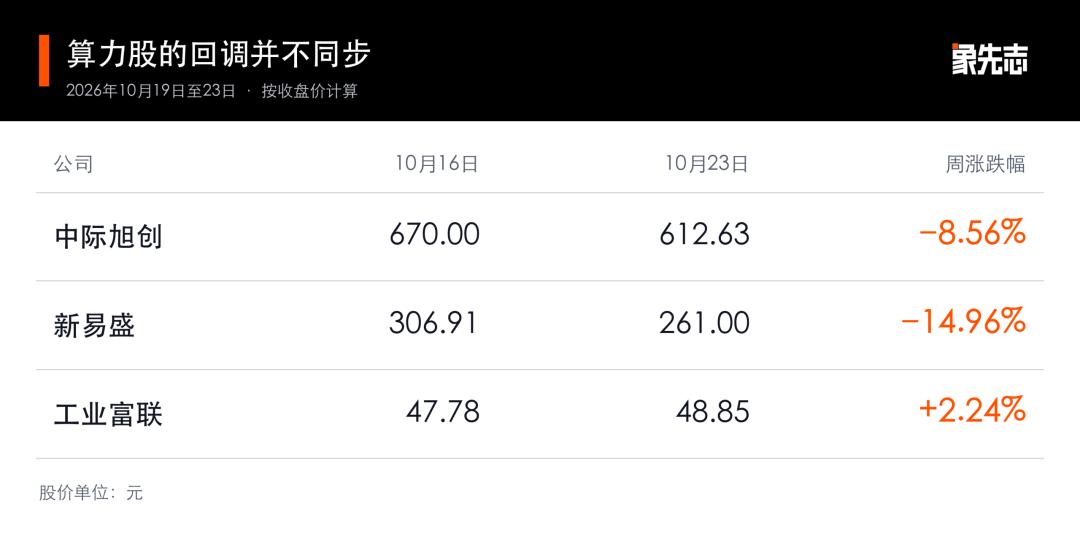
Divergence in share price performance of three computing power hardware companies
A report from Financial Investment News on October 22 mentioned a specific change: NVIDIA's CPO cooperation list has triggered market concerns about the future market share of optical module enterprises. Fund position adjustment and expectations for relevant US policies are also listed as influencing factors of this round of adjustment.
CPO, namely co-packaged optics, places optical components closer to switching chips to meet the requirements of high-speed transmission and reduce energy consumption. Data centers need more connections, but the connection modes are changing. Enterprises that originally supplied optical modules need to participate in the development of new products to continue to win clients.
On October 21, NVIDIA announced that it would expand the CPO optical engine production capacity in cooperation with Silicon Precision Industries, with the goal of increasing it to 15 times the current level by mid-2027, and doubling it again by the end of 2028. Links including substrates, advanced packaging and testing are also undergoing capacity expansion. NVIDIA is also preparing for larger-scale AI clusters, but only part of the procurement will go to new products and manufacturing links.
Innolight is also developing next-generation optical interconnection products. According to the announcement on October 23, some products have carried out joint R&D and sample delivery with key clients. For this company, it needs to deliver current 800G and 1.6T orders, and also push forward the development of new-generation products. The willingness of existing clients to conduct joint R&D is the foundation for subsequent cooperation; new revenue will only be generated after the samples pass tests and enter mass production.
The financing pressure of overseas clients has also begun to affect market expectations. On October 21, Meta announced plans to use new non-voting Class C shares to raise funds for AI investment and other matters. The company's free cash flow in the third quarter was negative 2.12 billion US dollars, turning negative for the first time in more than a decade. The next day, Meta's share price fell by 7%, and the Nasdaq dropped by 2.6%. Reuters reported that investors are worried about the return on AI investment, and also worried that after borrowing becomes more expensive, technology companies will need to issue additional shares, diluting the rights and interests of existing shareholders.
Innolight is still fulfilling clients' previous procurement orders, but investors have begun to worry about the next round of budgets. The announcements of sufficient orders explain the current production situation; how much money clients can spend in the future depends on their operation and financing status.
Suppliers Are Also Shareholders
In April this year, Amazon announced that it would invest another 5 billion US dollars in Anthropic, and may add up to 20 billion US dollars in additional investment according to commercial milestones in the future. At the same time, Anthropic promised that its expenditure on AWS technologies in the next ten years will exceed 100 billion US dollars, involving products and services such as Trainium chips. Amazon provides funds for clients, and clients in return give Amazon long-term procurement commitments.
Google is doing similar things. On April 24, Reuters cited a statement from Anthropic that Google promised to invest 10 billion US dollars in cash first, and will add another 30 billion US dollars if Anthropic reaches its performance targets. In the same month, Anthropic announced that it would expand cooperation with Google and Broadcom on next-generation TPU computing power, and the newly added capacity will go online starting from 2027.
The arrangement between Microsoft and NVIDIA is also similar. In November 2025, the two companies respectively promised to invest up to 5 billion US dollars and 10 billion US dollars in Anthropic; in the same cooperation announcement, Anthropic promised to procure 30 billion US dollars of Azure computing power and adopt NVIDIA's computing architecture.
These companies participate in the investment for the consideration of equity returns, and also for the benefit of winning computing power orders. After model companies get financing, they can afford larger-scale procurement, and cloud vendors and chip enterprises also seize future business opportunities through this method. The increase in procurement commitments will in turn become a reason for suppliers to expand production and raise funds.
Amazon and Google also control important sales channels for Anthropic. According to Reuters' report on September 29 based on the confidential IPO documents it saw, 47% of Anthropic's revenue in 2025 was sold through the two cloud platforms. For Anthropic, investors, computing power suppliers and sales channels overlap with the same group of companies.
The bubble can be amplified in this relationship. The financing of model companies supports procurement, and procurement in turn supports suppliers' revenue expectations. If the market regards the procurement commitments supported by financing as the demand that has been paid by end clients, the valuation may exceed the level that the actual business can support. Once financing tightens, the equity value held by suppliers and the unfulfilled procurement commitments of clients may be affected. In the analysis released by IMF in October, this kind of arrangement that links equity, debt and future revenue with each other is listed as a source of risk.
These procurements are also supporting the real use of products. In the middle of this year, Anthropic announced its cooperation with SpaceX. The agreement involves a capacity of more than 300 megawatts and over 220,000 NVIDIA GPUs in the Colossus 1 data center, and it was expected to obtain this batch of computing power within the month. The company also doubled the 5-hour usage limit of Claude Code for paid plans such as Pro and Max. Anthropic attributed the limit increase to the increased supply brought by the SpaceX cooperation and other recent computing power agreements.
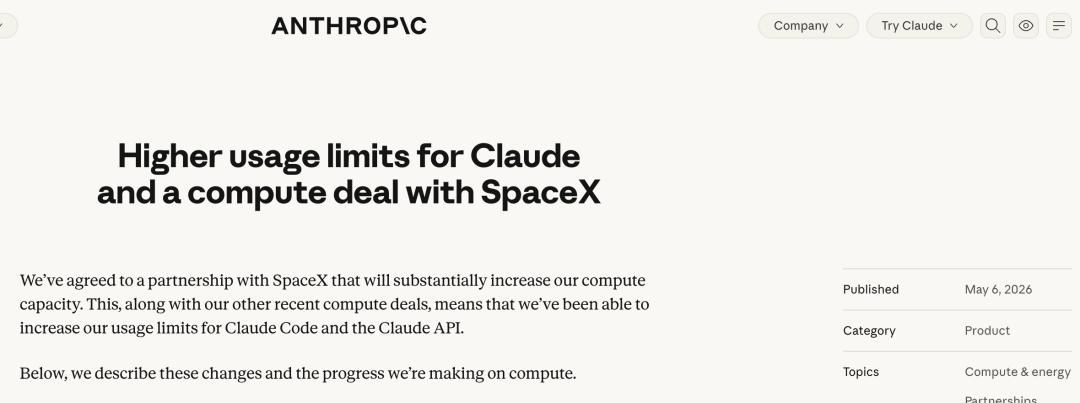
Anthropic announced cooperation with SpaceX and increased the usage limit of Claude
SpaceX itself also operates Grok, and acts as a computing power supplier in the cooperation with Anthropic. Its securities documents list the Anthropic contract under the third-party computing power service agreement. On September 29, the more complete cooperation arrangement disclosed by Reuters showed that the agreement between Anthropic and SpaceX's xAI may involve up to 845 billion US dollars of procurement by 2029, most of which can be cancelled with a 90-day prior notice.
Reuters cited this unpublished IPO document that including the above cooperation, Anthropic will involve at least 5.18 trillion US dollars of AI infrastructure arrangements in the next ten years, about 80% of which are non-cancellable or require payment regardless of usage. The company needs to rely on future client revenue and financing to continuously fulfill these obligations; if the capital is tight, the cancellable procurement will leave it room for adjustment.
This is also the risk that SpaceX needs to bear. Clients can withdraw according to the terms, but the equipment investment and financing obligations still exist. When Musk announced the 40 billion US dollar financing, he specifically mentioned SpaceX's investment-grade credit, as well as the revenue from Starlink and launch business. These revenues outside the AI business help support it to continue to borrow money to buy chips.
Foxconn Industrial Internet and Hygon Have Different Growth Paths
The procurement commitments of model companies are one of the bases for cloud vendors to expand construction and raise funds. If overseas clients slow down cluster construction or arrange procurement in batches due to financing pressure, the new orders and delivery rhythm of Innolight and Foxconn Industrial Internet may be affected first, and then reflected in revenue and profit.
Foxconn Industrial Internet undertakes server and cabinet business. The products it provides to cloud service providers involve two computing solutions: GPU and ASIC, as well as supporting facilities such as liquid cooling and power management. After clients purchase computing chips, they need to install the equipment and these supporting systems into cabinets before they can be used in data centers. Foxconn Industrial Internet arranges production and delivery according to the chips selected by clients and system requirements.
In the first half of the year, the revenue of the company's AI servers for cloud service providers increased by 2.3 times year on year, the shipment of GPU AI cabinets increased by 3.2 times year on year, and the attributable net profit of the entire company increased by 95.99%.
Hygon sells both CPUs and DCUs, mainly targeting the domestic general computing, AI computing and localization demands. Its growth depends more on the procurement and product adaptation of domestic clients. Musk's purchase of NVIDIA equipment has no direct corresponding relationship with Hygon's orders.
Hygon's revenue in the first three quarters was 14.955 billion yuan, a year-on-year increase of 57.58%, its attributable net profit was 2.847 billion yuan, a year-on-year increase of 45.12%; in the same period, its net operating cash flow was negative 2.443 billion yuan. The company explained that in order to match the sales plan and ensure supply, it increased stock preparation, and the expenditure on raw material procurement rose significantly.
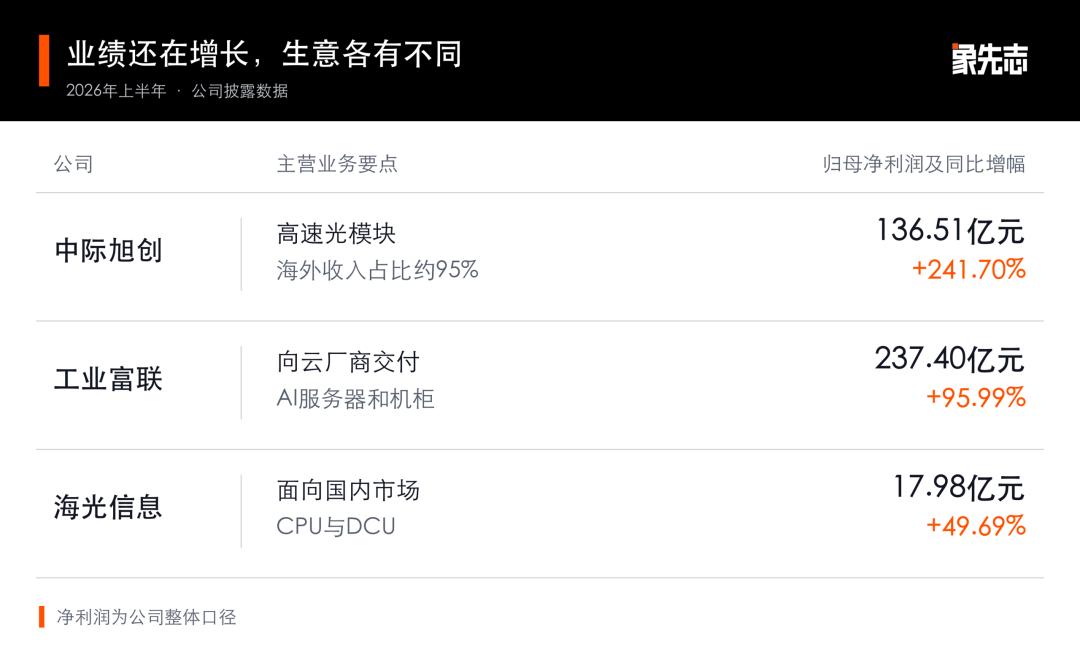
The profit growth of the three companies in the first half of the year came from different products and clients
Hygon increased stock preparation for subsequent supply, and when the cash will be recovered still depends on delivery and client payment.
When this round of adjustment takes place, Innolight and Foxconn Industrial Internet are still delivering products, and Musk is also preparing to receive new GPUs that will be delivered next year. The investment of suppliers and the financing of model companies are still supporting a new round of procurement. If the future revenue of model services cannot keep up with the expansion, the tightening of financing may change clients' procurement plans, and then pass to the orders of A-share suppliers.