2026 SaaS M&A Case Review: In the AI Era, What Kind of Software Can Be Sold at a Premium?
Earlier this year, the SaaS (Software as a Service) industry went through a drastic round of sentiment shocks. As AI Agents began to enter more specific work scenarios such as legal, financial and sales fields, the market started to question: if AI can complete a large number of tasks that were originally undertaken by massive software products at a far faster speed, how much are those traditional software products still worth? As a result, a rather dramatic new term "SaaSpocalypse" began to gain popularity.
Nine months later, the market offered another answer. Among SaaS companies that are all looking for buyers, some are snapped up at a premium, while others have to accept any offer they can get. What exactly happened in between? Let's review some of the landmark moments of this year together.
A Handful of Deals Props Up the Full Year
When Anthropic added plugins for roles including legal, finance and sales in the first quarter, investors began to raise a question: which types of software can be directly replaced by AI agents. What the market worries about is not a single company losing orders, but the subscription model itself. The revenue model of traditional SaaS is deeply tied to the size of human workforce. If AI agents can finish all the work for enterprises, why would enterprises still buy an account for each of their employees? Once this logic holds, what software companies need to answer becomes whether their revenue model is still tenable.
By June, the impact of the stock sell-off in related industries at the start of the year gradually faded. Several of the largest new deals of the whole year were announced one after another between June and September. SpaceX acquired Cursor in an all-stock deal valued at 60 billion U.S. dollars, NVIDIA agreed to acquire Hugging Face for a reported price of 12.9 billion U.S. dollars, Stripe agreed to acquire OpenRouter for a reported price of 7.5 billion U.S. dollars, and AMD agreed to acquire World Labs at the end of September for 8.2 billion U.S. dollars. Adding the two large security deals signed at the beginning of the year, Google's $32 billion acquisition of Wiz and Palo Alto Networks' $25 billion acquisition of CyberArk, the total value of these five deals exceeds 137 billion U.S. dollars.
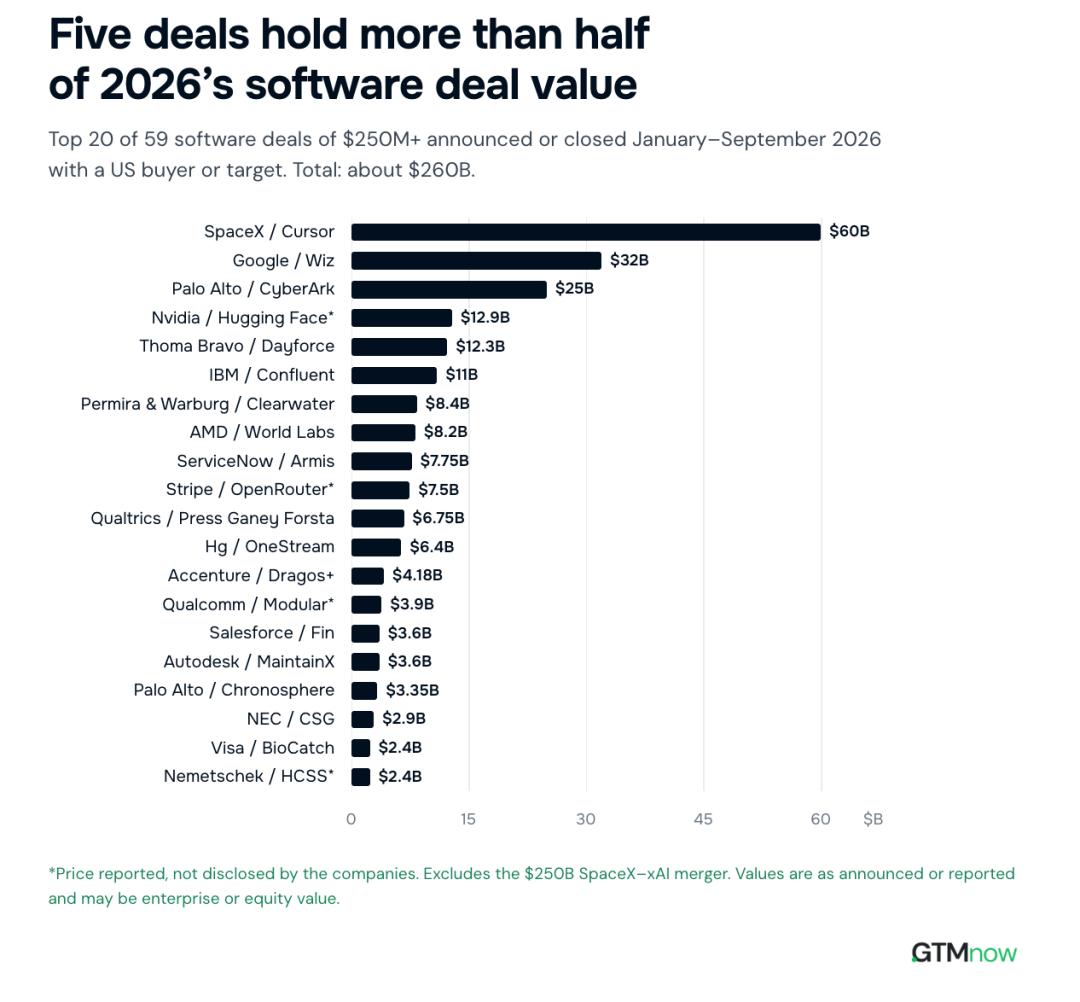
It is worth noting that these deals are characterized by extreme concentration at the top. The 60 billion U.S. dollar value of the Cursor deal alone is far higher than that of other deals. Among these five deals, two of them are for "security", and the other three are for "the entry point of models and developers". That is to say, what buyers are paying for is exactly the developer distribution capability and security capability, which are precisely the two things that are missing in the vast majority of AI implementation scenarios.
Two Segmented Markets, Two Sets of Valuation Logic
These deals send a not-so-relaxing but very clear signal: the market has not abandoned SaaS, it has just started to judge more selectively what kind of software is worth buying, and what kind of software can only be repriced.
At the top end of the market, buyers are raising their bids. OpenRouter is an aggregation startup platform for models founded in 2023, with a valuation of 1.3 billion U.S. dollars during its financing round in May 2026; in August, Stripe agreed to acquire it for a reported 7.5 billion U.S. dollars, with only three months in between. A few days after SpaceX's own IPO, it paid off the acquisition of Cursor with all stocks. Premiums are the norm in these fields.
In other fields, sellers are accepting whatever price the market offers. Airtable had a peak valuation of over 11 billion U.S. dollars at the end of 2021, but finally agreed to be sold to Bending Spoons at a price of about 1.3 billion U.S. dollars.
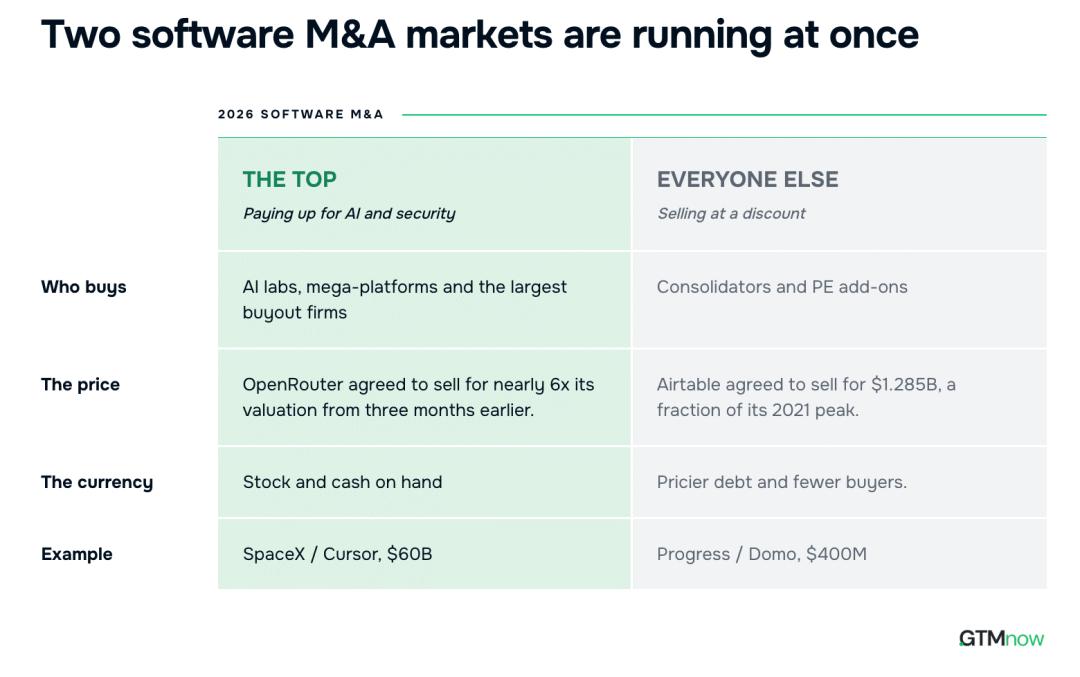
The difference between the two ends lies in the nature of the assets. OpenRouter holds the distribution channel for model calls, so buyers can directly access this channel after acquiring it; Airtable holds a set of collaborative spreadsheets, and this type of function is the easiest to be rewritten, and customers may not stay after the rewrite. The former sells strategic position, while the latter mostly sells operating results.
In other words, one type of asset is being scrambled for by strategic buyers:
- Infrastructure that can support AI development and deployment;
- Platforms that control developer entry points and distribution channels;
- Companies that provide security, identity and compliance capabilities;
- Critical nodes that connect models, data and applications;
- Software that is deeply embedded in customers' core business processes.
The other type of asset is facing more realistic evaluation:
- Whether customer renewal is stable;
- Whether cash flow is healthy;
- Whether the product is easy to replicate;
- Apart from existing customers, what else can buyers obtain;
- If the acquisition is not made, can competitors develop it on their own in a relatively short period of time.
Back to the Most Plain Questions
The total volume looks prosperous, but the buyer structure is tightening. The number of deals is increasing, while the number of active buyers is decreasing.
As of 2026, the number of mutual acquisitions among AI companies in the United States is 14% higher than that of the whole year of 2025. Among them, OpenAI ranks first with 10 deals, but the number of independent buyers has only increased by 2%. A small number of winners take up the vast majority of acquisitions, and the current market has not cultivated a broader group of buyers. For sellers, the number of available counterparties is less than imagined. The buyer list is highly repetitive, and every one of them is fully aware of their scarce status.
The question raised in January this year was whether AI would make software worthless. Nine months later, enterprises have given their answers. After the cost of code drops, the value focus of software companies moves to two ends: one end is data and workflows that others cannot obtain, and the other end is distribution channels that others cannot enter. Companies stuck in the middle with nothing but a feature list have been repriced by the market this year.
In the past, the fact of "already having customers, already having revenue, and already having a mature product" was enough to constitute considerable value. Now, this is still important. But if the product lacks unique data, irreplaceable workflow position, strong distribution capability or security and compliance barriers, buyers are more likely to regard it as a financial asset rather than a strategic asset.
The transaction prices this year actually provide three very plain test methods.
The first is the open source test. Assume that this company posts all its code online tomorrow, will customers still renew their subscriptions? If the answer is yes, it means that what customers really cannot live without is the data and workflows inside, and the code is just the shell; if the answer is no, it is only a matter of time before it is replaced by AI.
The second is "whether the money is paid for growth or existing stock". For the same software, some people are willing to pay 20 times of the annual revenue, because that part of revenue will be even larger next year; Airtable was only sold for 1.3 billion U.S. dollars, because the buyer calculated how many customers would leave and how long the remaining customers would continue to pay. One is buying the future, the other is buying residual value. There are essentially two different types of businesses under the same term.
The third is "the reason why customers have to buy it". Every enterprise has its own reason for purchasing software services, but their questions this year are also changing: if we don't make the acquisition, how long will it take for us to develop it on our own? If we can develop it, can we also obtain its customer trust, data accumulation, developer ecosystem and workflow position at the same time? Can we pass the security review, compliance certification and the lengthy internal procurement process of the organization? For SaaS enterprises, the fewer these advantages they have, the more passive they will be in negotiations.
Between "sellable software" and "must-buy software", a company does not have to wait until the day of sale to find out whether it will be regarded as an asset worthy of strategic acquisition. The answer often starts to form from today's product selection, customer relationship and capability accumulation. AI is making the supply of software services richer, and the M&A market is redefining scarcity in a much stricter way.
<References>
https://thegtmnewsletter.substack.com/p/2026-software-ma-deals-wave
This article is from the WeChat Official Account "HSG Summit" (ID: Sequoiacap), written by Hong Shan, republished with authorization from 36Kr.