Meta: Its core business has "breathed a sigh of relief", but the detailed accounts of Muse are still hanging in the air?
Hello everyone, I'm Dolphin!
Compared with the awkward performance report of the previous quarter, Meta delivered a transcript this time that relieved investors: revenue from core business, profit excluding one-off expenses, and Q4 guidance all exceeded expectations across the board; there were no exaggerated short-term spending guidance brought by Muse.
However, for the 2027 guidance that the market is also very concerned about this time, there are not many quantitative figures disclosed. At the same time, the expectation of equity financing will also keep long investors sober under optimistic expectations.
Meta usually holds a follow-up callback meeting after the earnings call. Dolphin will check later if there is any new important information, and the meeting minutes will also be sorted out. Those who are interested can follow our community updates.
The core points are as follows:
1. The core foundation of the main business is consolidated: Total Q3 revenue increased by 26% year-on-year, slightly exceeding expectations. The Q4 guidance is $73-76 billion, with the median meeting the buy-side expectation.
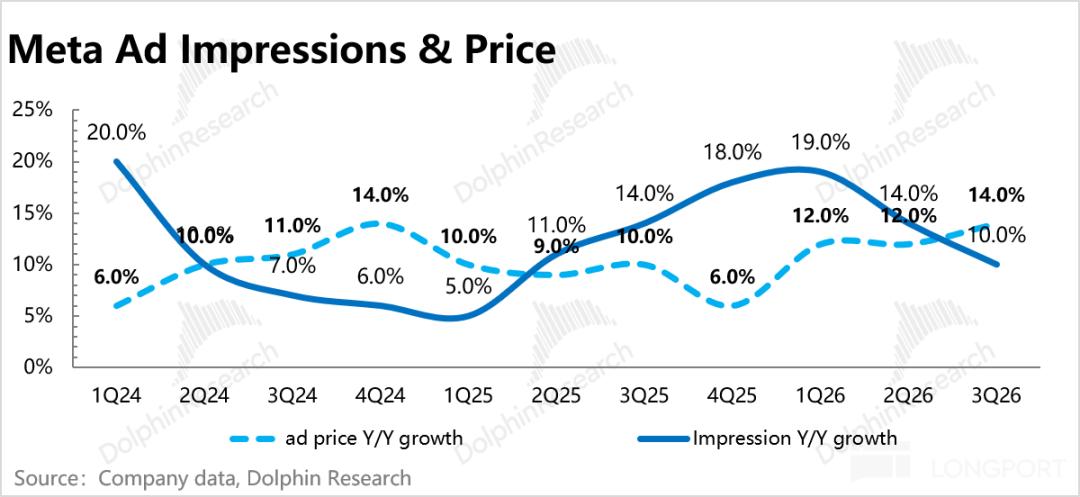
The growth is mainly driven by the increase in ad unit price (+14%), which has accelerated for the third consecutive quarter. Recommendation and advertising models including GEM, Andromeda, and generative recall have all delivered quantitative conversion improvements, continuing to support Meta's AI-driven ad return narrative.
The overall advertising industry in Q3 was already in a strong boom driven by the World Cup and political advertisements, so Meta's performance more reflects the stability of its core competitive advantages.
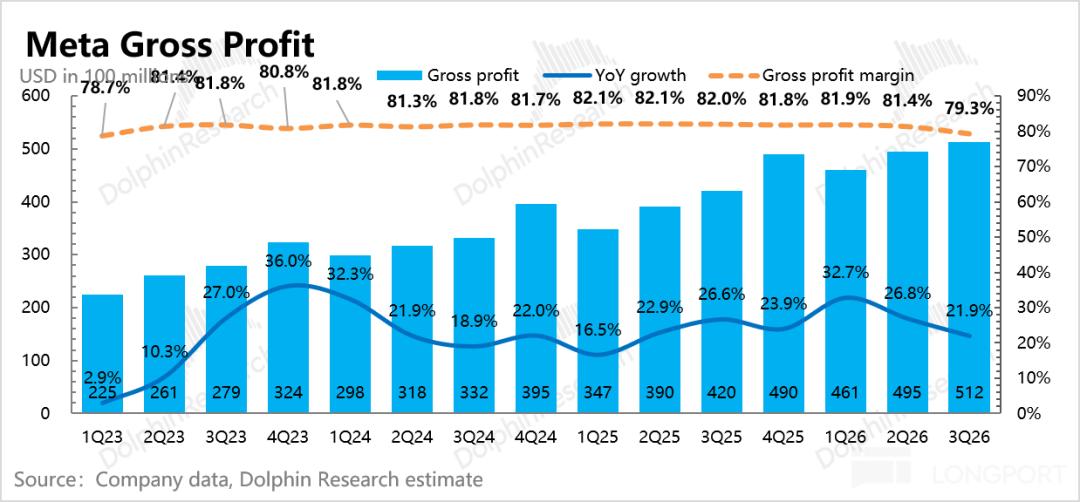
2. Headcount reduction and efficiency improvement offset the depreciation of AI investment: After excluding more than $9.9 billion of state settlement fees (litigations related to adolescent social media addiction, children's privacy, etc.), Q3 operating margin remained at 35%, which rebounded quarter-on-quarter. This seems to contradict the trend of rising depreciation costs brought by AI investment. In fact, the efficiency improvement brought by 15% headcount reduction offsets the incremental depreciation.
The full-year Opex guidance only added the settlement fee, no other increase was made, implying that the median Q4 operating margin is 33%, which is slightly weaker than Q3, indicating that the direction of profit suppression by AI investment remains unchanged.
The management did not give the 2027 Opex guidance, but with the development of Muse and cloud leasing business, as well as Meta's own computing power deployment plan, this year and next year will both be peak investment years. In the short term, Muse's monetization volume grows slowly, and Dolphin expects to see meaningful increments in 2028, so the erosion of depreciation on profits will continue to expand.
3. Annualized Capex in Q4 will exceed $200 billion: Q3 Capex was $34.9 billion, lower than expected, but the gap will be made up in Q4. The lower limit of the full-year guidance was slightly raised, implying that the median Q4 Capex is $54 billion. After quarterly annualization, it is expected to exceed $210 billion in the coming year, which is roughly in line with the expectations of most institutions, while more aggressive expectations are in the range of $230-250 billion.
The management's statement for 2027 is that "the budget is still being formulated, but we will continue to invest aggressively to support the core business and new AI projects", and said that the existing and under-construction production capacity can be flexibly allocated between model training, core business growth and new products. Zuckerberg emphasized on the earnings call that in the next few years, Meta will build computing power that can serve more than 1 billion users.
The current market divergence lies in whether the computing power demand brought by Muse is included in the original computing power deployment framework (14GW next year), or additional new capacity is needed in the short term.
Dolphin believes that most of the demand should be within the original computing power deployment framework, but if Muse continues to be more popular than expected, additional new capacity is still needed:
Muse is not a sudden whim of Meta, but the AI narrative that Zuckerberg has mentioned for more than two years, which has long obtained top-level resource allocation internally. Before the launch of the cloud leasing business in the middle of the year and the media report of the 14GW computing power supply deployment plan by the end of next year, the problem of delayed release of personal AI assistant was already rumored. Now we know that it is a targeted optimization for user authorization security issues before the Muse release.
Therefore, as Muse's user penetration gets higher and higher, there is no need to significantly raise the figure based on the original Capex investment expectation. But Muse is likely to crowd out the computing power supply required by the cloud leasing business, which will affect the short-term 2027 ROI data of per unit computing power (the revenue from leased computing power is higher).
And if Muse continues to be popular in the future, for example, MAU rushes to more than 2 billion (corresponding to DAU of more than 500 million), the required computing power will almost use up all Meta's reserves in the past two years. Zuckerberg stated that the current plan is based on 1 billion MAU production capacity. If it exceeds the management's expectation, Meta's computing power construction plan in the past two years will definitely not be sufficient.
Therefore, the 2027 Capex expectation of $220 billion has the potential to be raised, all depending on whether Muse exceeds the expected scale, and whether the company wants to steadily develop the cloud leasing business.
4. Muse delivered its first performance report: Muse has been online for about six weeks, with a total of more than 10 million users in the United States and Canada; in terms of user stickiness, about 25% of users will use it every day.
Shopping is the largest usage scenario for Muse users, more than 25% of weekly active users use Muse for shopping, and the average order value exceeds $200. The management expects the computing power cost efficiency to increase by more than 10 times within one year, and said that monetization will be advanced earlier than the previous strategy of "growing first and then monetizing".
Compared with Dolphin's previous assumption — 30% MAU shopping penetration + average annual order value of $500 (original review), Muse's actual performance exceeded Dolphin's expectation. Of course, whether it can be truly realized depends on the subsequent user penetration, that is, the expansion progress of MAU scale. The difference in monetization value brought by 100 million users and 1 billion users is far more than 10 times.
5. Financing arrangement has a framework but no details: If we continue to invest at the current pace, Meta's full-year cash flow will turn negative next year, which is a foregone conclusion. At the same time, its net cash position, calculated according to the strict definition (cash + short-term investments - interest-bearing debts in long and short terms), is not optimistic, so the market's expectation of Meta's financing has always existed.
But the incremental information the market needs is the details of the financing arrangement. The information disclosed this time mainly sets the subsequent financing method (the financing that has been carried out this year: $30 billion off-balance sheet joint venture, $25 billion corporate bond), instead of continuing to issue bonds, it will newly establish non-voting Class C shares for future additional issuance (the cost of debt financing has risen after the interest rate hike, and Meta's book health is also declining, so the interest advantage of issuing bonds has narrowed).
The dividend of Class C shares this time is distributed to all shareholders in the form of stock dividend of "1 Class C share for every 1 Class A or Class B share held".
The actual effect of this dividend is equivalent to a 2-for-1 stock split. Class C shares will be effective for trading on January 19, 2027. Theoretically, the shareholding structure remains unchanged after the dividend, but the company also acknowledges that Class C shares may be discounted relative to Class A shares. In the subsequent financing issuance, not only the additional issuance itself has dilution, but more shares need to be issued for the same amount of financing, which will further dilute the interests of original shareholders.
The company has no specific financing plan for the time being. Class C shares will be mainly used for fundraising, employee compensation and mergers and acquisitions in the future, without diluting Zuckerberg's voting rights. Due to the restriction of Zuckerberg's control, theoretically, under the original structure, the company can raise a maximum of about $700 billion in equity before Zuckerberg's voting rights fall below 50%, which indicates the upper limit of the potential financing scale from the side.
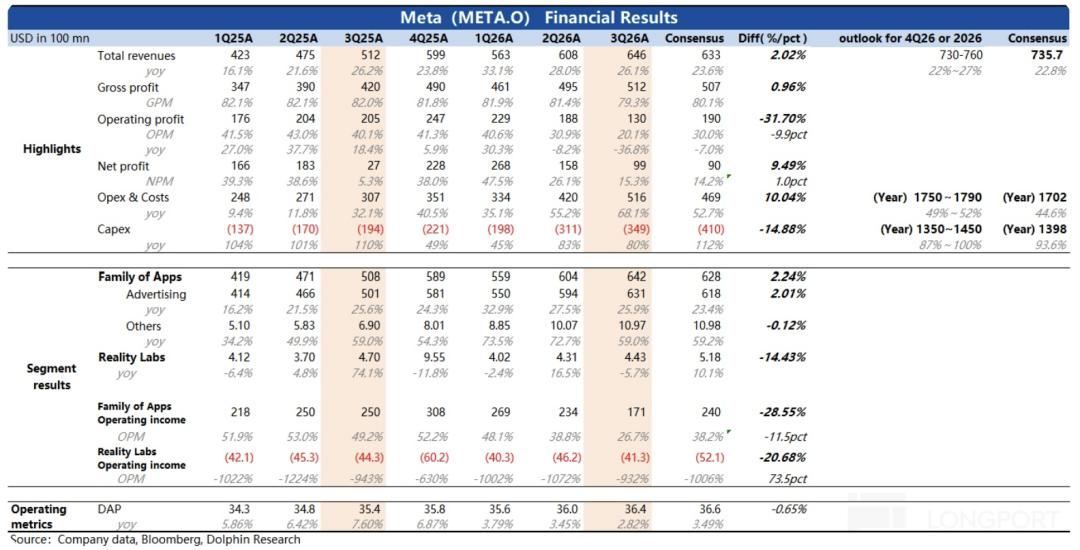
6. Overview of performance indicators
Dolphin's View
One-sentence summary of Q3: The advertising core business remains strong, cost control is better than expected, Muse has given the signal of "how to monetize and monetize as soon as possible", but the details of the 2027 ROI bill are still pending, which may be "criticized" by some long funds.
Last quarter, Dolphin said that what investors most wanted to see was "the trajectory of AI investment return becomes clear". This quarter, in addition to the stability of the advertising base that can continue to tell the narrative of AI's driving effect on advertising, and the remaining computing power for cloud leasing, Meta in Q3 further clarified the AI ROI trajectory in two aspects: ToC monetization and expenditure control.
1) Muse has delivered the monetization path. This time the management emphasized the importance of the shopping scenario, and clearly stated that "charging merchants based on completed transactions" is the main model, and it will be promoted as early as possible. This is in line with Dolphin's view in the hot review after Muse's launch in early September — Muse's subscription revenue will not be too much, the cost per user is very high, and the real monetization depends on transaction commission.
2) Expenditure control is better than expected, which is directly reflected in the 15% headcount reduction, the total expense growth rate after excluding one-off expenses in Q3 is significantly lower than the level the market worried about.
In addition, regarding the issue of whether Muse needs to occupy computing power outside the plan, the Q3 earnings report also gave an answer — the full-year Capex has not been significantly increased. Although the situation in 2027 is uncertain, it shows that at least in the short term, Muse's computing power occupation is already within the planned deployed computing power framework. In terms of growth rate, this year and next year are both peak investment years.
But if Muse becomes more popular than imagined, for example, more than the 1 billion users envisaged by the management, then this computing power production capacity needs to be built additionally on the basis of the existing plan. The establishment of Class C shares is essentially to prepare financing channels for this investment in advance. The irregular additional issuance financing arrangement also restricts the positive sentiment of long funds from being too high.
The following is the detailed content
I. The core foundation of main business is consolidated to support AI return narrative
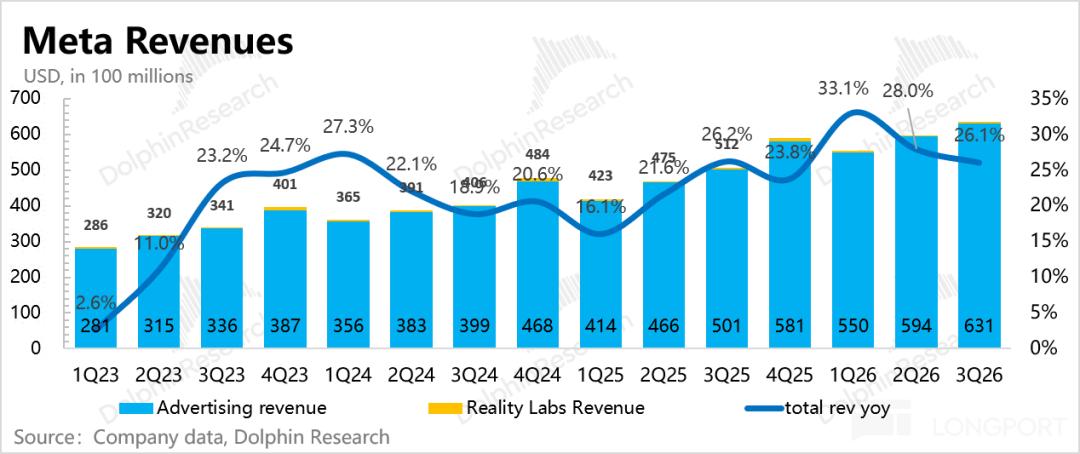
Total revenue in Q3 was $64.6 billion, up 26% year-on-year, 2% higher than Bloomberg consensus expectation, and also higher than the upper limit of the company's guidance ($64 billion).
Among them, advertising revenue was $63.1 billion (+26%, the same at constant exchange rate). The volume and price split is: ad impressions +10% (about 2 percentage points lower than expected), average ad unit price +14% (about 3 percentage points higher than expected).
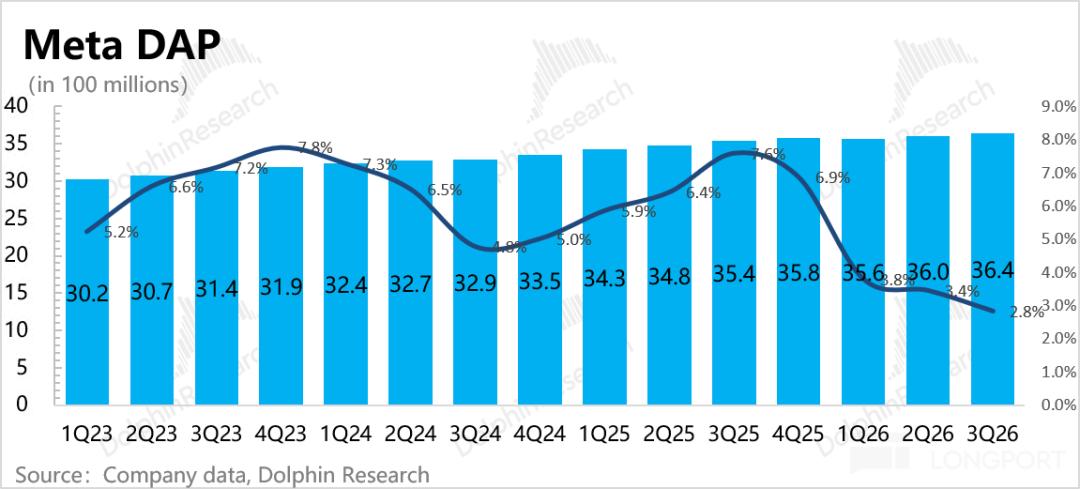
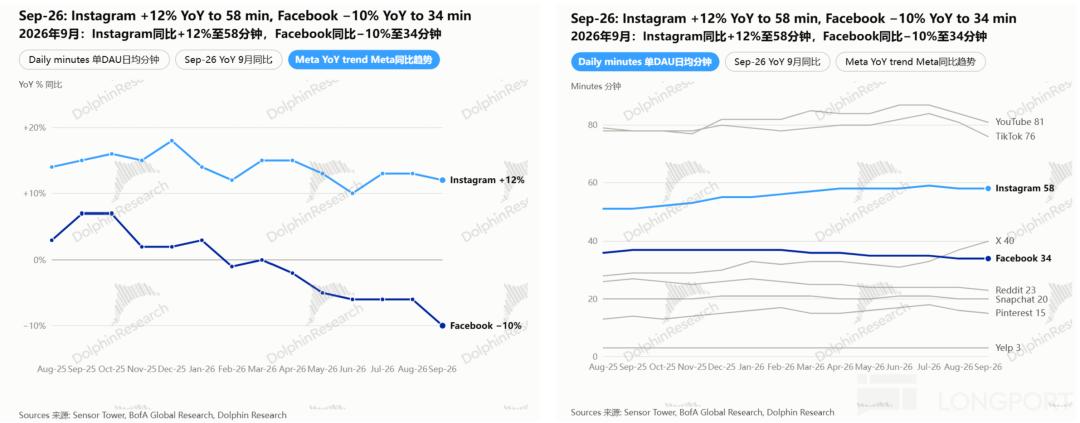
Volume is slowing down (user traffic only increased by 3%, Facebook usage duration declined), price is accelerating. Behind this, under the good industry boom, AI recommendation and advertising delivery efficiency improvement bring more pricing advantages to Meta.
The Q4 guidance is higher than the buy-side expectation: the guided revenue is $73-76 billion, the median is $74.5 billion, up 24% year-on-year, 1.3% higher than the consensus expectation; the upper limit of $76 billion is higher than the general expectation of $74-74.5 billion from the buy-side before the earnings report. This is the most reassuring point of this earnings report for investors: after the boost brought by the World Cup faded in Q4 (according to research, the total boost to the industry is 4 percentage points), the growth momentum of the main business did not slow down significantly as the market worried.
II. Headcount reduction and efficiency improvement offset the depreciation of AI investment
After excluding $10 billion of settlement fees, Q3 operating margin remained at 35%, 3 percentage points higher than the consensus expectation, but still nearly 5 percentage points lower than the 40% margin in the same period last year. Calculated according to the guidance, the implied margin in Q4 is 33%, which also decreased quarter-on-quarter, indicating that the general trend of AI investment eroding profits remains unchanged.
Specifically, the operating expenses of the core main business, driven by layoffs, directly declined in absolute value quarter-on-quarter, and the expense ratio also decreased, thus offsetting the incremental depreciation cost of 44% year-on-year and 11% quarter-on-quarter.
Capital expenditure in Q3 was $34.9 billion, much lower than expected, but it was mainly a matter of the timing of investment. The lower limit of the full-year guidance was raised by $5 billion, and the interval was narrowed to $135-145 billion. Calculated backwards, the investment in Q4 is $49.2-59.2 billion, and the annualized figure at the median exceeds $210 billion, which is the current market's embedded 2027 Capex expectation.
Free cash flow in Q3 was -$2.1 billion, the first time it turned negative in recent years. It is expected that the full-year 2027 cash flow will still be negative, which also forces Meta's subsequent financing demand.